Showing posts with label North America. Show all posts

05 February 2025

Comanches in Mexico, Early 1800s

From The Other Slavery: The Uncovered Story of Indian Enslavement in America, by Andrés Reséndez (HarperCollins, 2016), Kindle pp. 219-222:

The Comanche expansion into Mexico started suddenly and coincided with the initial turmoil of independence. Few testimonies are as eloquent as that of landowner and politician Miguel Ramos Arizpe, who had grown up in the state of Coahuila (just south of Texas) during the halcyon days of the Spanish silver boom. A line of presidios running along the Rio Grande had afforded his home state a measure of security that had made it wealthier and better populated than Texas. Though not impassable, these garrisons presented a real obstacle to Indian raiding. As Ramos Arizpe explained, “The various tribes of the Comanchería lived in the enormous plains and sierras between Texas and New Mexico north of the line of presidios . . . and they knew very well that the principal access into the interior provinces of Coahuila, Nuevo León, and Tamaulipas was closed off to them.”

...

Yet the struggle for independence opened the floodgates. “We observed that the heathen Indians who during entire centuries had taken just a handful of children as captives,” Ramos Arizpe recounted, “in the short years between 1816 and 1821 took more than two thousand captives of all kinds, genders, and ages, and killed as many people or more in Coahuila, Nuevo León, and Tamaulipas.” He was personally affected by the upsurge in Comanche activity. Ramos Arizpe owned eight hundred square leagues (more than four million acres) of well-irrigated land on the Rio Grande. But he could neither protect nor develop his vast domain because it lay in the path of Comanche expansion. His property included the ruins of the old presidio of Agua Verde, a poignant reminder of Mexico’s military retreat.

The Comanches would go on to wage a ruinous war in northern Mexico in the 1830s and 1840s, as historian Brian DeLay has shown. They mounted more than forty raids into Mexico during this period—more than two per year on average. Half of them were actually large-scale military operations involving up to a thousand warriors. Considering that the total Comanche population may have been between ten and twelve thousand, and assuming that there was one warrior for every five Comanches, a “raid” of one thousand men amounted to half the Comanche fighting force, as DeLay notes. Just as impressive was their geographic scope. They came to engulf much of Chihuahua, Durango, Coahuila, and Nuevo León, as well as half of Tamaulipas, reaching as far south as Zacatecas, San Luis Potosí, and Querétaro, not far from Mexico City.

These raiding campaigns were not intended solely or even primarily to take captives. Later interviews with Comanches make clear that the acquisition of horses was the principal objective. Warriors competed with one another over the number of mounts they possessed and sought to procure as many horses as they could by any means. Chief Esakeep expressed great pride in his four sons because they could steal more horses than the other young men in the tribe. In fact, horses were an absolute necessity for any long-distance raid. To conduct these campaigns, Comanches needed to travel hundreds of miles. And once deep in Mexico, they needed to retreat swiftly, carrying captives and loot. Having sufficient animals and the ability to change to fresh mounts was critical.

Procuring goods was another major goal of these incursions. The Comanchería was a trading center that absorbed a variety of commodities that were consumed internally or traded to other groups. Clothes and textiles were excellent forms of plunder—lightweight, easy to transport, and always in high demand. Raiders went through the trouble of removing the clothes of their prisoners before killing them and taking shirts and pants from corpses during a raid. They also paid special attention to metal objects. Knives, lances, and firearms were obviously important. But Comanche raiders also took latches, nails, bolts, and other metal objects that could be transformed into valuable tools with a forge.

Even though taking captives was not the primary purpose of these raids, Comanches took hundreds of them in the 1830s–1850s. Each could fetch anywhere between 50 and as much as 1,000 pesos (or dollars, for in that golden era, there was parity between the two currencies). In other words, by the middle of the nineteenth century, a captive was far more valuable than a horse or a mare.

04 February 2025

Indigenous Slavers in North America

From The Other Slavery: The Uncovered Story of Indian Enslavement in America, by Andrés Reséndez (HarperCollins, 2016), Kindle pp. 172-177:

NATIVE AMERICANS WERE involved in the slaving enterprise from the beginning of European colonization. At first they offered captives to the newcomers and helped them develop new networks of enslavement, serving as guides, guards, intermediaries, and local providers. But with the passage of time, as Indians acquired European weapons and horses, they increased their power and came to control an ever larger share of the traffic in slaves.

Their rising influence was evident throughout North America. In the Carolinas, for instance, English colonists took tens of thousands of Indian slaves and shipped many of them to the Caribbean. In the period between 1670 and 1720, Carolinians exported more Indians out of Charleston, South Carolina, than they imported Africans into it. As this traffic developed, the colonists increasingly procured their indigenous captives from the Westo Indians, an extraordinarily expansive group that conducted raids all over the region. Anthropologist Robbie Ethridge has coined the term “militaristic slaving societies” to refer to groups like the Westos that became major suppliers of Native captives to Europeans and other Indians. The French in eastern Canada had a similar experience. They procured thousands of Indian slaves during the seventeenth and eighteenth centuries, but as they moved away from Quebec and Montreal and into the Great Lakes region and upper Mississippi basin, they encountered a world of bondage they could scarcely comprehend, let alone control. Indians preyed on one another to get captives whom they offered to the French in exchange for guns and ammunition and to forge alliances. Throughout North America, Natives adapted to the sprawling slave trade and sought ways to profit from it.

...

The most dramatic instances of Indian reinvention occurred in what is now the American Southwest. Multiple factors propelled Indians of this region to become prominent traffickers. The royal antislavery activism of the Spanish crown and the legal prohibitions against Indian slavery dissuaded some Spanish slavers of northern Mexico, leaving a void that others filled. Moreover, the Indian rebellions of the seventeenth century that culminated in the Great Northern Rebellion [of the 1680s and 1690s] restricted the flow of Indian slaves from some regions and led to the opening of new slaving grounds, creating new opportunities. Most important, the diffusion of horses and firearms accelerated at this time, giving some Indians the means to enslave other people. Thus new traffickers, new victims, and new slaving routes emerged in the seventeenth and eighteenth centuries. Some Native communities experienced a process of “deterritorialization,” as Cecilia Sheridan has called it, becoming unmoored from their traditional homelands, fusing with other groups, and reinventing themselves as mobile bands capable of operating over vast distances. They made a living by trading the spoils of war, including horses and captives.

...

Comanche captive taking introduced Apaches from the east, Navajos from the west, and Pawnees from the north into New Mexico. The Comanches’ radius of action was astonishing. In 1731 a New Mexican friar asked one of the Comanches’ captives to which nation he belonged and how far it was to his country of origin. The slave responded that he was a “Ponna” (quite possibly a Pawnee, whose traditional homeland was along the North Platte and Loup Rivers in present-day Nebraska). The Indian also said that he had traveled with his captors for “one hundred suns,” moving at a rate of about ten leagues (thirty miles) for each one. The friar estimated that in the course of a year, Comanches might travel “more than one thousand leagues [three thousand miles] from New Mexico,” a distance that may have been entirely possible, considering that Pawnee country was eight hundred miles away from northern New Mexico and that the Comanches traveled to and from these lands, making various detours along the way.

The Comanches sold their first slaves in New Mexico sometime in the first decade of the eighteenth century. By the 1720s, they had become well-established traders. And by the 1760s, they were acknowledged as the preeminent suppliers of captives in the region.

22 January 2025

Finding the North Pacific Way East

From Conquering The Pacific: An Unknown Mariner and the Final Great Voyage of the Age of Discovery, by Andrés Reséndez (HarperCollins, 2021), Kindle pp. 189-192:

Not everything, however, was against the San Lucas expeditionaries. By paralleling the coast of Japan, they were riding the most powerful current in the Pacific Ocean. The Japanese call it Kuroshio, or “Black Current,” owing to its characteristic cobalt-blue color. An integral part of the North Pacific Gyre, the Kuroshio Current is an enormous ribbon of warm water that starts in the Philippine Sea, brushes against the coast of Taiwan, and moves rapidly up the eastern side of Japan, snaking and pushing against the cold waters coming from the Bering Sea. After veering off from Japan, the current continues eastward for about a thousand miles as a free jet stream known as the Kuroshio Extension, eventually feeding into the larger North Pacific Gyre. This explains why historically some Japanese ships disabled in storms have washed up in North America. This may have occurred prior to 1492, although no hard evidence has surfaced. More convincingly, scholars have estimated that between the sixteenth century and the middle of the nineteenth, more than a thousand Japanese vessels were swept out to sea. Among them, a handful are known to have made landfall in the Americas. A rice cargo ship called the Tokujômaru, for instance, ran into a storm that broke its rudder, causing it to drift for sixteen months until running aground in 1813 near Santa Barbara, California, with only the captain and two crew members still alive. Nearly twenty years later, a similar incident occurred when a merchant ship bound for Tokyo, the Hojunmaru, was knocked off course by a typhoon, only to reappear after fifteen months, rudderless and dismasted, in Cape Flattery, the most northwesterly point in the continental United States.

...

The San Lucas voyagers reported an unexpected abundance of life in that part of the ocean, an observation that confirms their whereabouts. The collision of the warm Kuroshio Current with subarctic water produces eddies of plankton that are visible even in satellite images. In turn, the plankton attract a variety of animals. The Spanish expeditionaries saw “pig fish as large as cows” and marveled at the “dogs of the sea with their paws and tails and ears . . . and one of them came aboard and barked at us” (almost certainly sea lions, with external ear flaps and very vocal, in contrast to true seals). Quite fittingly, the men of the San Lucas also crossed paths with the greatest migratory species of all. “Black shearwaters followed us, shrieking all day and night,” Don Alonso recalled, “and their cries were very unsettling because no sailor had ever heard them like that.” Sooty shearwaters pursue a breathtaking figure-eight migration spanning the entire Pacific. As they range from New Zealand to Alaska and from Chile to Japan, these noisy birds dive for food in some of the most productive regions of the Pacific, including the plankton-rich eddies off the coast of Japan, where some must have spotted the San Lucas slowly making its way in a northeasterly direction.

Climbing to forty degrees and up to forty-three degrees of northern latitude, the pioneers overshot the warm waters of the Kuroshio Current. They had journeyed farther north into the great ocean than any other Europeans, sailing through frigid waters coming from the Bering Sea. Only Magellan’s Trinidad had plied this part of the Pacific more than forty years earlier, where a storm had dismasted it and forced the last survivors to turn back. Extreme cold—that old nemesis of previous return attempts—became a serious concern for the crew members of the San Lucas, especially because they were missing most of their clothes after the washing party had to abandon them in Mindanao months earlier.

The San Lucas voyagers now faced “the greatest cold of winter,” as the captain put it, “even though it was the middle of summer in June and July.” For thirty days the sky turned so dark and stormy that they were unable to see the Sun or the stars. On June 11, snow fell on the deck and did not melt until noon. Lamp oil became so frozen that the bottle in which it was kept had to be warmed over a fire, “and it still came out in pieces like lard.” Modern historians have sometimes seized on such unlikely details to discount the veracity of Don Alonso’s account. “Porpoises as big as cows present no difficulty,” wrote one of these skeptics, “but it is unlikely that cooking oil would freeze in mid-summer.” Lamp oil freezes at around fifteen degrees Fahrenheit, and the process can start even at higher temperatures. Sailing by the Aleutian Islands in June, especially during the Little Ice Age, would force such doubters to amend their opinions.

26 August 2024

Capt. Cook & the Earl of Sandwich

From The Wide Wide Sea: Imperial Ambition, First Contact and the Fateful Final Voyage of Captain James Cook, by Hampton Sides (Knopf Doubleday, 2024), Kindle pp. 33-34:

IN EARLY FEBRUARY of 1776, Cook received an invitation to have dinner at the London home of one of the most powerful men in England: John Montagu, the Fourth Earl of Sandwich and First Lord of the Admiralty. It must have been clear by the nature and timing of the invitation that something very important was to be discussed. Cook promptly accepted and a date was set.

Lord Sandwich was a shrewd, cynical, and sometimes ruthless politician, adroit in the power games of London. He and his fellow lords presided over an institution that was the largest organization in Britain and indeed in all of Europe. But Sandwich was much more than a Machiavellian bureaucrat; he was an intellectual of sorts, interested in the science of the day, and an advocate for exploration—probably the staunchest advocate, in fact, behind Cook’s second voyage of discovery.

Sandwich was lanky and tall, with such an odd, shambling, lopsided gait that people liked to say he could walk down both sides of the street at the same time. When at the Admiralty, he was known to be a workaholic. He was, one critic said, a man of “limitless ambition to which he has sacrificed everything,” and he kept such fiendish hours that he would often forsake his meals, opting instead to place a piece of beef between slices of toasted bread, which is how he came to be known as the “inventor” of the sandwich. He was a competitive card player and gambler, and the handy snack he had devised is said to have sustained him through many a long night at the gaming table. Lord Sandwich was a man in a hurry, in other words, and so perhaps it’s fitting that he should be known for a food architecture that can be gobbled quickly—for, through his relentless advocacy of exploration and global cross-pollination, he had accelerated many a timeline.

To find relief from the general toil of his job, Lord Sandwich had cultivated a deep affection for the voyages of exploration that the Admiralty periodically supported. He was perhaps the country’s greatest admirer of James Cook, and everything that had emanated from Cook’s two expeditions to date. Sandwich had been a catalyst, a patron, a sponsor. As far as he was concerned, Cook could do no wrong.

Politically, Sandwich was the gray eminence behind the proposed expedition to North America’s “backside.” In advocating for the voyage, he had confronted considerable resistance within government circles. Mounting tensions in the American colonies had caused the Royal Navy to shift its already strained resources. In a time of imminent war, yet another expedition to the far side of the world seemed a luxury England could not afford. Yet the ever crafty Sandwich had managed to circumvent the naysayers to win official approval.

This was the voyage in which Cook "discovered" the Hawaiian Islands and named them after his sponsor. 

17 August 2024

Caribbean Demographic Changes, 1600s

From The Caribbean: A History of the Region and Its Peoples, ed. by Stephan Palmié and Francisco A. Scarano (U. Chicago Press, 2013), Kindle pp. 197-199:

European and African populations in the Caribbean grew quickly, almost exclusively through migration rather than natural increase. If the numbers are often vague, two patterns are clear. First, the white population in the islands was predominantly young and male until the late 17th century. Second, the population came to be dominated by enslaved Africans by the end of the century, first on the English islands and then on the French. The population of the French islands was 19% black by 1650 but 36% by 1660 (Boucher 2008, 115). By 1655 the population of Barbados contained some 20,000 Africans and 23,000 Europeans; 18 years later, the slave population outnumbered the European population, 33,184 to 21,309 (Dunn 1973, 87). Enslaved Africans came from a variety of ethnic groups, as did Europeans—especially on the English and Dutch islands.

Although most European migrants traveled as indentured laborers, there were some free migrants as well. Some were ambitious men eager to improve their economic condition: Tom Verney hoped in 1639 that his time in Barbados would “be an engagement for mee for my new lead-life,” promising both prosperity and personal redemption for past failures (Games 1999, 80). Some were men of the cloth. The presence of Caribs on French-occupied islands not only hindered French settlement but also inspired the French to send Catholic missionaries to proselytize. Jews found haven in Suriname, Curaçao, Barbados, and Jamaica. English Catholics, forbidden to practice their faith openly at home and banned from holding public office, inhabited all of the English colonies in the Caribbean. French Huguenots made their way to the islands, too, where many governors tolerated their presence. If for many the 17th-century Caribbean was a place of violence, premature death, and avarice, for others the islands offered relative sanctuary—whether prompted by indifference or acceptance from neighbors—from some of the religious and political violence of the era.

European affairs continued to punctuate Caribbean life in the middle of the 17th century, defining mature colonial settlements just as they had facilitated their creation. Other regions of the Atlantic also began to shape the Caribbean. Trading ties thickened connections to the American mainland, Europe, and Africa. One overpopulated Caribbean colony, Barbados, even spawned a supply colony on the American mainland, Carolina. Africans became a larger presence in the region, dominating some islands and posing strategic challenges and opportunities for residents and invaders. Several regional transitions illustrate these new intersections.

The first transition involved sugar, another commodity of growing popularity in Europe. Tobacco may have sparked interest in Caribbean land in the 1620s, but sugar wrought an even greater frenzy. It took hold gradually in the English and especially the French Caribbean, primarily because sugarcane cultivation and processing required a large capital investment in equipment and labor, one well beyond the reach of most European planters, many of whom also lacked expertise in processing cane. In 1654 came a crucial turning point in the Caribbean, sparked by events outside the region: the Dutch, after nine years of struggle with the Portuguese, finally abandoned Brazil, where they had learned the complicated and costly techniques of sugar cultivation and, more important, of transforming sugar into rum and molasses. As Dutch merchants, planters, and investors dispersed into the Caribbean, they brought those techniques with them. While some English settlers had already begun to experiment with sugar on Barbados, the infusion of Dutch capital contributed to the “sugar revolution,” in which sugar monoculture replaced other crops and enslaved Africans replaced European indentured laborers.

Sugar wrought major environmental transformations wherever it took hold, and those changes assisted the Aedes aegypti mosquito, which had crossed the Atlantic from Africa in slaving vessels. As Europeans cleared land for sugarcane, they felled trees, removing bird habitats and facilitating the survival of insects the birds had once consumed. Sugar processing also required clay pots, which stood empty much of the year, collecting rainwater that enabled mosquitoes to flourish. A. aegypti is the vector for yellow fever, and it is no accident that the Caribbean’s first yellow fever epidemic started in Barbados in 1647, in the wake of sugar’s introduction to the island. In that first epidemic, as much as one-third of the island’s population may have died.

13 August 2023

Early Danish Explorers

From The Rise and Fall of the Danish Empire, by Michael Bregnsbo and Kurt Villads Jensen (Palgrave Macmillan, 2022), Kindle pp. 183-184:

In Europe, the fifteenth century was the period of the great explorers. This led, among other things, to a collaboration between Portugal and the Danish Empire to find a route to India (Jensen 2007). The Portuguese Prince Henry the Navigator had written to Christopher of Bavaria about the project, and a Danish nobleman Vallarte arrived in Portugal in 1448 and participated with the Portuguese Order of Christ in a long expedition south of Africa to Cape Verde, where he lived the rest of his life in captivity of the local tribal chief, who turned out not to be Christian, as the expedition had expected. In 1461, King Afonso V of Portugal wrote to Christian I and warmly recommended Christian’s herald Lolland. Heralds could function almost as ambassadors and were often named after provinces or landscapes (i.e. Lolland). Lolland had participated in the Portuguese crusades and voyages of discovery to North Africa, and Afonso was so impressed by his bravery that the king knighted him when he returned to Portugal. These connections between Denmark and Portugal were later expanded. Around 1471, when Christian presented his grand crusade plan to the imperial diet in Regensburg, an expedition to the north embarked, led by well-known captains Didrik Pining of Denmark, Hans Pothorst of Iceland, and João Vaz Corte-Real and Alvaro Martins Homem from Portugal. They reached Greenland, where they erected a large memorial on one of the more recognizable mountains. From there, they proceeded to America and reached Newfoundland, which was known among Portuguese fishermen as “terra do bachalau,” the land of the stock fish. The goal was to find the northwest passage to India. This was reattempted later. In 1519, Christian II equipped a new expedition under the leadership of the notorious pirate and admiral Søren Norby: prior to this, he had wrought papal bulls that authorized the raid as a true crusade. The goal was to win Greenland back from the pagans, which would only be the beginning. At the time of Christian II it was believed that Greenland was the outermost peninsula of the great Asian continent, and if one could lead a crusade there, one would be able to confront the Muslims with a two-front war. At the same time, Christian's army would land in the Far East near where the legendary Christian priest-king Prester John was supposed to live in a giant kingdom ready to support Christian Western Europe in the fight against Islam. During the fifteenth century, it was said that Prester John was descended from Holger the Dane, hero to Charlemagne, and thus King Christian's distant ancestor. The Danish empire was so large that it included not only huge areas of the north with diverse peoples, but also a bridgehead to Asia. However, the Great Crusade to Greenland and Asia never commenced, because Christian II became preoccupied with problems in Sweden [trying to maintain the Kalmar Union].

12 May 2023

How They Handled European Settlers

From Indigenous Continent: The Epic Contest for North America, by Pekka Hämäläinen (Liveright, 2022), Kindle pp. 261-263:

After several generations of interactions with Europeans, variously violent and peaceful, the Six Nations knew how to manage anxious, land-hungry settlers. In 1742, at a large summit in the statehouse in Philadelphia, the Onondaga sachem Canassatego addressed the Lenapes as junior allies, relegating the English to a secondary role. “Cousins: Let this Belt of Wampum serve to Chastise You,” he reprimanded the Lenapes in sharply gendered language. “We conquered You, we made Women of you, you know you are Women, and can no more sell Land.” Canassatego ordered them to “remove immediately” from ancestral Iroquois lands. The settlers were mere spectators of the Six Nations’ power politics. The next year, another summit was held to defuse the mounting tensions between Pennsylvania and the neighboring Indians. The Six Nations envoy Zillawoolie focused on the Catawbas, promising to “persuade and charge them to be of good Behavior everywhere”—something Pennsylvania’s timid settlers dared not try. The Iroquois also demanded a right to travel through Virginia as they pleased, and they reasserted their dominance over the Delaware and Ohio Valleys.

Had they been present in Philadelphia, the Catawbas would have denounced the Six Nations’ presumption. The Great Trading Path between the Chesapeake Bay and the Piedmont continued to channel English trading parties to Catawba towns, keeping them prosperous and powerful. As ancient residents of the Piedmont, the Catawbas thought they could simply stay put and wait for goods to flow into their towns. In exchange for their precious deerskins and furs, they received guns, powder, lead, metal tools, cloth, blankets, luxuries, and rum. Certain of the strength of their position, they were aloof to the point of becoming arrogant and outright offensive. When the talks resumed in Philadelphia in the summer of 1744, the Catawbas sent a cutting message informing the Iroquois that they “were but Women; that they [themselves] were men and double men for they had two P——s [penises]; that they could make Women of Us, and would be always at War with us.”

In an era when pushing the colonists back into the sea was no longer a possibility, the Catawbas kept the settlers in a state of uncertainty: Europeans feared that the Indians might launch a war any day. The colonists’ nervousness about the Catawbas set that Indigenous group apart from the Iroquois and their artful diplomacy, and from the Shawnees and the strategic mobility they used to keep the settlers at a distance. The Catawbas knew that eventually they would have to adapt to new circumstances, compromise, and enter into negotiations with the Europeans, but they would hold on to their independence as long as they possibly could. They were determined to preserve Indigenous sovereignty in the face of unprecedented odds and to rebalance Indigenous power on the continent.

Other nations east of the Appalachians adopted a more counterintuitive approach. They relied on accommodation and compromises that required a new mindset: Indians should embrace the colonists—at arm’s length—to survive colonialism. When colonial frontiers inched toward them, they would meet the settlers on the borderlands between the two parties. This strategy demanded numbers, political gravitas, and delicate diplomacy. The Muscogee, Cherokee, and Chickasaw leaders in the Appalachian foothills and Trans-Appalachian West pursued this strategy. Tucked between French and English realms, these three Native nations were already fluent in colonial methods when the English began to push their farms and settlements uphill. The Indians left the Europeans alone, playing Louisiana, South Carolina, North Carolina, Virginia, and Pennsylvania off against each other and extracting gifts, weapons, and manufactured goods from all. The Indians were careful not to attach themselves to any single colony. The settlers thought that the Indigenous confederacies—most notably the Six Nations—had divided into pro-French and pro-English factions, but those divisions were more circumstantial than fixed. Operating in a different geopolitical landscape west of the Appalachians, the twenty-thousand-strong Choctaws divided into “Eastern,” “Western,” and “Sixtown” villages to engage with various colonies more flexibly.

By European standards, the Muscogees, Cherokees, Chickasaws, and Choctaws were dangerously decentralized and their leaders hopelessly weak, but therein lay the genius of their political systems. Most of their leaders commanded small groups, which threw the settlers off-balance: there was no single person for the Europeans to co-opt—just a multitude of seemingly ineffectual potentates who were useless to the settlers’ aims. But those leaders knew how to manage European newcomers.

08 May 2023

Early French Métissage in Louisiana

From Indigenous Continent: The Epic Contest for North America, by Pekka Hämäläinen (Liveright, 2022), Kindle pp. 226-228:

The Natchez war had shown, with graphic immediacy, what disregard for Indigenous sovereignty, traditions, and needs could bring: cataclysmic violence, massive loss of life and property, the utter collapse of colonial institutions. The violence discouraged French investments in the colony and impeded France’s empire-building in the lower Mississippi Valley. It also taught the colonists how little they could do without Native approval. In Louisiana, Indigenous customs prevailed, turning a colonial space into a hybrid one. Choctaw, Illini, Quapaw, and Apalachee societies were all intact, and they expected the French to comply with their traditions. The consequences for Louisiana were far-reaching. Métissage—cultural mixing—became the norm, shaping the most intimate aspects of the colonists’ lives: sexual practices, gender roles, and child-rearing. The French in Louisiana came to realize that to survive in North America, newcomers needed to embrace its Indigenous inhabitants and convince them to become allies. The French had been doing so elsewhere, and by the early eighteenth century, all the European empires had grasped, if not necessarily accepted, that reality. They had also learned that the most effective way of building alliances was generosity and trade, which could turn enemies into kin.

In the wake of the war and loss, French officers set out to appease the Indians with gifts and goods, creating a robust frontier exchange economy that stabilized French relations with the Indians. A new and improved French-Indian alliance centered on the Choctaw Confederacy, which, even after losing hundreds of its members to South Carolina slave raiders, numbered more than twelve thousand people and could mobilize five thousand soldiers. The Choctaws commanded more than twenty-five thousand square miles, overshadowing the neighboring Quapaws, Alabamas, Chickasaws, Taensas, Tunicas, Natchez, and Houmas. Their own slave-catching and -trading had garnered for the Choctaws a sizable arsenal of guns, turning them into a domineering military power in the lands between the lower Mississippi and Yazoo Rivers. They also welcomed a regular flow of English trading parties from the east. Weakened Native groups on Choctaw borderlands found shelter in their fortified towns, and the French asked the Choctaws to help restore order to Louisiana. The Choctaws punished the Chickasaws and Natchez, whose raiding operations destabilized the colony and disrupted trade; the Choctaws wanted an economically viable French Louisiana that could continue to supply them with guns, powder, lead, tools, and other goods.

The Choctaws were fighting for themselves. As much as the French officials wanted and needed to claim suzerainty over them, they could not deny that the Choctaws were the masters of the lower Mississippi Valley. When traders from the newly established colony of Georgia visited, the Choctaws welcomed them and their goods—to the dread and embarrassment of French officials. The Choctaw Confederacy had become Louisiana’s last best hope—a humiliating role reversal that the commandant of the New Orleans troops was forced to accept. He called the confederacy “the bulwark and security” of the colony and admitted that “none of those who have come to the country fail to be aware of the impossibility of keeping a country as vast as the one we occupy with the few troops and colonists who are there and who would soon be obliged to depart from it if the Choctaws refused us their assistance and decided to act against us.”

06 May 2023

New France Expands, 1700-1750

From Indigenous Continent: The Epic Contest for North America, by Pekka Hämäläinen (Liveright, 2022), Kindle pp. 214-215:

In the winter of 1704, a multiethnic party of two hundred French, Mohawk, Wyandot, and Wabanaki soldiers attacked the town of Deerfield in Massachusetts. The soldiers entered the town from three separate points before dawn, surprising the sleeping inhabitants. The attackers knew exactly what to do. They captured Eunice Mather Williams; her husband, pastor John Williams; and their five children—confident that they could expect a healthy ransom for their redemption. Overall, forty-one English colonists were killed, and more than a hundred women, men, and children were taken captive. The Williams’s daughter Eunice, seven years old, spent seven years in captivity, her story becoming a sensation in the English colonies and New France. She was adopted into a Mohawk family, converted to Catholicism, married a Mohawk man, had three children, lost her English, and became known as Kanenstenhawi. She did not want to be redeemed. She died in Kahnawake, near the Saint Lawrence Valley, at the age of eighty-five.

The attack on Deerfield announced the revival of French confidence and expansionism in North America. Emerging from the shadow of the Five Nations, French colonists, traders, and officials slowly picked up where they had been forced to stop in the 1680s. The outbreak of the War of Spanish Succession—which involved France, Spain, and Great Britain—instilled further urgency in French maneuvers, and the early decades of the new century saw the Saint Lawrence Valley quickly become safer, richer, and more crowded: its population of fifteen thousand in 1700 would more than triple by 1750. Fantasies of a New Jerusalem drew in colonists and soldiers from France, and a continuous strip of riverfront farms stretched for more than two hundred miles on both sides of the river. Native peoples from the interior trekked with their goods to Montreal, Trois-Rivières, and Quebec, and many of them were willing to fight with the French to keep the English at bay.

New France was becoming a realm of hard colonial power. The most obvious manifestation of its aggressive stance toward Native Americans was Indian slavery. The French began purchasing captives, mostly children, from Odawas, Ojibwes, Potawatomis, Miamis, Meskwakis [aka Fox], and Wyandots [aka Huron] in the interior. Code Noir, established to regulate slavery in France’s Caribbean colonies, was now applied in New France. Soon the colony had hundreds of Indian slaves working as millers, field hands, dock loaders, launderers, and domestics. Some were forced to labor as ship crewmen, and Indians with more skills were assigned to shops and factories. The French called the enslaved Indians Panis, a label of obscure origins that connoted loss of freedom, as well as slave status, that erased all ethnic identities. Some female slaves became concubines, and some married French men. Almost all were subjected to intense religious indoctrination and struggled under the demands made by their owners. The average slave entering the colony was just ten years old and died by the age of eighteen.

04 May 2023

Pueblo Revolt and Aftermath

From Indigenous Continent: The Epic Contest for North America, by Pekka Hämäläinen (Liveright, 2022), Kindle pp. 185-186, 188-189:

Like the wars waged by the Powhatans and Wampanoags in the East, the 1680 Pueblo insurrection was at once an act of self-preservation, cultural revitalization, and spatial reimagination. Attesting to strong intergroup attachments that transcended Spanish-imposed boundaries, many Apaches and Navajos fought alongside the Pueblos. The allied Indians killed nearly four hundred colonists and twenty-one friars, and they routed a thousand Spanish soldiers, sending them to El Paso, the colony’s southernmost town. The leaders of the rebellion set out to restore the physical and sacral landscape of the pre-Spanish era. Churches were to be demolished, their bells were to be shattered, and images of Jesus Christ and the Virgin Mary were to be destroyed. Alien crops were to be torched, and corn and beans planted in their stead. Not one Spanish word would violate the restored Indigenous soundscape. Even horses began to vanish from the Rio Grande valley. Repulsed by horses’ tendency to trample cornfields and by their elevated power, which symbolized Spanish might, the Pueblos embarked on vigorous horse trade with the outlying nomads and pastoralists. It had to be as though Spanish colonialism had never happened.

DESPITE THE PUEBLOS’ DESIRE to erase Spanish colonialism from their memory, it had, of course, happened, and its legacy proved sticky. As frail as Spanish dominance over the Pueblo world had been, Spanish colonists had profoundly altered Indigenous life in the Rio Grande valley. To reinstate the old cultural order—to turn back time—the Pueblo leaders issued sweeping decrees that bound all Pueblos. In order to purge Spanish influences, the Native leaders claimed all-encompassing dominion over the Pueblo world. But a single Pueblo world was a foreign fiction. Before the Spanish invasion, the Pueblos had lived in more than 150 communities that shared a general cultural outlook but possessed no central governing structures. When the colonial edifice dissolved, local identities resurfaced. In the 1680s, the Spanish built a buffer region of presidios and missions to keep European rivals away from the abandoned colony. They called it Tejas, a Spanish spelling of the Caddo word taysha, meaning “friend.”

Four generations of colonial presence had left a deep imprint on Pueblo life, and many had grown to see certain Spanish imports as natural. Renouncing the Franciscans and colonists roused little controversy; pigs, sheep, woolen textiles, metal tools, and spouses taken in matrimony were another matter. When droughts spoiled harvests, the already delicate Pueblo coalition began to disintegrate. Civic leaders, medicine men, and soldiers competed for authority within communities that soon descended into civil wars. Towns fought over diminishing resources and raided one another for grain. The Apaches, incensed by the collapse of trade relations, took what they needed through force.

While the Pueblo people struggled with lingering colonial legacies, the Spanish struggled with the legacy of Pueblo resistance. The Pueblo uprising had proved contagious, triggering a series of rebellions against Spanish rule from Coahuila to Sonora and Nueva Vizcaya. Janos, Sumas, Conchos, Tobosos, Julimes, and Pimas attacked colonists and destroyed missions, towns, and farms, rolling back Spanish colonialism across a vast area. The Spanish seemed paralyzed in the face of this explosion of Indigenous hatred and power. Colonial officials sentenced four hundred Native rebels to ten years of forced labor.

...

Vargas extinguished the second rebellion with a focused war of attrition, but the rebellion proved crucial for the future prospects of the Pueblo people. Vargas reinstated colonial rule in New Mexico, but it was not the colonial rule of old. Traumatized and exhausted by the latest rebellion, the Spanish accepted smaller landholdings than before, and they replaced the slavery-like encomienda labor system with the repartimiento system, under which the amount of required work was regulated. They appointed a public defender to protect the Pueblos against Spanish abuse, and Franciscans turned a blind eye to the previously banned Pueblo ceremonies—a concession that was made easier by the Pueblos’ token acceptance of Catholic sacraments. The colony had shrunk conspicuously.

The administrative apparatus of the Spanish colonial state remained in place, but the social distance between the Spanish and the Pueblos narrowed through intermarriages, quasi-kinship institutions such as compadrazgo—co-godparenthood—and multiethnic towns. The Spanish and the Pueblos remained distinct people separated by sharp disparities in power and privilege, but unwavering Pueblo resistance had forced the Spanish to enter a shared world where the colonists were allowed to reestablish only a drastically reduced version of their grandiose imperial project. Like Juan de Oñate a century earlier, Vargas had tried to create a bounded colonial state with carefully regulated commercial channels, and like his predecessors, he had encountered an Indigenous world that refused to bend to a rigid imperial logic. The Pueblo resistance proved contagious, igniting a series of rebellions that spread across northern New Spain. The terrified governor of Nueva Vizcaya insisted that all captured Indian rebels should be sentenced to ten years of enslavement.

The Pueblo Revolt—also known as the Great Southwestern Rebellion for its virulence and scale—changed the history of the region irrevocably. It cut the Spanish colonists down to size and emboldened the Indians—not just the Pueblos but also many other Indigenous nations—to challenge Spain’s imperial claims. During the decade after the rebellion, numerous uprisings and wars broke out between the Spanish and the Indians: Tarahumaras, Conchos, Pimas, Sobaipuris, Sumas, Jocomes, Janos, Opatas, Apaches, and many others fought to contain, punish, and kill the Spanish, and keep their territories inviolate. Their systematic mobile guerrilla war had confined the Spanish to their northwestern frontier.

By shaking up ancient traditions and practices, the war changed the Pueblo world from within by giving Pueblo women new avenues to express their religious ideas and spirituality; they began to explore Catholicism more deeply and to question ancient traditions. The most important geopolitical change came when the Pueblos started selling Spanish horses to neighboring nomads in the plains and the surrounding mountains. The horse trade ignited a technological revolution that reconfigured several Indigenous worlds within a generation. An ancient trade corridor in the Rocky Mountains became a conduit for the spread of horses far to the north. The Shoshones acquired horses in about 1690 and, emboldened by their suddenly supercharged capacity to move about, hunt, and fight, they pushed into the bison-rich northern plains. Others even farther away traced the flow of horses back to the source in the upper Rio Grande valley. In 1706 the residents of Taos Pueblo in the northeastern corner of New Mexico reported the arrival of strange people from the north. These newcomers, Nu–mu–nu–u–—“the people”—were rumored to be preparing an attack on the town. The Comanches had entered the Spanish consciousness as a shadowy frontier menace.

02 May 2023

Three Major Native Rebellions, 17th c.

From Indigenous Continent: The Epic Contest for North America, by Pekka Hämäläinen (Liveright, 2022), Kindle pp. 189-190:

THE NEARLY SIMULTANEOUS Indigenous rebellions against European imperial ambitions in all regions of North America at the end of the seventeenth century brought English, French, and Spanish colonists near their breaking points. Shockingly, Native Americans had rolled colonialism back in different corners of the continent, forcing colonists to retreat, recalibrate their ambitions, and reconsider their ingrained ideas about Native peoples. The Europeans suffered a crisis of self-confidence. Traumatized New Englanders, consumed by Indian wars [King Phillip's War], believed that their god was displeased with them. They turned against one other, denouncing neighbors, relatives, and those who were generally suspect as witches [Salem witch trials]. Virginians, unable to decide what to do or how to live with their Native neighbors, fell into a civil war [Bacon's Rebellion] that nearly pulled the colony to pieces. New France, once the most promising of the colonial ventures, found its expansive sphere of influence in the interior dramatically reduced in the shadow of the ascending Five Nations League. In New Mexico, Spanish colonists entered into a tense, postrebellion [Pueblo Revolt] accommodation with the Pueblos—an imperial retreat that instilled a softer edge on Spanish colonial rule.

What explains this simultaneity? It may have been pure coincidence, but perhaps something more structural was at play. By the time the rebellions erupted, the Wampanoags, Nipmucs, Susquehannocks, and Pueblos had withstood colonial abuse for two to three generations. Among them were Indians who had seen the beginning of colonial conquest, the seizure of Indigenous lands, and the marginalization of their people in their homelands. They had lived with colonialism most of their lives, and they could see that things were getting worse, not better, with time. As Indigenous elders recounted their nations’ histories, a subversive undercurrent may have crept into their stories, finding expression in disgust, hatred, and, eventually, cleansing violence. The elders may have warned that the opportunity to reverse the historical momentum was closing rapidly.

27 April 2023

An Iroquoian Empire, c. 1680

From Indigenous Continent: The Epic Contest for North America, by Pekka Hämäläinen (Liveright, 2022), Kindle pp. 123-125:

AROUND 1680, ABOUT FIFTY YEARS after the terrible smallpox epidemic that cut their numbers by half, the Five Nations were at the height of their power; they were now the domineering nation in the great interior. The French feared them, the English respected them as allies, and the Dutch no longer had a colony in North America. The Iroquois seemed to be everywhere. Their fleet-footed war parties ranged across the Great Lakes, seeking captives, pelts, and spiritual and emotional healing. Their world had expanded explosively, covering a massive domain. They seized pelts and captives from the Ottawa Valley to the western limits of the pays d’en haut, which the French still claimed—feebly now—as part of their empire.

With most English colonies now in their orbit, the Five Nations moved to draw their Native neighbors within their sphere of influence. Weakened Susquehannocks, Piscataways, and others sought refuge in Iroquoia against Maryland and Virginia, and soon Iroquois-Susquehannock war parties set out to “scour the heads” of the Potomac, James, and Roanoke Rivers to bring their Native tributaries into Iroquoia. The Iroquois also took in “Christian Indians” from Massachusetts and refused to return them—now their “flesh and blood”—to New England when asked. In the West, the Iroquois raided the French-allied Illinis, Miamis, and Odawas, taking hundreds of captives and shattering France’s commercial networks in the interior. When the Miamis offered three thousand beaver pelts in exchange for their relatives, the Iroquois took the furs but refused to release the captives. Iroquois sachems thought it politic to inform the governor of New France—Louis de Buade, comte de Frontenac—that “they would not eat his children.”

As Iroquois ambitions swelled, the confederacy became entangled in complex foreign political arrangements with the surrounding colonial powers. Since the mid-seventeenth century, New France had posed the most serious challenge to the Five Nations’ ambitions and sovereignty. Tracy’s invasion of Iroquoia in 1666 appeared to have locked the Iroquois into the French orbit by opening their towns to Jesuit black robes. The Five Nations had suffered enormous losses in their relentless beaver and mourning wars, leaving them uncertain of their spiritual virtue and political primacy. Many seemed to have become stout Francophiles who embraced the Christian god, accepted Onontio as their father, and opened their settlements to French merchants.

Against this backdrop, the Five Nations’ Covenant Chain with New York in the 1670s might appear to signal a splintering of the Iroquois League into rival factions. The sudden Jesuit ascendancy among the Saint Lawrence Iroquois seemed like a capitulation to a colonial power, and it fueled virulent anti-French sentiments within the league. The pro-English bloc of the Iroquois was emboldened to steer the league into a tighter alliance with the increasingly powerful New York. All this did not mean, however, that the Five Nations were divided or in conflict. On the contrary, the Francophile and Anglophile blocs together enabled the Iroquois League to keep North America’s two most powerful empires in a state of uncertainty, nurture commercial and political relations with both, and draw major concessions from each.

Suddenly, New France was besieged by a newly ascending Five Nations. France’s North American empire did not exist outside of its web of Indian alliances, and the Five Nations were at once usurping that web and tearing it apart. Captives poured into Iroquoia—a single raid yielded eight hundred Illini captives—and the number of Iroquois villages increased from fifteen in 1666 to twenty-four in 1680, while the area covered by their settlements increased from roughly seven thousand square miles to forty-five thousand. Iroquois war parties looted French vessels and demanded tributary goods at Fort Frontenac, while selling the bulk of their pelts to Albany. New France suffered a twenty-five percent drop in its fur revenue. Governor Frontenac kept postponing direct talks with the Iroquois. He had a good reason: they had threatened to boil and eat him.

There had never been anything like the Five Nations League in North America. No other Indigenous nation or confederacy had ever reached so far, conducted such an ambitious foreign policy, or commanded such fear and respect. The Five Nations blended diplomacy, intimidation, and violence as the circumstances dictated, creating a measured instability that only they could navigate. Their guiding principle was to avoid becoming attached to any single colony, which would restrict their options and risk exposure to external manipulation. French officials believed that the Iroquois strove to become “the sole masters of commerce." Such an idea was not far-fetched. Having observed how the Five Nations “completely ruined” several Native nations, the French knew they were defenseless. An Iroquois empire was consolidating in the interior.

25 April 2023

French Yield to Mohawks, 1622

From Indigenous Continent: The Epic Contest for North America, by Pekka Hämäläinen (Liveright, 2022), Kindle pp. 92-94:

In 1622, desperate to put an end to the violence that disrupted the fur trade, the raison d’être of New France, Champlain yielded to Mohawk demands. The Dutch came to their own conclusions about Mohawk power around the same time, retreating from closer interactions; and Champlain, spotting an opening, extended a peace proposal to the Indian nation. The Mohawks accepted a treaty, which freed them to focus on their Native rivals. They attacked Montagnais towns in the Saint Lawrence Valley, securing the northern and western flanks of Iroquoia, the Iroquois homeland. In the south and east, Mohawks, the “Keepers of the Eastern Door,” moved to discipline the Dutch, who, placing profits before politics, had opened Fort Orange to Mahicans. By 1628, the Mahicans and the Dutch had seen enough. The Mahicans agreed to pay the Mohawks an annual tribute in wampum, and the Dutch resigned to placate the Iroquois League with goods. Mohawk sachems now controlled who was allowed to trade at the fort—whose guns, lead, and powder could make and unmake Indigenous regimes in the Northeast.

France’s support for its Native allies was not altruism; it was secured by a generous trade in beaver pelts and through the social alchemy of sharing. “The Beaver does everything perfectly well,” a Montagnais hunter declared, “making sport” of French traders. “It makes kettles, hatchets, swords, knives, bread; and, in short, it makes everything.” It is only a slight exaggeration to say that the beaver also made New France itself. In 1627 the colony was home to mere eighty-five people, yet its charter granted it all of North America, from Florida to the Arctic Circle. To prop up the colony, Cardinal Richelieu, the chief minister of King Louis XIII, established the Company of One Hundred Associates to facilitate immigration. Expectations were still modest. The company had to bring in fifteen hundred French “of both sexes” during the first ten years, or face heavy sanctions. It was clear that collaboration with the Indians through the beaver pelt trade would remain New France’s lifeline.

However, New France was also a religious and moral project that mobilized French officials, missionaries, and soldiers to make a concerted effort to enforce acceptable behavior. Marriage customs, especially polygyny, became a source of contention between Jesuits and Indians. For Native men, having multiple wives was essential as a mark of status, as well as insurance that they would produce more children who would contribute to the household’s prosperity and reputation. When French missionaries challenged Indigenous marriage arrangements, both Native women and men fought back fiercely. But large numbers of women—especially captured secondary wives—also sought relief from the grueling labor and lack of autonomy under authoritative and abusive husbands. For them and others, missionaries and Christianity could be useful: they could offer a different life.

In the early 1630s, New France, already inseparable from its network of Indian allies, encompassed an expanding domain around the Saint Lawrence Valley. French traders were reaching out to the Indians for their furs, and Jesuit friars were reaching out for their souls, entrenching the French in North America. In 1631, Champlain wrote a booklet on French and English colonization in the New World, stating that the English “do not deny us all New France and cannot question what the whole world has admitted.”

...

By the mid-seventeenth century, the colonies in Maine that had been founded by European powers were confined to the Atlantic coast below the Penobscot River, and most of those colonies were small and vulnerable. European maps were remarkably accurate when depicting coasts and rivers, but the rest of the continent remained terra incognita. The English, French, and Dutch colonies had not become launchpads for territorial expansion, and only the French had a plan for colonization—a plan that emphasized coexistence. All colonial powers simply struggled to survive. Rather than looking to the west for conquests, they looked to the east, toward their mother countries, for goods, weapons, and soldiers to keep them safe. The settlements were more footholds than full-fledged colonies. It is telling that the out-of-the-way Great Fishery was still the most lucrative of the European schemes, and it was a business venture, not a colony.

The Spanish Empire had instigated an early European surge consisting largely of ruthless pillaging, which was lucrative but not sustainable. It had not led to permanent possessions in North America. By 1600, the Spanish were seriously questioning their methods. More than a century of colonialism had merely scratched the surface of the Indigenous continent.

23 April 2023

The Fox of the Mohegans

From Indigenous Continent: The Epic Contest for North America, by Pekka Hämäläinen (Liveright, 2022), Kindle pp. 86-87:

THE MOHEGAN SACHEM UNCAS SEEMED TO BE everywhere, shaping every major development in the borderlands between the colonists and the Indians. In 1626, at the age of thirty-six, he had forged a Mohegan-Pequot alliance by marrying the daughter of Tatobem, the great sachem of the Pequots. Uncas accepted a subordinate role under the senior sachem, only to immediately challenge Pequot authority when Tatobem died in 1633. Uncas persuaded the Narragansetts to join him but struggled to challenge the supremacy of the Pequots, who had drawn the Dutch into their orbit. The Pequots banished Uncas to live among the Narragansetts. Stripped of followers, Uncas seemed to have exhausted his options. The Mohegan territory was shrinking rapidly, and he had but a handful of followers.

But then Uncas spotted an opening in the form of the new English colony of Connecticut. He approached the newcomers and established ties with the leading Puritans. He warned the colonists of an imminent Mohegan attack and earned their trust. When the English moved against the Pequots, Uncas supported the colonists, having become alienated from the haughty Pequots. When the Pequots were crushed, he adopted several survivors as newly born Mohegans. He was one of the crucial signers of the 1638 Treaty of Hartford, which dispossessed all the Indians who were not party to it. He promised to live in peace with the English; in return, the remaining Pequots would be divided between the Mohegans and the Narragansetts. It was at once revenge and an attempt at ethnic erasure. The treaty’s clause that the Pequots “shall no more be called Pequots but Narragansetts and Mohegans” was as much Uncas’s doing as it was that of the colonists. Acutely aware of their weakness in the midst of powerful Indigenous confederacies, the English expected the Mohegans and Narragansetts to punish the Pequots and “as soon as they can either bring the Chief Sachem of our late Enemies the Pequots that had the chief hand in killing the English to the said English or take off their heads.” When peace came, the English held more than three hundred Pequots captives. They carried many of them to the colony of Providence Island, near the Spanish-controlled Mosquito Island, trading them for African slaves. New Englanders did not want Pequots nearby.

With the Pequots utterly defeated, the Mohegans emerged as a major regional power. While maneuvering to marginalize the leading Narragansett sachem, Miantonomi, Uncas directed the English—apparently through misinformation—to move against the Narragansetts. In the mid-1640s, the English began to encroach on Narragansett lands. Uncas captured Miantonomi and turned him over to the English. The colonists sentenced the sachem to death and asked Uncas to execute the order. With a Puritan delegation witnessing, Uncas’s brother Wawequa sank a tomahawk in the sachem’s skull. The Narragansetts soon signed a peace treaty with the Connecticut Colony.

Uncas’s opportunistic diplomatic maneuvering and his ability to create and break alliances placed the colonists at a significant disadvantage in the contest for position and power. Uncas and his Mohegans endured endless colonial challenges, large and small—not just surviving as a people but controlling the world around them. Huddling in their small colonial enclaves, the English and Dutch were insular and powerless in comparison, managing little more than glimpses of the Indigenous politics that determined events and outcomes. The English thought they could regulate matters of war and peace in the New World, but more often than not, Indians steered them into fighting and financing Indian wars and facilitating truces and treaties with goods and gifts when the fighting stopped. The colonists—whether Spanish, French, English, or Dutch—could be arrogant and brutal, but the Indians had learned how to exploit them for their own purposes. Properly managed and manipulated, they could be useful.

22 April 2023

Heydey of Dutch Wampum Trade

From Indigenous Continent: The Epic Contest for North America, by Pekka Hämäläinen (Liveright, 2022), Kindle pp. 74-76:

IMPERIAL RIVALRIES among the European powers exacerbated the tense situation in New England. More quietly than the Spanish, French, and English, the Dutch had entered the contest for North America in 1609, when Henry Hudson, having failed to find a sea route to China through North America, came to a river that still bears his name. When Dutch merchants arrived in the Hudson Valley in the 1610s, they realized it was a place of vast advantages. The Hudson was navigable for 160 miles into the interior, allowing access to bustling Native markets along the Saint Lawrence Valley and in the Great Lakes. Uninterested in converting and “civilizing” the Indians, the business-minded Dutch treated Indians as customers and trading partners.

The Dutch Indian policy was persistently practical. Dutch merchants quickly determined where the power lay and acted accordingly, forging close ties with the Mahican Nation, which dominated the interior trade. The Dutch built Fort Nassau in 1614 on the Hudson and, through the Mahicans, sold guns, powder, and iron tools across an enormous hinterland. In return, Fort Nassau was flooded with beaver pelts, North America’s most coveted commodity, making a fortune for the Dutch. The fort had only about four dozen employees, half of them traders and the other half soldiers. This kind of light colonialism was not exactly by design—Dutch imperial ambitions in Asia drew most of the available resources—but the relative modesty of their operations in North America would serve the Dutch well.

Dutch commercial prowess alarmed the English, triggering an unexpected imperial contest centered on processed clamshells. Clamshells were the raw material for wampum beads, which were sacred to many eastern Indians. They painted them with various colors and strung them into belts that were used in religious ceremonies, to proclaim social status, to stabilize border relations, and as mnemonic devices in relating traditional stories. Wampum also served as currency, and there the entrepreneurial Dutch merchants spotted an opportunity. They began to supply the coastal Indians with metal lathes that enabled them to manufacture wampum on an industrial scale. Native women could produce five to ten feet of wampum belt a day, and soon some three million monetized wampum beads were circulating in the Northeast, fueling an expanding exchange economy. Europeans had accepted a currency that a moment earlier meant next to nothing to them.

Struggling to enter into the lucrative wampum trade and to pay their European debts—building colonies was extremely expensive—the still fragile Puritan colonies approached the Wabanakis, who were expert mariners and trappers equally capable of producing great quantities of prime beaver pelts, swordfish, cod, or right whales. Living far to the north of the main clamshell-farming area, Wabanakis were eager for access to wampum; the Puritans began to demand it from their Native neighbors to buy Wabanaki furs. Their methods were harsh, ranging from naked extortion to thinly disguised tribute payments. New Englanders and the Dutch began using wampum belts as currency in their internal trade. In 1637, the Massachusetts General Court declared wampum legal tender, exchangeable for shillings and pennies. Weetamoo, a saunkskwa—female sachem—of the Pocasset people of the Wampanoag Confederacy, relied almost exclusively on wampum in her expansive diplomacy with colonists. It was a precarious dynamic, and the Wabanakis began to carefully consider the extent to which they should engage with the Indians in the interior. For them the interior was a terrifying place where the contest over territory unbalanced the world. The amphibious Mi’kmaqs, not the English, were their most dangerous neighbors. Mi’kmaqs traded with Europeans, accumulating guns and powder and projecting their power deep into the interior and far out into the sea, securing a near monopoly on fisheries and other maritime resources around the Saint Lawrence Bay. They became the foremost maritime power along the Northeast Coast. In their slipstream, the Wabanakis extended their operations in the Saint Lawrence Valley and New France, unnerving New England traders and officials.

20 April 2023

Little Ice Age Effects in North America

From Indigenous Continent: The Epic Contest for North America, by Pekka Hämäläinen (Liveright, 2022), Kindle pp. 21-23:

IF THE LITTLE ICE AGE posed daunting challenges to North America’s agricultural societies, it was a boon for the continent’s hunters. The cool and wet conditions favored buffalo and grama grasses, the bison’s preferred forage, and the springs were wet, supporting crucial early growth of grass after the winter’s deprivations. Now the sole surviving species of megafauna, the supremely adaptable and prolific bison faced no serious competitors, and the herds expanded their range all the way from the Rocky Mountain foothills to hundreds of miles east of the Mississippi River, and from the subarctic to the Gulf of Mexico. And where bison herds thinned out, thriving deer herds took over, their domain covering much of the eastern half of the continent.

The majority of North American Indians became generalists who farmed, hunted, and gathered to sustain themselves. Instead of striving to maximize agricultural output—an aspiration that had animated Ancestral Puebloans, Cahokians, and other early farming societies—they sought stability, security, and solidarity. Instead of priestly rulers, they preferred leaders whose principal obligation was to maintain consensus and support participatory political systems. Power flowed through the leaders, not from them. Most North Americans lived in villages rather than cities. Ancestral Pawnees, Arikaras, Mandans, and Hidatsas were typical. They settled along the upper Missouri Valley, where capillary action drew groundwater to the surface. They lived in dome-shaped earth-lodge villages that housed hundreds rather than thousands. They were horticulturists and built fortifications only rarely. This sweeping retreat from hierarchies, elite dominance, and large-scale urbanization may have turned North America—along with Australia—into the world’s most egalitarian continent at the time.

The collective mindset that prevailed, reflecting broad-based and carefully balanced economies, also distinguished North America’s Indigenous peoples. The continental grasslands—the Great Plains—were teeming with tens of millions of buffalo. Huge herds blackened the flat plains to the horizon, pulling humans in. The Shoshones moved east from the Great Basin, the Blackfoot came from the northeast, and the Crows, Omahas, Poncas, and Kansas abandoned their villages and fields along the Missouri Valley. The Kiowas migrated south from the upper Yellowstone Valley and forged an alliance with the resident Apaches. Former farmers did not give up tilling, but all of them now hunted bison, surrounding them in large communal hunts and felling them with spears and arrows, chasing them into concealed corrals in riverbeds, or driving them over cliffs to their deaths. In the Black Hills, hunters stampeded bison herds, driving the panicked animals into a corridor marked by stones that channeled the beasts toward a buffalo jump, a steep sinkhole where the high fall did the killing.

05 April 2023

Early Chinese Telegraph Codes

From Kingdom of Characters: The Language Revolution That Made China Modern, by Jing Tsu (Riverhead Books, 2022), Kindle pp. 91-92, 106-108, 110-111, 123-124:

In Morse code, the basic symbols were dots and dashes. The system’s twenty-six combinations of dots and dashes, ranging from one to four symbols, were meant to accommodate the twenty-six letters of the alphabet, with another ten combinations of five symbols each for numbers zero to nine.

To send a message, a telegraph operator pressed an electric switch, in the form of a key: a short tap for a dot and a long one for a dash. The message was converted into an electric current that traveled along the wires and was reverse translated into letters and numbers on the receiving end. The sound of clicking patterns could become so familiar that an experienced telegrapher could tell what word was being coded from its distinct rhythm. Telegraph costs were determined by how long they took to transmit—each dot or space was a single unit, and a dash—three times as long as a dot—was three units. As Morse explained early on, his system was designed to be cost-efficient. The most frequently used letter in English, “e,” was also the least expensive: It was represented by a single dot. The high frequency of “e” holds true for most European languages, from Italian to Dutch. But Morse code clearly favored the American English alphabet. An English letter takes up somewhere between one and thirteen units. To add even a single diacritical mark to the letter “a”—as when making the French “à”—required ten more units. So there was already plenty to disagree about among Roman alphabet users.

The inequities of Morse code were on a different scale for the Chinese. International telegraphy recognized only the Roman alphabet letters and Arabic numerals used by the majority of its members, which meant that Chinese, too, had to be mediated via letters and numbers. Whereas English could be English, and Italian mostly Italian, Chinese had to be something other than itself. Every Chinese character was transmitted as a string of four to six numbers, each of which cost more than a letter. The assigned code for a Chinese character first had to be looked up in a codebook before being converted to the dots and dashes of Morse code. Coding and converting Chinese characters into an ordinary telegram of twenty-five words required at least half an hour, whereas a comparable message in English took only about two minutes. Untold opportunity costs accrued with every telegraph that was delayed when the operator had to pause to check a character against its assigned number in a codebook or had to take extra time to correct an error.

...

[Septime Auguste] Viguier possessed the confidence and skill set that Great Northern [Telegraph Company (大北電報公司 / 大北电报公司 Dàběi Diànbào Gōngsī)] was looking for. He had already worked on developing a code for Chinese telegraphy years earlier for the French government in support of their failed efforts to interest the Chinese Empire in their telegraph cables. He was well versed in early word-copying machines like the Caselli pantelegraph, a precursor to the modern-day fax machine. When the French project was shelved, Viguier ended up in Shanghai—ripe for the Danes’ recruitment. He was the best candidate but not well-liked. Colleagues immediately noted his preening and boastfulness—the French way, they sneered. Viguier later also had a nasty exchange with the managing director Suenson, and his relationship with the company soured over questions of compensation and credit. Nonetheless, Viguier was able to work quickly enough to build out the Danish professor’s incomplete scheme. By June 1870, he had the first version. In 1872, he delivered the final, standardized telegraphic code table for 6,899 characters in The New Book for the Telegraph (Dianbao xinshu).

...

Viguier came up with a tabular form of twenty rows and ten columns per page. He assigned an arbitrary four-digit code from 0001 to 9999 to each character, with empty spaces left for potentially 3,000 more codes to accommodate customized vocabulary for individual business purposes. Each page contained 200 square spaces for listing 200 characters and their numerical codes. The code only included a relatively small number of characters out of the 45,000 or so that were extant. The mass scaling of telegraphy meant that it was geared toward the common person and the common tongue, so restricting the number of characters was not only efficient but also practical.

...

But Viguier’s telegraphic code did not go unchallenged. Almost immediately, the Chinese tried to outdo and improve upon it. A quiet young Chinese translator who had been part of that diplomatic mission to Europe in 1868, Zhang Deyi, became the first Chinese to do so. Zhang noted the pain of having to send Chinese messages back to the Chinese office in China in “foreign letters” whenever more urgent service was required. He also saw how Western telegrams were more secure, as secret messages were sent in numbers. That inspired Zhang to construct his own Chinese telegraphic codebook by following a similar format.

While the published version of Viguier’s work was an important landmark, Zhang zeroed in on its sloppiness. Viguier’s numbering of characters did not make them terribly easy to use for the Chinese. The continuous numbers did not separate out characters into groups, which was how the Chinese were accustomed to searching for characters in a dictionary. He decided to trim down the format of Viguier’s system and do some reorganization to make its content clearer. Zhang’s own New Method of Telegraphy (Dianxin xinfa) was published two years after Viguier came up with a draft of his telegraphic code in 1873. It reordered the characters so that the numbers were less arbitrary. Zhang used the same 214 radicals, but reselected about 7,000 characters from the Kangxi Dictionary and assigned them numbers from 0001 to 8000.

...

Westerners like Viguier had mapped Chinese onto numbers. Then the Chinese themselves had tried to use numbers to remap the alphabet. They kept bending the stick back and forth. Wang [Jingchun] was increasingly of the mind that one could put the Western alphabet in service of Chinese Romanization more permanently. He turned to Bopomofo, the Chinese phonetic alphabet approved at the 1913 National Language Unification Conference in Beijing, and its idea of an auxiliary phonetic alphabet formed from different styles and parts of Chinese characters. Working from this basis, Wang designed a use for Roman letters that was Latin in name but readapted to signal the three linguistic properties of Chinese characters: the phonetic representation of sound, tone, and the radical.

To indicate sound in his New Phonetic System, Wang mapped the sounds of Bopomofo—represented by symbols ㄅ, ㄆ, ㄇ, ㄈ, etc.—onto alphabet letters that shared similar starting consonant sounds. So ㄅ, ㄆ, ㄇ, ㄈ would match the letters “b,” “p,” “m,” and “f.” To show tone, Wang picked five letters to represent the five tones used in traditional and medieval phonology: “B” stands for the level or even tone; “P” marks the second or rising tone; “X” represents the third tone, which falls first then rises; “C” is fourth or falling tone; and “R” denotes the fifth or neutral tone. The last property, the radical, takes up two letters—a consonant and a vowel. Wang used two letters to spell the pronunciation of the radical part of the character only; e.g., tu for 土, li for 力, ko for 口, etc., in a way that was not dissimilar to what Wang Zhao had done with the Mandarin Alphabet. With one letter for sound, another letter for tone, and two more for phoneticizing the radical’s spelling, this system yielded a four-letter code for every character. The Chinese character could then be transmitted via telegraphy without using numbers at all. Wang’s idea took after other Romanization systems of the time, which were developed not for telegraphy per se, but to address the broader question of literacy. He borrowed from that conversation, run by linguists and ethnographers, to design a solution for what he had seen in the diplomatic arena.

During the year the Far Outliers spent in China in 1987-88, we had occasion to send a telegram to fellow teachers who were spending winter holidays in their hometown of Jingdezhen, famous for its pottery. They had written most of the text of the telegram and all we had to do was add the day and time when our train would arrive. So before we boarded the train for Jingdezhen, I handed the text of the telegram to a clerk at the telegraph office who proceeded to rewrite the message in a series of 4 digits for each Chinese character. It was very short and she had probably memorized some of the most frequent codes for 'arrive', 'depart', and dates and times, but it still looked like a tedious chore.

This interesting chapter includes a very misleading table, shown below. It shows American Morse code (also called Railroad Morse) that was standardized in 1844 and used by American railroads as late as the 1970s. Also called Morse landline code, its variable spacing and variable lengths did not travel well through undersea cables. Central Europeans used a modified code, the Hamburg alphabet, that evolved into the International Morse Code standardized in 1865. Working in the 1870s, Viguier and Zhang almost certainly used the international standard, the one where 'SOS' is rendered by the familiar dit dit dit dah dah dah dit dit dit.
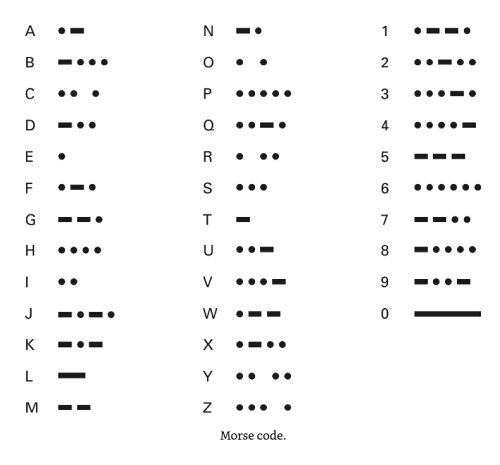
Erroneous Morse Code

02 February 2023

Effects of Cotton Gin and Indian Removal on Slavery

From Bitterly Divided: The South's Inner Civil War, by David Williams (New Press, 2010), Kindle pp. 18-19:

Aside from the moral issues involved, most Americans of that era [c. 1800] saw slavery as an economic dead end. The institution thrived only in the tobacco fields of the Chesapeake region and the rice country of coastal Carolina and Georgia. As the nation expanded, slavery would become proportionally less important to the nation’s economy and would eventually die a natural death. But the development of an efficient cotton engine, or “gin,” in the eighteenth century’s last decade changed all that. The cotton gin became the vehicle by which slavery was carried across the Deep South. Not surprisingly, attitudes toward slavery changed with the institution’s growing economic importance.

That change did not occur overnight. Antislavery sentiment in the South remained open and active through the early 1830s. As of 1827, 106 of the country’s 130 abolitionist societies were in the South. To discourage the use of slave labor, some of those societies paid above-market prices for cotton produced without slave labor. North Carolina Quakers and Methodists repeatedly petitioned their state legislature for emancipation. In 1821, a leading Georgia newspaper insisted: “There is not a single editor in these States who dares advocate slavery as a principle.” Far from advocating slavery, Alabama editor James G. Birney started an abolitionist newspaper. In 1827, the Alabama legislature passed a law prohibiting the importation of slaves from other states, and at every session throughout the decade, members proposed legislation favoring gradual emancipation. As late as 1831, a proposal to end slavery was introduced in the Virginia state assembly.

But the early nineteenth century was also the era of Indian removal. In 1827, Georgia forced out its few remaining Creeks. Nine years later, Alabama did the same. The 1830s saw the Choctaws and Chickasaws driven out of Mississippi. And Georgia annexed Cherokee land following the 1829 discovery of gold there. In an effort that carried the hopes of all Indian nations with it, the Cherokees fought to keep their land through the court system. The United States Supreme Court finally responded in 1832 with its Worcester v. Georgia decision: by treaty obligation, by prior act of Congress, and by the Constitution itself, the Indians held legal title to their land. But President Andrew Jackson refused to enforce the ruling, and Congress declined to intervene. Georgia ignored the court order, and the Cherokees were driven westward on the Trail of Tears. A quarter of them died on that brutal forced march. In 1842, Florida’s Seminoles became the last of the southern nations to be violently relocated to land that they were promised would be theirs for “as long as grass grows or water runs.” At the time it was called Indian Territory. Today it is called Oklahoma.

Indian removal completed the transition in slaveholder attitudes begun a generation earlier. Slaveholders no longer viewed slavery as a temporary necessity but held it to be a positive good, divinely ordained, for the slaveholder, the slave, the nation, and the world. Though religion, racism, pride, and fear were all used to bolster slavery at home and justify it abroad, the driving force behind planters’ proslavery campaign was the same that caused their change of attitude in the first place—economic self-interest. Some planters, like Georgia’s Benjamin Harvey Hill, were candid enough to admit it: “In our early history the Southern statesmen were antislavery in feeling. So were Washington, Jefferson, Madison, Randolph, and many of that day who never studied the argument of the cotton gin, nor heard the eloquent productions of the great Mississippi Valley. Now our people not only see the justice of slavery, but its providence too.”31 It was cotton, along with tobacco, rice, and sugar, all cultivated by slave labor, that gave planters their economic power. And it was this power that gave planters the political strength with which to control the South’s lower classes and silence or exile slavery’s opponents.

25 January 2023

Lakota Hunting Grounds, 1870s

From Lakota America: A New History of Indigenous Power, by Pekka Hämäläinen (The Lamar Series in Western History; Yale U. Press, 2019), Kindle pp. 332-335:

The railroad did eventually come, ushering in U.S. troops and U.S. authority, but well before it came Lakotas. Raids into the Crow country and American settlements in the Gallatin Valley became a routine with Sitting Bull serving as a gravitational force.... Suddenly all American settlements “within the reach of the Sioux hunting-grounds” were in danger. The Carroll Trail, a crucial transportation line connecting Helena to the Missouri River, was in risk of being cut off. At times it seemed it was Crows who protected Americans against Lakotas rather than vice versa. Both settlers and soldiers saw the Crows as an extra “regiment of cavalry.”

...

But the Crows were Lakotas’ primary target, for they stood between them and the bison. Crows were at times forced to flee their reservation in the face of massive Lakota war parties seeking game, horses, mules, and cattle, and their powerless agent seemed to accept “the annual Sioux invasion” as a fact of life. Such was the Lakota pressure that Crow chiefs were rumored to be considering “an offensive and defensive alliance with the Sioux as against the whites.” There could be no such alliance, of course—the game was too scarce and the hatreds ran too deep—and Crows remained close allies of the United States. Before long, Lakotas occupied “the larger and most fertile portion of their reservation.”

Like Crows, Shoshones looked to Americans for protection against Lakotas and their allies. But unlike Crows, they managed to put distance between Lakotas and themselves. Decades of fighting over hunting rights had left them debilitated, and they had accepted a reservation in the lee of the Wind River Range, far to the southwest of the Lakota sphere of operations. Yet, even there, fear of Lakota attacks forced them to periodically flee. Eventually, they ceded a mineral-rich section of their reservation to secure the government’s goodwill and protection. This, in the minds of U.S. agents, was a sign of supreme wisdom: they “are among the most intelligent and best disposed of any Indians on the plains,” gushed the governor of the Wyoming Territory. “Wash-a-kie, their chief, is in all respects a superior Indian.” Their agents reported a growing consumption of government rations—beef, bacon, flour, and sugar—which indicated that Shoshones were giving up the hunt.

So were Utes. They had secured a large eighty-seven-thousand-square-mile reservation in the new Colorado Territory in 1861, but in 1868 they were compelled to accept a much-reduced domain. Five years later the government imposed another reduction, which broke Ute power. Lakota-Arapaho-Cheyenne war parties pushed deep into Ute territory, and growing numbers of Ute hunters began to frequent Denver, expecting to be fed, much to the exasperation of the city’s inhabitants and the territory’s Indian agents: “Even were they ever so well able to pay for hotel accommodations, they are not a desirable class of customers to the proprietors of any of our public-houses.” In the summer of 1873 Ute hunters wished to parade enemy scalps on the streets of Denver: they had killed three Lakota warriors while hunting along the Republican. The Indian agent banned the parade, and Utes celebrated their surprising victory outside the city for a week. It was clear that there would not be many more. Agents reported “improved industrial habits,” larger crops, and a growing willingness to live in houses.

Establishing control over shrinking bison herds was the paramount motive of Lakota warfare in the early 1870s, and it spawned a sprawling raiding hinterland that extended from the Canadian plains into the Rockies and deep into the American Southwest. Closer to home, Lakotas waged a sporadic raiding war against the Arikaras, Hidatsas, and Mandans who now shared a reservation along the Missouri and Little Missouri Rivers. Lakota war parties raided the reservation for horses and corn with growing confidence, sometimes coming with women and often informing their agents of their intentions and successes. Arikaras retaliated by raiding Lakotas at their Grand River and Cheyenne River Agencies, but their agent wanted to move them to Indian Territory, farther away from Lakotas. He was promptly rebuffed: “they fear that it is too warm for them. . . . Besides they love their own country; their dead are buried here; the Government probably would not redeem its promises better there than here.” For Arikaras the U.S. Indian policy was a demoralizing exercise in hypocrisy. “‘The hostile Sioux have all they want from the Government without removal from their country,’” their chiefs protested. “‘Why cannot the Rees [= Arikaras], who have been so friendly and faithful these many years?’” The Arikaras stayed put, their numbers slowly declining in the shadow of an overpowering Lakota-U.S. alliance.

As their rivals yielded ground, Lakotas emerged, in many ways, more powerful than ever. Never before had they ranged over more territory or reached so far. Their core area—their homeland—exceeded the Great Sioux Reservation by tens of thousands of square miles, and their hunting and raiding domain stretched from Lake Winnipeg in the north to the Republican Valley in the south and from the Missouri Valley in the east to the Continental Divide in the west. They had thousands of Indigenous allies on their orbit and diplomatic and commercial ties to Canada and Washington, D.C. They had several handsomely stocked government agencies at their disposal, and they went to war with cutting-edge military technology. Formidable, flexible, and ubiquitous, they commanded the attention of the U.S. government like no other Indigenous nation.

23 January 2023

U.S. Reconstruction: Southerners and Sioux

From Lakota America: A New History of Indigenous Power, by Pekka Hämäläinen (The Lamar Series in Western History; Yale U. Press, 2019), Kindle pp. 267-268:

The United States emerged from the catastrophic war not as a nation but as an empire. The rebelling states remained on maps as before the war, but in reality they were captive territories under military occupation and governance. Acting without any political precedent—how does a failed republican state reunite?—the federal government set out to reconstruct the South after its own image. This was the era of authoritative government agents tasked to impose industrial capitalism, yeoman farming, democracy, and Christian civilization on a vast canvas. “We are to have the charge of this continent,” declared the Reverend Henry Ward Beecher. “This continent is to be from this time forth governed by Northern men, with Northern ideas, and with a Northern gospel.” It was a formula for a comprehensive reconstruction that would simultaneously target both the Southerners and Native Americans. There would two reconstructions, one focused on the rebuilding and reforming the South, the other on pacifying the Indigenous West.

The reconstruction of Indigenous America had to start with the rebellious Lakotas and their allies, and the first challenge was to agree how to achieve it. Several generals insisted that force alone would make Indians give up raiding and settle down, but many eastern politicians and philanthropists, sickened by the Sand Creek massacre, argued that moral education was the only justifiable course. Congress sided with the humanitarians and appointed, in March 1865, Senator James R. Doolittle, a staunch Baptist and patriot, to lead a joint special committee to investigate the state of Indian-white affairs in the West. It authorized commissions to negotiate new treaties with the plains tribes, including the Sioux. The Sioux commission was headed by Newton Edmunds, governor of the Dakota Territory, who was desperate to put an end to the Indian wars that hindered white settlement in his territory, blocking its path to statehood. Pressure came also from Nebraska to the south, where the construction of the Union Pacific Railroad was poised to start in Omaha, making Lakota appeasement a matter of national importance.

Repeatedly humbled by nomad warriors over the years, generals denounced the congressional version of the Indigenous reconstruction as lily-livered and misguided. Sully and Sibley wanted to keep the pressure on the Lakotas, and Pope, in charge of military operations in the Dakota Territory, was deeply cynical of the logic of offering new treaties to the plains tribes. How will they understand treaties and annuities he asked, if “the violation of former treaties and the murder of whites are to be thus compensated?” As he saw it, treaties actually boosted Lakota raids. “It is a common saying with the Sioux, that whenever they are poor, and need powder and lead, they have only to go down to the overland routes and murder a few white men, and they will have a treaty to supply their wants.” Pope was not entirely wrong. Since the opening of the Oregon Trail in the mid-1840s, Lakotas had tolerated overland traffic because it yielded resources, whether secured through trading, raiding, extortion, or, as Pope now claimed, through treaty goods.