Showing posts with label Europe. Show all posts

25 July 2026

Explorers Return to Europe, 1775

From The Traveler: One Man's Quest for Humanity from the South Seas to Revolutionary Paris, by Andrea Wulf (Knopf, 2026), Kindle pp. 207-208:

Before they had left England, it had been decided that the Resolution would return via Cape Town—which was why friends and families had sent letters there to wait for the crew on their arrival. The men devoured fresh food and letters and news. They read piles of old newspapers to catch up. ‘Sweden delivered from the yoke of aristocratical tyranny’, George was glad to learn. In the so-called Swedish Revolution, the young king Gustav III had been the mastermind in a coup d’état which had ended the stronghold that the nobility had exercised over the monarchy. He was not intending to take away freedom, the king had said, but wanted to stop aristocratic despotism and establish ‘a right kind of Liberty that only can make you, my dear subjects, happy’. Like other enlightened rulers at the time, he had then begun to reform the justice system and economy, as well as instituting limited religious freedom.

France had a new king: at the age of nineteen, Louis XVI had succeeded his grandfather in May 1774 during the second visit of the Resolution to Tahiti. Poland had lost vast swathes of land when Russia, Prussia and Austria had divided around a third of the country between them. Having added a huge territory to Prussia in the Polish partition, the Prussian king was, George noted, ‘resting from his triumphs’. George also read that Russia and the Ottoman Empire had signed a peace treaty in July 1774, ending the war that had begun in 1768. With Russia gaining land and the right to protect Christians in the Muslim realm, the treaty marked the beginning of the decline of the once powerful Ottoman Empire, which for long had controlled large parts of south-east Europe and the Middle East. George was optimistic. After the long years of war in Europe, peace seemed finally possible. Everything ‘promised general happiness to the human race’.

But trouble was brewing in the British colonies in North America. In December 1773 a group of colonists had dumped more than 300 chests of tea—the entire shipment of three East India Company vessels—into Boston harbour in protest against Britain’s new tax regulations on tea. A month later the rebels had tarred and feathered a British customs collector. On 5 September 1774, just as the Resolution had landed in New Caledonia, the colonists had convened the First Continental Congress in Philadelphia—a congress of elected colonial delegates—to discuss how best to respond to British rule in North America. Frustrated by the lack of parliamentary representation and economic restrictions, the delegates called for a boycott of British goods and recommended that each colony establish its own militia.

There was also news from the Adventure, which had stopped in Cape Town on her way to England exactly a year earlier, in March 1774. The men of the Resolution were horrified to learn that ten crew members had been killed and eaten by the Māori, but Cook refused to pass judgement until the news had been confirmed. He had always found the Māori to be brave and open-minded, ‘but they are a people that will never put up with an insult if they have an opportunity to resent it’. George agreed. John Rowe, one of the officers who had been cannibalized, had always shown a brutal disregard for indigenous people and ‘been exceeding desirous of firing upon them’. The Māori must have been provoked. ‘The whole tenour of their behaviour to Europeans, seems to acquit them of treachery and cruel malevolence,’ George wrote, ‘it is therefore greatly to be suspected that they took umbrage at some affront, perhaps unwittingly committed by the strangers, and revenged it.’

14 July 2026

Russia Boosts Ukrainian Nationalism

From The Russo-Ukraine War: The Return of History, by Serhii Plokhy (W. W. Norton, 2023), Kindle pp. 131-134:

The eight years of hybrid warfare that Russia had waged against Ukraine in the Donbas, divided by the Minsk agreements, turned Ukraine into a different country and society from those of 2014. A country divided by issues of history, culture, and identity when the Crimea was annexed was now united by the desire to defend its sovereignty, democratic order, and way of life at almost any price.

The war had changed the electoral map of Ukraine. The first wartime presidential elections, held in May 2014, yielded unprecedented results: Petro Poroshenko won in the first round with 55 percent of the vote—the first time this had happened since 1991. Even more important, Poroshenko carried 187 precincts out of 188 remaining under Ukrainian control. The dividing line of the previous presidential elections, which had split Ukraine in half between pro-European and pro-Russian candidates, was now gone. The war had produced a much more homogenous country.

Russia’s annexation of the Crimea and takeover of significant portions of Ukraine’s Donbas removed the traditionally most pro-Russian areas, with the greatest number of ethnic Russians and Russian speakers in Ukraine, from Ukrainian political and cultural space. Those areas had also served as bases for Russia-friendly political parties. Russia did its utmost to support former allies of the ousted president, Viktor Yanukovych, but they were divided and weak after losing a significant part of their electoral base. The forces led by the Ukrainian businessman and politician Viktor Medvedchuk, who was close to Putin, also remained weak despite the support of television channels and newspapers funded with Russian assistance.

The growth of Ukrainian political identity began with the rejection of symbols of the Soviet past. The Maidan protests of 2014 unleashed a wave of demolition of monuments to Vladimir Lenin, the main symbol of communist and, in the eyes of many, Russian domination of Ukraine. More than 500 such monuments were toppled by anti-communist activists in the first half of 2014, mostly in the center of the country. The rest, more than 1,500 that remained in the regions of southeastern Ukraine controlled by Kyiv, were removed in the course of the next few years by decision of parliament, which adopted the so-called “decommunization laws” prohibiting the public display of communist symbols.

Ukrainians survived the Russian onslaught during the first stage of the war, in 2014–15, by uniting across ethnic, linguistic, religious, and cultural lines. The war itself also promoted popular identification with the Ukrainian language and culture. Since Putin’s official rationale for invading Ukraine was the defense of Russian speakers, many Ukrainians and Russians who knew Ukrainian but used Russian as their language of preference began to switch to Ukrainian as an act of defiance. The number of those self-reporting their use of Ukrainian at home and at work spiked in 2014–15. That number returned to the previous norm once the immediate danger of all-out invasion passed, but readiness to adopt Ukrainian as the dominant language of government and education remained. In 2019, parliament adopted a new law making the Ukrainian language mandatory for government officials and public-sector employees. The Russian Foreign Ministry protested, claiming that the law would deepen divisions in Ukrainian society. That did not prove to be the case.

City and village bookstores were flooded with Ukrainian-language books, reducing Russian-language publications to secondary status. Works on Ukrainian history and culture began to top bestseller lists. Before the war, the government had spent little or no money on the promotion of Ukrainian culture abroad; now it created a special Ukrainian Institute under the auspices of the Ministry of Foreign Affairs. Its task was to emulate Germany’s Goethe Institute and similar agencies in other countries, familiarizing foreign countries with the Ukrainian language and culture. At home, the Ukrainian Cultural Fund and the Ukrainian Book Institute were charged with supporting cultural events and promoting Ukrainian publications.

In 2018 the government provided strong support for the unification of the two branches of the Ukrainian Orthodox Church that were independent of the Moscow Patriarchate, which still dominated Orthodoxy in Ukraine, while striving to restrain competition between them. President Poroshenko attended the unification council of the two churches, which were placed under the jurisdiction of the Patriarch of Constantinople—a major blow to the prospect of continuing Russian Orthodox hegemony. Moscow protested and severed ties with the Patriarch of Constantinople but could do little more to maintain its position. The newly united Orthodox Church of Ukraine (OCU) had mass popular support, and, given the ongoing if undeclared war with Russia, many Orthodox Ukrainians preferred a church independent of Moscow. The transfer of parishes from the Moscow Patriarchate to the OCU began in the first months of 2019.

Active government involvement in matters of language, memory politics, and religion met with substantial criticism not only from traditionally pro-Russian political forces but also from part of the country’s liberal establishment. Nevertheless, it was either supported or accepted by the population at large. After Russia’s aggressive weaponization of issues of culture and history in 2014–15, much of the population agreed that the new laws and policies were necessary elements of nation-building, designed to prevent further Russian aggression.

The new Ukrainian government fulfilled the promise of the Revolution of Dignity by moving closer to the European Union and Euro-Atlantic institutions, including NATO. The association agreement that had triggered the Maidan protests in 2017 was signed in June 2014. In March 2017 the European Union Council granted Ukrainians visa-free travel to the EU. The EU member nations provided badly needed financial assistance, altogether up to $14 billion, to help Ukraine deal with its losses of territory, population, and economic assets. An additional $2.2 billion came from the United States. Washington became the main sponsor of reform in the Ukrainian security sector, providing $1.6 billion for that purpose alone. Ukraine was rapidly acquiring a new professional army, and the government placed NATO membership back on its agenda by including it in the Ukrainian constitution.

10 July 2026

Post-Soviet Nations and NATO

From The Russo-Ukraine War: The Return of History, by Serhii Plokhy (W. W. Norton, 2023), Kindle pp. 82-84:

As far as Russia was concerned, the victory of the 2004 Orange Revolution in Ukraine was a major blow to the Kremlin’s interests at home and abroad. “It was our 9/11,” declared the Russian political adviser Gleb Pavlovsky, who was close to the Kremlin. A native of Ukraine, he went to Kyiv to advise Prime Minister Yanukovych and his campaign. The Orange Revolution was also a personal defeat for Putin because it was supported by Boris Berezovsky, his onetime sponsor, later nemesis, and ultimately refugee from his regime. The Kremlin was concerned that under the Western-leaning President Yushchenko, Ukraine might leave the Russian orbit forever and join the Western camp.

With the fall of communism, democratic rule became a prerequisite for post-communist and post-Soviet states aspiring to join Western institutions, both political, like the European Union, and military, NATO in particular. Ukraine, with its chaotic but viable democracy, could be a candidate for both, while Russia, failing one democracy test after another and eventually setting on the path of authoritarian rule, could not. The success and durability of Ukrainian democracy was a threat to the Putin regime, since it encouraged whatever remained of the pro-democratic forces in Russia and, in geopolitical terms, brought democratic institutions closer to Russia’s borders. In Putin’s eyes, this was not just undesirable but unacceptable.

By 2004, Putin was well on the way to laying the foundations for a future autocratic regime. He took control of the Russian Duma in the December 2003 elections, which saw his party, United Russia, obtain three times as many votes as the communists to become the largest party in parliament. He then exploited a hostage crisis produced by Chechen radicals who attacked a school in Beslan in September 2004. It was mishandled by the Russian security services, whose personnel stormed the school, contributing to the death of 314 hostages, including 186 schoolchildren. This gave Putin an opportunity to intervene and curtail whatever remained of Russian democracy: elections of regional governors were abolished, and new laws were introduced curtailing the activities of political parties and NGOs.

Putin was eager to see a similar political system installed in Ukraine, openly campaigning for Yanukovych and secretly pushing Kuchma toward the use of force. He failed on both counts. In early 2005, mass protests also shook a number of other post-Soviet countries, including Uzbekistan and Kyrgyzstan, where the “Tulip Revolution” unseated the local ruler, Askar Akayev, who had been in power since the late Soviet period. A year before the Orange Revolution, the “Revolution of Roses” in Georgia had brought to power a young, charismatic, pro-Western reformer named Mikheil Saakashvili. In Russia, all these protest movements were labeled “Orange.” Finding itself on the defensive, Moscow began to mimic the tactics used by the opposition during the Orange Revolution, creating and funding numerous pro-government youth organizations, the most notorious of which was “Nashi,” or “Ours.” “Ours” were there to defend the president against revolutionary upheaval, allegedly promoted by foreign powers. Ukraine was singled out in that regard, but behind Ukraine Moscow ideologues saw the threatening shadow of the West.

Indeed, as expected in Moscow, the Orange Revolution produced a major geopolitical shift in Kyiv. President Yushchenko returned to the pro-European policies launched by Kuchma before the Melnychenko tapes scandal of 2001. Those included gradual integration into European structures, from the European Union to NATO. Yushchenko wanted an invitation to join the alliance in the form of a Membership Action Plan, or MAP. His requests did not fall on deaf ears in Brussels, as NATO officials invited Ukraine to begin an Intensified Dialogue on possible membership. The Czech Republic, Slovakia, Hungary, and Poland, Ukraine’s western neighbors who had not wanted their efforts to join NATO to be compromised by association with Ukraine in the 1990s, now all supported Ukraine’s aspirations to membership. They were only too happy to yield their position on NATO’s eastern flank, vulnerable to possible Russian attack, to Ukraine.

In February 2022, a few weeks after his inauguration, Yushchenko attended a meeting of heads of state of NATO member nations in Brussels, where he publicly declared that he wanted his colleagues to regard Ukraine as a future member of the alliance. He did so in the name of the Orange Revolution that he had led and the people who had elected him to the presidency. “I’m pretty much sure, dear friends,” began Yushchenko, “that the people who went onto Kyiv’s squares and streets were motivated because they wanted to see Ukraine in Europe, not as a neighbor of Europe, because we are a country located in the center of Europe. And we would like to see Ukraine integrated into the European Union and into the North Atlantic Alliance.” Before leaving the podium, Yushchenko went out of his way to reassure Russia that his NATO aspirations and those of his country were not directed against Russia. “Russia is our strategic partner,” declared Yushchenko, “and Ukraine’s policy toward NATO will by no means be against the interests of other countries, including Russia.”

Ukraine was trying to solve its security dilemma as best it could. Since NATO had established a strategic partnership with Russia, the idea of Ukraine’s acceding to NATO without antagonizing Russia was theoretically feasible in the 1990s. But in the wake of the Orange Revolution, Kyiv faced a difficult choice: either to accommodate Moscow, which had long-standing territorial claims on Ukraine and had intervened directly in that country’s presidential elections, or to seek protection in a military alliance that could guarantee its territorial integrity and sovereignty. The threat from Russia was real and immediate, while membership in NATO was hypothetical and removed in time. After long vacillation, Kyiv opted decisively for NATO.

13 June 2026

Classical Pontic Steppe Divisions

From The Gates of Europe: A History of Ukraine, by Serhii Plokhy (Basic Books, 2017), Kindle pp. 39-41:

Ovid’s contemporary Strabo, author of the acclaimed Geographies, knew more about the Pontic steppe than did the famous Roman exile. From Strabo we learn the names of the Sarmatian tribes and the areas under their control. According to him, the Iazyges and Roxolani were “wagon dwellers,” or nomads, but the famous geographer gives us literally nothing about the sedentary population of the forest-steppe areas around the Dnieper, not to mention the wooded areas farther to the north. Unlike Ovid, however, he did not live among the peoples of the region; nor were his sources as good as those of Herodotus. They knew nothing about the “northerners,” and Strabo complained about the ignorance that prevailed “in regard to the rest of the peoples that come next in order in the north; for I know neither the Bastarnae, nor the Sauromatae, nor, in a word, any of the peoples who dwell above the Pontus, nor how far distant they are from the Atlantic Sea, nor whether their countries border upon it.”

Strabo’s informants came from one of the colonies, but if Herodotus made numerous references to the Dnieper, Strabo seemed more familiar with the Don. His sources likely came from Tanais, a Greek colony at the mouth of the Don that belonged to the Bosporan Kingdom, the most powerful union of Greek colonies revived with the arrival of the Romans. For Strabo, the Don had a special meaning. It served as the easternmost boundary of Europe, the term used in the Aegean homeland to describe the expanse of the Greek presence in the outer world. Europe lay to the west of the Don, while Asia began to the east of it.

Thus, at the beginning of the first millennium AD, when the Romans came to the Pontic colonies, the Ukrainian territories found themselves once again at the very edge of what would become Western civilization. The northern frontier of the Hellenic world had now become the eastern boundary of Europe. There it would remain for almost two thousand years, until the rise of the Russian Empire in the eighteenth century redrew the map of Europe, moving its eastern boundary all the way to the Urals.

The division of the Pontic steppes into European and Asian parts did not mean much in the time of the Romans. Strabo wrote about the Sarmatians on both the left and right banks of the Don, and Ptolemy, one of his successors, wrote in the second century AD about two Sarmatias, one European, the other Asian—a division that would remain constant in the works of European geographers for another millennium and a half. More important than the imagined eastern boundary of Europe was the real civilizational frontier between the Mediterranean colonies on the northern shore of the Black Sea and the nomads of the Pontic steppes. Unlike the Greek colonies with their surrounding fortifications, that frontier was never set in stone, creating instead a broad zone of interaction between colonists and locals in which languages, religions, and cultures intermixed, producing new cultural and social realities.

The all-important boundary between the steppe nomads and the agriculturalists of the forest-steppe areas that was known to Herodotus became invisible for Strabo. Whether it disappeared altogether or Mediterranean writers simply did not know about it is hard to say. Geography and ecology stayed the same, while the population probably did not. It certainly refused to stay put in the middle of the first millennium AD, when we next encounter references to the region in the writings of learned Greeks.

17 March 2025

Chinese Empire Demand for Silver

From The Chinese Question: The Gold Rushes and  Global Politics, by Mae Ngai (W. W. Norton, 2021), Kindle pp. 9-10:

AT THE TIME OF the gold rushes, China was already in the grip of European colonialism. China was never directly colonized by a Western power; in fact, by the mid-eighteenth century the Qing Dynasty (1644–1911) had built an empire of its own, having expanded China’s boundaries to the west, most notably by annexing Tibet and Xinjiang. But in the mid-nineteenth century China was battered by European aggressions: the opium trade, gunboat diplomacy, and the forced opening to Western trade and missionaries. China’s humiliation stood in stark contrast to the position it had once held, even relatively recently.

For two hundred years, from 1550 to 1750, China had been arguably the most important economic actor in the world. It was not only the single largest domestic economy; it was also at the center of global trade, both with its Sino-centric tributary and trading networks in East and Southeast Asia and as the premier destination market for silver produced in Spanish America and Japan. Europeans shipped silver to China not as “money” but as commodity arbitrage: the Ming Dynasty’s (1368–1644) demand for silver for fiscal and commercial purposes fetched the highest silver prices in the world, double its price in Europe. China was the world’s great “silver sink” that not only drew but also stimulated its production in the New World.

Through the seventeenth century, Europeans traded silver for luxuries, including gold. For example, the British East India Company’s first direct transaction with China in 1637 exchanged 60,000 Spanish dollars for sugar, silk, spices, porcelain, and “loose gould.” Chinese traders also made handsome profits by buying low and selling dear, earning gross profits of 100 to 150 percent on silk and silk textiles sold to Europeans. Economic historians Dennis Flynn and Arturo Giràldez describe these late sixteenth-century dynamics of global trade as “multiple arbitrage.”

Europeans began trading silver for tea in large quantities in the early eighteenth century. Like silk, tea was a luxury item in Europe, but it had greater potential for mass consumption. The creation of a mass market for tea in Europe coincided with the rise in consumption of sugar from the plantation-slave colonies of the Caribbean in the late seventeenth century. Indeed, tea and sugar, along with tobacco, undergirded a global trade in stimulants—“food drugs”—based on a symbiosis of colonialism and slavery, on the one hand, and new mass-consumption economies in European metropolitan societies, especially Britain, on the other.

By 1800 silver’s arbitrage advantage in China had ended. The British, now hooked on tea, looked for a different means of exchange. The East India Company had already drained India of much of its silver to sell in China; now it turned to India for the mass production of opium for export to China.

12 September 2024

Caribbean Syncretic & Creole Religions

From The Caribbean: A History of the Region and Its Peoples, ed. by Stephan Palmié and Francisco A. Scarano (U. Chicago Press, 2013), Kindle pp. 409-412:

Caribbean religions are among the most complex examples of the emergence and transformation of cultural lifeworlds in the Americas. Given their numerous sources and formations, and their tendency to eschew orthodox axioms in favor of heterodox practices guided by a few broad principles, religions emerging from the Caribbean are characterized by amalgamation and recombination. Added to syncretic or creole religions deriving from the Caribbean context are religions whose doctrines and belief systems, themselves varied and changing over time, derive from “Old World” origins. Thus, today even a cursory list of religions in the region would be long—Catholicism, Protestantism, evangelical and Pentecostal movements, Judaism, Hinduism, vodou, Santería, Islam, espiritismo, Rastafari, and orisha—made even longer by a number of demographically smaller but socially significant traditions such as Kali worship in Guyana, brujería and Mita worship in Puerto Rico, Quimbois in Martinique, and Winti in Suriname.

Equally important are historical and contemporary magical practices (often subsumed under the term “obeah”) that involve supernatural powers, deriving largely from West African divination and healing practices and, to a lesser extent, Hindu and Christian cosmologies. The meaning of obeah has changed over the centuries. Among 17th- to 19th-century Africans and Afro-Caribbeans it was associated with salutary objectives, such as alleviating illness, protecting against harm, and avenging wrongs. Euro-colonial and local bourgeois ideologies emphasized the dangerous aspects of obeah, often equating it with Judeo-Christian interpretations of evil forces. Often, positive and negative assessments existed simultaneously, making local opinion about obeah ambiguous. Today, as in earlier eras, its practice represents tensions between the ways in which practitioners interpret obeah’s methods and objectives, and the ways in which those methods and objectives are perceived by outsiders.

Caribbean religions are expressions of traditions of creativity, resistance, and flexibility that continuously build on as well as disassemble older and current forms of knowledge, heritage, and custom. The challenge in understanding them is to grasp that difference and similarity exist at the same time. Hinduism, as practiced by the progeny of indentured laborers, reflects both the remembered traditions that early immigrants brought with them from India and a contemporary global Hinduism that travels across the Hindu diaspora. While Caribbean Hindus may interpret their forms of worship as replicating those in India, they also recognize that certain transformations and syncretisms have occurred for almost 170 years in the Caribbean.

In contrast, Rastafari’s origins are in Jamaica, where religious movements based in Afro-Caribbean folk Christianity, the pan-Africanism of Marcus Garvey, grassroots reinterpretations of the Old Testament, and the veneration of Haile Selassie of Ethiopia coalesced in the 1930s, giving rise to the religious, philosophical, and political worldview of today’s Rastafari movement. In it, Africa plays a great symbolic role as a place of desired return and the antithesis of “Babylon”—all places and forms of consciousness in which predatory relationships and “mental slavery” abound. Yet although thus memorialized, Africa is not literally remembered by many Rastafari, the vast majority of whom have never had direct experience with societies and cultures in Africa or Ethiopia (two terms often used synonymously). Nonetheless, Africa/Ethiopia represents for them an indispensable emblem of unity, self-determination, authenticity, and morality.

Islam, meanwhile, first came to the Caribbean as the religion of some African slaves. With the advent of indentured laborers from India, Islam gained an increased presence in the region. Notable today are the numerous masjids (mosques) that dot the landscape of many countries, from Trinidad to Guyana, Puerto Rico, and Suriname. Some masjids are humble, built to serve small communities and local villages; others are grand, built as centers of learning as well as centers of worship for larger populations in the towns and cities. In these places of worship that serve jamaats (congregations) large and small, imams (religious leaders) work to preserve the Sunnah (Muslim way of life). At the same time, Islam in the Caribbean encapsulates the simultaneous inclusiveness and exclusions of a religion claimed by different ethnic groups, practiced according to divergent interpretations of doctrine, and, in certain contexts, participated in by non-Muslims. This is perhaps best seen in the ritual of Hosay, the Caribbean version of Shi’a Islam’s commemoration, Muharram.

Historically spread throughout the Anglophone Caribbean, today Hosay is practiced on a major scale only in Trinidad, where it is simultaneously an important religious event, a freighted political statement, an embattled heritage claim, and a multicultural symbol. Mourners of Hussain march with enormous, elaborate representations of the tadjas (tazzias, or representations of the martyrs’ tombs; see fig. 27.2). This procession has been treated by some local participants less like a sacred commemoration than like a parade, where music and general revelry may occur on the sidelines. Despite its Muslim origins, Hosay in Trinidad also has always involved Hindus and Afro-Trinidadians. Hindus have long been key participants in the building of the tadjas, and Afro-Trinidadians traditionally have played a significant role as drummers as well as bearers (along with Hindu and Muslim Indo-Trinidadians) of the tadjas in procession. Moreover, Hindus sometimes make their own vows and offerings during Hosay. This ritual was the only significant element in the Indian cultural repertoire that provided a social bridge to the rest of 19th-century Trinidadian society (Singh 1988, 4). Given its multiple interpretations and diverse participants, Hosay lends a distinctive religious and cultural tenor to Trinidad’s national culture. The combination of participants and their varied forms of involvement has given rise to debates among Muslims and non-Muslims about the authenticity of Hosay and its appropriateness in Islam. Other observers argue that this ceremony’s heterogeneity and cooperation counters the divide-and-rule antagonism among subordinate groups (notably Afro- and Indo-Caribbeans) encouraged by British colonizers, offering a natural space for a creole unity.

Religion is just one of innumerable examples of the ways in which Africa, Europe, and Asia have together produced the 20th-century Caribbean.

I hope the author of this chapter (Aisha Khan) and the editors and publisher forgive my multiple extracts from this chapter, which is my favorite in this meaty volume from U. Chicago Press.

Aisha Khan is an associate professor of anthropology at New York University. She is the author of Callaloo Nation: Metaphors of Race and Religious Identity among South Asians in Trinidad and co-editor of Empirical Futures: Anthropologists and Historians Engage the Work of Sidney W. Mintz.

09 April 2024

Kellogg-Briand Delusions, 1927

From The Weimar Years: Rise and Fall 1918–1933, by Frank McDonough (Bloomsbury, 2023), Kindle pp. 468-470:

At the same time as Hitler was planning a future world war, the world’s major powers were gathering in the Clock Room (Salon de l’Horloge) inside the French Foreign Office on the Quai d’Orsay, Paris, on 27 August, for an elaborate ceremony to sign the General Treaty for Renunciation of War as an Instrument of National Policy. The pact had evolved from negotiations begun in 1927 by Frank Kellogg, the US Secretary of State, and Aristide Briand, the French Foreign Minister. On 6 April 1927, Briand announced his country’s intention to enter into a bilateral agreement with the USA, stipulating that neither country would resort to war with each other, and that any dispute between them would be settled by peaceful means. Two months later, Briand submitted to the American government a draft of the proposed treaty. The American reply came in December 1927. Kellogg suggested the proposed Franco-American agreement should be expanded into a multilateral treaty to be signed by other countries, to which Briand readily agreed. In recognition of their joint diplomatic efforts, the agreement became known as the Kellogg–Briand Pact, and was greatly welcomed by the public.

At the signature ceremony in Paris, Briand gave an inspiring speech, saying at one point: ‘Can the world present a nobler lesson than the spectacle of this assemblage, where Germany appears for the signature of a pact against war, of its own free will, and without reserve, among the other signatories, its former enemies?’ Briand also spoke in glowing terms of Stresemann: ‘One can believe me particularly happy, to render homage to the highness of mind and to the courage of this eminent politician who, during more than three years, has not hesitated to assume full responsibility in the work of European co-operation for the maintenance of peace.’

The main text of the Kellogg–Briand Pact consisted of two brief articles. Under Article 1, the signatories condemned the ‘recourse to war for the solution of international controversies’, and further promised to ‘renounce it as an instrument of national policy in their relationship with one another’. Article 2 required the contracting parties to solve all disputes or conflicts by peaceful means. The original 15 signatories were the United Kingdom, Germany, USA, France, Italy, Japan, Australia, Belgium, Canada, Czechoslovakia, India, Ireland, New Zealand, Poland, and South Africa. Eventually, a further 47 nations followed suit. Elements of the pact were later incorporated into the League of Nations charter.

The Kellogg–Briand agreement, which was seen at the time as a milestone in international relations, gave the public around the world the false illusion that perpetual peace had arrived, but did not limit in any way the right of a nation to self-defence against the attack of any other nation, or alter the military obligations arising from the Covenant of the League of Nations or already agreed binding treaties. The pact contained no legal mechanism for enforcement and was, for some, a ‘worthless piece of paper’, which proved completely ineffective as a means of preventing war. It did provide, however, a legal basis for the concept of a ‘crime against peace’, the crime for which the Nuremberg Tribunal and the Tokyo Tribunal tried and executed the senior leaders judged responsible for starting the Second World War.

23 January 2024

U.S. Status in 1946

From 1946: The Making of the Modern World, by Victor Sebestyen (Knopf Doubleday, 2015), Kindle pp. 12-14:

The US experience of World War Two was entirely different from that of every other combatant nation. There was much hardship, to be sure, and loss of lives. But America was the only country to emerge from the conflict better off than when it entered it in 1941. No attempt had been made to invade and occupy the country; no cities were destroyed by bombs. There were no refugees roaming the American countryside, desperately searching for food and shelter as in much of Europe and Asia. There were no direct war casualties from military action in mainland America. Around 420,000 Americans from the services died in combat or went missing in action, which, given the scale of the fighting on three continents, is a modest number. British losses, at around 330,000 service personnel, were lower, but from a population about a quarter of America’s size. And combined American and British losses were fewer than Russian deaths in the Siege of Leningrad alone.

America’s economy boomed as never before. Its annual GNP doubled between 1940 and 1945 from $102 billion to $214 billion. Unemployment fell from 14.6 per cent to a historic low of 1.2 per cent. The war dragged the US out of the Depression. There had been rationing on a range of products such as milk, sugar, gasoline, rubber for tyres, some meats and vegetable oils, and even typewriter ribbon. But for most people, living standards improved dramatically as incomes rose by more than 50 per cent. The war was a leveller economically, unusually so in American history. The share of income of the top 5 per cent of the population fell by almost a fifth and remained that way until the gap began widening again in the 1970s.

America was the granary of the world, and its industrial workshop. At the beginning of 1946 more goods were manufactured in the US than in the rest of the world put together. During the war, America had created a new financial system that ensured the US dollar would become the world’s chief trading currency, which it continued to be well into the twenty-first century. Most Americans believed not only that US soldiers had done most of the fighting to win the war but, justifiably, that American money had bankrolled the Allies to help with the rest.

Immediately post-war, Americans wanted a brief period to celebrate victory. After that, the demands were equally uncomplicated. Dean Acheson, an advisor to the President who would become US Secretary of State three years later, put it in straightforward fashion. ‘I can state in three sentences what the popular foreign policies are among the people of the United States. 1. Bring the boys home. 2. No playing Santa Claus. 3. Don’t be pushed around.’ They also wanted the security that wealth could provide.

Before the war the only substantial US military base outside homeland America was in the Philippines. But Pearl Harbor marked the beginning of America’s development as a military superpower. In 1946/47 the defence budget was $13 billion, 36 per cent of national spending and thirteen times more than it had been for each of the nine pre-war years. It was to remain at similar levels for the next three decades. By the end of the war, new naval and air bases had been leased in the Americas, in Iceland, Greece and Turkey, in Korea and the Middle East. More than half a million US troops were stationed in Europe. As it turned out, many thousands would remain for the next forty years – and America would be the strongest military power in Europe. But however counter-intuitive it might seem in retrospect, at the time it was assumed on both sides of the Atlantic that the GIs would soon return home. When the final details of D-Day were being planned in spring 1944, the US military’s top brass asked President Roosevelt how long he expected occupation troops to stay in Germany and elsewhere after the war was won. The Commander-in-Chief was explicit: ‘At least a year, maybe two,’ he replied. But not more. That was still America’s clear intention throughout 1946. It changed only when the Big Three alliance began falling apart and perceptions in Washington hardened about the USSR’s objectives in Europe. Meanwhile, America’s allies – including the Soviets – believed the same. Winston Churchill wrote a note to the British cabinet before VE Day emphasising the point: ‘We must not expect that the United States will keep large armies in Europe for long after the war,’ he said. ‘I doubt there will be any American troops in Europe four years after the cease-firing.’

There was to be no return to isolationism. US soldiers, engineers and an army of idealistic bureaucrats would remake Japan as a modern democracy in the American image, but disarmed so it could never again pose a threat to its neighbours or to the United States. And though the plan was to bring the troops home, it was never the intention to withdraw from European peace-making and diplomacy.

05 April 2023

Early Chinese Telegraph Codes

From Kingdom of Characters: The Language Revolution That Made China Modern, by Jing Tsu (Riverhead Books, 2022), Kindle pp. 91-92, 106-108, 110-111, 123-124:

In Morse code, the basic symbols were dots and dashes. The system’s twenty-six combinations of dots and dashes, ranging from one to four symbols, were meant to accommodate the twenty-six letters of the alphabet, with another ten combinations of five symbols each for numbers zero to nine.

To send a message, a telegraph operator pressed an electric switch, in the form of a key: a short tap for a dot and a long one for a dash. The message was converted into an electric current that traveled along the wires and was reverse translated into letters and numbers on the receiving end. The sound of clicking patterns could become so familiar that an experienced telegrapher could tell what word was being coded from its distinct rhythm. Telegraph costs were determined by how long they took to transmit—each dot or space was a single unit, and a dash—three times as long as a dot—was three units. As Morse explained early on, his system was designed to be cost-efficient. The most frequently used letter in English, “e,” was also the least expensive: It was represented by a single dot. The high frequency of “e” holds true for most European languages, from Italian to Dutch. But Morse code clearly favored the American English alphabet. An English letter takes up somewhere between one and thirteen units. To add even a single diacritical mark to the letter “a”—as when making the French “à”—required ten more units. So there was already plenty to disagree about among Roman alphabet users.

The inequities of Morse code were on a different scale for the Chinese. International telegraphy recognized only the Roman alphabet letters and Arabic numerals used by the majority of its members, which meant that Chinese, too, had to be mediated via letters and numbers. Whereas English could be English, and Italian mostly Italian, Chinese had to be something other than itself. Every Chinese character was transmitted as a string of four to six numbers, each of which cost more than a letter. The assigned code for a Chinese character first had to be looked up in a codebook before being converted to the dots and dashes of Morse code. Coding and converting Chinese characters into an ordinary telegram of twenty-five words required at least half an hour, whereas a comparable message in English took only about two minutes. Untold opportunity costs accrued with every telegraph that was delayed when the operator had to pause to check a character against its assigned number in a codebook or had to take extra time to correct an error.

...

[Septime Auguste] Viguier possessed the confidence and skill set that Great Northern [Telegraph Company (大北電報公司 / 大北电报公司 Dàběi Diànbào Gōngsī)] was looking for. He had already worked on developing a code for Chinese telegraphy years earlier for the French government in support of their failed efforts to interest the Chinese Empire in their telegraph cables. He was well versed in early word-copying machines like the Caselli pantelegraph, a precursor to the modern-day fax machine. When the French project was shelved, Viguier ended up in Shanghai—ripe for the Danes’ recruitment. He was the best candidate but not well-liked. Colleagues immediately noted his preening and boastfulness—the French way, they sneered. Viguier later also had a nasty exchange with the managing director Suenson, and his relationship with the company soured over questions of compensation and credit. Nonetheless, Viguier was able to work quickly enough to build out the Danish professor’s incomplete scheme. By June 1870, he had the first version. In 1872, he delivered the final, standardized telegraphic code table for 6,899 characters in The New Book for the Telegraph (Dianbao xinshu).

...

Viguier came up with a tabular form of twenty rows and ten columns per page. He assigned an arbitrary four-digit code from 0001 to 9999 to each character, with empty spaces left for potentially 3,000 more codes to accommodate customized vocabulary for individual business purposes. Each page contained 200 square spaces for listing 200 characters and their numerical codes. The code only included a relatively small number of characters out of the 45,000 or so that were extant. The mass scaling of telegraphy meant that it was geared toward the common person and the common tongue, so restricting the number of characters was not only efficient but also practical.

...

But Viguier’s telegraphic code did not go unchallenged. Almost immediately, the Chinese tried to outdo and improve upon it. A quiet young Chinese translator who had been part of that diplomatic mission to Europe in 1868, Zhang Deyi, became the first Chinese to do so. Zhang noted the pain of having to send Chinese messages back to the Chinese office in China in “foreign letters” whenever more urgent service was required. He also saw how Western telegrams were more secure, as secret messages were sent in numbers. That inspired Zhang to construct his own Chinese telegraphic codebook by following a similar format.

While the published version of Viguier’s work was an important landmark, Zhang zeroed in on its sloppiness. Viguier’s numbering of characters did not make them terribly easy to use for the Chinese. The continuous numbers did not separate out characters into groups, which was how the Chinese were accustomed to searching for characters in a dictionary. He decided to trim down the format of Viguier’s system and do some reorganization to make its content clearer. Zhang’s own New Method of Telegraphy (Dianxin xinfa) was published two years after Viguier came up with a draft of his telegraphic code in 1873. It reordered the characters so that the numbers were less arbitrary. Zhang used the same 214 radicals, but reselected about 7,000 characters from the Kangxi Dictionary and assigned them numbers from 0001 to 8000.

...

Westerners like Viguier had mapped Chinese onto numbers. Then the Chinese themselves had tried to use numbers to remap the alphabet. They kept bending the stick back and forth. Wang [Jingchun] was increasingly of the mind that one could put the Western alphabet in service of Chinese Romanization more permanently. He turned to Bopomofo, the Chinese phonetic alphabet approved at the 1913 National Language Unification Conference in Beijing, and its idea of an auxiliary phonetic alphabet formed from different styles and parts of Chinese characters. Working from this basis, Wang designed a use for Roman letters that was Latin in name but readapted to signal the three linguistic properties of Chinese characters: the phonetic representation of sound, tone, and the radical.

To indicate sound in his New Phonetic System, Wang mapped the sounds of Bopomofo—represented by symbols ㄅ, ㄆ, ㄇ, ㄈ, etc.—onto alphabet letters that shared similar starting consonant sounds. So ㄅ, ㄆ, ㄇ, ㄈ would match the letters “b,” “p,” “m,” and “f.” To show tone, Wang picked five letters to represent the five tones used in traditional and medieval phonology: “B” stands for the level or even tone; “P” marks the second or rising tone; “X” represents the third tone, which falls first then rises; “C” is fourth or falling tone; and “R” denotes the fifth or neutral tone. The last property, the radical, takes up two letters—a consonant and a vowel. Wang used two letters to spell the pronunciation of the radical part of the character only; e.g., tu for 土, li for 力, ko for 口, etc., in a way that was not dissimilar to what Wang Zhao had done with the Mandarin Alphabet. With one letter for sound, another letter for tone, and two more for phoneticizing the radical’s spelling, this system yielded a four-letter code for every character. The Chinese character could then be transmitted via telegraphy without using numbers at all. Wang’s idea took after other Romanization systems of the time, which were developed not for telegraphy per se, but to address the broader question of literacy. He borrowed from that conversation, run by linguists and ethnographers, to design a solution for what he had seen in the diplomatic arena.

During the year the Far Outliers spent in China in 1987-88, we had occasion to send a telegram to fellow teachers who were spending winter holidays in their hometown of Jingdezhen, famous for its pottery. They had written most of the text of the telegram and all we had to do was add the day and time when our train would arrive. So before we boarded the train for Jingdezhen, I handed the text of the telegram to a clerk at the telegraph office who proceeded to rewrite the message in a series of 4 digits for each Chinese character. It was very short and she had probably memorized some of the most frequent codes for 'arrive', 'depart', and dates and times, but it still looked like a tedious chore.

This interesting chapter includes a very misleading table, shown below. It shows American Morse code (also called Railroad Morse) that was standardized in 1844 and used by American railroads as late as the 1970s. Also called Morse landline code, its variable spacing and variable lengths did not travel well through undersea cables. Central Europeans used a modified code, the Hamburg alphabet, that evolved into the International Morse Code standardized in 1865. Working in the 1870s, Viguier and Zhang almost certainly used the international standard, the one where 'SOS' is rendered by the familiar dit dit dit dah dah dah dit dit dit.
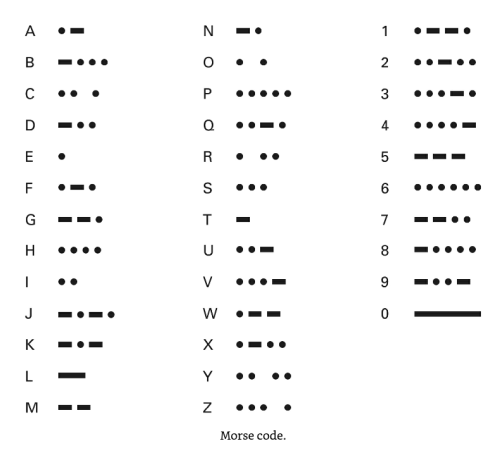
Erroneous Morse Code

13 December 2022

Origins of Russia's Old Believers

From A Journey into Russia, by Jens Mühling (Armchair Traveller series; Haus, 2015), Kindle Loc. 176ff.

In the not exactly bloodless history of Russia, the 17th century was one of the bloodiest. A bizarre religious controversy divided the country: people argued over the question of whether to make the sign of the cross with two fingers or with three. The Moscow Patriarch, who advocated for the three-finger cross, persecuted the followers of the two-finger cross viciously; he had unruly believers’ hands chopped off, and their priests’ tongues ripped out. Many rendered the mutilations unnecessary by simply chopping off their own thumbs in order not to have to blaspheme God with three fingers. Whole communities barricaded themselves in their churches, set their altars on fire and watched as the flames ate away at their hands, two fingers outstretched to the very end.

The conflict had been sparked by one man who exerted all of his dubious ambition to rectify the course of history. Around the middle of the century Patriarch Nikon, head of the Russian Orthodoxy, introduced a church reform. He invoked the origins of the Orthodox faith: the Russians had adopted Christianity from Byzantium in 988, when the Grand Duke of Kiev baptised his subjects according to the Greek rites. Over the centuries the inevitable happened: little by little, the Russian Orthodoxy developed its own, non-Greek traits, arising partly as a result of incorrect translations of Greek liturgical texts, but more often through the everyday practice of the faith. No Russians considered these characteristics to be a betrayal of their Orthodox roots. Patriarch Nikon alone was embarrassed when he received Greek dignitaries in the Kremlin, whose astonishment at the customs of the Russians did not escape him.

With his reforms, Nikon attempted to rectify the most obvious deviations of the Russian liturgy from the Greek. At first glance, they were trifles: the Trinity was no longer praised with two hallelujahs but with three; one letter was to be added to the name of the Lord, ‘Iisus’ instead of ‘Isus’; there should be not seven loaves but only one on the altar during the Eucharist; finally, the sign of the cross would no longer be made with two fingers but with three, the way the Greeks did it.

These interventions might have been accepted without complaint if at the same time much more drastic changes had not been overtaking Russia. The long isolated country was opening up to the West. Things appeared that had never been in Russia before; tobacco, tea and coffee; trimmed beards; sacred images with saints barely recognisable, so outlandishly were they depicted; foreigners, summoned by the Tsar to modernise the country, brought foreign manners to Russia, foreign languages and foreign gadgets. On the main tower of the Kremlin wall a huge mechanical clock from England appeared, the first in all of Russia. Its message was unmistakable: the times were changing.

All of these upheavals had one thing in common with Nikon’s reforms: they made Russia look bad. Many Russians did not want to admit that the traditions of their fathers should suddenly be worth less than the inventions of foreigners, be it English clocks, Dutch paintings, German books or Greek church rules. The Old Believers, as the opponents of reform were soon called, rejected Nikon’s heresies as vehemently as the ever-advancing West. Their two-fingered cross became a gesture of resistance against a Russia that was betraying its roots in every respect.

The times were changing. And perhaps, as the Old Believers in fact suspected, the world was actually approaching its prophesied end. There was evidence. As the religious controversy reached its bloody climax, people in Russia wrote the year as 7174 – their calendar started with the creation of the world. But in the West, where the years were numbered from the birth of Christ, a different number appeared on the calendar, a terrible one: 1666. There could be no doubt: the foreigners were messengers of the apocalypse.

While Russia drifted towards the west, the Old Believers fled towards the east. Persecuted by the Patriarch’s henchmen, they withdrew to the sparsely populated, peripheral regions of the Russian Empire. They founded communities where time stood still, where nothing diluted the spirit of old Russia, no tobacco and no coffee, no razor and no clockworks, not one hallelujah too many, not one altar loaf too few.

28 November 2022

Whither Europe Now?

From Adriatic: A Concert of Civilizations at the End of the Modern Age, by Robert D. Kaplan (Random House, 2022), Kindle pp. 283-284:

Once again, the ground is moving silently under our feet, as city- and region-states grow in importance and a neo-medievalism sets in. In the sixteenth and seventeenth centuries, as the British historian Mark Greengrass (echoing Denys Hay) explains, the concept of Christendom was gradually replaced by that of Europe. Though Christendom had in the course of Late Antiquity and the Middle Ages come to represent a geographical concept, it remained at root a religious identity, whereas Europe was at root all about geography. Europe’s subjugation of Christendom was complete when Christianity stopped being a political identity and became merely a private religion having to do exclusively with the soul. Given that Europe replaced Christendom, are we now in a transition period in which some concept will replace Europe? And if it does, where does identity finally settle—at the national level, at the regional level, the level of the city or town? Or will Europe revert to a religious identity, a neo-Christendom of some sort, to psychologically wall off Muslims from the Middle East? Or might Europe itself simply fade as a concept, as it dissolves into Afro-Eurasia and identities within the continent become, as I’ve speculated, increasingly local? Greengrass traces the destruction of the concept of Christendom over an arc of 131 years. So it is quite likely that the real substantive changes that are occurring now will not be apparent inside the strictures of any news cycle.

The late British-American historian Tony Judt provides a somewhat alternative view; or rather, a view focused on the immediate future rather than on the middle-term and distant one. As he explains, the integration process that culminated eventually in the European Union was in part an accident born of the realpolitik of politicians who each needed a predictable economic framework for their own national aims. To wit, France needed German coal, but at the same time needed to contain German political power; and Germany needed to hide its own national interests within a larger community in order to regain legitimacy in a post-Hitler era. The context for this realpolitik was a just-ended Second World War that was “peculiar,” in that countries were often divided among themselves and “almost every European participant lost.” Thus, everybody wanted to forget about what had just happened, so that defeatism, pacifism, and ahistoricism reigned. At the same time, the Cold War had enforced unity in the western half of the continent. It was defeatism and unity that gave birth to this new Europe. Yet, because the combination of these and other factors (e.g., the Marshall Plan) was specific to a certain moment in history, they could never be repeated in the same way, and so the European Union could not simply go on as it had indefinitely—for other factors must eventually intrude.

What is particularly impressive is that Judt published this analysis in 1996, when few troubles loomed on the horizon and Europe was dull and happy. He then goes on to expose Europe’s “foundation myth”: that it must keep expanding to the east in order to improve not only Europe but the world, or else the current success would merely indicate an amoral utilitarian arrangement. Of course, as we know, Europe’s eastward expansion following the end of the Cold War occurred under different historical circumstances and so the result has been complex and not altogether a triumph. Judt concludes his 1996 essay noting again, presciently, that with postmodern life hollowing out the communal functions of family, church, school, the military, and even political parties and trade unions, all that is left now is the nation. For it is the nation that embodies a common memory and a community within an “appropriately scaled frame”: larger than that of the city, but smaller than that of a nebulous pan-European or global identity.

27 November 2022

Greek Travails, 1949-2009

From Adriatic: A Concert of Civilizations at the End of the Modern Age, by Robert D. Kaplan (Random House, 2022), Kindle pp. 272-274:

The end of World War II brought not peace but a civil war lasting until 1949, between the Communists and the ultimately victorious right-wing loyalists, which resulted in 80,000 dead and 700,000 internal refugees. Because of the brutality on both sides, particularly against civilians, Greek politics would remain polarized for decades, divided between parties of the hard Left and the hard Right, so that a modern liberalism and a modern conservatism would find little room to emerge. Thus did Greece, abetted by its geography—as close to Moscow as to Brussels—become an ideological battleground of the Cold War.

Greece’s Cold War years were marked by weak governments as well as deep, internecine political divisions, which were further aggravated by the independence struggle on Cyprus, with its consequent calls for Enosis (or union) of the island with Greece. (Of course, this itself was an echo of the Great Idea.) In 1967, junior officers staged a coup, toppling the Greek government in Athens. This led to a particularly brutal seven-year military dictatorship in which the Athens “Regime of the Colonels” bore greater similarities to those of the Third World than to any government in Western Europe. The Colonels’ regime dissolved in 1974 after their failed political intervention in Cyprus led to a Turkish invasion and occupation of the northern part of the island.

It was only with the reestablishment of democracy in July 1974 under the conservative politician Constantine Karamanlis (who had returned to Greece from exile in France) that Greek politics began slowly—for the first time in history—to stabilize and achieve a modern, Western character. Greece, the birthplace of the West, finally reentered the West. This process was helped by the country’s admission to the European Economic Community (later the EU) in 1981.

Like membership in NATO, membership in the EU and Greece’s subsequent admission to the Eurozone represented purely political decisions on the part of the Western alliance. In fact, neither Greece’s bureaucratic institutions nor its economy was ever up to the standards of core-Europe and the West. Yet, it was felt (if never publicly admitted) that leaving Greece outside European institutions, given the country’s vulnerable geographical position and its long history of instability, would pose a greater threat to the West than bringing Greece inside them. As it turned out, the Greek variant of the Great Depression, in which the country was brought to its knees beginning in 2009 by widespread poverty, a dramatically declining GDP, and mass unemployment—leading to a far-left-wing government initially close to Moscow—was directly related to the country’s abject lack of preparedness for the rigors of the Eurozone. The Byzantine and Ottoman legacies of underdevelopment, while not determinative and always able to be overcome, still counted for something in Greece in the second decade of the twenty-first century.

23 November 2022

"Who Is Djilas?"

From Adriatic: A Concert of Civilizations at the End of the Modern Age, by Robert D. Kaplan (Random House, 2022), Kindle pp. 168-169:

As we are discussing books, I bring up the name of Milovan Djilas, the great World War II partisan fighter who was once Tito’s heir apparent, and later the original East European dissident, a man who wrote such classics of World War II and Cold War literature as Wartime, Conversations with Stalin, and The New Class. I interviewed Djilas every year in the 1980s in his Belgrade apartment behind the Parliament building. Through a clinical interpretation of history Djilas saw the vague outlines of the future, and specifically foresaw the war of the 1990s.

“Who is Djilas?” the students at the table exclaim, practically in unison. Though all are former Yugoslavs, these students and teachers have simply never heard of him. It turns out that the combination of censorship lasting into the 1990s, when they were young and in school—Djilas, after all, was a longtime dissident after he broke with Tito—and the constricting, often abstract, and theoretical reading lists of their university and graduate courses left no room for this great chronicler of an entire era in the second half of the twentieth century: an era that gave birth to the 1990s’ wars of the Yugoslav succession. Books and manuscripts vastly proliferate nowadays, even as less is really read, and so much of what is vital does not get passed down from generation to generation.

There is an air of depression and consternation at the restaurant table. And it isn’t just about the state of academia. Europe and especially the Balkans do not look hopeful. I am now told about how, among other things, Montenegro has become a colony of the Russian mafia and Albania the colony of the southern Italian mafia, accounting for the eruption of designer restaurants, bars, expensive hotels, and jewelry stores in Podgorica and Tirana. And there is, by now, the familiar litany about the poor and nasty ethnic climate in Bosnia, Serbia, Kosovo, and Macedonia. In this part of Europe at least, it seems that NATO is only a superficial layer of reality, and the European Union is simply out of gas and credibility.

19 November 2022

Trieste at the Edge of Empires

From Adriatic: A Concert of Civilizations at the End of the Modern Age, by Robert D. Kaplan (Random House, 2022), Kindle pp. 103-106:

Trieste signals a fault zone. It is a city that has hosted Romans from the West, Byzantines from the East, Goths, Venetians, Napoleon’s empire, the sprawling and multiethnic Habsburg Empire, Italy, Nazi Germany, Yugoslavia, and Italy again since 1954. That last handover took years of diplomatic wrangling, as if to confirm that Trieste’s very location—on a spit of territory that could have been placed in either Italy or Yugoslavia—constitutes proof of Trieste’s unstable position on the map. The mid-twentieth-century American journalist John Gunther noted that between 1913 and 1948, Trieste lived under no fewer than five different occupations. The race between Allied and Communist Yugoslav forces for control of Trieste in May 1945 was arguably the first major confrontation of the Cold War, perhaps providing a “reference point” for President Truman in the later crises of the Berlin blockade and the Korean War.

Trieste marks the borderline not only between the Latin world and the Slavic one, but also between the Latin world and the German one. Indeed, this city of Italians, Germans, Austrians, Slovenes, Croats, Serbs, Greeks, Armenians, Jews, and so on registers Mitteleuropa, with its own unparalleled cosmopolitanism, broadening out into an international civilization. Though, if this neoclassical, utilitarian, and commercial city has one cultural identity or spirit above others, it might be that of the Austrian Habsburgs, who ruled here between 1392 and 1918, except for a short Napoleonic interlude.

Trieste does indeed put empire on your mind. I visit the castle of Miramare, just north of the city, built with round porthole-like windows by Maximilian, the younger brother of Franz Joseph, who believed that the Habsburgs had no choice but to control the Adriatic. It is a monument to imperial delusion.... Maximilian, who believed deeply in liberal reform as a means of preserving and sustaining empire, was fated (of all things!) to go to far-off Mexico in 1864 as its new emperor—encouraged by his wife—only to be executed by indigenous revolutionaries three years later, completing his dark and tragic imperial fantasy.

Trieste reminded historian and travel writer Jan Morris “poignantly of the passing of all empires, those seductive illusions of permanence, those monuments of hubris which have sometimes been all evil, but have sometimes had much good to them.” Because empires, by definition, are often multinational and multiethnic, it is when empires collapse that “racial zealotry,” in Morris’s words, can rear its head. When the Italians seized Trieste from the Habsburgs in 1919, they closed Slovene schools in the city and tolerated violence against the Slavs. When the Yugoslavs arrived in the city in 1945, they reopened the Slovene schools and forced many Italians to change their names. In 1946, when Morris first saw Trieste, the writer “pined” for a cohesive and “distilled” Europe, and imagined this city as “the ghost of that ideal.” But the “false passion of the nation-state,” Morris continues, “made my conceptual Europe no more than a chimera.” History isn’t over, though. And as Morris says in old age, “One day the very idea of nationality will seem as impossibly primitive as dynastic warfare or the divine right of kings…a hobby for antiquarians or re-enactment societies.”

In the present day, the port of Trieste will soon sign an agreement with Duisburg, the world’s largest inland port, located at the confluence of the Rhine and Ruhr Rivers in western Germany, with the aim of increasing traffic on the new Silk Road that China is organizing. Trieste will acquire through Duisburg access to the northern—land—part of the Silk Road that terminates at the Pacific; while Duisburg will acquire by way of Trieste access to the southern, maritime Silk Road that runs through the Suez Canal and the Indian Ocean. A postmodern, multinational imperial system may re-emerge, this time supervised by the Chinese, and encompassing Trieste. A few months hence, I will get a message from a friend about “Chinese, Russian, American, and Mitteleuropean investors competing for bases in the port here—the second great opportunity after Maria Theresa,” during whose reign the city became a vibrant, multiethnic hub. Yes, Trieste always did prosper under a big project—this time maybe with the Chinese, who will make Trieste another imperial reference point.

14 November 2022

Operation Magic Carpet, 1945-46

From When the Shooting Stopped: August 1945, by Barrett Tillman (Osprey, 2022), Kindle pp. 261-262:

With broad vision, two years before VJ Day, Army Chief of Staff George C. Marshall anticipated the need to return millions of servicemen to their homes. He raised the subject as early as 1943, and after D-Day in June 1944 some planners thought that VE Day might dawn by year’s end. But whenever the timeframe, some essential factors forced themselves upon joint staffs.

First was the need for large-capacity staging areas and processing facilities, not only in Europe but in the much broader expanse of the Pacific. Internal concerns within the U.S. included receiving ports and railroads capable of absorbing huge numbers of personnel and delivering them to “separation centers” in every state.

Paramount was shipping, as the vast majority of returnees had to travel by sea. The U.S. Navy was only marginally available at the time, with millions of tons of vessels committed to the two-phase invasion of Japan in November 1945 and March 1946. Therefore, heavy reliance was placed upon Army and Merchant Marine ships with some augmentation by Coast Guard vessels.

Tasked with finding enough hulls to meet the demand, the War Shipping Administration (WSA) came through. Shortly after VE Day it identified nearly 550 vessels capable of carrying useful numbers of personnel.

In the actual event, absent Operation Downfall, the Navy suddenly afforded a huge bonus for Operation Magic Carpet. Ten aircraft carriers, six battleships, and 26 cruisers were hastily modified to accept cheek-by-jowl accommodations for troops who willingly endured long days and nights at sea, returning to “Uncle Sugar.”

Within two months of Emperor Hirohito’s surrender announcement, more than 700 ships of all types were available, notably Liberty and Victory cargo ships. Foreign vessels obtained for the project included origins as diverse as Panama and Italy.

The record for returning troops home belonged to the veteran aircraft carrier Saratoga (CV-3), which embarked some 29,000 grateful veterans, as fleet carriers were among the fastest ships afloat. But for maximum capacity, living space was likened to cramming 12 pounds into a ten-pound bag. The new carrier Lake Champlain (CV-39), only commissioned in June, was altered to accept 3,300 bunks. On her first Magic Carpet mission she set a transatlantic record of 32 knots, only surpassed by the liner United States in 1952.

The millions of personnel returned from war zones were not limited to American servicemen. The Army and WSA allocated 29 troop ships to transport nearly 500,000 European war brides. On the other side of the globe, it was estimated that 12,000 Australian women married American servicemen as well.

Magic Carpet was an immense success. At the time of VE Day in May 1945 more than 3 million soldiers were stationed in Europe alone. By year’s end, seven months later, the Army counted fewer than 700,000 troops.

The Navy also experienced a huge reduction: from 3.3 million personnel in 1945 to fewer than 500,000 at the end of 1946.

Overall, Magic Carpet spanned the year following the climax in Tokyo Bay. On average, between September 1945 and September 1946 the operation landed 22,000 men and women at a U.S. port every day for 13 months. As noted by the National WWII Museum, “The sum total of which provides the mathematical framework behind the staggering post-war baby boom nine months later.”

05 November 2022

Planning the Invasion of Japan, 1943-45

From When the Shooting Stopped: August 1945, by Barrett Tillman (Osprey, 2022), Kindle pp. 57-58:

While naval air combat carried on unabated, groundwork continued for the ultimate objective, an invasion of Japan. The overall Allied invasion plan, aptly titled Downfall, originally had been discussed at the 1943 Casablanca Conference, calling for a two-phase assault: Operation Olympic against the southern island of Kyushu in November, and Operation Coronet on the main island of Honshu the following March. Both would be enormous undertakings: Olympic involved about 350,000 men in combat units plus a further 125,000 support personnel; Coronet more than half a million. In comparison, the initial D-Day landings in Normandy committed approximately 150,000 Allied troops.

Building the force to invade Japan required a gargantuan combination of planning, coordination, and logistics. Previously, Admiral Ernest King, chief of naval operations, had reportedly quipped, “I don’t know what the hell this ‘logistics’ is that General Marshall is always talking about, but I want some of it.” In fact, the Navy was the essential factor in transferring troops from Europe and the United States. Nearly everything without wings had to go by sea, and so did many aircraft.

By August 1945 at least four armored divisions were based in the continental United States, with two or more infantry divisions preparing to deploy west.

The Army also intended to redeploy more than 395,000 men directly from Europe, all between September and December. They included units dedicated to Olympic or Coronet, representing Army Ground Forces, Air Forces, and Service Forces.

At the same time planning proceeded for 477,000 soldiers and airmen to round out the Coronet order of battle, moving from Europe through “ConUS” to the Pacific between September 1945 and April 1946. That amounted to a total of nearly 875,000 personnel moving halfway around the world in eight months. And that did not count Army, Navy, and Marine Corps personnel already in the Pacific. Nor did the redeployment figures include Doolittle’s Eighth Air Force units transitioning to B-29s with 102,000 aircrew and maintainers, either from Europe or originating in the States. The transport burden was further increased by 75,000 European Theater hospital patients beginning in late 1944.

Despite the clear logistical nightmare of such an undertaking, there was one clear advantage to the Allies. Throughout the war they had consistently outperformed the Axis in the crucial realm of supply, which was far more than simply building “stuff.” King’s quip concealed the Anglo-American mastery of the logistical trilogy: planning, production, and distribution. British historian Richard Overy properly noted that the American “tooth to tail” ratio of warfighters to rear-echelon and support personnel ran 18 to one; Japan operated at a support to combat ratio of a mere one to one.

26 July 2022

Overfishing Problems Worldwide

From Cod, by Mark Kurlansky (Penguin, 1998), pp. 198-200:

Overfishing is a growing global problem. About 60 percent of the fish types tracked by the Food and Agriculture Organization of the United Nations (FAO) are categorized as fully exploited, overexploited, or depleted. The U.S. Atlantic coast has witnessed a dramatic decline in the bluefin tuna population, though Gloucester fishermen refute this on the grounds that they still have good catches. Mid-Atlantic swordfish stocks are diminishing. Conch and redfish are vanishing from the Caribbean. Red snapper, which is a by-catch of shrimp, is in danger of commercial extinction in the Gulf of Mexico. Peru is losing its anchovy population. Pollock is vanishing from Russia’s Sea of Okhotsk. With 90 percent of the world’s fishing grounds now closed off by 200-mile exclusion zones, fishermen have been searching greater depths for new species. Little is known about the ecology of these depths, but since they often have very cold water, reproduction is probably very slow. Orange roughy was introduced to the world markets after implementation of the 200-mile zone and immediately gained such popularity that five tons an hour were being hauled up from the depths near New Zealand. In 1995, the catch nearly vanished.

The collapse of the Soviet Union destabilized many fishing agreements. Russia has become a major cod fisher, and cod has become almost the equivalent of cash in the Russian Barents Sea fishery. The reason the Canadians have been buying Russian cod processed in Norway is that Russia has been flooding the Norwegian market.

With the Atlantic long overworked by Europeans, the action has been switching to the Pacific, where not only are there large Japanese, Russian, American, and Korean fleets, but the Chinese, who do not have a history of international cooperation, have been notably enlarging their fishing capacity.

Replacing the Atlantic with Pacific fisheries is an old idea. Pacific cod was one of the reasons the United States bought Alaska from the Russians in 1867. But since the major markets were far away along the Atlantic, the Pacific cod did not have the same success as the Atlantic cod. Nevertheless, in 1890, a half million Pacific cod were landed. An 1897 book by an American scholar, James Davie Butler, suggested that with the alternative of a Pacific cod fishery, the only remaining bone of contention between the United States and Canada, cod fisheries, would be less important, and the way would now be cleared for “eventual union with Canada.”

But the Pacific cod is a different fish, its flesh less prized. It does not migrate, and it does not appear to live more than twelve years. More important, the catch has never measured up to that of its Atlantic cousin. Instead, walleye pollock has become the prize of the northern Pacific, “the cod of our times,” as a Gorton’s employee put it, and that fish is becoming so overfished that not only its stocks but its predators, sea lions and several species of seabirds, have dramatically declined since the mid-1970s.

01 March 2022

San Martin's Plans for Peru, 1822

From Bolivar: American Liberator, by Marie Arana (Simon & Schuster, 2013), Kindle pp. 299-300:

When they finally spoke about the political system San Martín had in mind for Peru, Bolívar’s suspicions were confirmed. The Protector laid out his plan for establishing a monarchy with a European prince in rule. Bolívar had heard rumors about this, but hoped they weren’t true. A year before, he had sent one of his aides, Diego Ibarra, to Lima, with a letter of congratulations for San Martín and instructions for Ibarra to learn what he could. Was San Martín considering a monarchical plan and, if so, how deeply was he committed to it? “Sound out the general’s spirit,” he ordered Ibarra, “and persuade him, if you can, against any project of erecting a throne in Peru, which would be nothing short of scandalous.” Now he was hearing about a Peruvian king from the Protector himself. San Martín explained to Bolívar that he had spoken about his plan to both viceroys; that he had sent a delegation of diplomats to England months before to discuss just such a throne and which prince or duke might fill it. If England weren’t willing, his delegates would look for qualified candidates in Belgium, France, Russia, Holland, or—even—Spain. It was the reason he had stalled in forming a Peruvian congress or drawing up a Peruvian constitution. As far as San Martín was concerned, the nation was not ready for democracy—education was in a shambles; ignorance abounded; the pillars upon which democracy could depend did not exist. Bolívar might have agreed on this last point, but he was viscerally opposed to royalty, to kings and queens, to that old, musty European system that had required so much American blood to purge. He would not hear of it. Bolívar left the meeting as somber and impenetrable as a sphinx. San Martín left it deeply mortified.

There had been no question that at every point of discussion, San Martín had been the supplicant, Bolívar the khan. The Liberator had everything the Protector needed: a winning army, the acclaim of his people, the luster of success, the recognition of a major world power. But Bolívar had given nothing; instead he had walked away deeply apprehensive of San Martín’s motives.

25 February 2022

A Year Without Summer, 1816

From Bolivar: American Liberator, by Marie Arana (Simon & Schuster, 2013), Kindle pp. 181-182:

Eighteen sixteen was the year without a summer. As Lord Byron put it, the bright sun had vanished and stars wandered “darkling in the eternal space.” The colossal eruption of Mount Tambora in Indonesia on April 10, 1815—the largest volcanic event in recorded history—had traveled the globe to spew a fine ash over Europe and the Americas. A year later, the earth’s atmosphere was so saturated with sulfur that brilliant sunsets inflamed the English skies, torrential rains washed away European crops, and a persistent gloom hung over North America. At the time, few imagined that a single geologic event in a remote location could affect the entire globe, and yet there was so much evidence of a freak imbalance: stinging frosts carpeted Pennsylvania in the middle of summer, killing the livestock; in Germany, harvests failed, causing a crippling famine; a typhus epidemic swept through the Mediterranean. There were surprising ramifications. Food riots gripped England and Ireland; Luddites torched textile factories with renewed frenzy. In a dark castle in rain-pelted Switzerland, Mary Shelley wrote the novel Frankenstein. In northern Europe, J. M. W. Turner was so stunned by the fiery skies that he recorded them in magnificent canvases for years to come. In France, rampant disease prompted a new age of medical discovery. And in the Caribbean, where Bolívar prepared to relaunch his revolution, a perfect calm preceded the hurricane season, which arrived a month sooner than usual, tossing the sea with singular fury.

Eighteen sixteen also became the revolution’s cruelest year. There were wholesale beheadings, hangings, firing squads—all in the name of “pacification.” General Morillo had installed draconian laws to rid Venezuela—Spain’s most defiant colony—of revolutionaries once and for all. The royalists arrested suspects in rural backwaters and relocated them to heavily defended towns, where they could be overseen. Anyone found wandering the countryside was a candidate for the gallows. Morillo’s men burned crops, purged the forests of fruit trees, killed farm animals, impounded horses, and executed any blacksmith capable of forging a lance’s head or any other weapon. Royalist commanders exacted taxes and punitive fines, making themselves rich and powerful in the process. Patriots, on the other hand, were stripped of whatever property they had.

18 December 2021

First Foreign Enclave in Tokyo, 1869

From Emperor of Japan: Meiji and His World, 1852–1912, by Donald Keene (Columbia U. Press, 2005), Kindle pp. 164-165:

During Meiji’s stay in Tōkyō, negotiations were opened with the foreign diplomats living in Yokohama on a number of matters: the end of their policy of neutrality in the conflict between the government and the rebels; the destruction of the rebels in Hakodate; the disposition of the Japanese Christians; and the issuance of paper money. The negotiations did not go smoothly. The foreign representatives, headed by the redoubtable Sir Harry Parkes, refused to consider any request that seemed to threaten the sacred right to trade—in Hakodate and anywhere else.

On January 2 a foreign trade center was opened in Tōkyō at Tsukiji, which was also made available to foreigners for residence. Samurai were forbidden to enter the settlement without written permission. This restriction on the passage of samurai into the concessions was probably intended to allay the foreigners’ fear of sworded samurai, but it had the effect of lowering their prestige. Before long, the samurai were given the task of protecting foreign ships, something none of them could have foreseen. Ōnuma Chinzan wrote a poem on their plight:

A little Yang-chou—that’s the new Shimabara;
Our browbeaten Japanese warriors guard the barbarian ships.
“Please don’t come here wearing your swords—
Please come instead with a hundred thousand coins.”

In the winter of 1868, at the same time that daimyo mansions in Tsukiji were demolished to provide living space for the foreigners, a new licensed quarter, named after the old Shimabara in Kyōto, was opened nearby. The last two lines of the poem indicate that for the prostitutes of the new Shimabara, money counted more than a customer’s rank. This surely was no less humiliating for the samurai than the duty of protecting foreigners, despite their jōi [Expel the Barbarians] convictions of a few years earlier.

On January 5 and 6 the emperor received the ministers from foreign countries, evidence of his hope for increased and better relations between Japan and the rest of the world. In Western diplomatic practice, there was nothing remarkable about the emperor’s receiving foreign diplomats and providing refreshments for them, but it was unprecedented in Japan. It is all the more astonishing when one recalls that Kōmei, who considered that the presence of foreigners on the sacred soil of Japan was an unspeakable offense to the gods, had died less than two years earlier. The young emperor was willing not only to meet foreigners but was affable to them.