The coup in Lisbon in April 1974 changed the fortunes of Rhodesia irrevocably. The end of Portuguese rule in Mozambique not only deprived Rhodesia of a long-standing ally and brought to power there a left-wing nationalist movement; it meant that Rhodesia's entire eastern border, some 760 miles long, was potentially vulnerable to infiltration by Zanu guerrillas operating freely from bases in Mozambique. Moreover, Frelimo's accession to power in Mozambique emboldened Rhodesian nationalists to believe that in Rhodesia too guerrilla warfare would succeed in overthrowing white rule.Black Star Journal has an update on the latest reactions of African leaders to what Mugabe hath wrought.
The South Africans were quick to recognise, in the aftermath of the Lisbon coup, that an entirely new strategy was needed. Hitherto, they had looked on Angola, Mozambique and Rhodesia as a valuable buffer separating them from contact with black Africa, a cordon sanitaire which it was in their own interests to strengthen. But with the withdrawal of the Portuguese from Angola and Mozambique, Rhodesia was no longer important as a front-line defence, for the winds of change had finally reached South Africa's own frontier. The South African prime minister, John Vorster, calculated that in the long run Smith's position, without an open-ended South African military and financial commitment, was untenable. White rule in Rhodesia was ultimately doomed. In this new assessment, Smith, with his long history of intransigence, was no longer a useful partner but a potential liability. His stubborn resistance to change only served to magnify the dangers of communist involvement in southern Africa. An unstable white government in Rhodesia was less preferable than a stable black government, heavily dependent on South African goodwill.
With this objective in mind, Vorster set out to force Smith to come to terms with the Rhodesian nationalists. He was obliged to act circumspectly for fear of antagonising his own electorate and provoking an outcry in Rhodesia. Fortuitously, he found an ally in Zambia's President Kaunda, who had become increasingly concerned about the disruption caused in Zambia by the Rhodesian imbroglio and about the dangers of a widening guerrilla war there. In conjunction with other African leaders, Vorster and Kaunda conspired to impose on Smith and the nationalists their own plan for a Rhodesian settlement. As a preliminary step, Smith was required, much against his better judgement, to release nationalist detainees, including Joshua Nkomo and Robert Mugabe....
Under pressure from South Africa, Smith went through the motions of attempting a negotiated settlement but, like Mugabe, saw no need to compromise. A conference in August 1975, held under the auspices of Vorster and Kaunda in railway carriages parked on the Victoria Falls bridge on the border between Rhodesia and Zambia, broke up in disarray after the first day....
In early 1976 the guerrilla war entered anew and more perilous phase. From bases in Mozambique, hundreds of Zanu guerrillas infiltrated into eastern Rhodesia, attacking white homesteads, robbing stores, planting landmines and subverting the local population. When Nkomo's talks with Smith broke down, Zapu guerrillas joined the war, opening a new front in western Rhodesia, along the borders with Zambia and Botswana. Main roads and railways came under attack. White farmers bore the brunt, living daily with the risks of ambush, barricaded at night in fortified homes. A growing number of whites, rather than face military service, emigrated.
Though Rhodesia's army commanders still expressed confidence in their ability to defeat the guerrilla menace, in many parts of the world it seemed that Smith was embarked upon an increasingly risky venture to sustain white rule which endangered the stability of the whole region. Among those whose attention was drawn to the Rhodesian war was Henry Kissinger. In the wake of the Angolan debacle, Kissinger was particularly alert to the dangers of how nationalist guerrilla wars could widen the circle of conflict, drawing in neighbouring countries and providing the Soviet bloc with opportunities for intervention. He found Vorster similarly worried and impatient with Smith's intransigence. In tandem, they agreed on a plan to force Smith to accept majority rule. To make Smith amenable to the idea, Vorster cut back oil shipments and supplies of arms and ammunition, withdrew helicopter pilots and technicians from Rhodesia and delayed its import and export traffic through South Africa. Kissinger was left to present the terms of surrender.
At a meeting in Pretoria in September 1976, Kissinger handed Smith a typed list of five points that he said must be used as the basis for a Rhodesian settlement. Smith took the document and slowly read aloud the first point: 'Rhodesia agrees to black majority rule within two years.' He looked around the room and said: 'you want me to sign my own suicide note.'...
When Smith finally left the stage as prime minister on the last day of white rule on 31 May 1979, his legacy was a state unrecognised by the international community, subjected to trade boycotts, ravaged by civil war that had cost at least 20,000 lives and facing a perilous future.
As the war intensified, Britain launched one last initiative to find a solution, calling for negotiations at a conference to be held in London. Muzorewa and Nkomo readily agreed to attend, but Mugabe saw no need. His guerrilla army was planning to embark on a new phase of urban warfare. 'We felt we needed yet another thrust, and in the urban areas, in order to bring the fight home to where the whites had their citadels', he recalled. The longer the war lasted, the greater were the prospects for achieving his revolutionary objectives.
Only under extreme pressure from Zambia 's Kenneth Kaunda and Mozambique's Samora Machel did he eventually agree to attend. Both Zambia and Mozambique had suffered heavily as a result of Rhodesian raids on guerrilla bases and supply lines they harboured. Neither could afford to sustain the war any longer. Machel was blunt in his warnings: if Mugabe refused to go to London and explore negotiations, then Mozambique would withdraw its support....
Mugabe arrived in London in September 1979, a cold, austere figure who rarely smiled and seemed bent on achieving revolution, whatever the cost. While in exile he had repeatedly insisted on the need for a one-party Marxist state, threatened that Ian Smith and his 'criminal gang' would be tried and shot, and warned that white exploiters would not be allowed to keep an acre of land. His main hope was that the conference would break down.
Against all odds, however, the conference stumbled towards agreement. At the final hurdle, when Mugabe balked at accepting the ceasefire arrangements and made plans to fly to New York to denounce the whole proceedings at the United Nations, he was given a direct warning by an envoy from Machel that unless he signed the agreement, he could no longer count on using Mozambique as abase for operations; in other words, as far as Mozambique was concerned, the war was over. Mugabe was resentful about the outcome of the conference: 'As I signed the document, I was not a happy man at all. I felt we had been cheated to some extent, that we had agreed to a deal which would to some extent rob us of [the] victory we had hoped we would achieve in the field.'...
Returning to Rhodesia in January 1980, nearly five years after his escape into exile, Mugabe was given a hero's welcome by one of the largest crowds ever seen in Rhodesia. Banners portraying rockets, grenades, land mines and guns greeted him, and many youths wore T-shirts displaying the Kalashnikov rifle, the election symbol that Zanu wanted but the British had disallowed. But Mugabe himself was unexpectedly conciliatory. In Mozambique, shortly before Mugabe's return to Salisbury, Samora Machel, still struggling to overcome the massive disruption caused by the exodus of whites at independence in 1975, had intervened to warn Zanu against fighting the election on a revolutionary platform. 'Don't play make-believe Marxist games when you get home,' he said. 'You will face ruin if you force the whites into precipitate flight.' Consequently, Mugabe's manifesto was stripped of all reference to Marxism and revolution.
06 July 2008
Foreign Surgeons at the Birth of Zimbabwe, 1974-79
From The Fate of Africa: A History of Fifty Years of Independence, by Martin Meredith (PublicAffairs, 2005), pp. 321-326:


05 July 2008
Baciu's Memories of Brasov: Country Cousins
From Praful de pe Tobă: Memorii 1918-1946, by Stefan Baciu (Editura Mele, 1980), pp. 11-12 (my translation):
UNSOLICITED PLUG: I've bought a motley assortment of Romanian dictionaries in print, none of them either comprehensive enough or bilingual enough to handle this translation. Instead, whenever I translate from Romanian, I now keep open the best Romanian-English dictionary I've found in any medium. According to the publisher, it has over 30,000 words in Romanian, along with more than 35,000 translations of common and less common phrases. And it is indeed "extremely fast and easy to use."
UPDATE: Mulţumesc cititorului Mihai, who pointed me toward zemos 'juicy', related to zeama 'juice', a word I knew but didn't think of when I needed it.
From the earliest years of my childhood, we would spend part of our holidays, especially at Easter and in summer, together with Father in his native village, Nadeşul Săsesc [Saxon Nades] in Târnava Mică county, where lived Grandmother, an uncle who was a priest, married to my father’s sister, Auntie Elena, and several first and second cousins. We would leave from Braşov for Sighişoara on either the express or the limited express, and from there we would take a suitably dilapidated bus for about an hour, through potholes, dust, or mud, along the road between Sighişoara and Târgul Mureş. At the bus station, which was at the head of the village, would be waiting Uncle Rusu and a few cousins, who would accompany us on the road to the parsonage in the middle of the village, where they lived. We would walk, while the oxcart followed slowly behind with the suitcases and packages we had brought along, with an occasional “haw” or “gee,” which would give me great pleasure. It makes me nostalgic to think of the evenings we spent crammed around the table, chatting over a glass of Târnave wine or, when I was still small, listening to my elders. During the days, we would go for walks through the vineyards or to the neighboring villages, Ţigmandru and Pipea, collecting mushrooms on the road through the woods. In the evening we would roast them with pieces of bacon skewered on spits of hazel wood expertly carved by Uncle Ionel.NOTES: ‘Auntie’ renders Tuşa; ‘express’ renders accelerat and ‘limited express’, rapidul; ‘dilapidated’ renders hodorogit; ‘haw’ renders hăiş and ‘gee’, cea, which steer draft animals to the left or right, respectively; ‘mushrooms’ renders bureţi (also ‘sponges’); ‘cousins’ renders veri şi verişoare (Fr. cousins et cousines); ‘juicy’ renders zămoase (zămos), a word I couldn’t find in my dictionaries (but see zămoşiţă ‘hibiscus’, which has a sticky sap); ‘was just about to leave’ renders eram gata de drum (lit. ‘was road-ready’).
Every afternoon around five was a special moment, when the bus delivered the postal sack, which was carried to the Post Office, whose mistress was my cousin, Tiţa Dan. I would attend the undoing of the sack as a kind of ritual, snatching out of her hands envelopes addressed to me. Other cousins would usually attend this “cult”: Elvira and Sabina Dan, Ionel Moldovan, Lucia and Stela Rusu, with whom I would discuss the news in the letters and magazines we received. Sometimes I would go home with Ionel Moldovan and we would sit on a wooden bench under a leafy tree, breaking open large and juicy onions and drinking generously of wine brought by Auntie Aurelia, the mother of Ionel, a newly commissioned second lieutenant in the cavalry.
The last time I was in Nadeş was only for a single day, with Mira, in the spring of 1946, only a few months before leaving the country. Grandmother examined us with her weak eyes under the ever-present headscarf covering her forehead, then took me aside and said, “Bravo, Ştéfane (accented on the first e), fine wife you’ve taken. She’s a real lady!” At parting, she asked me if I had opened an office (she knew that I was licensed in law), and when I was just about to leave she put a question to me that I didn’t realize at the time showed prophetic vision, “What do you think, Ştéfane; will this democracy last a while? Because the kids roam the streets and shout that that’s democracy!”
UNSOLICITED PLUG: I've bought a motley assortment of Romanian dictionaries in print, none of them either comprehensive enough or bilingual enough to handle this translation. Instead, whenever I translate from Romanian, I now keep open the best Romanian-English dictionary I've found in any medium. According to the publisher, it has over 30,000 words in Romanian, along with more than 35,000 translations of common and less common phrases. And it is indeed "extremely fast and easy to use."
UPDATE: Mulţumesc cititorului Mihai, who pointed me toward zemos 'juicy', related to zeama 'juice', a word I knew but didn't think of when I needed it.
04 July 2008
Baciu's Memories of Brasov: Hobbies
From Praful de pe Tobă: Memorii 1918-1946, by Stefan Baciu (Editura Mele, 1980), p. 10 (my translation):
I don’t think that I would have been more than 6 or 7 when I began to use scissors to cut caricatures of politicians out of the newspapers, saving them in different shoeboxes. I recognized from “the lines” and signature the most important caricaturists of the era: Sell, Ross, Dragoş, Anestin, Dralex. Thus I learned, without yet being able to read very well, such figures as Trancu-Iaşi, Tancred Constantinescu, Jean Th. (Tehaş) Florescu, Mihail Oromolu, Marshal Averescu, Iuliu Maniu, Vaida Voievod, I. G. Duca, Nichifor Robu, Leonte Moldovanu, Ştefan Ciceo Pop, and all the Bratianu family, not to mention Argetoianu, Iorga, A. C. Cuza, and Octavian Goga. At about the same time, I “organized” a collection of automotive insignia that, with the aid of a pin on the back of little metal plaques, could be worn on the chest like a kind of brooch. I kept them in boxes lined with wadding and can still see before me the various insignia: NSU, Alfa Romeo, Hispano Suiza, BMW, Austro Daimler, Lancia, Ford, Chevrolet, Puch.NOTES: ‘Old Man’ renders Moş.
After that came an era of postage stamps, stuck in a Schaubeck album, but philately didn’t last long. One fine day I began to sell them to Old Man Gebauer, who owned a toy shop in front of the Council House, in a style that today reminds me of certain surrealist photographs. I sold him row upon row of my hard-won collection, and with the money I bought pamphlets and magazines at Staicu’s kiosk facing Military Circle on the Promenade. I would have been 10 or 11 when one day I asked, “Who is Stelian Popescu” and “the hundred millions of Romulus Boila.” A man who at just that moment was buying a pack of cigarettes looked me up and down, then said, “Well, now, my boy, is that what you’re reading about?” Yes, it was true, that is what I was reading, and I remember how avidly I bought articles signed X.X.X., which were said to have been written by Marshal Averescu himself.
Speaking of collections, I also remember my autograph collection, about which more will be said later, and my collection of political posters, probably an extension of ... the caricatures. I remember that one day Father found me, probably rather surprised, stringing up as if for exhibit large posters of the Iron Guards, and other little red ones with stickers on the back, of the Workers and Peasants Bloc, communists, which I had obtained from their respective leaders (the lawyer Trifan and the doctor Kahane), presenting myself as “the son of Prof. Dr. Ion Baciu.” I think both were amused, each in his own way, by the unexpected visit, but they both gave me “rich material” that I placed in respectable enough bundles classified by party: liberals, socialists, peasant parties, factions loyal to Lupu, Iunian, Cuza, Iorga, or even Ghelerter, because I had discovered at Dealul Zorilor [Dawn Hill] tavern, where they sold wines from liberal vineyards, the old “agitator” Iuliu Neagu Negulescu, who had become an innkeeper in Brasov.
02 July 2008
Red Cross Inspector Shibai, Nagasaki, 1944
From First into Nagasaki: The Censored Eyewitness Dispatches on Post-Atomic Japan and Its Prisoners of War, by George Weller (1907-2002), ed. by Anthony Weller (Three Rivers, 2006), pp. 63-67:
Underground in the mine you could always tell when the B-29s were making a visit overhead. The main power plant on the surface closed down, the weaker auxiliary pumps went into action, and the air grew gluey and hard to breathe. In a slightly different way you could tell, while underground, when the Red Cross man was making a visit. From every section gang the strongest American was told off and ordered to take the mine train to the surface. He had ceased being a miner; he was now an actor. He had a role in a play that the mine authorities were going to put on for the benefit of the audience of one: the Red Cross inspector.
Two or three days before the Red Cross man—usually a Swiss or Swede—actually arrived, secret rehearsals had already been begun by what might be called the leads: the Japanese authorities of the camp. But for the real fibre of the performance the Japanese counted on their unrehearsed extras, the Americans.
Show day comes. A one-shot performance can be as good as its scenery, rarely any better. What is this extraordinary change that has overtaken the filthy little clinic, where operations without anesthesia have often taken place? It is transformed. Not only ether and morphine, but other medicines have appeared, the very medicines that were unobtainable 24 hours ago.... And look at the notice board! What are those neatly typewritten sheets fluttering from its black surface, now suddenly innocent of punishment records? It is the Daily News Bulletin, no less. ("We do what we can, Mr. Inspector, to satisfy the extraordinary American curiosity about current events.")
And here comes the Red Cross visitor, walking like a prisoner himself in a phalanx of potbellied Japanese colonels and majors. Has he been underground? He has not. Will he get a view of the barracks? Well, a quick one, maybe. But first he is shown documents for three hours, till his eyes ache. Then the place for him to go is to the hospital. After all, a hospital is the great index of humanity. If the hospital in a prison camp is all right, everything else must be all right, too.
And everything in the little hospital is right, as superlatively right as the last canto of Scrooge's Christmas. Just the entrance alone is beautiful. On each side of the door, Red Cross boxes are piled tastefully in twin pyramids—medicines, food, a cornucopia of abundance. The military interpreter opens the door and the inspector enters. Order and cleanliness, a lovely sight. The faces of the men on their cots are turned toward him. Sick? If these men are the sick, confined to the hospital under medical treatment, then it is hardly necessary to see the healthy, now working down in the mine. For these men, as prison standards go, are not badly off at all. Their faces—though wearing a peculiar quizzical, stolid expression—are round and full. Their eyes are clear. A Japanese doctor would call them robust.
The visitor, stroking his moustache, turns to the Japanese nurse, one of several chubby little starched creatures who have been placed at even intervals the length of the ward, like markings on a clinical thermometer. "How are the prisoners doing?" he inquires through the interpreter. "Oh, very well, very very well," she says, with a shining nursely smile.
The inspector observes there are white sheets on the mattresses. Really not bad, altogether. Each man has a can of salmon or of pears at the same geometrical point near his bed. Not quite within reach, perhaps, but nearby.
Gently Captain Fukuhara suggests that perhaps the official party had better not delay too long in the hospital. Luncheon is already waiting. Would the inspector like to see what the prisoners are eating? The party passes rapidly through the kitchen to the mess hall, where the prisoners are lined up, waiting to be seen. Their faces still bear looks of unmistakable pleasure and anticipation, in which a sharp eye might detect strong traces of astonishment. There is no doubt that this is a happy camp. Look at the faces of the prisoners as they scan the miracle that lies waiting for them in their wooden mess gear: three camp rolls with a dab of margarine, bean soup with a bit of pork, a spoonful of Japanese red caviar, and a baked apple.
(It is the baked apple, though the visitor does not know this, which has really bewitched them. This baked apple is more than remarkable; it is historical. It is the only baked apple ever seen at Camp #17 in two years.)
The inspector has now seen the camp. But he must not go away without talking to one or two individual prisoners. So he is led to the Japanese headquarters, he is settled in the comfortable chair of the commandant, and several handpicked Americans are brought to him. The room is full of Japanese military and police; the only non-Japanese are the prisoner and the Red Cross man.
"We were selected for health, first," Sergeant Joe Lawson of Klamath Falls explains it. "Then, when they knew the inspector was at the railroad station, they double-timed us to a bath, clean clothes and a shave. We went in that room and only needed to look around at the familiar faces to know what we were up against. We'd had plenty of stickwork done on us already. We knew that to get plenty more, all we needed to do was open our mouths."
Now the last monosyllabic prisoner has walked out. The inspector rises. It is all over. Everybody is smiling. Nobody has said or heard anything disagreeable or discordant. Even the prisoners back in their quarters are happy in a way, for their fears that the visitor would ask penetrating questions and make it impossible for them to conceal the truth have been dispelled. The lie is still intact. How cheerful everyone is! Captain Fukuhara—on whose hands is the blood of five Americans beaten and starved to death in the aeso, the guardhouse—is geniality itself. He suggests a photograph to perpetuate the occasion. His lieutenants take up the proposal with an acclaim like bacchantes. A picture, a photograph of everybody! We must have it!
A table is decorated with cigarettes, cookies and fruit from the mess of the kempeitai, the military police. A Japanese Cecil Beaton runs around, all dithery excitement until he finds what he wants to put on the table with the edibles: a trumpet, a harmonica and a guitar. A suggestion is made that some of the irreproachable prisoners might be summoned back to get in the picture, but the picture is too crowded already, and the suggestion falls flat.... "All smile, prease!" (It is a little joke, for the fussy photographer to use the language of the prisoners, and all smile at it.) "Sank you! All finish!"
The military motorcar is waiting for the Red Cross man. Perhaps, in this last moment of shaking hands, he may be troubled by some inner doubts. But there is no time to sift them. He must hurry off, for he is to catch the train for Moji, connecting with the express for Tokyo. See you next year!
If he had seen the prisoners the next day, instead, the inspector would have learned more. If his officer escort would allow him to get off at the first station, turn around and go back to the camp, the inspector might see how the pageant of his welcome, as insubstantial as Prospero's, faded into nothingness as soon as he left.
What has happened in the camp? The pyramids of Red Cross packages are demolished. The boxes are in Captain Fukuhara' s closet, and the key is in his pocket. The cans of fish and pears have disappeared. Gone, too, are the white sheets from the hospital beds; where, nobody knows. The little nurses are climbing into their truck to be taken back to the local hospital in Omuta, swans never seen before in camp, unlikely to be seen again. The Daily News Bulletin is gone without a trace from the notice board, and a kempeitai is frowningly nailing back the punishment schedule. In the kitchen the Navy cook, Woodie Whitworth of Bourne, Texas, is preparing supper. The menu is the same as usual: one-half bowlful of plain rice, laced with millet to make it cheaper.
A column of prisoners dressed for work, with cap-lamps and sweat rags, is marching past the god of the mine (a giant, greenish-black statue of an idealized Mitsui miner, towering in the prison yard above the buildings). As their guards command them, they all bow to his exalted, unsmiling image. These miners are the extras of the benefit performance, who were patients in the hospital until a few minutes ago.
Having arrived at the entrance shaft they adjust their lamps for the last time, hug their mess-gear full of cold rice, climb into the roller coaster-like iron train and hold on. The cable starts moving. The train slides down the slanting chute into the sooty, echoing tunnel. For a while its roar is loud, but soon it dies away. After five minutes or so a bell rings. The cable slows, tightens, and finally stops. The patients from the hospital have reached their normal level of operation, 1,440 feet below ground. The sideshow is over. The Mitsui show is on once more.
30 June 2008
Barbarians at the Gate, Dinosaurs at the Dock
After watching a frustratingly clueless, "barbarians at the gate" NewHour segment on campaign smears (which apparently never existed before the Internet and were never spread by the old media) hosted by Gwen Ifill, who also hosts a conventional wisdom synchronization and self-congratulation session known as Washington Week (which I long ago gave up watching), I turned to NYU journalism professor Jay Rosen's PressThink for a more critical view of the old media and, by Jove, I found it in a post called Migration Point for the Press Tribe. Here's how it begins.
We are early in the rise of semi-pro journalism, but well into the decline of an older way of life within the tribe of professional journalists. I call them a tribe because they share a culture and a sense of destiny, and because they think they own the press—that it’s theirs somehow because they dominate the practice.
The First Amendment says to all Americans: you have a right to publish what you know, to say what you think. That right used to be abstractly held. Now it is concretely held because the power to publish has been distributed to the population at large. Projects that cause people to exercise their right to a free press strengthen the press, whether or not these projects strengthen the professional journalist’s “hold” on the press.
The professional news tribe is in the midst of a great survival drama. It has over the last few years begun to realize that it cannot live any more on the ground it settled so successfully as the industrial purveyors of one-to-many, consensus-is-ours news. The land that newsroom people have been living on—also called their business model—no long supports their best work. So they have come to a reluctant point of realization: that to continue on, to keep the professional press going, the news tribe will have to migrate across the digital divide and re-settle itself on terra nova, new ground. Or as we sometimes call it, a new platform.
Migration—which is easily sentimentalized by Americans—is a community trauma. Pulling up stakes and leaving a familiar place is hard. Within the news tribe some people don’t want to go. These are the newsroom curmudgeons, a reactionary group. Others are in denial still, or they are quietly drifting away from journalism. Many are being shed as the tribe contracts and its economy convulses. A few are admitting that it’s time to panic.
And like reluctant migrants everywhere, the people in the news tribe have to decide what to take with them, when to leave, where to land. They have to figure out what is essential to their way of life, and which parts were well adapted to the old world but may be unnecessary or a handicap in the new. They have to ask if what they know is portable. What life will be like across the digital sea is of course an unknown to the migrant. This creates an immediate crisis for the elders of the tribe, who have always known how to live.
Baciu's Memories of Brasov: "Four Eyes"
From Praful de pe Tobă: Memorii 1918-1946, by Stefan Baciu (Editura Mele, 1980), pp. 9-10 (my translation):
My first two years of primary school I did at the Saxon school, with Tante Dora Teutsch as my teacher, a kind and gentle soul. I remember that she was the one who observed, while checking my calligraphy in a double-lined notebook for gothic letters, that I had begun to write above and below the lines. That is why I was taken to Doctor Pildner von Steinburg, who diagnosed “juvenile cataracts” in both eyes. Because an operation would follow, we planned to seek consultation in Vienna, which in those days had well-known ophthalmologists, but just then there chanced to arrive in Brasov an ophthalmologist, a professor from Vienna who, being informed of my illness, agreed to see me. He was, I remember, a tall man with a goatee, dressed in black, who examined me at length in a room plunged into darkness in which burned a candle, after which he sat me down before various devices with colored lights. In his opinion, I could be operated on in Brasov, by Doctor Pildner von Steinburg. Thus it was that, at the age of 7 or 8, I was put through two operations and, as one of them failed to produce the results desired, my left eye was operated on once again, in the private sanatorium on Castle Street. Its garden was on the slope of Mt. Tâmpa, in that respect resembling the garden in my home in Honolulu, which I see before me as I write. I remember the devices for testing vision, with moving spots of light, the operating room, the chloroform anesthesia, after which I vomited, full of fear, even though Mother, Father, and the doctor were at the head of my bed. Afterwards I lay in bed, completely immobile, with bandaged eyes, for several days that seemed endless to me. The lights dazzled me once the bandages were removed, but the objects around me had precise contours, as if they were in relief.
I wore glasses with thick lenses, and later on my playmates and my classmates at the Andre Muresianu mixed primary school would shout after me, “four eyes,” “bicycle,” or patroski (‘four eyes’), which didn’t particularly hurt me but did separate me from them and, without my realizing it, drew me toward my world of books, of art albums, of various collections that I spent time on, dedicated body and soul to those early passions of my childhood.
29 June 2008
Ethiopia, 1978: One More Equal Than Others
From The Fate of Africa: A History of Fifty Years of Independence, by Martin Meredith (PublicAffairs, 2005), pp. 245-248:
In September 1976 the Ethiopian People's Revolutionary Party (EPRP), drawing support from the labour unions, teachers and students, all vehemently opposed to military rule, embarked on a campaign of urban terrorism against the Derg and its civilian ally, the All-Ethiopian Socialist Movement, usually known by its Amharic acronym, Meison. An assassination attempt was made on Mengistu in the centre of Addis Ababa in September, the first of nine such attempts. Scores of officials and supporters of the Derg were murdered. The Derg in turn sent out its own murder squads.... By mid-1977 the EPRP was effectively destroyed. In the final phase of the red terror, to establish his own supremacy, Mengistu turned on his Meison allies, destroying them too. The young generation of intellectual activists, who had so avidly supported the revolution were all but wiped out.You get the same result every single time a revolutionary thug promises equality—and begins to deliver it with the help of other revolutionary thugs. Every French Revolution yields a new Robespierre—and then a new Napoleon.
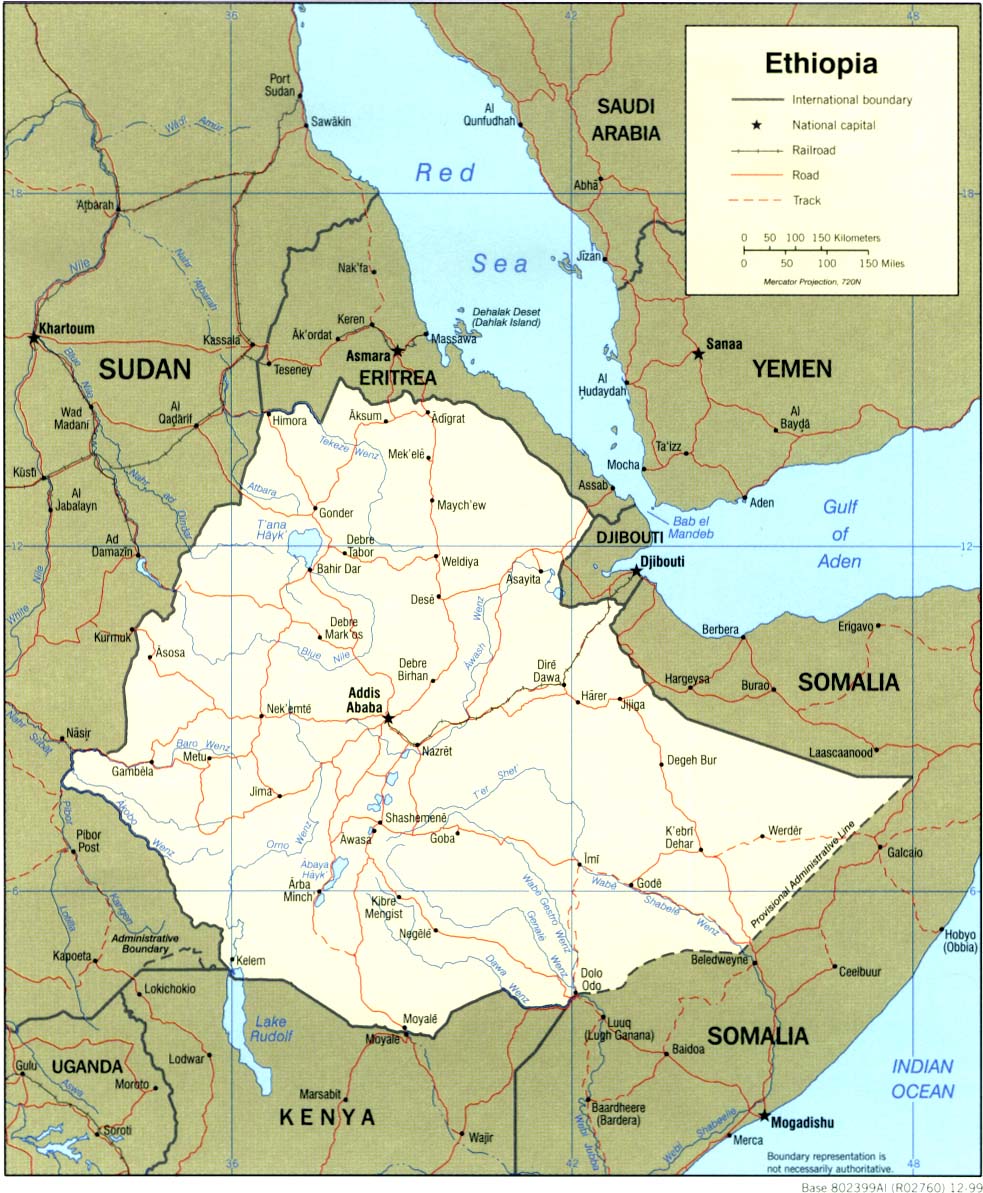
Mengistu's hold over other parts of Ethiopia was nevertheless precarious. By mid-1977 the Ethiopian army in Eritrea had lost most major towns and controlled little more than Asmara and the ports of Massawa and Assab. In July 1977 Somalia, deciding the time was ripe to take advantage of the Derg's preoccupation with Eritrea and other revolts, launched a full-scale invasion of the Ogaden. By August the Somalis controlled most of the Ogaden. In September they captured Jijiga, an Ethiopian tank base, and pressed on towards the town of Harar and the rail and industrial centre of Dire Dawa, the third largest city in Ethiopia.
What rescued Mengistu from military defeat was massive intervention by Soviet and Cuban forces, determined to prop up his Marxist regime. In November 1977 the Soviets mounted a huge airlift and sealift, ferrying tanks, fighter aircraft, artillery, armoured personnel carriers and hundreds of military advisers to Ethiopia. A Cuban combat force numbering 17,000 joined them. Led by Cuban armour, the Ethiopians launched their counter-offensive in the Ogaden in February 1978, inflicting a crushing defeat on the Somalis. The full force of the Ethiopian army, supported by the Soviet Union, was then turned on Eritrea.
At the fourth anniversary celebrations marking the overthrow of Haile Selassie in 1978, Mengistu sat alone in a gilded armchair covered with red velvet on a platform in Revolution Square in Addis Ababa watching a procession of army units and civilian groups pass before him. Then he returned to his headquarters at the Grand Palace. Having succeeded in holding the old empire together, he liked to portray himself as following a tradition of strong Ethiopian rulers. Indeed, Mengistu came to be compared with the Emperor Tewodros, a nineteenth-century ruler who started his career as a minor local chieftain, fought his way up to take the Crown and then strove to reunite the empire after a period of disintegration. At official functions at the Grand Palace, while members of the Derg stood respectfully to one side, Mengistu chose to preside from the same ornate chair that Haile Selassie had once favoured.
One of his ministers, Dawit Wolde Giorgis, once a fervent supporter of the revolution, recalled his growing sense of disillusionment.At the beginning of the Revolution all of us had utterly rejected anything having to do with the past. We would no longer drive cars, or wear suits; neckties were considered criminal. Anything that made you look well-off or bourgeois, anything that smacked of affluence or sophistication, was scorned as part of the old order. Then, around 1978, all that began to change. Gradually materialism became accepted, then required. Designer clothes from the best European tailors were the uniform of all senior government officials and members of the Military Council. We had the best of everything: the best homes, the best cars, the best whisky, champagne, food. It was a compete reversal of the ideals of the Revolution.He recalled, too, how Mengistu changed once he had gained complete control.He grew more abrasive and arrogant. The real Mengistu emerged: vengeful, cruel and authoritarian. His conduct was not limited by any moral considerations. He began to openly mock God and religion. There was a frightening aura about him. Many of us who used to talk to him with our hands in our pockets, as if he were one of us, found ourselves standing stiffly at attention, cautiously respectful in his presence. In addressing him we had always used the familiar form of 'you', ante; now we found ourselves switching to the more formal 'you', ersiwo. He moved into a bigger, more lavish office in the Palace of Menelik. He got new, highly trained bodyguards – men who watched you nervously, ready to shoot at any time. We now were frisked whenever we entered his office. He began to use the Emperor's cars and had new ones imported from abroad – bigger, fancier cars with special security provisions. Wherever he went he was escorted by these cars packed with guards, with more riding alongside on motorcycles.He concluded: 'We were supposed to have a revolution of equality; now he had become the new Emperor.'
27 June 2008
Baciu's Memories of Brasov: Languages, Holidays
From Praful de pe Tobă: Memorii 1918-1946, by Stefan Baciu (Editura Mele, 1980), pp. 8-9 (my translation):
I was sent to a Saxon kindergarten. It seems to me that it would have been on Castle Street, beneath Mt. Tâmpa, but I don’t remember the exact location, even though I can still see before me the dark stairway to the upper floor. Fraülein’s name would seem to have been Liewehr, and I see myself singing, leaping like a pony, hear melodies like “Wulle, wulle, Gänschen” and “Alle Vögel sind schon da,” and see myself sitting on a stool cutting stars out of cardboard for the Christmas tree, on each of which Fraülein had written in gothic letters “Ştefan” and which Mama used to hang from the tree year after year. At about the same time, I went once or twice a week to a nursery school where we learned French with the Grande Dame Staia, singing “Savez-vous planter le chou.”NOTES: ‘The Grande Dame’ renders doamna maior; ‘stovepipe hats’ renders ţilindru pe cap (usu. cilindru) ‘cylinder on the head’; ‘continents’ renders geografii ‘geographies’; ‘Father Christmas’ renders Mos Crăciun; ‘Epiphany’ renders Bobotează (cf. boteza ‘baptize’); Twelfth Night (= Epiphany) renders Iordanul (the Jordan [River]); archpriest = protopop. I hadn't realized that the Epiphany holidays came to focus on the baptism of Christ (in the Jordan River) among Eastern-rite Christians but on the coming of the Magi among Western-rite Christians. The Wikipedia entry for the holiday contains an interesting observation that may apply to Transylvanians in general: "Hungarians, perhaps because of their location between East and West, celebrate the coming of the Magi, but refer to the celebration as Vízkereszt or "water cross," clearly a reference to baptism."
My education was, from the beginning, trilingual: Romanian at home, German in my earliest schools, Hungarian with the maidservants, because the latter all came from Szekler villages. Hungarian, I haven’t heard since leaving Brasov in 1937, and I’ve almost totally forgotten it, except for the songs I used to hear in the kitchen or on the Promenade, where we used to go for walks, listening to the city orchestra composed of solemn gentlemen in black jackets and stovepipe hats.
Christmases were celebrated at our home, where all the family gathered, but from the morning of Christmas Eve we were sent to my Aunt Jenny, who lived far from us, sometimes on Fork Street (Cuza Voda), sometimes on Postal Orchard. My parents felt bound to resort to this strategy because it was hard for them to restrain me until the arrival of the “Angel.” In those years, Father Christmas didn’t exist in Transylvania, and Saint Nicholas used to come on the evening of the 6th of December.
Otherwise, these traditions were scrupulously respected at home. At Easter came the Bunny, with Father making the sound of speedy steps going into the distance, to show that the Bunny had run past our house, leaving behind red eggs and chocolates, mandarins, and oranges. On the 6th of December came Saint Nicholas, with a big sack on his back, with a fur hat over his eyes and a white beard, in whom I believed with a religious intensity until I discovered that he wore the same gaiters as Father, and which he had bought a few days earlier at Lischka.
Christmas was, of course, the ultimate celebration, with a tree that reached to the ceiling, mountains of presents (the maidservants would carry theirs off in woven clothes baskets), a huge meal, interrupted by carolers who came down from Şchei hillside, or up from Old Brasov, who ended off with the chorus “To Şaguna High School” before being invited to partake of wine and pound cake. Name days were not celebrated; instead, birthdays had a special importance, with a ritual I still follow today, across decades and continents. Speaking of religious celebrations, I cannot forget Epiphany, when on the Twelfth Night came the archpriest Iosif (Sâvu) Blaga or the priests Nae Stinghe and Furnica, who had baptized me, and was now professor of religion at the “Real School” (Liceul Dr. Ioan Meşota).
26 June 2008
Kenya, 1950s: The Mau Mau Civil War?
From The Fate of Africa: A History of Fifty Years of Independence, by Martin Meredith (PublicAffairs, 2005), pp. 84-86:
In postwar years the African population of Nairobi doubled in size. More than half of the inhabitants were Kikuyu, their ranks swelled by a growing tide of desperate, impoverished vagrants. Adding to their numbers were groups of ex-servicemen returning from the war with high expectations of a new life but finding little other than poverty and pass laws. Unemployment, poor housing, low wages, inflation and homelessness produced a groundswell of discontent and worsening crime. Mixing politics and crime, the 'Forty Group' – Anake wa 40 – consisting largely of former soldiers of the 1940 age group who had seen service during the war in India, Burma and Ethiopia and other militants were ready to employ strong-arm tactics in opposing the government's policies and in dealing with its supporters. The trade unions, gathering strength in Nairobi, carried the agitation further, conducting a virulent campaign against the granting of a royal charter to Nairobi. In the African press, too, the tone was becoming increasingly strident. By 1948, the oathing campaign, started by squatters in the Rift Valley and taken up in the Kikuyu reserves and in Nairobi, was in full swing. At fervent gatherings, Kikuyu songs, adapted from church hymns, were sung in praise of Kenyatta and prayers recited to glorify him. In all, several hundred thousand Kikuyu took the oath.
The rising temper of the Kikuyu made little impression on the British governor, Sir Philip Mitchell, a solitary, unapproachable figure from the old colonial school, contemptuous of African nationalists, more preoccupied with the recalcitrant white community than with signs of African discontent, and singularly ill-equipped to deal with the crisis unfolding before him.
Kenyatta, too, found difficulty in controlling the surge of militancy. He favoured constitutional means to oppose colonial rule but was outflanked by militant activists prepared to use violence. In 1951 a hardened group, including two prominent trade unionists, Fred Kubai and Bildad Kaggia, captured control of the Nairobi branch of the KAU [Kenya African Union], proceeded to gain a virtual stranglehold over the national executive and then formed their own secret central committee with plans for an armed uprising. Kaggia, a former staff sergeant in the army, had seen wartime service in Africa, the Middle East and England. Outbreaks of violence – murder, sabotage, arson and forced oathing – became more frequent.
The move towards violence split the Kikuyu people. Both the old Kikuyu establishment – chiefs, headmen and landowners – and the aspiring middle class – businessmen, traders, civil servants and government teachers – opposed violence. So did large numbers of Christian Kikuyu. But by 1952, much of the Kikuyu tribe was caught up in rebellion.
Kenyatta tried to ride out the turbulence, seeking to defuse the crisis rather than to stir it up. Leading activists in Nairobi, while using his name to justify their actions, regarded him with profound suspicion. When the government asked him to denounce Mau Mau publicly, he duly obliged, using a traditional Kikuyu curse. 'Let Mau Mau perish for ever,' he told a huge crowd in Kiambu in August 1952, 'All people should search for Mau Mau and kill it.' His speech infuriated the central committee. Summoned to a meeting of the central committee at KAU headquarters in Nairobi, he was clearly surprised to discover who its members were. 'We said, "We are Mau Mau and what you have said at this Kiambu meeting must not be said again",' recalled Fred Kubai. 'If Kenyatta had continued to denounce Mau Mau, we would have denounced him. He would have lost his life. It was too dangerous and he knew it. He was a bit shaken by the way we looked at him. He was not happy. We weren't the old men he was used to dealing with. We were young and we were serious.'
As the violence grew worse, with daily incidents.of murder, forced oathing and intimidation, a new governor, Sir Evelyn Baring, on the advice of his officials, concluded that the best way to deal with it was to lock up all KAU leaders. In October 1952, shortly after his arrival, Baring declared a state of emergency and ordered the detention of Kenyatta and 150 other political figures, a move taken by Mau Mau activists as tantamount to a declaration of war. In growing panic, white farmers in the Rift Valley expelled some 100,000 squatters, providing Mau Mau with a massive influx of recruits. Many headed straight for the forests of the Aberdares and Mount Kenya to join armed gangs recently established there. Far from snuffing out the rebellion, Baring's action intensified it. It was only after the emergency was declared that the first white settler was murdered.
The brunt of the war, however, fell not on the whites but on loyalist Kikuyu. They became the target of Mau Mau leaders determined to enforce complete unity among the Kikuyu people before turning on the whites. Nearly 2,000 loyalists died. The official death toll of rebels and their supporters was listed as 11,500, though modern researchers put the real figure far higher. Some 80,000 Kikuyu were detained in camps, often subjected to harsh and brutal treatment. As the tide against Mau Mau turned, gang leaders in the forests tried to keep control by employing ever more perverted oaths, horrifying to the Kikuyu and to whites alike. By comparison, the white community escaped lightly. Though white farmers in isolated farmsteads often lived in fear of attack, after four years only thirty-two white civilians had been killed, less than the number who died in traffic accidents in Nairobi during the same period.
25 June 2008
Baciu's Memories of Brasov: Earliest Friends
From Praful de pe Tobă: Memorii 1918-1946, by Stefan Baciu (Editura Mele, 1980), pp. 6-8 (my translation):
On the floor below lived Major Mihailescu, who had two children, Mircea and Coca (the daughter had an air I now recognize as Japanese), with whom I didn’t become friends. The major had an orderly he called Zachariah, with whom the maidservant who used to take me for walks had fallen in love, calling him "Zakarias" and singing a pitiful song that ended with the words “Zakarias szép eletem.” One day, the major had a conflict with Mr. Borescu, apparently having to do with the beating of carpets at unauthorized hours. When the insulted concierge leapt up to hit the major, the latter rushed into his house, from which he appeared in a martial pose, brandishing a saber in the air like a fencer, threatening the head of the typographer, who didn’t know how to respond to this unexpected invitation to a duel. I remember that during the 1940s, as a discharged general, Mihailescu was named inspector of the casino in Sinaia.NOTES: Baciu spelt cearşaf 'sheet' as cearceaf—it's just the difference between English sh and ch. A “Şagunist” is a student at Andrei Şaguna High School. After failing to find clipici in my dictionaries, I translated it 'slapdash' (after considering 'rush job'), despite its relation to a clipi 'to wink, blink' (and its Saxon equivalent, Zwinkelmisch). The hardest phrase to translate in this passage was de moţi tocmiţi cu ziua, which didn't make sense until I found that Moţi designates people from the Western Mountains (Munţii Apuseni) of Transylvania, sometimes known as Ţara Moţilor, known for their pre-Roman features, archaic customs, isolated settlements, and fierce independence—sort of the West Virginians of Transylvania. An explanatory translation like ‘men from Munţii Apuseni hired by the day’ was too long-winded, while 'hillbilly day-laborers' was too pejorative. I almost went with 'itinerant woodcutters’ before settling on 'backwoodsmen'.
In the back of the courtyard lived Doctor Valeriu Negrila, married to a beautiful Polish woman. I was friends with their daughter, Valerica, while I was little, but later, as often happens, we drifted apart and hardly even greeted each other when I became a “Şagunist” and she a student at the Princess (Elena). One day when I was returning from a walk with the maidservant, I saw two people dressed in white carrying a stretcher on which lay a body covered with a sheet, with locks of black hair hanging out from under it. The maidservant later told me that Valerica’s mother had been found to have “taken poison,” but after a few days I saw her passing through the courtyard with Valerica in tow. I don’t recall the other neighbors, but I cannot forget the entrance hallway in the evenings, with gilded metal bars glittering in the light of the bulbs, and marble veneer shining in a way that seemed fairylike.
Just outside the alleyway, on the right and left were two shops: Lischka, men’s clothing; and Books Cooperative Enea, Stinghe, and Ţigoiu, one of whose owners, Professor Sterie (Sterica) Stinghe, had written a few books about the history of Brasov, and whose wife, named Lucia I think, had the habit of strutting around haughty and elegant, the tapping of her high heels audible from far off.
I lived on Customs Street, I believe, until around 1928–29, when I finished primary school, thus eight or nine years, maybe ten. The fact is, I cannot recall exactly when we moved from Spitz Palace, just as I cannot remember exactly when we left Prundul Florilor.
But I have some vivid memories of the building, which during the early years did not yet have electric lights. I recall those autumn days when Mr. Stroescu, the father of my primary school classmate, Elena Stroescu, used to set up his machine in the Graft Valley, beyond the walls, and cut whole cartloads of wood, which after being chopped up was hauled into the cellar on a kind of wooden stretcher by backwoodsmen hired by the day, who at lunchtime would pull out of their knapsacks “pită şi slană” [bread and fatback, usu. slănină] eating slowly and silently.
I recall going with the maidservant to the first silent films I saw at the movie theatre Modern (a wooden shack sitting on the site they later made into the city park), where I enjoyed watching Lia Mara, Maciste, Zigoto, Fatty, Harry Piel, Pat and Patachon, with little Patachonel, and then returning at nightfall to find at the entrance to our apartment dozens of galoshes and overshoes belonging to the “students” at the night classes Father used to teach in the years after unification [of Transylvania and other territories with the Old Kingdom of Romania]: bank directors, officials, attorneys, merchants, who were keen to learn Romanian in those first years of Greater Romania. About that time, Zeidner Books had come out with a grammar of Romanian for foreigners, whose authors were Father and Michael Teutsch. It was a bit slapdash, of a type the Saxons called Zwinkelmisch [lit. ‘twinklemix’], but it sold well and was reprinted several times.
After the students left, Father used to amuse himself by telling stories about the mistakes his “students” would make. Carved in my memory are words like “Berger-leţkia” (lecţia) [lesson], or “tratavitele” in place of tratativele [‘negotiations’], which the Hungarians and Saxons had trouble pronouncing, as they did â as opposed to a. Other friends that I remember from the age of 4 or 5, besides Puiu Borescu and Valerica Negrila, were the sisters Takáts, Tony and Baba, somewhat older than me.
On the Promenade, where I went with the maidservant, I had “friends” who seemed at that time to be over a hundred years old, if not older: “Old Man Snow,” gone completely white, who talked with me as if I was his age, whom they used to call Cipu (Cipariu) or Ţipu, and who I believe was a judge on “penzie” [pensie ‘pension’]. One “friendship” that my parents did not regard well was that with the doctor of law, Aurel Olteanu, who wore a shiny clip on his tie, patent leather shoes with laces, and a long, sturdy cane, with whose handle he would hook my calf, while glaring at me with bulging eyes and shouting: “I’ve got you, you knave! I’ve got you, you bandit!” To me, the words were amusing, as I knew what bandit meant (Tomescu and Munteanu were famous bandits at the time), but I had no idea what knave [şnapan] meant and my parents showed themselves to be less than enchanted by this “enrichment” of vocabulary. The third “friend” was a little, or rather a short, elderly man, Patruţ Pop, wrapped summer and winter in a long overcoat, something between a blanket and a frock, wearing a black hat, who would stroke my head without saying a word. I vaguely remember having heard that Patruţ Pop was from the family of someone who had played a leading role on the Field of Liberty, at Blaj [in 1848]. As I grew and entered primary school, I lost track of those friends of my early childhood.
23 June 2008
POW Language Use, Nagasaki, 1944-45
My sociolinguistics professor in grad school once opined that the best place to learn a foreign language was in a foreign prison. I assume he was thinking of the advantages of a complete immersion environment, total physical response methodology, and very rigorous incentive structures.
He must have been at least half serious, because he later applied for a grant to fund an audacious experiment to see what innate linguistic structures might emerge in an isolated, silently administered camp whose workers were recruited in equal numbers from communities speaking languages of a full range of word-order typologies and in minimal prior contact with typologically different languages. I believe the granting agency's Committee on Human Experimentation nixed the proposal, for reasons one can well understand.
What makes me recall this is the abundance of fascinating bits of data about foreign language learning in prison that I've been finding in one of the books I'm currently reading, First into Nagasaki: The Censored Eyewitness Dispatches on Post-Atomic Japan and Its Prisoners of War, by George Weller (1907-2002), ed. by Anthony Weller (Three Rivers, 2006). Here are some of the insights of the reporter and the prisoners themselves, arranged under a few general headings.
Incentive Structure
Methodology
Bilingual Assistants
Japanese for Special Purposes
Graduate Assistants
Thoughts on Graduation
He must have been at least half serious, because he later applied for a grant to fund an audacious experiment to see what innate linguistic structures might emerge in an isolated, silently administered camp whose workers were recruited in equal numbers from communities speaking languages of a full range of word-order typologies and in minimal prior contact with typologically different languages. I believe the granting agency's Committee on Human Experimentation nixed the proposal, for reasons one can well understand.
What makes me recall this is the abundance of fascinating bits of data about foreign language learning in prison that I've been finding in one of the books I'm currently reading, First into Nagasaki: The Censored Eyewitness Dispatches on Post-Atomic Japan and Its Prisoners of War, by George Weller (1907-2002), ed. by Anthony Weller (Three Rivers, 2006). Here are some of the insights of the reporter and the prisoners themselves, arranged under a few general headings.
Incentive Structure
Tervald Thorpson (Wadena, Iowa): "I managed to go a whole year without being beaten. Americans worked hard in the mine, but some had difficulty learning Japanese, and misunderstanding commands got them beatings." (p. 97)
Sergeant Robert Aldrich (Capitan, New Mexico): "I was in the mine ever since it opened, but I was more fortunate than most because I learned Japanese, thus avoiding beatings due to misunderstanding." (p. 101)
Methodology
Oscar Otero of Los Lunas, a husky New Mexican captured on Bataan, learned Japanese by being chauffeur to a colonel. By refusing to allow him to talk any Filipino [?], the Japanese furnished the coal mine prisoners with their ablest unofficial interpreter. (p. 88)
Bilingual Assistants
Dark-skinned Junius Navardos (Los Angeles): "Pressure in the mine caused me to pass out once while working. When I came around in the hospital I found myself with burned patches all over my skin. The boys told me that the burns had been made by an American-educated interpreter, Yamamuchi [prob. Yamaguchi], whom we called Riverside because he was brought up there. Asked whether he had done the burning, the interpreter told the doctor, 'Yes, I did this, because I thought he was feigning.'"
Leland Sims (Smackover, Arkansas): "Many guards could speak English. One who we called Long Beach, because he was educated there, caught me smoking and said, 'It's all right with me, but don't let the other guards catch you.'" (p. 96)
Japanese for Special Purposes
Corporal James Brock (Taft, Texas): "I was most often overworked by a boss we called Shitbird, usually with a hammer handle or a mairugi—that's a small timber [丸木 maruki 'round wood = log'?]. He hit everybody who passed him, whether you belonged to his shift or not. I'm sorry he's disappeared since the camp was liberated." (p. 86)
Henry Sublett of Cisco, Texas, a Marine captured on Corregidor: "I was down with pneumonia and worked in the mine both after and before. Our first Buntai Joe [分隊長 buntaichō 'squad leader'], or overseer, used to be drunk all the time and beat me every day for my first three months. He always used to the day start off with a few savas [サービス = sābisu 'freebie']—meaning 'gifts'—of blows." (p. 88)
Runge, captured at Singapore, was "an old Aussie," which means he arrived at the Mitsui camp and entered the coal mine in June 1944, joining the Bataan and Corregidor Americans who had already been toiling for nearly a year underground. By February 1945 Runge was instructing "new Aussies" in the use of a jackhammer. He was showing F. R. Willis and Robert Tideswell how to chip rock, the whole party being under an overman named Katu-san [prob. Katō], when three cars carrying coal ran off the rails, causing Katu-san's temper to do likewise. Saying "Dummy, dummy, that's no good," the Japanese promised that he would report Runge for haitis savis [兵隊サービス heitai sābisu 'soldier freebie'], meaning "military gifts"—that is, a beating. (p. 104)
The idea of the camp administrator, Captain Yuri, was that a prisoner's main and only job was to dig coal for the Japanese, and his only reward for twelve hours' daily labor should be his salary of three-quarters of a cent daily, plus a yassamai [休み yasumi 'rest'] or rest day every ten days or so. (p. 108)
With the arrival by train from Nagasaki of the first Army-Navy team for the evacuation of Kyushu's largest prisoner of war camp, the final sinkes [出欠 shukketsu 'attendance, (take) roll'] (Japanese for roll calls [otherwise 点呼 tenko lit. 'point call']) were sounding today over the grimy buildings and meagerly-clad G.I.s. This camp, 1,700 strong—700 being Americans from Bataan and Corregidor—has been thinned already to 1,300 by impatient ex-prisoners, mostly Americans, who have hit the high road for the American airbase at Kanoya in southernmost Kyushu. (p. 92)
So profound is the prisoners' hatred of Baron Mitsui's coal mine, the Japanese military police, and the aeso [営倉 eisō] or guardhouse where five Americans have found a violent death, that the entire camp would probably have been deserted had not the Army-Navy team arrived today. Hospitals filled with cases of malnutrition, diarrhea, beriberi, and mutilated men offer special problems. (p. 92)
Graduate Assistants
Pharmacist William Derrick (Leesville, Louisiana): "The Korean straw bosses were decent to us except when the Japs were around, who frightened them." (p. 96)
Sergeant Wiley Smith (Coushatta, Louisiana): "We looked across the bay toward Nagasaki after emerging from the mine and saw black smoke starting up. The atomic bomb, falling ninety minutes before, had kindled Nagasaki. Our Japanese bosses kept pointing that way and chattering. It was better than Germany's surrender, which we only heard about from Korean miners." (p. 91)
Thoughts on Graduation
Navy Cook Laurel Whitworth (Bourne, Texas): "Leaving Japan for me means not having to cook any more dogs to eat. One day I had to cook sixty-nine, another seventy-three, another fifty-five. I hate cooking dogs." (p. 94)
22 June 2008
How Modernism Feeds Tribalism
From The Fate of Africa: A History of Fifty Years of Independence, by Martin Meredith (PublicAffairs, 2005), pp. 154-157:
African societies of the pre-colonial era – a mosaic of lineage groups, clans, villages, chiefdoms, kingdoms and empires – were formed often with shifting and indeterminate frontiers and loose allegiances. Identities and languages shaded into one another. At the outset of colonial rule, administrators and ethnographers endeavoured to classify the peoples of Africa, sorting them out into what they called tribes, producing a whole new ethnic map to show the frontiers of each one. Colonial administrators wanted recognisable units they could control. 'Each tribe must be considered as a distinct unit,' a provincial commissioner in Tanganyika told his staff in 1926. 'Each tribe must be under a chief.' In many cases, tribal labels were imposed on hitherto undifferentiated groups. The chief of a little-known group in Zambia once ventured to remark: 'My people were not Soli until 1937 when the Bwana D.C. [District Commissioner] told us we were.' When local government was established under colonial rule, it was frequently aligned with existing 'tribal areas'. Entirely new ethnic groups emerged, like the Abaluyia or Kalenjin of western Kenya, formed from two congeries of adjacent peoples. Some colonial rulers used tribal identities to divide their subjects, notably the British in southern Sudan and the French in Morocco. Chiefs, appointed by colonial authorities as their agents, became the symbol of ethnicity.It doesn't seem all that different in kind, only in degree, from what happened in Europe with the spread of vernacular literacy, Protestantism, historical and comparative linguistics, and the scientific subclassification of everything and everyone on earth—and what continues apace in modern universities, prisons, and other political/protective patronage networks that privilege race/ethnicity over social class, religion, or other more mutable cross-cutting categories.
Missionary endeavour added to the trend. In the process of transcribing hitherto unwritten languages into written forms, missionaries reduced Africa's innumerable dialects to fewer written languages, each helping to define a tribe. The effect was to establish new frontiers of linguistic groups and to strengthen the sense of solidarity within them. Yoruba, Igbo, Ewe, Shona and many others were formed in this way.
Missionaries were also active in documenting local customs and traditions and in compiling 'tribal' histories, all of which were incorporated into the curricula of their mission schools, spreading the notion of ethnic identity. African teachers followed suit. In southern Nigeria, young men from Ilesha and Ijebu who attended school in Ibadan or Oyo were taught to write a standard form of the Yoruba language and to identify themselves as Yoruba – a term previously reserved for subjects of the Oyo empire. As mission stations were largely responsible for providing education, educational achievement tended to depend on their locality and thus to follow ethnic lines.
Migration from rural areas to towns reinforced the process. Migrants gravitated to districts where fellow tribesmen lived, hoping through tribal connections to find housing, employment or a niche in trading markets. A host of welfare associations sprang up – 'home-boy' groups, burial and lending societies, cultural associations, all tending to enhance tribal identity. Certain occupations – railwaymen, soldiers, petty traders – became identified with specific groups which tried to monopolise them.
It was in towns that ethnic consciousness and tribal rivalry grew apace. The notion of a single Igbo people was formed in Lagos among the local 'Descendants' Union'. The Yoruba, for their part, founded the Egbe Omo Oduduwa – a 'Society of Descendants of Oduduwa', the mythical ancestor of the Yoruba people; its aim was 'to unite the various clans and tribes in Yorubaland and generally create and actively foster the idea of a single nationalism throughout Yorubaland'. Ethnic groups became the basis of protest movements against colonial rule.
In the first elections in the postwar era in Africa, nationalist politicians started out proclaiming nationalist objectives, selecting party candidates regardless of ethnic origin. But as the number of elections grew, as the number of voters expanded, as the stakes grew higher with the approach of independence, the basis for campaigning changed. Ambitious politicians found they could win votes by appealing for ethnic support and by promising to improve government services and to organise development projects in their home area. The political arena became a contest for scarce resources. In a continent where class formation had hardly begun to alter loyalties, ethnicity provided the strongest political base. Politicians and voters alike came to rely on ethnic solidarity. For politicians it was the route to power. They became, in effect, ethnic entrepreneurs. For voters it was their main hope of getting a slice of government bounty. What they wanted was a local representative at the centre of power – an ethnic patron who could capture a share of the spoils and bring it back to their community. Primary loyalty remained rooted in tribal identity. Kinship, clan and ethnic considerations largely determined the way people voted. The main component of African politics became, in essence, kinship corporations.
The formation of one ethnic political party tended to cause the formation of others. In Nigeria the National Council of Nigeria and the Cameroons, the first modern political organisation in West Africa launched in 1944, started out with the aim of establishing a broad-based national movement, but after tribal dissension it became an Eastern regional party, dominated by Igbo politicians. Yoruba politicians left to form the Action Group, building it around the nucleus of Egbe Omo Oduduwa. In Northern Nigeria, the Hausa-Fulani, while disdaining the nationalist cause which Southerners espoused, nevertheless formed in 1949 the Northern People's Congress as a political offshoot of a predominantly Hausa cultural organisation, Jam’yyar Mutanen Arewa – Association of the Peoples of the North. In a more extreme example, in the Belgian Congo rival tribal parties were launched by the score. In most countries, political leaders spent much time on 'ethnic arithmetic', working out alliances that would win them power and keep them there.
Few states escaped such divisions. In Tanganyika, Julius Nyerere was helped, as he himself acknowledged, by the fact that the population was divided among 120 tribal groupings, none of which was large enough or central enough to acquire a dominant position. He benefited too from the common use of the Swahili language, spread initially by Arab traders, then taken up by the Germans and the British as part of their education system. Other states had to contend with a variety of languages, sometimes numbering more than a hundred. In all, more than 2,000 languages were in use in Africa.
There was a widespread view at the time of independence that once the new states focused on nation-building and economic development, ethnic loyalties would wither away under the pressure of modernisation. 'I am confident', declared Nigeria's first prime minister, Abubakar Tafawa Balewa, during a 1959 debate over the motion to ask for independence, 'that when we have our own citizenship, our own national flag, our own national anthem, we shall find the flame of national unity will burn bright and strong.' Ahmed Sékou Touré of Guinea spoke in similar terms in 1959. 'In three or four years, no one will remember the tribal, ethnic or religious rivalries which, in the recent past, caused so much damage to our country and its population.' Yet African governments were dealing not with an anachronism from the past, but a new contemporary phenomenon capable of erupting with destructive force.
21 June 2008
Baciu's Memories of Brasov: Birth, Baptism, Spitz Palota
From Praful de pe Tobă: Memorii 1918-1946, by Stefan Baciu (Editura Mele, 1980), pp. 4-5 (my translation):
I was born in Brasov on 29 October 1918, in the last days in which the Austro-Hungarian monarchy gave up its ghost, in other words, at the end of the era that Emil Cioran called “the Time of Franz Joseph.” My birthday was the day Czechoslovakia was declared independent, so the Republic of Czechoslovakia and I are of the same age. Father had just returned from the front and Mother was still living in her parents’ house, located in the center of the city, maybe 500 meters from the Council House. The house in which my grandparents were living—and I know it still exists in 1980—was an old building, with a stairway I remember as dark, at the corner of two streets, Michael Weiss and Prundul Florilor (Rosenanger), but their rooms were upstairs, with windows overlooking both streets. I heard that Michael Weiss was changed—horribile dictu—into Red Army. Of Prundul Florilor I know nothing, but I would not object, nor would I be all that surprised, if some day, even a day certain, this street might bear my name.NOTE: Baciu's adjective describing the Austro-Hungarian monarchy, chezarocrăiască, gave me a lot of trouble. I couldn't find it anywhere until I tried its masculine singular form, which is more commonly rendered as cezaro-crăiesc, equivalent to German kaiserlich-königlich, lit. 'imperial-royal', respectively describing the Austrian and Hungarian thrones. As an educated Transylvanian, Baciu's Romanian is sometimes Germanified. For instance, he says that in high school his friends called themselves ştudenţi, with a German sh, and not studenţi as in standard Romanian. That may be why he rendered cezar 'caesar, emperor' as chezar 'Kaiser'. The Romanian translation of königlich in this construction comes from crai, a Slavic term for 'prince' that is nowadays especially common in fairy tales (basme), as is its feminine equivalent crăiasă 'princess'.
I was baptized with the name Ştefan Aurel in the orthodox church in the “Fortress” (Council Plaza) by Father Nicolae Furnică on 19 January 1919, as evidenced in Vol. III, page 75, no. 4 of the Baptismal Registry, my godparents being Dr. Nicolae Popovici and wife, professor at Andrei Şaguna High School, later at the Theological Academy of Arad. (A detail: their daughter Lucia, with whom I used to play as a child, and whom I have never seen since, married Nicolae Aloman, who published a few fragments of very interesting prose in the first series of Biletelor de Papagal [Of the Parrot Tickets?], which fact was later communicated to me by Lucia Aloman in a few letters during the 1930s.)
Soon after my birth, my parents moved into rooms on a street that begins right at the Council Plaza, reaching as far as the Promenade, strada Vămii [Customs Street]. The house was the second or third on the left as you headed toward the Promenade. You couldn’t see it from the street, as it was a large building at the back of a paved courtyard, reached by way of a long corridor or gang. It was named, solemnly, Spitz Palace (Spitz Palota) after the name of the owner (Spitz-bácsi), a gentleman who seemed to me very old (how old could he have been?), with white mustaches and a bowler hat [gambetă]. The apartments opened onto long balconies on the right, perhaps three stories high, overlooking the courtyard. The building also had an exit at the back, which gave onto the Graft Valley, through a gloomy corridor, along which were aligned some cellars that seemed immense to me, in which they stored wood for the winter, which used to be cut with a machine that made a monotonous sound by Mr. Stroescu, from the Gypsy quarter.
From Spitz Palace, I remember the concierge Borescu, typographer in the workshop of the Hungarian newspaper Brassoi Lapok, which had a boy of about my age, Puiu, with whom I used to play in the courtyard. Puiu used to suffer massive beatings from time to time with a belt that Mr. Borescu used to pull from his waist, yelling as loud as his mouth could bear while his father would administer the beating: “Father, daddy, mother, mommy, grandma, dear mama!” Then one day he fell sick, I think from tubercular meningitis. I see from our balcony the black umbrella under which they used to lay Puiu in the sun, stretched on blankets, until one day the umbrella no longer appeared, and I found that Puiu had died. He was the first death of my childhood.
On the same floor as us, in rooms overlooking Customs Street, used to live Wilhelm and Emilie Schreiber, a pair of sad and withdrawn millionaires (I think their only child had died while still a baby), the co-owners of the factory Scherg. “Onkel Willi” used to come and go from the factory by carriage, which seemed to me fabulous, and “Tante Emilie” would sometimes play on the piano melodies as melancholic as she was, looking after the flowers in the pots on the terrace, which in their absence I used to water with an immense watering can, receiving as recompense a book with a dedication written in impeccable gothic calligraphy, which I can still see. At Easter, I used to go “watering” (darf ich spritzen?), receiving from her the first chocolate eggs and mandarin oranges, which had been brought the day before, in large packages, from the Hessheimer grocery.
19 June 2008
Baciu's Memories of Brasov: Introduction
From Praful de pe Tobă: Memorii 1918-1946, by Stefan Baciu (Editura Mele, 1980), pp. 3-4 (my translation):
UPDATE: By coincidence, the Brasov country library has just started hosting a literary exhibit entitled Ştefan Baciu între Ulise şi Don Quijote.
From the Bank of Flowers to the Sandwich ArchipelagoNOTE: I've translated Prundul Florilor, the former name of a street in Brasov, as 'Bank of Flowers', since the primary meaning for prund seems to be 'gravel' or 'gravelly bank of a river'. But the German name for the same street in Brasov was Rosenanger 'Rosemeadow' (or 'Rosedale'?). Better suggestions are welcome.
I write this autobiographical sketch in my study in Honolulu, in a spot on the globe where I would never have been able to imagine that I would live thirty years ago, when I was living in what the Nicaraguan poet Salomón de la Selva would call “the Romania of my birth.”
At this moment as I look outside, I hear a parrot sitting on a branch of the lemon tree in front of my window, while on the facing hillside one can see two Chinese cemeteries, their gravestones low and gray, hardly visible in the grass. Only occasionally, at the odd burial or religious ceremony, can one hear crackles and pops of devices designed to drive away bad spirits. In back of the hill rises a volcano long extinct—called Punchbowl in English, Puowaina in Hawaiian—in the crater of which lie the heroes fallen in battles in the Pacific, the Punchbowl National Cemetery. To the left and right of the cemetery stretch the infinite waters of the Pacific.
From below, in Pauoa Valley, where children play baseball and football, one hears the shouts of those leaping into the swimming pool, but the houses are all lost in the gardens of abundant greenery, especially in this year full of heavy and frequent rainfall.
I note these summary facts of a possible autobiography of tomorrow, not to rediscover my old self of yesterday and the day before, of Brasov, Bucharest, Bern, Rio de Janeiro and Seattle, because that I can do more easily through poetry.
I want, on the one hand, to fix certain guideposts for a possible autobiography sometime later, and—more importantly—I do it in order to avoid errors, omissions, misunderstandings or interpretations to which might be subjected the life of a man whose life unfolded over the last decades (1946–1980), in such countries and regions, in such terrains and latitudes, that any confusions could be explained as due primarily to lack of information.
In a world in which even some “experts” say that Mexico lies in “South America,” and in which it is seldom realized that the city of Honolulu is situated on the island of Oahu, it would not be remarkable some time in the future (and perhaps not all that long into the future) for legends to arise that I wish to prevent, at least to the extent I am able.
UPDATE: By coincidence, the Brasov country library has just started hosting a literary exhibit entitled Ştefan Baciu între Ulise şi Don Quijote.
18 June 2008
Chinese Prisoners in Nagasaki, September 1945
From First into Nagasaki: The Censored Eyewitness Dispatches on Post-Atomic Japan and Its Prisoners of War, by George Weller (1907-2002), ed. by Anthony Weller (Three Rivers, 2006), pp. 56-57 (reviewed at length in Japan Focus and more briefly at HNN):
Omuta, Japan—Wednesday, September 12, 1945, 0100 hours
Allied Prison Camp #17, Omuta, Kyushu
American and Chinese prisoner coal miners emerging from underground darkness in central Kyushu are discovering for the first time that their prison camps are adjacent.
For nearly one month since the surrender the Chinese have been going foodless because their Japanese guards have departed from the camp. Their serious medical condition was discovered today by two parties headed by American doctor Captain Thomas Hewlett, of New Albany, Indiana, and Crystal River, Florida, who was captured on Corregidor, and Australian Captain Ian Duncan, of Sydney, captured in Singapore.
B-29s today dropped the Chinese their first food supplies since the surrender.
Hewlett reported that the nearest Chinese camp commander is a remnant of a party under American-trained Airman Lieutenant Colonel Chiu, which left North China two years ago, then numbering 1,236. Three hundred men died on reaching Japan. The Japanese never provided a camp physician and the Chinese have none. Thus in the Chinese camp every man regardless of condition has been considered by the Japanese fit for underground work. Fifty are seriously ill, about half of these with deficiency disease.
This Chinese camp counted 70 men killed by Japanese guards in two years, plus 120 dead of disease, with 546 still living.
The other coal miners' camp of Chinese consists of what remains of 1,365 who left China eighteen months ago; 54 have been executed or otherwise beaten to death by the Japanese, and 60 died of mining injuries.
Many of the surviving Chinese are ''as thin as skeletons," with bandages made of rags or newspapers. The camp has one Chinese doctor who possesses neither a scalpel, forceps, thermometer nor stethoscope.
Both those Mitsui mines worked by Americans and those worked by Chinese are defective, "stripped" mines, dangerous to operate because their tunnels' underpinnings have been removed to obtain the last vestiges of coal.
Another Chinese camp is known to exist somewhere in Kyushu and is being sought by a party headed by Medical Warrant Officer Houston Sanders, of Hartwell, Georgia.
17 June 2008
A Bad Omen: Nkrumah vs. Cocoa Farmers, 1954-57
From The Fate of Africa: A History of Fifty Years of Independence, by Martin Meredith (PublicAffairs, 2005), pp. 24-27:
After winning the 1954 election, Nkrumah seemed set to make rapid progress towards independence. But he encountered unexpected resistance centred on his conduct of government. In the final stages of colonial rule, the Gold Coast, once a model colony, was riven by such bitterness, division and violence that it appeared in danger of breaking up.
At the core of the crisis was cocoa money. To protect cocoa farmers from price fluctuations, the colonial authorities had established a Cocoa Marketing Board (CMB) which each year fixed a guaranteed price for farmers and acted as the sole buyer, grader, seller and exporter of cocoa. Once in office, Nkrumah instructed the CMB to keep the price as low as possible, aiming to raise funds for development projects. But the CMB soon became notorious for corruption and mismanagement; it was regularly exploited to distribute credit, contracts, commissions, licences and jobs to CPP [Convention People's Party] supporters. An official investigation revealed that the CPP used a CMB subsidiary to enrich the party's coffers, to coerce farmers into joining the party and to control petty commerce.
Soon after the 1954 election, Nkrumah announced that the price paid to farmers would be fixed for a period of four years at a level less than one-third of ruling world prices. This decision provoked a surge of anger across Asante, the central forest region where half of the country's cocoa crop was grown. Not only farmers but cocoa traders, merchants and businessmen based in the Asante capital, Kumasi, resented the loss of income. A new opposition party, the National Liberation Movement (NLM), sprang up, proclaiming to defend Asante interests and culture against a central government it portrayed as corrupt, dictatorial and bent on undermining the beliefs and customs of the Asante people. With the blessing of the Asante paramount chiefs and backed by fervent support in the Asante heartland, the NLM demanded a federal constitution prior to independence, giving Asante and other areas that wanted it a substantial measure of local autonomy.
Nkrumah saw the issue as a struggle between a modern democratic government and the feudal power of traditional chiefs trying to protect the old order. But he misjudged the extent of popular support for Asante institutions. As the NLM and Nkrumah's CPP struggled for ascendancy, violent disturbances broke out. A bomb attack was made on Nkrumah's house in Accra. Alarmed by the disorders, the British government refused to set a date for independence and eventually insisted on resolving the issue by calling another general election. At the polls in July 1956, Nkrumah's CPP won an outright majority, 72 of 104 seats, though only 57 per cent of the votes cast. While the CPP received 398,000 votes, the opposition tally was 299,000 votes. Satisfied with the result, Britain finally pronounced a date for independence: 6 March 1957....
No other African state was launched with so much promise for the future. Ghana embarked on independence as one of the richest tropical countries in the world, with an efficient civil service, an impartial judiciary and a prosperous middle class. Its parliament was well established, with able politicians in both government and opposition. The prime minister, himself, then only forty-seven years old, was regarded as a leader of outstanding ability, popularly elected, with six years of experience of running a government. The country's economic prospects were equally propitious. Not only was Ghana the world's leading producer of cocoa, with huge foreign currency reserves built up during the 1950s cocoa boom, but it possessed gold, timber and bauxite.
15 June 2008
A Whirlwind Visit in the Wisconsin Dells
 The Far Outliers spent last weekend in the stormy Wisconsin Dells, celebrating my mother-in-law's 80th birthday with a small family reunion in a cabin at Cedar Crest Lodge on the Wisconsin River, just off Sauk County Highway A, barely half a mile from where Lake Delton cut a new path (or widened an old path) across the highway into the river. When we tried to drive out down Highway A last Monday, we were turned back by policemen at the floodpath who told us to head back uphill to Bunker Drive, which we had heard was partially washed out the previous night when part of the family drove back to Madison.
 We got away at 6 a.m., stopped in tiny DeForest, WI (home of the Pink Elephant), to refill our rented Camry's near-empty gas tank for $57.50 (@ $3.96/gal., the cheapest we found) and to have a good, meaty breakfast at DeForest Family Restaurant, and managed to return the car to O'Hare by 10:30 a.m., in ample time for our flight out. That one full tank took us from O'Hare to the Dells and back, and from the Dells to Dane County Regional Airport and back to pick up our daughter on Saturday, the day when all hell broke loose.
 Soon after Miss Outlier and I returned, the sky darkened, the wind kicked up, the power went out, and the manager came around to announce a tornado warning and advise us to seek shelter in the exercise lodge, which had windowless concrete block walls in two long, narrow restrooms on the ground floor. That warning period lasted about an hour. Not long after it ended, we heard sirens again, and spent another half hour watching tree branches fall to the ground and getting to know our few neighbors a bit better. Fortunately, the wind and rain let up a little and the power came back on by the time the last of our party arrived from Madison for dinner, which featured brats, burgers, grilled veggies, salad, and a birthday cake with 80 candles (unfrosted except for some residue of candlewax on top).
 Friday had been clear enough for us to drive down through Baraboo to Devil's Lake and hike halfway up a rock face to a balanced rock. And Sunday was clear enough for me to walk a mile or so up Highway A to take a picture of the now rather beachless Aloha Beach Resort & Suites. The highway was crisscrossed with trails for Wisconsin Ducks, vehicles that have aided rescue efforts in many flood conditions, including yeoman work in New Orleans in the wake of Hurricane Katrina. For much of our time around the cabin, the Ducks would pass us going up Hillside Drive, but we saw one or two rush back downhill just after the tornado warnings.
UPDATE: On the way to and from Aloha Beach Resort, I passed some interesting gateways and an historical marker, which I'll reproduce here.

Here on the Wisconsin River the lost village of Newport was begun in 1853, planned for a city of 10,000. Assuming that the Milwaukee & Lacrosse Railroad would cross the river here, over 2,000 settlers quickly came to Newport, causing a lively land boom. When the bridge and dam were ultimately located a mile upstream after an alleged secret moonlight survey, Newport was almost completely deserted in favor of Kilbourn City (today Wisconsin Dells). Only Dawn Manor, with its servant quarters, remains. Dawn Manor was completed in 1855 by Capt. Abraham Vanderpoel, friend of Lincoln and a signer of the Wisconsin Constitution. The home is built of Potsdam sandstone, white mahogany, and white pine, put together with brass screws and wooden pegs. Dawn Manor houses the art collection of George Raab, one of Wisconsin's famous artists.More on Dawn Manor and the aftermath of the flooding and drainage of Lake Delton can be found at random blonde thoughts.
14 June 2008
Rise and Fall of the Comanche Empire
From Frank McLynn's review of The Comanche Empire, by Pekka Hämäläinen (Yale University Press, 2008) in Literary Review:
via Arts & Letters Daily
At the beginning of the eighteenth century the Comanches were a small tribe of hunter-gatherers in New Mexico. Once they acquired the use of horses, in three generations they evolved into the 'Spartans of the plains' and provided the fiercest of all Native American resistance to the Anglo-Hispanic conquest of the American West. For a hundred years from 1750, the Comanches dominated New Mexico, Texas and even parts of Louisiana and northern Mexico. As Amerindians, the Comanches were even more impressive than the Aztecs or the Iroquois, for until the American Civil War they largely forced Europeans to bend the knee, and did so moreover when the European imperialist impulse was at its height. Although the word 'empire' may be author's hyperbole, the Comanches ruled an extensive domain that worked on a melange of kinship ties, trade, diplomacy, extortion and violence....Sounds a bit more impressive than the Yapese Empire, though probably shorter-lived.
So why were the Comanches so exceptional among American Indians? Pekka Hämäläinen, a Finnish scholar of the American West, currently at the University of California, Santa Barbara, argues that, like the Iroquois, the Comanches were fortunate geographically, since their heartland was at once central and peripheral, and at the intersection of Spanish and Anglo spheres of influence. They were inventive and flexible, using a nuanced division of labour in everyday life and operating a dual economy of hunting and pastoralism; they had a unique ability to make use of the horse; and their culture enabled them to incorporate change better than other Indians. They depended on two animals, the horse and the bison, which in the early days were present on the Great Plains in vast numbers. They had 120,000 horses in their herds and access to another two million wild ones.
Hämäläinen's most detailed scholarly labours concern the eighteenth century: he claims that by 1730 the Comanches had all their people on horses and had reached what he calls 'the critical threshold of mounted nomadism'. The narrative, firmly based on admirable scholarship, shifts from warfare to diplomacy and back in the Comanche's dealings both with the colonial Spanish (for in those days the white-occupied American West was wholly Hispanic) and with the other Indian tribes of the Great Plains - principally the Utes, Navajos, Apaches, Osages, Pawnees and Wichitas. With the exception of the Lakota (Sioux) and the Blackfeet, every western Indian tribe was linked to the Comanches' informal 'empire'. Far from being bit players in the drama of the Spanish colonial empire, the Comanches, especially after obtaining guns from French traders in the 1740s, had the edge in the continuing conflict with 'New Spain'. One single statistic is eloquent on the Comanches' rise to dominance in the American Southwest. Their population, 15,000 in 1750, had ascended to 45,000 by 1780 because of their superior diet and plentiful food supply. Their heartland was the so-called Comancheria - an area covering the valleys of the Arkansas, Cimarron, Canadian and Red Rivers, plus all the plains of northern Texas, especially the Llano Estacado in the Panhandle....
Hämäläinen's great achievement is to force a rethink about Mexican history from its independence from Spain in 1821 to its defeat by the United States in 1846-8. Every September the Comanches sent a major raiding force into northern Mexico, and some of these bands of plains Indians ended up exploring tropical jungles and snow-covered mountains. Their penetration of northern Mexico was astonishing, since they raided as far south as Guadalajara and Queretaro, just 135 miles north of Mexico City and one thousand miles away from the centre of Comancheria....
By some indices the Comanches reached the apex of their power at just the moment, in the 1840s, when they began to collide with the US expansion westwards. Actually, smallpox and other diseases had already brought the Comanche population down to 20,000. And a whole host of factors seriously weakened them even before they inevitably came to blows with white settlers and the US government. Essentially the Comanches were overstretching their resources and habitat. They were killing more than 280,000 bison a year - the maximum loss the herds could sustain without imploding - and at the very time the great drought of 1845-50 was exacerbating the situation. Even worse, bison and horses were in competition for the same pasture and water, and if the bison moved farther west to new grasslands, they found these occupied by the sheep and shepherds of New Mexico. On the other hand, if the Comanches cut their horse numbers, they also cut down their military capacity. As everyone except a handful of Native American fundamentalists now accepts, the bison herds were in terminal decline even before the arrival of white hunters. There had originally been seven million 'buffalo' on the southern plains but by the 1860s, before the frenzy of the white bison hunters, half of these had already been killed by the Indians. Put simply, by the end of the 1840s there were too many Comanches raising too many horses and hunting too many bison on too small a land base. The writing was on the wall in other ways, too. While Comanche numbers had declined to 10,000 by 1850, the population of white Texas rose from 140,000 in 1847 to 600,000 by 1860s. Meanwhile, Arapahos and Cheyennes, pushed west by the expanding power of the Lakota, began encroaching on the Comanche heartland.
The end came suddenly. Faced with a shortage of bison, having lost access to firearms, maize and garden produce, and been forced to relinquish control of the long-distance trade routes into Mexico and across the Great Plains, the Comanches began literally to starve to death and in their weakened state to become prey to cholera, smallpox and other deadly diseases. In this terminal crisis, at the end of the 1850s they were engaged in warfare on three fronts, against the Fox Indians, the Texas Rangers and the Spanish buffalo hunters of new Mexico. Driven out of Texas by 1859, the Comanches were abruptly handed a lifeline when the American Civil War erupted. By 1865, with Texas on the losing side, the end of the drought on the Great Plains and a short-lived increase in bison numbers, the Comanches were able to enjoy a (literal) Indian summer. A new era of raiding in Texas partially restored the Comanche position there; in two years of devastation Texas lost 4,000 horses, 30,000 cattle and hundreds of human lives. But in 1871 the United States finally unleashed its military might on the Comanches. The US Cavalry wore down the enemy by dogging them so that they had no time to pasture and tend horses, hunt buffalo, dry meats or prepare hides. The coup de grace came when white buffalo hunters poured onto the plains. In just two years they slaughtered 3.3 million bison. The once proud Comanches ended up on tacky Indian reservations.
via Arts & Letters Daily
Subscribe to:
Posts (Atom)