Showing posts with label Hawai'i. Show all posts

20 October 2025

Early Baseball in Hawai'i

From Kenichi Zenimura, Japanese American Baseball Pioneer, by Bill Staples, Jr. (McFarland, 2011), Kindle Locations 266-283, 338-343:

When young Zeni arrived in Honolulu in 1907, ... baseball was already the most popular sport in the islands. For that matter, the game was played in Hawaii long before it was introduced to Japan or to most of the continental U.S. In 1849, Alexander Cartwright - the man recognized as the father of the modern game - moved to Honolulu after a failed attempt at life in California. Upon arrival he quickly became one of the Hawaii's leading citizens by founding the first fire department, library, and baseball field. In 1852, he organized several teams and began to teach the game across the islands. In the mid-1880s, Japanese plantation laborers played baseball to escape the tedious work of the sugarcane fields. As the rivalries between the plantation camp and company teams grew, so did the competition....

The first Japanese American baseball team - the Excelsior - was founded in Hawaii in 1899 by the Rev. Takie Okumura. "I formed a baseball team, made up mostly of boys in my home," Okumura said. "Being the only team among the Japanese, its competitors were Hawaiian, Portuguese and Chinese." The Excelsiors were a successful baseball club and considered one of the pioneering Japanese baseball teams in Hawaii.'

Another early all-Japanese team in Hawaii was the Asahi ("Rising Sun") club, organized by Gikaku "Steere" Noda. The Asahi started off as a group of teenagers honing their skills on the sandlots of Iwilei in 1905. Within a few years they were playing in multi-ethnic leagues competing against the All-Chinese, the Braves (all Portuguese) and the Wanderers (all Caucasians). The diversity of the leagues inspired Noda to say "that through the world of sports, we can promote goodwill and fellowship." Zeni joined the Hawaiian Asahi ballclub club in 1915, and it appears that he gleaned Noda's wisdom and applied it throughout his career on goodwill tours.

...

In January 1915, Honolulu witnessed the development of a formal league comprised of four and sometimes six teams, including a native team, a Japanese team, an American team, and an army team. Over time the league developed senior and junior leagues based on skill level. After touring Japan in 1915, the Hawaiian Asahi competed in the junior league in 1916. That same year, Zenimura joined the Asahi.

Between 1916 and 1919, Kenichi dedicated his playing time to two baseball teams, the semipro Hawaiian Asahi and the Mills High School ball club. Mills, which later changed its name to the Mid-Pacific Institute, was a perennial baseball powerhouse in the late 1910s. In his 1943 Gila River Courier interview, Zeni proudly shared that his Mills High school nine "played the Hilo All-Stars for Hawaii's Inter-Island Championship after defeating prep and semi-pro clubs."

07 September 2025

Korean POWs in Hawaiʻi, 1940s

From Most Prisoners In Hawaiʻi's WWII Internment Camp Were Korean, by Kirsten Downey (Honolulu: Civil Beat, 5 September 2025). While hundreds of Japanese-Americans were the first held at Honouliuli, many more Koreans followed:

The Honouliuli internment camp in central O’ahu is best known in Hawaiʻi as the place some 400 Japanese Americans were detained during World War II.

But new research is bringing to light the fact that Koreans were the largest single population group there.

In fact, there were seven times as many Koreans held there as Japanese Americans. Of the 4,000 people held, about 2,700 were Korean, captured elsewhere and brought to Hawaiʻi, and about 400 were Japanese Americans who had been living and working in Hawaiʻi when the war broke out.

The Koreans were prisoners of war who fell into American hands as U.S. forces made their way across Oceania fighting Japanese imperial forces, who had seized lands all across the Pacific, including in China, the Philippines, the Dutch East Indies (now Indonesia) and French Indochina (now Vietnam, Cambodia and Laos), Guam, Hong Kong and Singapore.

Most of the Koreans were in fact doubly prisoners: The Japanese, who had invaded and conquered Korea in the early 1900s, had conscripted many of them against their will. Dragooned by the Japanese, they then ended up American prisoners when the Japanese garrisons fell.

The little-known fact that Koreans made up the lion’s share of residents at the internment camp is becoming the focus of new academic scrutiny and discussion.

Korean Prisoners Identified

Last year, researchers at the University of Hawaiʻi’s Center for Oral History began a new collaboration with the National Park Service to collect accounts from the Korean or Korean American descendants of people who were detained at the camp or who worked there to incorporate this new information into current understanding and historical interpretation.

This work builds on the scholarship of Duk Hee Lee Murabayashi, president of the Korean Immigration Research Institute in Hawaiʻi, and Professor Yong-ho Ch’oe, who taught Korean history at the University of Hawaiʻi and was the author of a book about Korean immigration to Hawaiʻi called “From the Land of Hibiscus: Koreans in Hawai‘i, 1903–1950.” Ch’oe died last year.

Murabayashi has identified the 2,700 Koreans held at Honouliuli, providing their names and home locations, which is helping people identify their deceased relatives.

...

‘A Complete Shock’

The fact that so many Koreans were present in the camp during World War II has come as a surprise even to the Korean community.

“Until a few months ago, I certainly did not know about Koreans who, during World War II, ended up as prisoners of war right here in Hawaiʻi at Honouliuli Internment Camp,” said David Suh, president of the United Korean Association of Hawaiʻi, at a recent talk hosted by the park.

“It came to me as a complete shock,” said Edward Shultz, former director of the Center for Korean Studies at the University of Hawaiʻi and the immediate past president of the Korean American Foundation.

...

As the war progressed and American forces began advancing on Japanese-controlled strongholds, they took a number of Koreans into custody as prisoners of war, bringing them to the internment camp at Honouliuli. According to the National Park Service, hundreds arrived after each battle in the Pacific, including from Guam, Peleliu, Tinian and Palau, sometimes intermingled with Japanese prisoners.

Following the 1944 battle in Saipan, the NPS reported, about 350 Koreans arrived, all noncombatants, many with bullet and slash wounds. The bullet wounds came from the American troops, but the Koreans also appeared to have been victims of sword attacks by Japanese, suggesting they suffered systematic abuse.

Relations between the Koreans and the Japanese Americans at the camp became at times so strained that they had to be kept separate from each other, said Professor Alan Rosenfeld, the associate vice president of academic programs and policy at the University of Hawaiʻi, who has spent years studying Honouliuli.

“There are archival incidents of Koreans and Japanese fighting,” said Mary Kunmi Yu Danico, director of the University of Hawaiʻi’s Center for Oral History, who is leading the project to gather oral histories of the descendants of people who lived or worked at the camp.

...

Word began to seep out in Hawaiʻi that Koreans were there, probably because the American military hired some local Korean Americans to serve as translators and guards at the camp.

The first published report that Koreans were living at Honouliuli came in the pages of the Methodist Church bulletin in 1944, according to Murayabushi [Murabayashi!]. Church leaders had apparently been told that many Korean men in their 20s and 30s were being held there, and that they were bored and lonely. The first notice about their existence came when the church asked if anyone had spare musical instruments they would be willing to donate so the men could entertain themselves.

Later, church leaders began organizing an outreach to them, delivering Christmas gifts and arranging to loan them books.

That means there may be people living in Hawaiʻi today who recall those years and those interactions. Murayabushi [Murabayashi!], Danico and Ogura are asking people to come forward to share those memories.

For an earlier blogpost about Korean POWs in WW2, see Koreans, Taiwanese, and Okinawans Among Japanese POWs. See also Origins of Korean POWs in Hawaii, excerpted from an article by the late Yong-ho Ch’oe, mentioned above. Prof. Ch’oe was a fine scholar and a kind gentleman.

23 March 2025

First Australian Gold Rush

From The Chinese Question: The Gold Rushes and  Global Politics, by Mae Ngai (W. W. Norton, 2021), Kindle pp. 26-27:

THE POLYNESIAN also circulated to Sydney, Australia, via Pacific whaling ships, bringing news of California gold to the antipodes. Between April 1849 and May 1850, some eleven thousand people left Australia for California. Mostly they came from Sydney, a combination of fortune seekers and former convicts. White Americans on the goldfields disliked the Australians, considering them to be criminals of rough and immoral character, claim jumpers and “hardened thieves and robbers.” The stereotype contained an element of truth in the predations of a San Francisco street gang known as the Sydney Ducks, so called for the convicts’ bowed legs and peculiar gait that resulted from years of wearing leg irons. But most Australian gold seekers were not former convicts; the California census of 1852 showed that Sydney men were more likely to be married with children, working, and noncriminals than Americans.

...

Colonists in New South Wales had noted the presence of gold since at least the 1840s, but authorities had not encouraged prospecting. In 1844 Governor FitzRoy quashed news of gold discoveries in the Blue Mountains west of Sydney, believing it would inflame rebellion and disorder among the large population of convicts and former convicts; in 1849 Charles LaTrobe, the superintendent of Port Phillip district, broke up a minirush near Melbourne on grounds of trespass on crown lands. But news of California gold convinced colonial leaders that Australia’s future prosperity might lie in gold, not least to spur “a healthy emigration” of miners and workers to diminish the influence of convicts and paupers. FitzRoy appointed a geological surveyor in 1850 and announced his offer of a prize.

Hargraves set out to find gold. “I knew I was in gold country for 70 miles,” he wrote, before finding water to wash the earth at Auroya Goyong, near Bathurst, in February 1851. He enlisted three young men to help him, teaching them how to use a pan and build a rocker, skills he had learned in California. Hargraves claimed the reward (cutting out his three assistants), renamed the spot Ophir, and publicized his findings broadly. Within a few months there were several hundred people at the diggings, farmers and shepherds from the countryside and clerks and mechanics from Sydney.

The Australian gold rush was on. Observers remarked that Sydney virtually emptied of people as carpenters dropped their tools, merchants shuttered their shops, and house servants fled their masters’ homes. Not a few people from Port Phillip (Melbourne) trekked north up to Bathurst, but prospecting spread westward in earnest. In July 1851 the Port Phillip district of New South Wales separated and founded the new colony of Victoria. A month later gold seekers hit a rich strike north of Geelong. By mid-October upward of ten thousand people made their way to the central midlands of Victoria; many diggers were taking out an ounce of gold a day (£3). Most important, perhaps, Hargraves had introduced the “California rocker” to Australia, which enabled more efficient washing than tin pots and dishes. Over the next decade 170,000 colonial settlers (nearly half the entire nonnative population) moved to the goldfields, and another 573,000 gold seekers arrived from abroad, mainly from the British Isles, as well as continental Europe, California, and China. Chinese called Victoria Xinjinshan, or New Gold Mountain, and renamed California Jiujinshan, Old Gold Mountain. To this day Chinese call the city of San Francisco Jiujinshan.

Honolulu was, and still is, called Tanxiangshan (Sandalwood Mountain) in Chinese.

20 March 2025

Pacific Trade Growth in 1849

From The Chinese Question: The Gold Rushes and  Global Politics, by Mae Ngai (W. W. Norton, 2021), Kindle pp. 23-25:

Even as the forty-niners poured in from the eastern United States, California’s Pacific connections grew. Who would feed and provision the masses of gold seekers? There were entrepreneurs among the forty-niners, like Robert LeMott, who quickly sold a stock of pants and nails he had brought from Pennsylvania. But emigrants from the East could bring only small amounts of goods with them, and there was little farming in California to support the forty-niners, least of all in the hills. Most American merchants who sold provisions and amenities during the gold rush dealt in imported goods—dried fish and beef jerky, canvas and clothing, tools, lumber, candles, coffee, livestock, and even prefabricated houses—from Honolulu, Valparaiso, and Oregon; from Hong Kong and Sydney. LeMott, who speculated broadly, invested in clothing, especially that which was “heavy, well made, and of dark colors.” He wrote that merchants were making a 50 percent profit on everything they sold. Or more: in 1851 over 300,000 barrels of foreign flour—mostly from Chile—entered San Francisco, selling at an average price of thirteen dollars per barrel, compared to one dollar a barrel in New England.

The schooner Julia exemplified the changing Pacific trade of the era. She was a prize ship seized during the Mexican war, bought at auction by an American in December 1847 and registered in Honolulu. A decline in the number of Pacific whaling ships calling at Hawaiian ports had created an economic slump there in the spring of 1848, but the gold rush opened new opportunities, according to the Polynesian, for “an immense market for our products.” From June to October 1848, nearly thirty ships left Honolulu for San Francisco, carrying all manner of goods and provisions. The Julia’s voyage that summer commanded payments of $30,000 for cargo shipped by the Honolulu firm of Skinner and Company, which chartered the ship, and hefty sums from consignees, including $50,000 for Starkey Janion and Company and $6,700 for the Hudson’s Bay Company—all paid in gold. Soon the Julia would add a Honolulu-Guangzhou leg to her journeys across the Pacific.

The Julia’s transpacific travels linked Old and New World trade by connecting California to a longer history of British and American interests in China. The Hudson’s Bay agent in San Francisco who sent the gold sample to Hong Kong for advice on its quality knew it was much faster to get from San Francisco to Hong Kong than to London. The San Francisco-Honolulu-Hong Kong connection also was one of the main ways that people in both Hong Kong and California received news about each other. Just as the Hong Kong paper Friend of China reprinted news from California that was reported in the Honolulu Polynesian, the San Francisco newspaper the Californian reprinted news from the Friend of China, which traveled via Honolulu.

The gold rush dramatically changed the nature of the U.S.-China trade. Yankee merchants in Guangzhou and Hong Kong, anchored in the traditional U.S.-China trade to Boston and New York via the Indian and Atlantic Oceans, had already begun to establish transpacific routes in the 1830s and ’40s. They linked China to Hawaii and then to California, which was less a final destination than a transshipment point for goods headed to Acapulco, Valparaiso, or, via the Horn, New York. The gold rush represented a new opportunity for merchants in Hong Kong—both Euro-Americans and Chinese—to export diverse goods to California.

Hong Kong was a British colony and a free port—that is, imported goods from one place could be unloaded and reloaded for export to another place without payment of customs duty—and as such it quickly became the premier Asian entrepôt for both goods and emigrants headed for the gold mountains. For the year 1849 alone, twenty-three vessels exported nearly five thousand tons of goods from Hong Kong to San Francisco, including sugar, rice, and tea; beer, coffee, cigars, and chocolate; hats and clothing; furniture and canvas; tools and implements; timber logs and planks, window frames, bricks, and marble slabs. In 1849 Chinese imported and erected some 75 to 100 buildings, modular designs of premade frames and constructed with interlocking camphor wood panels. Most of these were built in San Francisco—including John Frémont’s home—but some were erected in the interior. One such “Chinese house” built in Double Springs, Calaveras County, was used as the county courthouse, then as the post office, and later as a chicken coop. In the early 1850s, Hong Kong merchants shipped thousands of blocks of granite, along with Chinese workers, for building the homes and businesses of San Francisco’s new elites.

19 March 2025

First Hong Kong to California Gold Rush

From The Chinese Question: The Gold Rushes and  Global Politics, by Mae Ngai (W. W. Norton, 2021), Kindle pp. 19-21:

California gold arrived in Hong Kong at Christmas, 1848. It came as a packet of gold dust sent by George Allan, the San Francisco agent of the Hudson’s Bay Company. The envelope contained a small sample taken from a payment that Allan had made for a shipment of goods, sent from the company in Hawaii to San Francisco—$6,720—payment that was made entirely in gold dust, about 420 ounces of it (two and a half cups in volume). Allan wrote to his counterpart in Honolulu, “No one here seems to doubt for a moment the purity of the Gold Dust,” but he asked that the sample be sent “forward with all dispatch” to British experts in China for evaluation.

The same ship that brought gold dust to Hong Kong also carried recent issues of the Polynesian, a Honolulu newspaper. Hong Kong’s English-language weekly, Friend of China, often reprinted articles from the Polynesian for local consumption. In the January 6 edition, Hong Kong readers learned that six thousand people had taken gold valued at $4 million out of the earth in the six months since its discovery in California. The account predicted at least twenty thousand more arrivals in the coming year and the production of $62 million of gold in 1849, one-third of the world’s total product of gold and half of the world’s silver product in 1846. If the numbers (just predictions, really) weren’t exciting enough, the paper reported that digging for gold was not complicated. It involved simply collecting gravel in the bed of a stream and separating gold from the dirt by means of gravity and a little mercury. The arrival of the latest news and of gold itself sent a wave of excitement throughout the British colonial port. The following week the English brig Richard and William carried the first gold seekers from Hong Kong to California. They were not Chinese but Americans, including a former opium runner, a tavern owner, and a livery stable keeper.

Chinese gold seekers were not far behind. Yuan Sheng, a businessman, left Hong Kong on May 6 on the English bark Swallow, along with two other passengers and a cargo of Chinese goods. Yuan Sheng was from the Zhongshan region of Guangdong province. He was born on Sanzao, one of the small islands off the coast, near Macao. Yuan had actually been to the United States before: he had traveled to New York in 1820, probably on one of the clipper ships of the early China trade, and from there he had gone to Charleston, South Carolina, where he became a merchant. While in the United States, Yuan Sheng became a Christian and a naturalized American citizen. It’s not known when he returned to China, but in 1849 he decided to go back to America, this time to California, most likely not to dig for gold but to find business opportunities in San Francisco, another kind of golden fortune. He already knew English and something of the ways of American life, notwithstanding the differences between New York, South Carolina, and California.

Yuan Sheng went by the Anglicized name of Norman Assing. His selection of this name is intriguing. His surname is a homophone for the Yuan Dynasty (1271–1368) that was founded by Kublai Khan, the son of Genghis Khan. He might have chosen Norman after the medieval Europeans, a contemporary analogue of the Yuan. The Normans and Mongols were formidable conquering forces of their time. Sheng, his given name, means “birth”; Assing is a rendering of “Ah-Sing,” the familiar form of address of his name in Cantonese. Yuan Sheng means “born of the Yuan”; Norman Assing suggests “born of the Normans.” His choice was a clever point of pride even if it remained opaque to his American acquaintances. An English-speaking merchant, Yuan Sheng was one of the few Chinese headed for California who were named in the ship’s passenger manifest. We are not certain of those who ventured before him. Only seven Chinese arrived in San Francisco in 1848. When Yuan Sheng arrived in July 1849, there were barely fifty Chinese in California. Euro-Americans writing about exciting polyglot scenes on the streets of San Francisco in 1849 invariably commented on the Chinese they encountered, both high-cultured men in flowing silk robes and miners carrying bamboo poles strung with tools, straw hats, and gigantic boots.

23 February 2025

Down the Danube: Romania

For two weeks in September-October this year, the Far Outliers took a Viking cruise down the Danube River from Budapest to Bucharest. Here are some impressions from our return to Romania at the end of our cruise. A photo album from the trip (Danube 2024) is on Flickr.

Romania is far better off than during our year there in 1983–84. It is almost self-sufficient in energy from its old oil wells and new natural gas fields, and Bucharest daytime traffic is in perpetual gridlock. We didn’t have time to ex­plore all our old haunts, but we did get to visit the Old Town: Calea Victoriei and the old merchant quarter of Lipscani (< Leipzig), where we had a big lunch at the renovated classic Hanul lui Manuc, which we well remembered from our earlier time there. Afterwards, we paid a short visit to the Village Museum of old buildings from all over the country. On a lovely spring day in 1984, we spent time there. Many of the old wooden buildings from that time had to be replaced after a big fire.

Our fancy hotel was north of the huge Parliament building and the huge People's Salvation Cathedral, so we didn't have time to explore our old haunts around the University of Bucharest and Parcul Tineretului (Park of Youth) near where we used to live. But my Romanian language returned enough that I was able to use it to talk with drivers, waiters, desk clerks, and others besides our guides with their fluent English. I was once or twice mistaken for an expat Romanian.

The next day we headed through the Carpathians to Brasov, with a long, tedious stop at the old royal palace at Sinaia, very much overtouristed. We had fond memories of Brasov and fell in love with it all over again. We met a Ukrainian old friend of an old friend (who had taught in Ukraine) for a fine dinner of Romanian cuisine at the Sergiana Muresenilor. We opted out of any guided excursions the next day and enjoyed walking around the old town, visiting the nostalgic Museum of Communism near our hotel, riding the gondola up to the top of Mt. Tampa, and exploring the old Romanian quarter outside the Schei Gate. where we found Colegiul Andrei Saguna, the first Romanian language school in old Kronstadt.

We also made a pilgrimage to the memorial childhood home of Stefan Baciu, and spent a long time chatting with the very hospitable docent. I had known that Baciu attended Andrei Saguna, where his father taught German and Latin. But I had not heard that his mother was the daughter of a prominent and wealthy Austrian forestry engineer, Arthur Sager, who had Jewish heritage. Baciu's parents were among the wealthiest and most cultivated citizens of Brasov. They raised their children as Romanian Orthodox, and Baciu achieved some fame as a young poet. At the end of World War II, he got a diplomatic post to Switzerland, then went into exile in Latin America. He spent his last years in Honolulu, where he gave me a Romanian proficiency exam for graduate school, as my second language for academic research, after French, for which I took a standardized exam. (I had more use for German than French in my Papua New Guinea research.)

Our final stop in Romania was at scenic Bran Castle, a tourist trap wrongly tied to Count Dracula. We had spent an April weekend there after Easter in 1984, when it was a sleepy town with dirt roads and not chock full of tourists, traffic, and souvenir vendors. When I asked a Turkish-coffee vendor for two Armenian coffees, he nodded knowingly and said, yes, they were the coffee vendors back in the day. We enjoyed a leisurely lunch at a nice inn, and then boarded our Viking bus back to the Bucharest hotel for a very short night before heading for Otopeni Airport hours before dawn, when the roads were less crowded.

12 January 2025

Returning Shinto Shrines in Hawaii

From Ghosts of Honolulu: A Japanese Spy, A Japanese American Spy Hunter, and the Untold Story of Pearl Harbor, by Mark Harmon and Leon Carroll, Jr. (Harper Select, 2023), Kindle pp. 209-211:

In December 1947, Hawaii’s Kotohira Shrine was finally allowed to reopen its doors, along with the other closed Buddhist and Shinto shrines. Rev. Isobe was still deported, so the religious services were nonexistent. As the shrine struggled to find its footing, the Justice Department swept in. In April 1948, citing the Trading with the Enemy Act of 1917, the government seized Kotohira’s assets. The Act cited was passed into law to confiscate German American property during World War I. Other shrines across Hawaii also had their assets seized, including the Izumo Taishakyo Mission, Hawaii Daijingu Temple and Wahiawa Daijingu.

Upon hearing of the move to liquidate the land, the Kotohira Jinsha solicits the services of the law firm Robertson, Castle & Anthony, which files suit on March 31, 1949, against the United States attorney general, the State of Hawaii and the Federal Alien Land Office. They’re challenging the apparent misuse of the Trading with the Enemy Act.

It’s the first such lawsuit initiated by a Japanese organization, and many eyes across Hawaii and the mainland are eagerly watching to see who wins.

...

Judge Joseph McLaughlin knows the value of a good legal fight. That’s why he refuses both the plaintiff and the defendant requests for a summary judgment in Kotohira Jinsha v. McGrath.

It would have been easier to just rule from the bench and save months of judicial headache. The shrine wants its property back, and the government just wants the whole matter ended. But some scraps are worth having in the open forum.

Several trial dates were set and changed, delayed by both sides’ trips to Japan to gather evidence. The trial began on March 27, paused as attorneys travelled to Japan and resumed on May 3. The trial ended May 17, after a “two-day argument upon the facts and the law,” as the court puts it.

Today, McLaughlin dismantles the government’s case one blow at a time. His ruling finds the government presented no justification for Kotohira Jinsha’s closure. “The evidence does not establish any Japanese governmental control, direct or indirect, of this plaintiff, nor any direct or indirect doctrinal or financial control by any state shrine in Japan,” he states in his decision. “Nor is there any evidence upon which I could possibly find or hold that the national interests of the United States required that this little insignificant shrine in Hawaii, with not more than five hundred members, should be deemed to be an economic, military, or even ideological threat to the United States.”

The judge includes a pocket history of how the imperial government used religion to foster war. “To accomplish the ends desired by the militarists of Japan, Shinto was distorted and state Shrine loyalty became a test of patriotism and the false doctrine of Japanese supremacy and eventual world domination was fostered, which led to its ultimate defeat in World War II.”

He reserves some editorial commentary to the shrine’s form of Shinto, finding an umbrella approach to spirituality confusing. “Plaintiff and its members did not even understand what it was they believed or why,” he writes in the court’s ruling. “I am not even prepared to find on this evidence that this plaintiff, operating in the United States of America, held beliefs which could be agreed to constitute a religion . . . Its members practiced by way of prayers and ceremonies a primitive mythology known as Shinto or Way of the Gods, with special attention to three gods, but whether the plaintiff’s tenets were the same as state Shintoism in Japan, or even Sect Shintoism in Japan, has not been established by either party.”

Aside from these sharp elbows under the robe, the ruling is an unambiguous victory, not just for the shrine but for the democratic system tested by governmental overreach. “We have not yet come to the point nor will we ever while ‘this Court sits’ where the government can take away a person’s property because it does not approve of what that person believes in or teaches by way of religion or philosophy of life,” Judge McLaughlin writes. “The First Amendment forbids.”

The property is returned to the shrine. Getting legal permission for its leader, Rev. Isobe, to return from Japan will take longer. But the legal victory paves the way for more lawsuits and more overturned seizures.

11 January 2025

Extent of Martial Law, 1941

From Ghosts of Honolulu: A Japanese Spy, A Japanese American Spy Hunter, and the Untold Story of Pearl Harbor, by Mark Harmon and Leon Carroll, Jr. (Harper Select, 2023), Kindle pp. 126-129:

Lt. Col. Thomas Green, now the Hawaiian Department’s judge advocate, moves into Iolani Palace the day after Pearl Harbor. The man who wrote the rules governing the military administration is on hand to direct martial law operations.

At 12:30 P.M., Green switches on the radio to hear President Roosevelt address a joint session of Congress....

Green switches the radio off. The reality of his position washes over him like a wave—with the war official, the martial law over Hawaii is good as permanent. Now the Army must run everything. All civilians need to be registered and fingerprinted. Manpower is needed to censor the press, long-distance telephone calls and all civilian mail. The Army must police the ban on liquor sales. The list seems endless.

Emergency medical facilities fall under direct Army control. That includes the Japanese Charity Hospital—the military took control of over half of the hospital’s facilities in the aftermath of the attack. The day before, eight hundred volunteers from the United Japanese Society in Honolulu, freshly trained to respond to medical emergencies, went straight from their graduation ceremony to tend to the wounded.

Of all the challenges Green faces, creating a functioning justice system is the thorniest. It’s not easy to replace the civil system with military courts overnight. Easing his job is the lack of impediments: the writ of habeas corpus remains suspended, search warrants are unneeded and even written charges are optional. Being tried before a military court will be a shadow of the former process—presided over by a sole officer, who’ll be encouraged to sentence offenders the same day of their arrest.

Japanese Hawaiians are subject to special restrictions. For them, meeting in groups of more than ten is forbidden. Being outside during the nightly blackouts is cause for detention. The entire community is ordered to turn in all firearms, flashlights, portable radios and cameras.

At his home on Kalama Beach, Otto Kuehn hears the rap on his front door, blood frozen. The military police hustle him, Friedel, Hans Joachim and Susie into a truck. All are held in cells at the US Immigration Service’s detention center in Honolulu, held for the crime of being German in Hawaii.

10 January 2025

Honolulu's Roundup Begins, 1941

From Ghosts of Honolulu: A Japanese Spy, A Japanese American Spy Hunter, and the Untold Story of Pearl Harbor, by Mark Harmon and Leon Carroll, Jr. (Harper Select, 2023), Kindle pp. 121-123:

Gero Iwai tries not to feel the other men’s eyes on him as they gather in a conference room on the second floor. Most know him, but some do not. They’re taking second looks at the only Japanese American in the room of Army intelligence agents and G-men.

SAC Shivers is in charge. Army officials order their four commanding generals (and nine corps commanders) to work with the FBI to round up all persons on their detention lists. Shivers, Bicknell and Honolulu police acting captain John Burns sit down with a card file and make the final determinations on who’s to be arrested. Personal friends and acquaintances are spared at the last moment, but the number still hovers at more than four hundred people.

The wheels to sanction these arrests have been spinning for hours. Just after the second wave, Lieutenant General Short stood in Iolani Palace to ask Hawaii territorial governor Joseph Poindexter to declare martial law. The governor called President Roosevelt, who advised him to follow the recommendation, which he did. By the rules drafted beforehand by Lt. Col. Thomas Green, this enables local military authorities to apprehend US citizens without cause.

Hoover telegrams his field offices: “Urgent. Immediately take into custody all Japanese who have been classified in the A, B, and C categories.”

At just before 2:00 P.M., Shivers is handed a letter from Short authorizing execution of the arrests. By then, President Roosevelt has signed Proclamation 2525, classifying all Japanese aliens living in the United States or any of its territories as “alien enemies” subject to apprehension. Some arrests had already begun, but under martial law, the final official authorization had to be given by the Army.

Across Honolulu, FBI men, military intelligence agents and local cops gather the detainees and deliver them to the Honolulu Immigration Station. There are almost five hundred residents in Hawaii, citizen and alien alike, placed under armed guard that day: 345 Japanese aliens, twenty-two Japanese American citizens, seventy-four German nationals, nineteen citizens of German ancestry, eleven Italian nationals and two citizens of Italian descent.

Nearly every consulate support worker is seized, including Richard Kotoshirodo and John Mikami. (Of more than two hundred seized, only these two are actually guilty of abetting espionage.) Also detained are the Japanese language school teachers and religious leaders from Shinto shrines and Buddhist temples. Members of mainstream Japanese civic societies are hustled into cars and ferried away from their families.

Those detained are brought under armed escort to an immigration building next to the territorial government officers near Honolulu Harbor. The prevailing feelings inside the cramped quarters are disbelief and shame. These are the leading merchants, priests, teachers and social organizers in Honolulu, now rounded up with fewer rights than those afforded criminals.

08 January 2025

Planning for Martial Law, 1940

From Ghosts of Honolulu: A Japanese Spy, A Japanese American Spy Hunter, and the Untold Story of Pearl Harbor, by Mark Harmon and Leon Carroll, Jr. (Harper Select, 2023), Kindle pp. 48-50:

US Army Colonel Thomas Green takes in the view from his new post at Fort Shafter, gazing at the Kalihi and Moanalua valleys. The Army base is still in Honolulu, but it’s located away from downtown, perched on a ridgeline rising from the coastal plain. ... The landscape here is nearly alien—and so are many of the people.

Green freely admits to having no knowledge of, or experience with, Japanese culture, not to mention the subtleties of the Nisei and Issei. Yet he’s a key architect of their futures in Hawaii if there is war in the Pacific. He now works among the senior Army leaders in Hawaii; the headquarters of the Hawaiian Department moved here from the Alexander Young Hotel in June 1921.

Green is a freshly arrived lawyer, serving as a judge advocate. He graduated from Boston University in 1915; the next year he joined a cavalry unit of the Massachusetts National Guard and deployed to the Mexican border. Military life suited him, and he joined the regular Army....

In 1921, Green ... was assigned to Washington, DC, where he worked in the office of the assistant secretary of war while earning a master’s degree from George Washington University Law School. After duties in New York City, he transferred to the judge advocate general’s department in 1925 and helped adjudicate claims from German detainees during the Great War.

Green arrived in Hawaii on a lawyer’s mission: the search for a definition of “martial law.” It’s a hazy term that’s barely protected by US Supreme Court precedent. In 1849, the Court upheld the legality of a military seizure of control in Luther v. Borden, but that case centered on a state’s declaration (Rhode Island) and managed to never explicitly enshrine “martial law” as a legal term. After the Civil War, the federal government used martial law quite a bit less than individual states. Military generals also invoke it more than presidents to handle imminent crises; for example, in 1920, General Francis Marshall imposed martial law in Lexington, Kentucky, to protect a courthouse from a riotous lynch mob.

Green is finding that the precedential gray area can be exploited. “Martial law is not a law nor are the limitations or the responsibilities well defined anywhere,” he writes. He’ll pass this understanding to General Charles Herron, one of four district Army commanders. The idea that martial law is whatever the Army wants it to be informs the service’s wartime plans for the Hawaiian population.

That includes Green’s other assignment: drafting a set of General Orders to be implemented if shooting starts with Japan. The framework Green envisions will consolidate all the functions of government under the sole authority of the commander of the Army in Honolulu. When fully written, they’ll become the plan for a military governor to usurp the civilian government in Hawaii.

06 January 2025

U.S. Patriots at "Tokyo High"

From Ghosts of Honolulu: A Japanese Spy, A Japanese American Spy Hunter, and the Untold Story of Pearl Harbor, by Mark Harmon and Leon Carroll, Jr. (Harper Select, 2023), Kindle pp. 79-81:

People in Honolulu have called McKinley “Tokyo High” since the 1920s. The majority of Nisei in Hawaii attend the public school here; it’s more responsible for the Americanization of Japanese Hawaiians than any other institution besides the city’s movie theaters.

Today’s rally is the work of the Oahu Citizens Committee for Home Defense, a new group formed to promote patriotism on the island. The committee is led by Dr. Shunzo Sakamaki, a University of Hawaii teacher. He’s been at the forefront of the Japanese loyalty movement in Oahu, forming aid groups to assist dual citizens to renounce their Japanese citizenship and promoting student military service.

Behind the scenes, Sakamaki is one of six Nisei leaders who meets Shivers to advise the FBI on domestic security. He endorses incarceration of Shinto and Buddhist priests in the event of war, citing elements of emperor worship in their rituals. He himself is Christian, rare even among the Nisei in Hawaii.

“This meeting is not an end in itself,” Sakamaki tells the crowd. “It’s a step toward the goal of complete national unity, preparedness and security.” If war comes, he adds, “we will do everything we possibly can, giving our lives if necessary, in defense of those democratic principles for which other Americans have lived and fought and died.”

The outreach that produced this display at McKinley would not have been possible if not for Masaji Marumoto, whose relationship with Shivers has developed into a close personal one. Their families vacation together, and Shivers makes sure to invite other government officials to meet the charming attorney. Marumoto makes connections with the military intelligence apparatus amid dinners in Hawaii and bouts of bridge. One of the people he meets through Shivers is Col. Morrill Marston, the new assistant chief of staff for military intelligence for the Hawaiian Department.

The FBI man also gains connections. Marumoto has introduced him to a wide swath of his community, and it’s borne fruit in the form of patriotic citizen groups like the Oahu Citizens Committee for Home Defense, formed earlier this year. The committee’s seventy-five directors, men and women, meet with Shivers or other FBI agents once a week. One goal of the group, Shivers says, is “to prepare the Japanese community psychologically for their responsibilities toward this country in the event of war, and for the difficult position in which the war would place them.” The group’s publicly stated purpose is to “promote racial cooperation, unity and unswerving loyalty to the United States.” That message is certainly on display at the McKinley rally, with each speech and song.

...

News of the rally is carried across the islands and the nation. It’s a high point of Nisei patriotism in Hawaii, and those in the crowd act on the emotion it inspires. As a direct offshoot of the rally at McKinley, multiple small community advisory groups form to promote unity. A “Speak English” campaign begins, aimed at replacing Japanese characters on public signs and businesses.

01 January 2025

AJA Baseball, Honolulu, 1936

From Ghosts of Honolulu: A Japanese Spy, A Japanese American Spy Hunter, and the Untold Story of Pearl Harbor, by Mark Harmon and Leon Carroll, Jr. (Harper Select, 2023), Kindle p. 13:

It’s the second inning of the scoreless Americans of Japanese Ancestry championship game, played before a packed house. AJA games have been a staple of Hawaiian sports since 1909, and starting for a team is a high-profile position for the university student. Sunday games are major events in Honolulu; most draw about a thousand fans who pay a quarter each to watch. Since the stadium costs just one hundred dollars to rent, profits are guaranteed. There’s even more action to be found in the illegal (but tolerated) betting pools that spring up in and around the stadium.

Today’s game is more than a typical matchup. Wada plays for the Wahiawas, who haven’t won a championship in the twelve years of the league’s existence, and today they’re squaring off against their rivals, the Palamas.

The AJA League is a very public, popular expression of Nisei pride. There’s an outcry in 1936 when the Japanese American owner of the Asahis team appoints Neal “Rusty” Blaisdell as coach. “The Asahis have always been the only strictly one-race team,” writes Hawaii Hochi sports reporter Percy Koizumi. “The Asahis have a tradition to uphold. You might pass this up as a lot of hocus-pocus entertained by fossil-headed fans, but you’d be surprised to see how empty the stands will be if these fossil-heads decide to keep away.” (Blaisdell kept the job [and became mayor of Honolulu, 1955-69].)

Behind the Wahiawas-Palamas rivalry is intra-Nisei racial tension. After some hand-wringing, the AJA League leadership allowed mixed-race players, provided that they have the proper Japanese surnames of their fathers. Not every team holds to the same rules: the Palamas are a mixed-race team, while the Wahiawas are not.

18 December 2024

U.S. Navy in Wartime Honolulu

From The Mighty Moo: The USS Cowpens and Her Epic World War II Journey from Jinx Ship to the Navy's First Carrier into Tokyo Bay, by Nathan Canestaro (Grand Central, 2024), Kindle pp. 56-57:

Hawaii had occupied a special place in the American popular consciousness since the 1930s. Even during the darkest days of the Depression, as much as half of the US population saw a movie every week, and “Hawaii Hollywood-style” was a staple of the films of the era. A string of blockbusters romanticized it as a tropical paradise with a hula girl under every palm tree. The islands’ exclusiveness also added to their popular mystique. In the prewar era, a Hawaiian vacation was well out of reach of the vast bulk of American society, affordable only for the very affluent.

Once servicemen arrived in Honolulu, it was difficult to reconcile the popular image of the place with reality. Rather than an idyllic paradise, Honolulu was just another crowded Navy town, “full of sunlight and sailors and bad liquor.” Pearl Harbor was a major shipyard, supply center, and way station for the Pacific Fleet, and from 1941 to 1945 more than a million servicemen and defense workers passed through it on their way to or from the war. Sam Sommers commented that with the huge volume of men, equipment, and supplies pouring into Hawaii, “the island could have fought a pretty good war by itself.”

Few servicemen said much good about it, however, dubbing it “the rock.” Some of this was just a case of unrealistic expectations, although there were also plenty of legitimate gripes. These included overcrowding by fellow servicemen, high prices, a male-to-female ratio that most men swore was at least several hundred to one, and the seedy industries that sprung up to separate the sailors from their $50-a-month salary. The complaint that there were just too many servicemen was the most common. The men waited in line for everything—restaurant, movie theater, bar, or brothel. The crowds would reach their peak in December 1944, when 137,200 soldiers, sailors, and Marines were ashore, more than half of Honolulu’s 1940 population. The islands had a tradition of hospitality, but many residents felt they had avoided a Japanese invasion only to suffer through a Navy one.

Cowpens had six days at anchor in Pearl Harbor before putting out to sea for exercises, and during that time McConnell released the crew for liberty in rotating shifts. While the officers enjoyed time in the O clubs or playing golf and tennis, some of the sailors went sightseeing, or swam or sunbathed on Waikiki Beach, seeing for the first time that the iconic beach was marred with double lines of barbed wire and patrolled by sentries. Other popular destinations were the USO clubs, the largest being the Army-Navy YMCA in downtown Honolulu. At these clubs, A-list celebrities such as Bob Hope and Jack Benny put on lavish musical variety shows, which interspersed big band music with stand-up or dance routines. The Navy had its recreation center, the Breakers Club, on Waikiki Beach—Artie Shaw and his Navy band made it famous, and up to 4,400 men visited every day.

The Army’s Maluhia Club, at the other end of Waikiki, had the best dance floor on the island. Many soldiers and sailors went there in hopes of meeting women, but the odds were skewed against them. Paraphrasing Winston Churchill, the men joked that “never have so many pursued so few, with so much, and obtained so little.” The Maluhia was staffed by a cadre of volunteer USO girls, many of them the daughters of socially prominent Hawaiian families, each accompanied by a watchful chaperone. Perhaps 250 or so were there on any given night to dance with 3,500 or so men. There was no cutting in until the whistle blew, which it did every 2.5 minutes. The female volunteers danced for three or four hours at a stretch just to make sure each of the lonely servicemen got their turn. One such group of patriotic women volunteers called themselves the “Flying Squadron,” and in twelve months from 1942 to 1943 they attended 127 dances with more than sixty thousand men.

The most popular destination for the enlisted men in Honolulu was Hotel Street, the city’s vice district—where they went to get “stewed, screwed, and tattooed.” While the men had arrived looking for the Hawaii they had seen in the movies, on Hotel Street they found the Hawaii later depicted in From Here to Eternity. James Jones’s iconic 1951 novel detailed the intersection between the island’s servicemen and its seedy side, what one scholar of the period called “a small world of rough men and prostitutes, of drinking, gambling, sex, violence, and despair.”

10 August 2023

Photos of Historic Sites in Maui

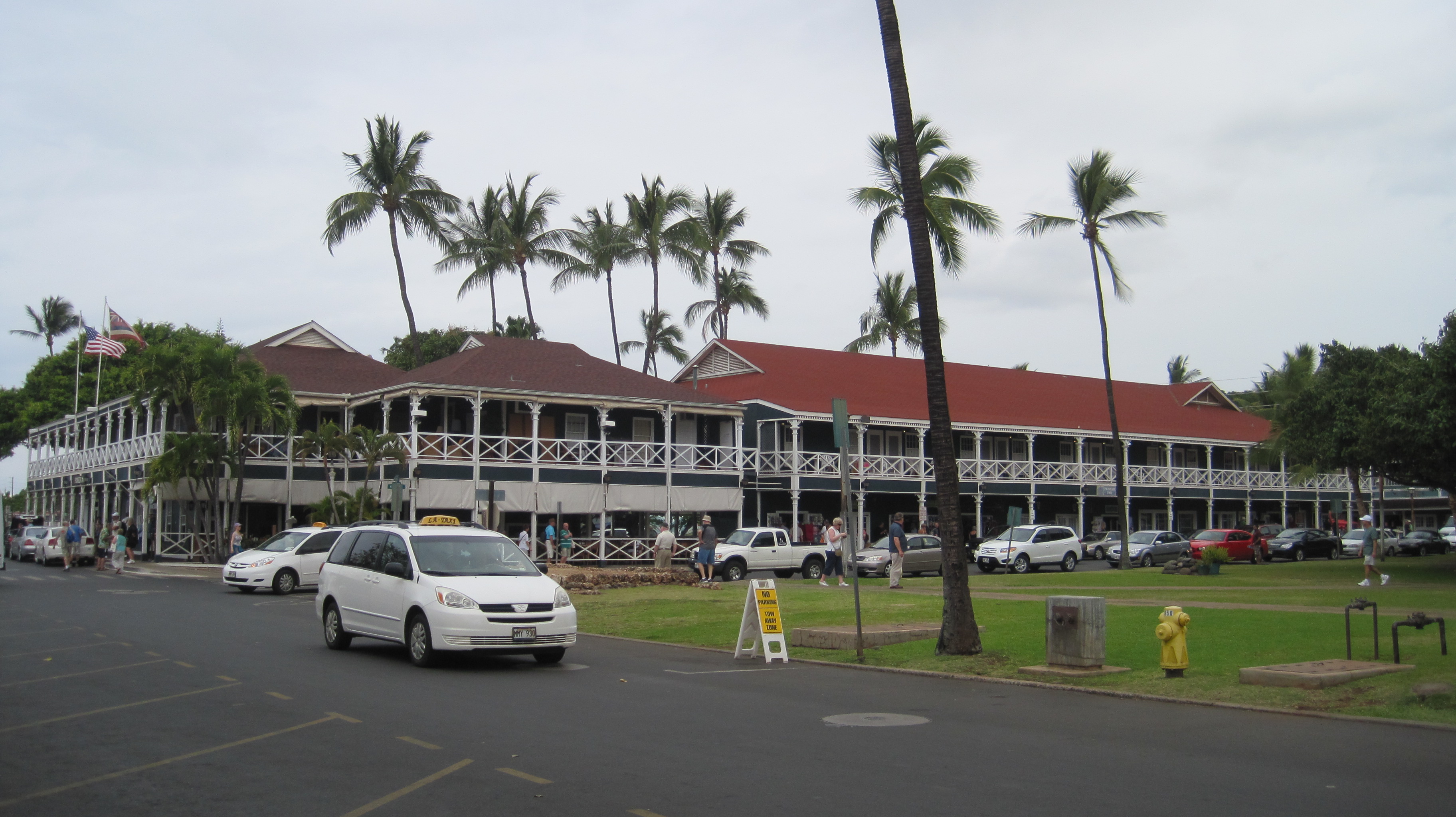
Pioneer Inn, Lahaina, Maui 

Pioneer Inn, Lahaina Historic District, 2010, destroyed by wildfire in 2023

The Far Outliers paid a visit to Maui in March 2010 and, as is our custom, we made an effort to photograph sites on the National Register of Historic Places. I uploaded most of them to Wikimedia Commons, put them in the public domain, and then inserted them into the Wikipedia NRHP listings and articles for sites in Maui. The rest I uploaded to my Flickr site, where I created a separate album for Maui. In the wake of the destructive wildfires on Maui, I'm now adding my Wikimedia Commons photos to my Maui album on Flickr for extra backup.

22 July 2021

Okinawan Emigration Destinations

From Liminality of the Japanese Empire: Border Crossings from Okinawa to Colonial Taiwan, by Hiroko Matsuda (U. Hawaii Press, 2018), Kindle loc. ~840:

Before migration to the US mainland became popular in Okinawa, anti-Japanese sentiment spread across the West Coast, where the Japanese population had increased rapidly at the turn of the twentieth century. After the enactment of the Gentlemen’s Agreement in 1908, Okinawans were unable to enter the United States as migrant laborers. Thus, very few Okinawans followed the thousands of Japanese who had migrated to the US mainland. The few who did so during this period were youths pursuing higher education. Some went to the US mainland via Hawai‘i, Canada, and Mexico; a few traveled directly from Okinawa. As the Gentlemen’s Agreement allowed only families of migrants to enter for the purpose of reuniting with husbands and fathers, some female Okinawans arranged to immigrate and join their grooms in the United States as picture brides.

Elderly Okinawans have a saying that best sums up these migration trends: “The richest people were able to immigrate to South America; people with some money migrated to the Philippines; and the poorest worked on mainland Japan.” Indeed, when it proved too difficult to enter the United States as migrant workers, the Japanese turned to South America—especially Brazil—and the Philippines as alternative destinations. Later, the South Sea Islands [Micronesia] became popular as the South Seas Development Company (Nan’yō Kōhatsu) targeted and recruited Okinawan laborers for its sugar industry. While Brazil, the Philippines, and the South Sea Islands were under different governments and Okinawan immigrants there worked in different industries, there are some commonalities among them. First, the initial immigrants in these countries worked in manufacturing and commercial crop industries such as coffee (Brazil), abaca [aka "manila hemp"]  (the Philippines), and sugarcane (the South Sea Islands). Second, Okinawan immigrants accounted for the majority of Japanese immigrant communities in these countries despite their treatment as “second-class Japanese” and “the other Japanese.”

Japan sent the first indentured migrant farmworkers to Brazil in 1908. Okinawans accounted for more than 40 percent, 325 of the 781 immigrants, of that inaugural group of economic immigrants to Brazil. In fact, many of the first Okinawan immigrants left the plantations to which they were allocated shortly after their arrival. This gave a negative impression to both the Japanese and Brazilian governments. In 1913, the Japanese government refused to accept Okinawans wishing to travel to Brazil as indentured laborers, citing their propensity to leave the plantations and their cultural difference from Japanese workers from the other prefectures, but when migration agencies were unable to recruit enough laborers from the other prefectures, Okinawans were once again permitted to go to Brazil as indentured migrant workers. However, as was the case in the United States, Okinawan migration to Brazil was prohibited in 1919, and only immigrants who were currently in Brazil were allowed to send for their families.

...

In addition to Brazil, Okinawa sent a significant number of immigrants to other Latin American countries. For instance, Peru quickly became one of the most popular destinations for Okinawan migrant workers after the first group of Okinawan immigrants arrived there in 1899. Between 1899 and 1941, Okinawa sent 11,461 immigrants to Peru, accounting for nearly 30 percent of the total number of Japanese immigrants. Although the immigrants were initially employed on plantation farms, many later moved to urban areas, where they became grocery store or restaurant owners.

...

Similarly, most Japanese immigrants to Argentina were Okinawans. This is despite the fact that Japanese immigrants had been arriving in Argentina since 1910. There were 1,831 Okinawans in Argentina in 1940, accounting for approximately 45 percent of the Japanese population in the country. Not all Okinawans in Argentina had migrated directly from Okinawa; in actuality, many ended up in Argentina after traveling to Brazil and Peru. In Argentina, many Okinawans initially found work as factory laborers or porters. A sizeable number eventually set up small businesses such as coffee shops and laundries.

06 August 2020

Arrival in Honolulu, 1840

From Twenty Years Before the Mast, by Charles Erskine (Fossil, 2016), Kindle pp. 126-128:
AT daylight on the morning of the 23d of September we made Oahu, one of the Sandwich Islands, and about eight o’clock entered the harbor of Honolulu. A couple of small hawsers were run out from the starboard bow, and these were seized by several hundred natives, men, women, and children, who were on the reef, up to their necks in water, and very soon the ship was warped over the bar and into port, amid such shouting and singing that it seemed as though bedlam had broken loose. All Honolulu, including its land-sharks, was at the waterside and joined in the shouting and cheering. It was not the novelty that created the excitement, for the arrival of a man-of-war, in their port, was no uncommon thing; but they looked upon the event as a sort of golden shower which was to fill their pockets. They had been expecting our arrival for six months.
...
There were nine whale-ships lying here, besides our squadron. Five of them were American. The next morning between five and six hundred American sailors, all dressed in white frocks and trousers, black tarpaulin hats and neckerchiefs, and their pockets well filled with Spanish dollars, went on shore. Passing the American consul’s house, half-way up Main Street, we hove to, and saluted the Star Spangled Banner, which was proudly waving from his house. The consul, Mr. Brinsmade, and his wife, bowed very gracefully to us from the veranda.

It astonished the natives greatly to see so many sailors let loose at once. The principal street of the town was Main Street. The first settlers lived on this street, in frame houses. Some of these were painted white, with green blinds, and were inclosed with neat picket-fences. The next street was about half a mile back, and ran crosswise. The buildings on this street had thatched roofs and sides, with glass windows and frame doors. Here were located the grog-shops, dancing-halls, billiard-rooms, cock-pits, sailors’ boarding-houses, and gambling-saloons. Some of these houses were inclosed by walls of brick, dried in the sun, and were whitewashed. These were occupied by the middle classes. European garments were worn by this class of people. On the next street the houses were rudely fashioned. They were built of sticks, vines, and half-formed sun-dried bricks, and plastered with mud. The residents on this street were not quite half-dressed. Some of the men wore hat and shirt, and some wore trousers and no shirt. The dress of the ladies was made very much like a bag with a hole in the bottom, for the head to be slipped through, and arm-holes in the sides. It reached to the ankles, and appeared to be of the same width throughout its entire length.

In the outskirts, mud huts were found, which once formed the only habitations of the Sandwich Islanders. The natives occupying these were dressed in the garb of the heathen, a narrow strip of tapa tied around the loins, or a blanket of the same material thrown corner-wise over the left shoulder and tied in a large knot on the breast.

The greatest curiosity I saw while here was the Seaman’s Bethel. This was built in Boston by the Boston Seaman’s Friends’ Society, taken down and shipped to this port in 1826 or 1828. It was in this bethel that Father Damon preached so many years.

13 July 2020

Islands Seeking Hawaiian Protection

From A Power in the World, by Lorenz Gonschor (Perspectives on the Global Past, U. Hawaii Press, 2019), Kindle Loc. c. 2340ff:
Unsurprisingly, one of the key elements of this reassertion of Hawaiian political, cultural, and spiritual identity during Gibson’s premiership was a public reiteration of the concept of Hawaiian primacy in the Pacific. In late 1880, still dealing with the aftermath of the Moreno affair and preparing for his voyage around the world, Kalākaua had received a request by Tonga’s King George Tupou I to enter negotiations for a friendship treaty with Hawai‘i, modeled after those Tonga had already concluded with Germany in 1876 and Great Britain in 1879. The Hawaiian king had responded enthusiastically. Tonga did not follow through on it, however, likely because it experienced domestic instability throughout the 1880s (Rutherford 1996, 143). Against this backdrop of renewed interest in the South Pacific for engagement with Hawai‘i, shortly after the king’s return from the world tour, Gibson had once more written an editorial urging that “the policy of this kingdom should be to assist, in every way that is practicable, to preserve the independence of all those communities of Polynesian race which have not already been driven by circumstances to seek the protection of foreign Powers.” He went on to mention “the significant fact that twenty years ago the Hawaiian Government had been thus represented in the South Pacific by a Commissioner, Mr. St. Julian, whose assistance had been gladly availed of by the inhabitants of the islands.” When this proposal was ridiculed by the Missionary Party press, Gibson had provided a lengthy Hawaiian-language rebuttal, written as a fictional discussion between a Hawaiian diplomat and the minister of foreign affairs of the island of Rarotonga. As the new head of the foreign office, Gibson had now full access to the department’s archives and further studied St. Julian’s earlier correspondence with Wyllie (Bailey 1980, 200–201). Being of like mind with the king on this matter, the two men now intended to bring those visionary ideas to fruition at last.

At the same time, during 1882 and 1883, petitions were received from Butaritari and Abaiang in the Gilbert Islands, asking for Hawaiian protection or outright annexation by the kingdom (Horn 1951, 62). One such petition had already been received in 1878 from Tabiteuea in the same archipelago (60), which had led to detailed discussions in the English-language press, referring to Wyllie’s and St. Julian’s earlier project. Replying to these requests, Kalākaua refused outright Hawaiian annexation but declared his intent to establish closer political relations with the islands’ leaders and unsuccessfully invited them to attend his coronation (63). In May 1883, the king of the Tokelauan atoll of Fakaofo also wrote Kalākaua, requesting him to bring back his people who had left the island. To follow up with the Gilbertese chiefs, in July 1883, Gibson commissioned Alfred Tripp, a ship captain involved in recruiting Gilbertese laborers who had been a member of Kalākaua’s privy council since 1874, as special commissioner for Central and Western Polynesia. Tripp’s mission was cut short because his ship was wrecked in the Gilbert Islands, but he communicated with all major chiefs of that archipelago and brought home more petitions for Hawaiian aid or protection.

12 July 2020

Sources of Samoan Legal Terms

From A Power in the World, by Lorenz Gonschor (Perspectives on the Global Past, U. Hawaii Press, 2019), Kindle Loc. c. 3412ff:
What is also intriguing about the Samoan constitutional system is that despite the absence of classical state-like political structures, the vocabulary created for concepts of modern statecraft was remarkably traditional, much more than the equivalent terms in Tongan and Fijian. For instance, the Samoan term for law is tulāfono, a concept clearly grounded in classical concepts of governance. Other terms for innovative institutions were literal translations, such as failautusi (someone doing writing or accounting) for secretary (that is, cabinet minister). Very few words, however, were direct borrowings from foreign languages comparable to Tahitian ture and basileia or Tongan lao and minisitā.

In the end, however, the Constitution failed to produce a stable government, but this was due to antagonistic foreign interests, agitation by settlers, and naval intervention. In early 1876, Steinberger was arrested and deported by a visiting British warship due to a conspiracy of the US and British consuls who objected to the premier’s pro-Samoan policies, especially his commitment to examine fraudulent land sales in the past and prevent further such sales (Gilson 1970, 321–331).

In the resulting chaos, the Ta‘imua deposed Laupepa, who then set up a rebel government. Although all parts of the Constitution were not fully in force, the Ta‘imua continued to run at least the external affairs of the government quite successfully for a while. This included sending High Chief M. K. Le Mamea on a diplomatic mission to the United States to sign a Samoan-American treaty in 1878 and concluding similar, albeit unequal, treaties with Germany and the United Kingdom in 1879. After multiple crises and hostilities between the rivaling parties, Malietoa Laupepa was restored to the throne in 1880—Mata‘afa Iosefo, another paramount title holder, serving as premier—but the government’s authority remained tenuous (Gilson 1970, 332–382; So‘o 2008, 39–41). Nonetheless, the Samoan government published a new set of laws, a copy of which was sent to the Hawaiian government (Kingdom of Sāmoa 1880).

In the absence of Steinberger or another trusted European, the position of premier was abolished and a more extensive executive cabinet created instead. By the mid-1880s, this cabinet included a failautusi sili (secretary of state), failautusi mo Sāmoa (secretary of interior, literally secretary for Sāmoa), failautusi teu tupe (secretary of treasury), failautusi o taua (secretary of war), failautusi o fanua (secretary of lands), failautusi o galuega (secretary of works), the faamasino sili (chief justice), and a failautusi faamau-upu (registrar). The American-derived terminology for these offices reflected the continuing legacy of Steinberger’s political ideas.
In Samoa, Robert Louis Stevenson was called Tusitala 'Write-story'.

11 July 2020

Sources of Tahitian Legal Terms

From A Power in the World, by Lorenz Gonschor (Perspectives on the Global Past, U. Hawaii Press, 2019), Kindle Loc. 3001:
Unlike the Hawaiian constitutional model with its hybrid forms combining classical elements of statecraft with Western forms, the Tahitian legal code and its derivatives primarily used concepts from either biblical or English law, for example, the word ture for “law,” a Tahitian form of the Hebrew word ה רָוֹתּ (torah), basileia (pātīreia in contemporary Tahitian spelling), deriving from Greek βασιλεία (basileía) for kingdom, or tāvana, Tahitian rendering of governor (>*gāvana>tāvana) to designate the heads of the formerly independent clans or chiefdoms that were reorganized as districts within the new Christian kingdom (Académie Tahitienne 1999, 530; Montillier 1999, 270–271).

The marked contrast to the terminology for the equivalent political institutions in the Hawaiian kingdom—namely, kānāwai, aupuni, and kia‘āina, all of which derive from classical Hawaiian statecraft—is clear. It is also hardly surprising, given the nature or Pomare’s kingdom and the other Tahitian-language realms as secondary states modeled on outside examples, and not primary states that developed endogenously, such as the classical Hawaiian predecessor states of the Hawaiian Kingdom (Hommon 2013, 184–185).

For this book, the contrast becomes most relevant where influence of the Tahitian model intersected with that of Hawai‘i. For a short period, this also included the Hawaiian Islands themselves, where Tahitian converts played a significant role in converting the leading figures of the Hawaiian court to Christianity in the 1820s. However, this influence was short lived, and the Hawaiian political system developed along significantly different lines as we have seen earlier in this book.

08 July 2020

Kalākaua as pan-Austronesianist

From A Power in the World, by Lorenz Gonschor (Perspectives on the Global Past, U. Hawaii Press, 2019), Kindle Locs. c. 2060, 2160:
During Kalākaua’s stay in Bangkok, relations with King Chulalongkorn of Siam were similarly warm and deep, and included the mutual conferral of high decorations. Like the Meiji Emperor and Viceroy Li, Chulalongkorn was presiding over a rapidly modernizing non-Western nation attempting to reach parity by hybridizing its system of government (Wyatt 1969, 1976, 2003, 166–209; Baker and Phongpaichit 2005, 47–80). Unfortunately, documentation of what exactly might have come out of possible discussions about Siam joining the proposed pan-Asian league has not been found.

During the following visit in Johor, at the southern tip of present-day Malaysia, relations between the Hawaiian king and another non-Western ruler reached another climax. Johor’s ruler, Maharajah Abu-Bakar, was another monarch using the tools of modernity to secure a certain degree of parity for his country (Trocki 1979; Andaya and Andaya 2001, 173–174, 202; Keng 2014). Because he had traveled extensively on his own, Abu-Bakar was Kalākaua’s first non-Western host as fluent in English as himself, so they could talk without an interpreter. But this more familiar atmosphere aside, the king also found the maharajah physically quite similar to a Hawaiian ali‘i, specifically, the late Prince Leleiohōkū I. As Kalākaua remarked in a letter to his brother-in-law, “if [the maharajah] could have spoken our language I would take him to be one of our people the resemblance being so strong.” Although Abu-Bakar could not speak Kalākaua’s native language, the two monarchs compared words in Hawaiian and Malay, and within a few minutes could identify a number of them that the two Austronesian languages had in common, and they reflected on the common origins of their peoples (Armstrong 1977, 44; Requilmán 2002, 164). Back home, Gibson was delighted to see his long-time vision of pan-Austronesian relations finally become reality and used the comparison between the two realms to point out flaws in the current state of affairs in Hawai‘i:
We are very glad that our Hawaiian King visited a Malay sovereign, the Maharajah of Johore: that His Majesty recognized striking evidences of kinship between Hawaiian and Malay: that His Majesty observed that these brown cognates of Johore were healthy, prolific and an increasing people, though living under the guidance and dominion of the European race; that His Majesty recognizes that there is no natural law, or destiny, that the brown races shall pass away in the presence of the whites, as is alleged in Polynesia; and that evidently decay and decline among His Majesty’s native people must be the results of some mischievous interferences with the natural order of things, and of hurtful radical changes affecting the sanitary condition of the aborigines of Polynesia.
...

Kalākaua maintained close relations with the court of Johor during the rest of his reign, attested by a steady exchange of letters between the two monarchs and their government officials throughout the 1880s. It was likely similar considerations of pan-Austronesian solidarity that later motivated Kalākaua to include Queen Ranavalona III of Madagascar among the heads of state he notified via autographed letters of the death of his sister Likelike in February 1887. Like Siam and Johor, the Kingdom of Madagascar was another non-Western hybrid state using strategies of selective similitude to achieve international parity (Valette 1979; Esoavelomandroso 1979; Brown 2006). At the time of Kalākaua’s letter, however, Queen Ranavalona’s government was embattled by French imperialism, which had led to the forcing of a French protectorate on the Indian Ocean island kingdom in 1885 and would culminate in the French conquest and colonial annexation of the island in 1896 (Randrianarisoa 1997). Hence, Kalākaua’s gesture to include the Malagasy queen among the heads of state of the world should be seen as a remarkable gesture of pan-Austronesian anticolonial solidarity.