Scores of African rulers who resisted colonial rule died in battle or were executed or sent into exile after defeat. Samori of the Mandingo was captured and died in exile two years later; the Asantehene, King Agyeman Prempeh, was deposed and exiled for nearly thirty years; Lobengula of the Ndebele died in flight; Behazin of Dahomey and Cetshwayo of the Zulu were banished from their homelands.
In the concluding act of the partition of Africa, Britain, at the height of its imperial power, set out to take over two independent Boer republics, the Transvaal and the Orange Free State, and incorporate them into the British Empire, assuming that a war of conquest would take at most a matter of months. It turned into a gruelling campaign lasting three years, required nearly half a million imperial troops to finish it, and left a legacy of bitterness and hatred among Afrikaners that endured for generations. Faced with guerrilla warfare for which they were unprepared, British military commanders resorted to scorched-earth tactics, destroying thousands of farmsteads, razing villages to the ground and slaughtering livestock on a massive scale, reducing the Boers to an impoverished people. Women and children were rounded up and placed in what the British called concentration camps, where conditions were so appalling that some 26,000 died there from disease and malnutrition, most of them under the age of sixteen. All this became part of a Boer heritage passed in anger from one generation to the next, spawning a virulent Afrikaner nationalism that eventually took hold of South Africa.
Small-scale revolts against colonial rule continued for many years. The Baoulé of Côte d'Ivoire fought the French village by village until 1911; the Igbo of Nigeria were not fully defeated until 1919; the Jola of Senegal not until the 1920s; the Dinka of southern Sudan not until 1927. In the desert wastelands of Somaliland a fiery Muslim sheikh, Muhammad ’Abdille Hassan, dubbed by his adversaries the 'Mad Mullah', led Dervish warriors in a holy war against the British for twenty years until his death in 1920. Bedouin resistance against Italian rule in Libya ended only in 1931 after nine years of guerrilla warfare. By the 1930s, however, the colonial states of Africa were firmly entrenched; they had, moreover, acquired a legitimacy in the eyes of their inhabitants.
13 June 2008
Fates of Resistance to the Partition of Africa
From The Fate of Africa: A History of Fifty Years of Independence, by Martin Meredith (PublicAffairs, 2005), pp. 3-4:


Wordcatcher Tales: Hack, Buckboard, ... Democrat
From Plain Buggies: Amish, Mennonite, and Brethren Horse-Drawn Transportation (Intercourse, Penn.: Good Books, 1998), by Stephen Scott, pp. 46-47:
The open spring wagon, the utility vehicle with one seat and a hauling space in back, has a wide variety of local names. In Holmes County, Ohio, it is a "Hack"; in Arthur, Illinois, a "Buckboard"; in Dover, Delaware, a "Durban"; in Adams County, Indiana, a "Johnny wagon"; in Daviess County, Indiana, a "Long John"; and in Aylmer, Ontario, a "Democrat."
A recent style of spring wagon, featuring an open bed or long storage compartment in back and an enclosed driver's seat will be referred to as a "cab wagon" in this book. In Pennsylvania a carriage-like vehicle with heavier suspension on the rear axle is called a "market wagon" or "peddle wagon."
A number of vehicles used by the plain people are somewhat out of the scope of this book. These include heavy farm wagons and other agricultural vehicles. The special wagons designed to transport benches from one Amish meeting place to the next are found in each Amish church district. In Lancaster County the Old Order Amish and Mennonites make use of specially designed hearses. In Holmes County vehicles resembling a cab wagon transport the coffins.
Sleighs, cutters, and bobsleds are rarely used in most communities and are not of any special style. Few new snow vehicles are produced. Enough antique vehicles are around to serve the limited demand.
12 June 2008
European Horsetrading for Backwaters
From The Fate of Africa: A History of Fifty Years of Independence, by Martin Meredith (PublicAffairs, 2005), pp. 1-2 (reviewed here, here, and here):
During the Scramble for Africa at the end of the nineteenth century, European powers staked claims to virtually the entire continent. At meetings in Berlin, Paris, London and other capitals, European statesmen and diplomats bargained over the separate spheres of interest they intended to establish there. Their knowledge of the African hinterland was slight....
As the haggling in Europe over African territories continued, land and peoples became little more than pieces on a chessboard.... Britain traded the North Sea island of Heligoland with the Germans for Zanzibar, and parts of northern Nigeria with the French for fishing rights off Newfoundland. France exchanged parts of Cameroon with Germany in return for German recognition of the French protectorate over Morocco. By the time the Scramble for Africa was over, some 10,000 African polities had been amalgamated into forty European colonies and protectorates.
Thus were born the modern states of Africa.
01 June 2008
Wordcatcher Tales: Lē‘ahi 'Tuna Point'
Most people who have lived in Hawai‘i for a while know that Diamond Head crater got its English name from the sparkle of worthless crystals in its rocky exterior, and not from real diamonds. And many know that it got its Hawaiian name, Lē‘ahi, from the resemblance of the crater's ridgeline to the dorsal fin of a tuna. But the name doesn't exactly mean 'dorsal-fin of tuna'.
I gave the etymology a closer look after finding a bogus etymology on the historical plaque that marks Diamond Head Lighthouse. Lē‘ahi does not come from lei 'wreath' plus ahi 'fire', and thus has nothing to do with Hawaiian practices of navigational bonfires imagined by the builders of the modern lighthouse. Haw. ahi 'fire' comes from Proto-Polynesian (PPN) *afi 'fire', a good and widely reflected Austronesian root. In Numbami, a language I studied in Papua New Guinea, the word for 'fire' is yawi (with the /w/ slightly fricative before front vowels). Even highly aberrant Yapese seems to have a cognate, nifiy 'fire'. But Haw. ‘ahi 'tuna' comes from Proto-Nuclear Polynesian (PNP) *kasi (with *k > /‘/, *s > /h/), which seems not to be so widely attested beyond Polynesia.
The first part of the compound is trickier. According to Place Names of Hawaii, lē comes not from lei 'wreath, garland', but rather from lae, which in place names usually translates 'cape' or 'point'. However, the Hawaiian Dictionary lists a wider range of meanings: 'forehead, brow; cape, headland, point, promontory; wisdom' (< *la‘e). So some of the tourist literature now translates Lē‘ahi inappropriately as 'tuna brow' or 'brow of the tuna'. Tuna Head(land) would be just as accurate, but Cape Tuna or Tuna Point would be more in keeping with the glosses in Place Names of Hawaii. (I think we can also rule out Tuna Wisdom!)
UPDATE: But what about Aku Head?
There used to be a well-known radio personality in Hawai‘i who called himself "J. Akuhead Pupule" (= 'J. Tunahead Crazy'), reputedly after being called as much by irate listeners. I'm not sure why aku-head would be a sharper insult than ‘ahi-head, but it might be because aku is the Hawaiian name for the bonito or skipjack tuna genus Katsuwonus, whose name derives from Japanese katsuo, which in Japan is usually dried into a woodlike block, katsuobushi, from which flakes are shaved off for use as a flavoring. So maybe akuhead = blockhead.
From my fieldwork experience long ago in Papua New Guinea, where I elicited far more fishnames than I had ever heard of before, I would guess that Haw. ‘ahi matches pretty well with the genus Thunnus while Haw. aku names tuna of the genus Katsuwonus (and perhaps a few other similar genera).
In checking Wikipedia entries for other members of the family Scombridae (tunas, bonitos, and mackerals), I see that the one for wahoo, Haw. ono (< PPN *‘ono), offers entirely unsupported speculative etymologies for both names. Wikipedia should not confirm one person's speculation with that of another. Leave that to the news media.
UPDATE 2: The cape at the southwestern tip of O‘ahu—a long, flat counterpart to Lē‘ahi at the southeastern tip—was for a time called Barber's Point, but has now reverted to its Hawaiian name, Kalaeloa 'The Long Point'.
A reader asks why I don't simply consult a fluent native speaker of Hawaiian. One reason is that native speakers with encyclopedic knowledge are extremely rare in any language, but especially for Hawaiian these days, where most fluent speakers learned the language in a classroom, not from their parents and grandparents long resident on a plot of land. (In fact most have lost the lands of their ancestors.) Another reason is that local residents are usually content to offer folk etymologies and wild guesses when asked about anything not utterly transparent linguistically and historically. At least that is my experience from incessantly asking just such questions of local drivers, store clerks, wait help, baristas, sushi chefs, and random passers-by in my travels to odd parts of the globe over many years.


I gave the etymology a closer look after finding a bogus etymology on the historical plaque that marks Diamond Head Lighthouse. Lē‘ahi does not come from lei 'wreath' plus ahi 'fire', and thus has nothing to do with Hawaiian practices of navigational bonfires imagined by the builders of the modern lighthouse. Haw. ahi 'fire' comes from Proto-Polynesian (PPN) *afi 'fire', a good and widely reflected Austronesian root. In Numbami, a language I studied in Papua New Guinea, the word for 'fire' is yawi (with the /w/ slightly fricative before front vowels). Even highly aberrant Yapese seems to have a cognate, nifiy 'fire'. But Haw. ‘ahi 'tuna' comes from Proto-Nuclear Polynesian (PNP) *kasi (with *k > /‘/, *s > /h/), which seems not to be so widely attested beyond Polynesia.
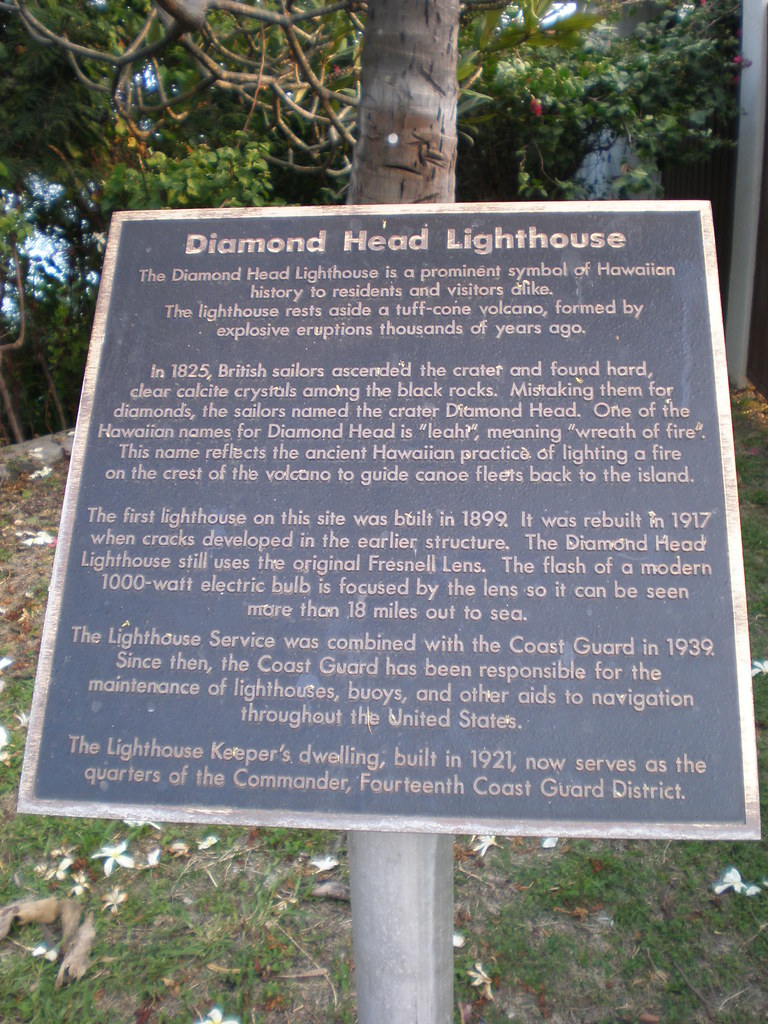

The first part of the compound is trickier. According to Place Names of Hawaii, lē comes not from lei 'wreath, garland', but rather from lae, which in place names usually translates 'cape' or 'point'. However, the Hawaiian Dictionary lists a wider range of meanings: 'forehead, brow; cape, headland, point, promontory; wisdom' (< *la‘e). So some of the tourist literature now translates Lē‘ahi inappropriately as 'tuna brow' or 'brow of the tuna'. Tuna Head(land) would be just as accurate, but Cape Tuna or Tuna Point would be more in keeping with the glosses in Place Names of Hawaii. (I think we can also rule out Tuna Wisdom!)
UPDATE: But what about Aku Head?
There used to be a well-known radio personality in Hawai‘i who called himself "J. Akuhead Pupule" (= 'J. Tunahead Crazy'), reputedly after being called as much by irate listeners. I'm not sure why aku-head would be a sharper insult than ‘ahi-head, but it might be because aku is the Hawaiian name for the bonito or skipjack tuna genus Katsuwonus, whose name derives from Japanese katsuo, which in Japan is usually dried into a woodlike block, katsuobushi, from which flakes are shaved off for use as a flavoring. So maybe akuhead = blockhead.
From my fieldwork experience long ago in Papua New Guinea, where I elicited far more fishnames than I had ever heard of before, I would guess that Haw. ‘ahi matches pretty well with the genus Thunnus while Haw. aku names tuna of the genus Katsuwonus (and perhaps a few other similar genera).
In checking Wikipedia entries for other members of the family Scombridae (tunas, bonitos, and mackerals), I see that the one for wahoo, Haw. ono (< PPN *‘ono), offers entirely unsupported speculative etymologies for both names. Wikipedia should not confirm one person's speculation with that of another. Leave that to the news media.
UPDATE 2: The cape at the southwestern tip of O‘ahu—a long, flat counterpart to Lē‘ahi at the southeastern tip—was for a time called Barber's Point, but has now reverted to its Hawaiian name, Kalaeloa 'The Long Point'.
A reader asks why I don't simply consult a fluent native speaker of Hawaiian. One reason is that native speakers with encyclopedic knowledge are extremely rare in any language, but especially for Hawaiian these days, where most fluent speakers learned the language in a classroom, not from their parents and grandparents long resident on a plot of land. (In fact most have lost the lands of their ancestors.) Another reason is that local residents are usually content to offer folk etymologies and wild guesses when asked about anything not utterly transparent linguistically and historically. At least that is my experience from incessantly asking just such questions of local drivers, store clerks, wait help, baristas, sushi chefs, and random passers-by in my travels to odd parts of the globe over many years.
31 May 2008
Applebaum Sour on Baker and Blogs
In a review entitled The Blog of War, Anne Applebaum first parodies then purees Nicholson Baker's Human Smoke: The Beginnings of World War II, the End of Civilization (via A&L Daily).
But, geez, Anne, give us a break. Baker's book was published by Simon and Schuster, not Gawker Media. Book publishers supposedly employ rigorous editors that blog media so often lack. Your review appeared in The New Republic, a magazine whose writers include fabulists and whose fact-checkers have repeatedly fallen down on the job. Most major media outlets have suffered similar embarrassments in recent years. Do you seriously believe that the reliability and expertise of the world's legions of newspaper reporters are any more impressive than those of Wikipedia's legions of contributors? News reports may claim to be the first draft of history, but they are usually the umpteenth draft of tired conventional wisdom. Finally, did the writing of purblind, partisan, and provincial-minded history only begin with blogging? Surely the writing of such history began with the advent of writing, the beginning of history.
Baker never answers the questions that he asks. That is, he has not undertaken the historian's task of hearing multiple arguments, listening to myriad explanations, looking at a wide range of evidence and then marshaling the evidence in order to draw a conclusion. He has not even carefully examined, as other historians have done, the various arguments about the aerial bombardment of civilians--the military tactic that appears to bother him most--to make a judicious argument against its use. Instead, he has used his license as a "novelist" to excuse himself from all of the tedious work of genuine knowledge. By way of research, he has read back issues of The New York Times and The New York Herald Tribune, along with a notably limited group of other historical sources, all long familiar. From them, he has plucked bits of information, shards of the historical record that he finds compelling, or perhaps contrary to what he imagines to be the conventional wisdom--and left his readers to draw their own conclusions.But then she segues into a sour diatribe on blogs and Wikipedia.
Here is where I should note, and gladly, that there are many legitimate ways to write history, even many avant-garde, non-linear, novelistic ways to write history, as the historiography of World War II itself well illustrates. There are, after all, political histories of that war, diplomatic histories, social histories, military histories, and intellectual histories, as well as histories written from American, British, Polish, Russian, German, Jewish, Japanese, Slovak, Estonian, Bulgarian, Chinese, and Italian points of view, among dozens of others. Besides all that, there are shelves of memoirs of victims and the children of victims, and perpetrators and the children of perpetrators. There are more purely literary accounts, such as W.G. Sebald's semi-autobiographical novels, which mix fact and fiction but are nonetheless deeply committed to understanding precisely what happened and why....
But what Baker has produced is nothing like this, nothing like history. You cannot fault his scholarship, because aside from the process of accumulating a set of anecdotes, no scholarship has been conducted. Though the book purports to pronounce upon the international situation, all of Baker's sources are in English. Almost all of the stories take place in America, Britain or Germany, as if the war was not really happening in Eastern Europe or Russia, let alone Indonesia and Singapore. He has not worked with many primary sources, other than a few memoirs, and he has not discovered any new material. He leaves out enormous chunks of the story. His description of the invasion of Poland in September, 1939, is limited to two sentences--Goering "ordered a thousand planes into Poland. There were dive-bombers over Danzig"--and he does not mention the Soviet invasion of Poland seventeen days later at all.
You cannot disagree with Baker's argument, because no argument has been made. Baker does not build a case, he insinuates something, leaving the reader to guess what. My best paraphrase of his view goes like this: Churchill was a bully and a drunk. The Roosevelts were snobs and anti-Semites. Therefore they were not good people. Therefore their so-called "good" war must have been hypocritical. Therefore they could only have been fighting because they were in hock to the military industrial complex and they had a bloodthirsty fondness for bombing raids. Moreover, the Holocaust was in part a German response to British aggression, and the Japanese invasion of China was a response to Chinese aggression, and Britain's very participation in the war was the result of Churchill's aggression, especially his stubborn refusal to respond to Hitler's "peace offensive." Therefore the pacifists were right....
Perhaps, I wondered at one point, the whole book is a gigantic practical joke, a stunt intended to provoke scholars, anger Jews, infuriate Poles, and thereby create massive publicity for Nicholson Baker. And so my initial reaction to Human Smoke was to throw it across the room. Subsequently, I discovered that this reaction was very common, especially among practicing historians.
Unlike Nicholson Baker or the editors of Gawker, I cannot really supply an anecdote that will explain, in a hundred words or less, why I decided to pick up the book again and write this review. But a few days after finishing Human Smoke as well as Baker's treatise on Wikipedia, I happened to be sitting with a group of writers, historians, and critics, all fellows at the American Academy in Berlin, talking about it. As fate would have it--Baker loves portentous and possibly significant coincidences, and who doesn't?--we were sitting in a villa overlooking the Wannsee. Just across the lake, we could see the Haus der Wannsee-Konferenz, the place where, in 1942, the Nazis decided to exterminate the Jews of Europe.Now, I have great respect for Applebaum's knowledge of history and her writing of it. In fact, I think I have blogged more excerpts from her fascinating and well-done Gulag: A History than from any other book I've read. Nor do I have any sympathy for Baker, nor any desire to inhale the smoke he's blowing in the book under review. I'm also getting more sour on the blogosphere these days, as it becomes less and less distinguishable from 24-hour journalism's endless gotcha coverage and partisan shouting matches. And I'm also pretty routinely dismayed by the sloppy amateurishness of much of the stuff I find in Wikipedia (to which I'm contributing more and more these days, but only on subjects I know well).
Had the drunken Churchill and the anti-Semite Roosevelt not decided to fight World War II, none of us would have been there. There would have been no American Academy in Berlin, of course, with its prominently hung portrait of the villa's original Jewish owners, now the Academy's patrons; indeed, there would have been no Jews in Berlin, no Americans in Berlin, and no critics and writers in Berlin, save those approved by the Third Reich. Instead, a happy Nazi family would have been looking out over the lake, enjoying the same view.
Yet the dull truth is that we arrived at the topic of Nicholson Baker not because we were talking about the war, but because we were talking about the contemporary cult of the non-expert, or rather the anti-expert: the bloggers who assume that the "mainstream media" is always wrong, the Wikipedia readers who think that a compilation of random anecdotes is always preferable to a learned study, and of course the college students who nowadays prefer to get their news in emails from friends because it is too bothersome to read a newspaper. And the even duller truth is that Human Smoke belongs to this cult, and not to the more exotic outer reaches of the historiography of World War II.
But, geez, Anne, give us a break. Baker's book was published by Simon and Schuster, not Gawker Media. Book publishers supposedly employ rigorous editors that blog media so often lack. Your review appeared in The New Republic, a magazine whose writers include fabulists and whose fact-checkers have repeatedly fallen down on the job. Most major media outlets have suffered similar embarrassments in recent years. Do you seriously believe that the reliability and expertise of the world's legions of newspaper reporters are any more impressive than those of Wikipedia's legions of contributors? News reports may claim to be the first draft of history, but they are usually the umpteenth draft of tired conventional wisdom. Finally, did the writing of purblind, partisan, and provincial-minded history only begin with blogging? Surely the writing of such history began with the advent of writing, the beginning of history.
28 May 2008
Inciting Backlash in Spain, 1931
From: Sacred Causes: The Clash of Religion and Politics, From the Great War to the War on Terror, by Michael Burleigh (HarperCollins, 2007), pp. 128-129:
The newly elected left-Republican and Socialist coalition in June 1931 further provoked the religious with controversial articles in the new Constitution, Spain's first experiment in democracy. This went much further than a legal separation of Church and state. It extruded the Church from education, restricted its property rights and investments, and dissolved the Jesuits, who played a role in liberal and leftist mythology equivalent to that of freemasons, Jews and Marxists in the demonology of their opponents. This last measure was a bitter pill to swallow in the homeland of St Ignatius Loyola. Civil marriage and divorce were legalised, while the agreement of the authorities was henceforth necessary for any public celebration of religion – another indigestible measure in a society where religious processions were a highly developed art form. A supplementary law in 1933 nationalised all Church property, including secularising the cemeteries by putting them under local authority control and dismantling the walls which separated the dead religious from their non-believing fellows. Having nationalised Church property, thereby ignoring the wishes of those who had donated it, the government then taxed the clergy who used it. Measures against Church charities simply hurt poor people. The government also closed all religious schools, which since they educated 20 per cent of Spanish children, and were not replaced by secular alternatives, sat oddly with the Republic's expansion of education.Is the lash or the backlash the driving force of history? Who was the Prime Lasher?
Although these measures were implemented with varying local intensities, there can be no doubt that preventing the ringing of church bells, removing religious symbols from classrooms, and bureaucratising the procedures for those wanting religious funerals grievously irked many Catholics. Officious insistence that dying people fill out forms to get the send-off they wanted failed to charm their friends and relatives. These measures were condemned by Pius XI in the forceful 3 June 1933 encyclical Dilectissima nobis, which, while carefully professing indifference to forms of government, stressed the hypocrisy of these measures in terms of 'those declared principles of civil liberty on which the new Spanish regime declares it bases itself'. These laws were the product of 'a hatred against the Lord and His Christ nourished by groups subversive to any religious and social order, as alas we have seen in Mexico and Russia'. Republican Spain had become part of a 'terribile triangolo' whose object was the eradication of religion. Anticlericals in the Cortes responded in kind, with snide remarks about the 'Mercantile Society of Jesus', while the Socialist leader Azaña crowed that with these 1931–3 measures Spain had ceased to be Catholic.
Of course, things had been tending that way far longer than the wave of measures introduced in 1931–3 may suggest. In 1881 the Churches had lost control of the universities. In 1901 religion had become optional within the curriculum leading to the school leavers' certificate. In 1913 non-Catholic parents could exempt their children from religious instruction. With a few exceptions, the arts and intelligentsia were dominated by secular-minded people. The Catholic presence among the urban working class and the southern rural poor was also exiguous. In 1935 a Jesuit calculated that, taking the eighty thousand parishioners of a Madrid working-class suburb, 7 per cent attended mass on Sundays; 90 per cent died without the benefit of the sacraments; 25 per cent of children were unbaptised; and of couples marrying, 40 per cent could not recite the Lord's Prayer. Similar levels of indifference and ignorance were revealed in studies of Bilbao and Barcelona. The Church was also like an alien presence in the villages of Andalucia, with anarchist and Socialist activists converting peasant indifference or quasi-pagan superstition into outright hostility. Churches were falling into disrepair, when they even existed, and priests were poorly paid with government stipends equivalent to the lowest grade of janitors. The priesthood was not an attractive career option, with recruitment for seminaries falling by 40 per cent between 1931 and 1934.
27 May 2008
The Gulag Economy's Peace Dividend
From The Whisperers: Private Lives in Stalin's Russia, by Orlando Figes (Metropolitan, 2007), pp. 467-468:
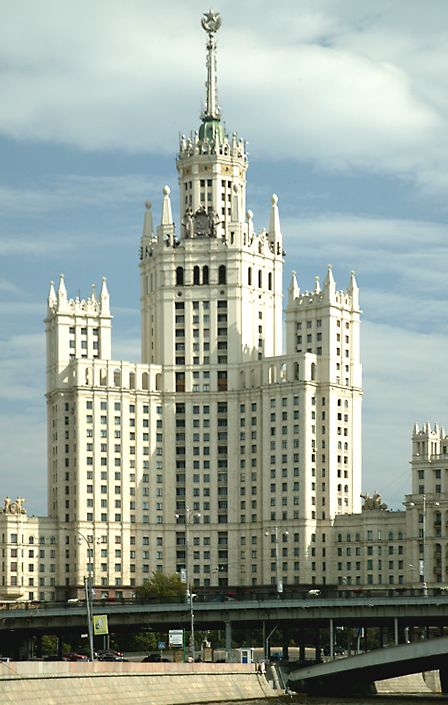
Forced labour played an increasingly important part in the post-war Soviet economy, according to a policy dictated by Stalin and his 'kitchen cabinet' of advisers. With the ending of the war the pool of unpaid labour available for exploitation by the state grew enormously. Apart from Gulag prisoners and labour army conscripts, there were 2 million German POWs, and about another million from other Axis nationalities, who were mostly used for timber-felling, mining and construction, although those with skills were employed occasionally in Soviet industry. In some factories German POWs were so integral to production that detention camps were built on the factory grounds and officials tried to block the prisoners' repatriation to Germany. The Gulag population also grew, despite the release of many prisoners in the amnesty of 1945; the camps took in well over a million new prisoners between 1945 and 1950, largely as a result of the mass arrest of 'nationalists' (Ukrainians, Poles, Belorussians, Latvians, Lithuanians and Estonians) in territories captured or reoccupied by the Red Army but never really reconciled to Soviet power. The Gulag system expanded into a vast industrial empire, with 67 camp complexes, 10,000 individual camps and 1,700 colonies, employing a captive labour force of 2.4 million people by 1949 (compared with 1.7 million before the war). Overall, it is estimated that conscript labourers represented between 16 and 18 per cent of the Soviet industrial workforce between 1945 and 1948. They were especially important in the mining of precious metals in cold and remote regions where free labour was very expensive, if not impossible, to employ (hence their contribution to the Soviet economy was even more significant than the figures would suggest). Slave labour also made up the workforce in the big construction projects of the late 1940s which came to symbolize, officially at least, the post-war confidence and achievements of the Soviet system: the Volga–Don Canal; the Kuibyshev hydro-electric station; the Baikal-Amur and Arctic railways; the extensions to the Moscow Metro; and the Moscow University ensemble on the Lenin Hills, one of seven wedding-cake like structures ('Stalin's cathedrals') in the ostentatious 'Soviet Empire' style which shot up around the capital in these years.
The post-war years saw a gradual merging between the Gulag and civilian economies. Every year about half a million Gulag labourers were contracted out to the civilian sector, mostly in construction, or wherever the civilian ministries complained of labour shortages; about the same number of free labourers, mostly specialists, were paid to work in Gulag industries. The Gulag system was increasingly compelled to resort to material incentives to motivate even its forced labourers. The population of the camps had become more unruly and difficult to control. With the amnesty of about a million prisoners in 1945, mainly criminals, who had their sentences either reduced or annulled, the camps were left with a high proportion of 'politicals' – not the intellectual types who filled the camps in the 1930s but strong young men who had fought as soldiers in the war, foreign POWs, Ukrainian and Baltic 'nationalists' – who were hostile to the Soviet regime and not afraid of violence. Without a system of rewards, these prisoners simply refused to meet the set targets. The cost of guarding the prisoners was also becoming astronomical. By 1953, the MVD was employing a quarter of a million guards within its camps, spending twice as much on the upkeep of the Gulag than it received in revenue from its output. Several senior MVD officials were seriously questioning the effectiveness of using forced labour at all. There were even mooted plans, supported by Beria and Malenkov, to dismantle sections of the Gulag and convert the prisoners into partially civilian workers, but since Stalin was a firm supporter of the Gulag system, none of these ideas was seriously proposed.
25 May 2008
Soviet Wartime Disunity and Unity
From The Whisperers: Private Lives in Stalin's Russia, by Orlando Figes (Metropolitan, 2007), pp. 419-421:
Contrary to the Soviet myth of wartime national unity, Soviet society was more fractured during the war than at any previous time since the Civil War. Ethnic divisions had been exacerbated by the Soviet state, which scapegoated certain national minorities, such as the Crimean Tatars, the Chechens and the Volga Germans, and exiled them to regions where they were not welcomed by the local populace. Anti-Semitism, which had been largely dormant in Soviet society before the war, now became widespread. It flourished especially in areas occupied by Hitler's troops, where a large section of the Soviet population was directly influenced by the Nazis' racist propaganda, but similar ideas were imported to places as remote as Kazakhstan, Central Asia and Siberia by Soviet soldiers and evacuees from the western regions near the front. Many people blamed the Jews for the excesses of the Stalinist regime, usually on the reasoning of Nazi propaganda that the Bolsheviks were Jews. According to David Ortenberg, the editor of Krasnaia zvezda, soldiers often said that the Jews were 'shirking their military responsibilities by running away to the rear and occupying jobs in comfortable Soviet offices'. More generally, this gulf between the front-line servicemen and the 'rats' who remained in the rear became the focus of a widening divide between the common people and the Soviet elite, as the unfair distribution of the military burden became associated in the popular political consciousness with a more general inequality.
But if there was no genuine national unity, people did unite for the defence of their communities. By the autumn of 1941, 4 million people had volunteered for the citizens' defence (narodnoe opolchenie), which dug trenches, guarded buildings, bridges and roads, and, when their city was attacked, carted food and medicine to the soldiers at the front, brought back the injured and joined in the fighting. In Moscow the citizens' defence had 168,000 volunteers from over thirty nationalities, and another half a million people prepared for defence work; in Leningrad, there were 135,000 men and women organized in units of the citizens' defence, and another 107,000 workers on a military footing, by September 1941. Fired up with civic patriotism, but without proper training in warfare, they fought courageously but died in shocking numbers in the first battles.
Comradeship was also crucial to military cohesion and effectiveness. Soldiers tend to give their best in battle if they feel some sort of loyalty to a small group of trusted comrades, or 'buddies', according to military theorists. In 1941–2, the rates of loss in the Red Army were so high that small groups seldom lasted long: the average period of front-line service for infantrymen was no more than a few weeks, before they were removed by death or injury. But in 1942–3, military units began to stabilize, and the comradeship that men found within them became a decisive factor in motivating them to fight. The closeness of these friendships naturally developed from the dangers the men faced. The mutual trust and support of the small collective group was the key to their survival. 'Life at the front brings people closer very fast,' wrote one soldier to the fiancée of a comrade, who had been killed in the fighting.At the front it is enough to spend a day or two together with another man, and you will find out about all his qualities and feelings, which on Civvy Street you would not learn in a year. There is no stronger friendship than the friendship of the front, and nothing can break it, not even death.Veterans recall the intimacy of these wartime friendships with idealism and nostalgia. They claim that people then had 'bigger hearts' and 'acted from the soul', and that they themselves were somehow 'better human beings', as if the comradeship of the small collective unit was a cleaner sphere of ethical relationships and principles than the Communist system, with all its compromises and contingencies. They often talk as if they found in the collectivism of these groups of fellow soldiers a type of 'family' that was missing from their lives before the war (and would be missing afterwards).
23 May 2008
The Rise of Salazar in Portugal
From: Sacred Causes: The Clash of Religion and Politics, From the Great War to the War on Terror, by Michael Burleigh (HarperCollins, 2007), pp. 140-142:
In contrast to Spain, where the presence of Catholics on both sides of a vicious civil war dictated a cautious response by the Vatican, there were two countries where Pius XI's vision of a 'golden mean' between invasive totalitarianism and weak democracy was apparently being realised by authoritarian governments. The first was Portugal, where in 1911 the new Republican regime had introduced some of the most anticlerical legislation in Europe. The Church was an easier target for urban radicals, many of whom were freemasons, than either the army or the large landowners of the south. Church property was nationalised, the university of Coimbra's famous theology faculty was abolished, and feast days were restored to the world of work. Foreign priests and Jesuits were expelled, and both civil marriage and divorce were introduced. Religious teaching was prohibited in all schools. Both women and the 65 per cent of the population who were illiterates were disfranchised to destroy any potential Catholic voting base. Virtually the entire hierarchy were either exiled or expelled and in 1913 the Republic broke off diplomatic relations with Rome.
The fight-back against the efforts of a radicalised minority to impose French-style laicisation began among students in the devoutly Catholic north, and particularly among students at Coimbra. Two leaders emerged, Manuel Gonçalves Cerejeira and Antònio de Oliveira Salazar, of the Academic Centre for Christian Democracy, out of which developed a political party called the Portuguese Catholic Centre Party. Circumstances enabled this moderate party to make its influence felt. During the First World War, the Republic needed the Church to provide chaplains to its army of Catholic soldiers, while missionaries became crucial to the retention of a vast overseas empire at a time when the military was overstretched. By 1919 the Republic and the Vatican had restored diplomatic relations.
Initially, Salazar, an academic economist, subscribed to democracy as 'an irreversible phenomenon', but by the 1920s he and many others had become disenchanted with what was a highly corrupt local version of it. When he was elected to parliament in 1921, his revulsion for the opening session was so great that he walked out and returned to university teaching the same day. Between 1911 and 1926 Portugal had eight presidents, forty-four governments and twenty attempts at coups or revolution.
In 1926 the parliamentary republic was finally overthrown by general Manuel de Oliveira Gomes da Costa. Within two months, he was in turn deposed by general Carmona. Since Carmona had few ideas of his own, he depended upon conservative lay Catholics, including Salazar, who was twice brought in to right Portugal's parlous finances. Salazar was careful to separate his political ambitions from his Catholicism, even if this meant tensions with his old student friend Cerejeira, who had become archbishop of Lisbon. When Salazar told the latter that he represented 'Caesar, just Caesar, and that he was independent and sovereign', Cerejeira shot back that he represented 'God ... who was independent and sovereign and, what's more, above Caesar'. Salazar's dictatorship retained the Republic's separation of Church and state.
Restoring the Portuguese economy at a time when the world was sliding into depression lent Salazar a wizardly mystique, which he used to civilianise the military dictatorship from within. In 1930 he proclaimed a new National Union, an authoritarian nonparty whose primary purpose was to demobilise opinion. One of its first casualties was the Catholic Centre Party, which, Salazar argued, would impede the march to dictatorship. Thereafter Catholic Action became the main vehicle for the Church's plans to reconquer Portuguese society for Catholicism.
President Carmona appointed Salazar premier in July 1932. He proclaimed the New State a year later. Catholic corporatist teachings, however misunderstood, were combined with a form of integral nationalism derived from Charles Maurras. The quiet professorial dictator, who avoided public speaking and staffed his regime with numbers of fellow academics, faced one remaining challenge. Portuguese disillusioned with the low-key tone of Salazar, and suffering under his austere economic policies, turned to the National Syndicalist Blue Shirts, who modelled themselves on the Fascists and Nazis. Salazar dealt with this radical Fascist threat deftly. He co-opted its more opportunist members into the regime, and then in July 1934 dissolved the remainder. This hostility to the National Syndicalists was similar to that of the Portuguese Catholic hierarchy. Referring to their desire for a 'totalitarian state' he asked: 'Might it not bring about an absolutism worse than that which preceded the liberal regimes? ... Such a state would be essentially pagan, incompatible by its nature with the character of our Christian civilization and leading sooner or later to revolution.'
Salazar saw little difference between the Communists, Fascists and Nazis, all of whom were wedded to a totalitarian ideal 'to whose ends all the activities of the citizen are subject and men exist only for its greatness and glory. Portugal had no imperial ambitions – its empire was already the world's fourth largest – and the regime dissociated itself from Nazi antisemitism, welcoming Jewish refugees fleeing their oppressors. The regime's object was to entrench and intensify conservative Catholic values rather than to experiment with a 'new man' or woman. That lack of ambition, which extended to an aversion to modernising the nation's economy, may partly explain why Salazar remained in power in this backwater until 1968.
22 May 2008
Kotooshu, Gambare!
I haven't been following sumo very closely these days, but this week when I checked the standings of the May tournament that concludes this coming Sunday, I noticed that the undefeated Bulgarian ozeki Kotooshu had handed the senior yokozuna Asashoryu the latter's second loss. But I didn't get my hopes up because Kotooshu was scheduled to face the other yokozuna, Hakuho, yesterday, even though he has a better record against Hakuho than against Asashoryu. Well, this morning I saw that Kotooshu was now 12-0, having handed Hakuho (10-2) his second loss. Better yet, veteran Japanese ozeki Chiyotaikai (4-8) had saddled Asashoryu (9-3) with his third loss. If Kotooshu can win two out of the three remaining bouts, he won't have to face either yokozuna for a tie-breaker, and will win his first tournament championship in sumo's highest division (Makuuchi).
UPDATE: Reader Thomas of Nihonhacks provides a JapanProbe link to video of the two bouts on Youtube.
DAY 13: All the leaders lost, so Kotooshu (12-1) now has to win just one of his two remaining bouts to win the Emperor's Cup. Hakuho dropped to 10-3, Asashoryu to 9-4.
DAY 14: He did it! Kotooshu (13-1) got behind the scrappy Mongolian Ama (another crowd favorite) and shoved him down to clinch his first Emperor's Cup. The last day's results won't matter to him, but they will matter to everyone who is 7-7 and needs a winning record to maintain their ranking, like Tochinoshin ('horse-chestnut-heart'), the Georgian rookie who just made his Makuuchi debut this tournament.
Of the 42 rikishi in the top division this tournament, there are 8 Mongolians, 3 Russians, 2 Georgians, 1 Bulgarian, 1 Estonian, and 1 Korean.
UPDATE: Reader Thomas of Nihonhacks provides a JapanProbe link to video of the two bouts on Youtube.
DAY 13: All the leaders lost, so Kotooshu (12-1) now has to win just one of his two remaining bouts to win the Emperor's Cup. Hakuho dropped to 10-3, Asashoryu to 9-4.
DAY 14: He did it! Kotooshu (13-1) got behind the scrappy Mongolian Ama (another crowd favorite) and shoved him down to clinch his first Emperor's Cup. The last day's results won't matter to him, but they will matter to everyone who is 7-7 and needs a winning record to maintain their ranking, like Tochinoshin ('horse-chestnut-heart'), the Georgian rookie who just made his Makuuchi debut this tournament.
Of the 42 rikishi in the top division this tournament, there are 8 Mongolians, 3 Russians, 2 Georgians, 1 Bulgarian, 1 Estonian, and 1 Korean.
21 May 2008
A Linguistic Rediscovery Close to Home
During my dissertation fieldwork in Papua New Guinea over thirty years ago, I discovered that a bunch of Austronesian languages in Morobe Province mark their relative clauses in a manner that is pretty rare from a typological point of view: they mark both the beginning and the end of the clauses. An English equivalent would go something like, "The language [that they were speaking that] sounded vaguely familiar," or "The language [which they were speaking such] sounded vaguely familiar."
The only other place where I could find languages that did the same was in Central Africa, and my dissertation cited a 1976 article by the great French linguist Claude Hagège which mentioned by name two Nilo-Saharan languages, Moru and Mangbetu, and two Niger-Congo languages, Mbum and M'baka. Over the years, I lost track of anything pertaining to those languages except their names.
But I got curious again recently as I worked on updating for publication an old paper on clause-bracketing in PNG Austronesian languages. So, yesterday, after googling those names and finding out that Mbum and M'baka (= Ngbaka) are spoken in the Central African Republic, I emailed my historian brother in Strasbourg, whom I recently visited, to ask whether he knew of any CAR languages that bracketed their relative clauses. He had spent years working in the (at that time) Central African Empire for the US Peace Corps and USAID while I was writing my dissertation in linguistics, and he later wrote a dissertation himself on Japan-Africa relations before World War II.
My query didn't ring any bells with him at first, but after some reflection he came up with some examples in Sango, CAR's national lingua franca. And then he emailed to ask his linguist friend Raymond Boyd at CNRS whether he could think of Adamawa-Ubangi languages that used such markers for relative clauses. Boyd replied:
I can't believe I never thought to ask my own brother before! Back in January, when he took us to the used book vendors in place Gutenberg in Strasbourg, I discovered a book I couldn't resist buying—despite the 30€ price—for no other reason than that I had mentioned the language it described in my dissertation. It was La Langue des Makere, des Medje et des Mangbetu, par A. Vekens, Dominicain (Editions Dominicaines Veritas, 1928), and the pages were still uncut. But even then, it didn't cross my mind to quiz my brother about the CAR languages he had worked on.
Here are some examples of bracketed relative clauses.
Mangbetu (Vekens 1928) in Congo
A belu [si kesia né môlô ta kira ne] kambuba e faranga môkôtu.
Les hommes [ceux font le travail avec intelligence ceux-là] gagneront des francs beaucoup.
‘Those who work smart get plenty money.’
Sango (my brother, pers. comm.) in CAR
Tene [so mo tene so] ake nzoni ape.
word [thus you say thus] is good not
‘What you say is no good.’
Jabêm (Dempwolff 1939) in PNG
Lip [tec aê gawa nec] gêjac mocseŋ teŋ.
trap [Dem I I-set Dem] it-catch bushfowl one
‘The trap I set caught a bushfowl.’
South Watut (Holzknecht 1989) in PNG
Jek i-ra jiyaʔ ri naip a [ti ra-gin afu ŋga]
Jack he-cut tree with knife [Dem I-give to Dem]
‘Jack cut the tree with the knife which I gave him.’
Patep (Lauck 1980) in PNG
Ông ob tyoo yii yuu nuhu [wê ob lam ge]
you will dodge spear two arrow [Rel will come Rel]
‘You will dodge the spears and arrows that will come.’
The only other place where I could find languages that did the same was in Central Africa, and my dissertation cited a 1976 article by the great French linguist Claude Hagège which mentioned by name two Nilo-Saharan languages, Moru and Mangbetu, and two Niger-Congo languages, Mbum and M'baka. Over the years, I lost track of anything pertaining to those languages except their names.
But I got curious again recently as I worked on updating for publication an old paper on clause-bracketing in PNG Austronesian languages. So, yesterday, after googling those names and finding out that Mbum and M'baka (= Ngbaka) are spoken in the Central African Republic, I emailed my historian brother in Strasbourg, whom I recently visited, to ask whether he knew of any CAR languages that bracketed their relative clauses. He had spent years working in the (at that time) Central African Empire for the US Peace Corps and USAID while I was writing my dissertation in linguistics, and he later wrote a dissertation himself on Japan-Africa relations before World War II.
My query didn't ring any bells with him at first, but after some reflection he came up with some examples in Sango, CAR's national lingua franca. And then he emailed to ask his linguist friend Raymond Boyd at CNRS whether he could think of Adamawa-Ubangi languages that used such markers for relative clauses. Boyd replied:
Right off, I can't think of one that DOESN'T. In languages like Sango and Chamba, opener and closer can be the same. In Zande, the opener is etymologically an indefinite and the closer is a locative. I've been reading a dissertation on Mambay (an Adamawa language closely related to Mbum and Mundang) where there is only an opener, but I take this to be perhaps a Chadic influence (I'd have to check this on a much larger range of data).It was a Eureka moment for both of us.
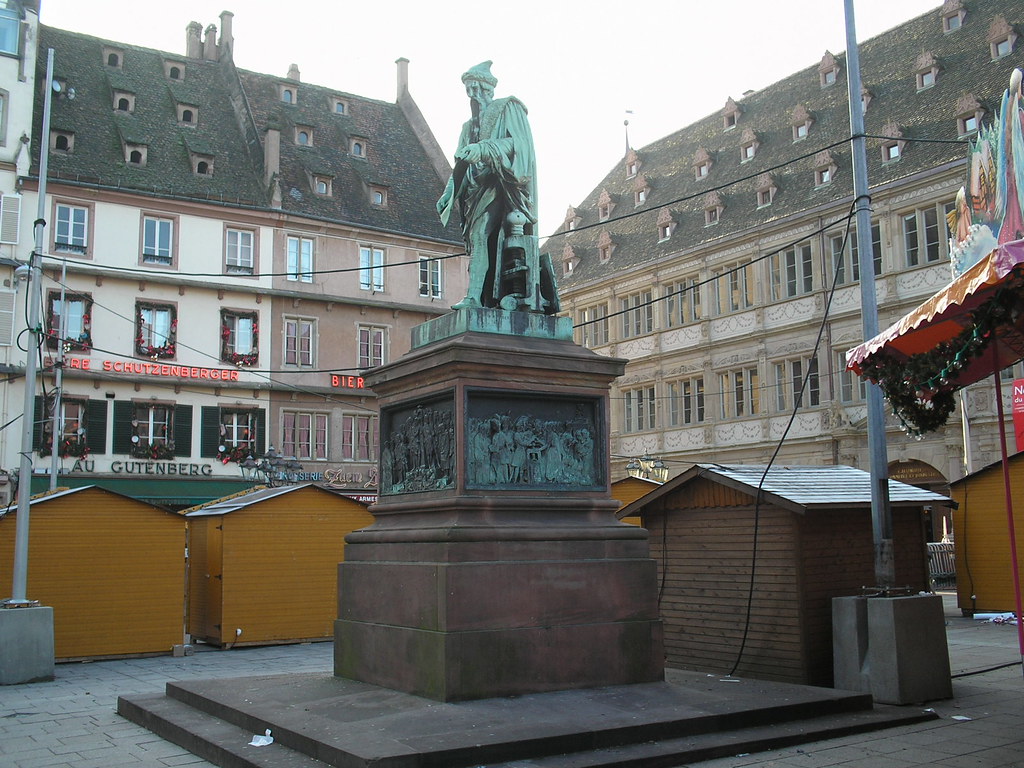
I can't believe I never thought to ask my own brother before! Back in January, when he took us to the used book vendors in place Gutenberg in Strasbourg, I discovered a book I couldn't resist buying—despite the 30€ price—for no other reason than that I had mentioned the language it described in my dissertation. It was La Langue des Makere, des Medje et des Mangbetu, par A. Vekens, Dominicain (Editions Dominicaines Veritas, 1928), and the pages were still uncut. But even then, it didn't cross my mind to quiz my brother about the CAR languages he had worked on.
Here are some examples of bracketed relative clauses.
Mangbetu (Vekens 1928) in Congo
A belu [si kesia né môlô ta kira ne] kambuba e faranga môkôtu.
Les hommes [ceux font le travail avec intelligence ceux-là] gagneront des francs beaucoup.
‘Those who work smart get plenty money.’
Sango (my brother, pers. comm.) in CAR
Tene [so mo tene so] ake nzoni ape.
word [thus you say thus] is good not
‘What you say is no good.’
Jabêm (Dempwolff 1939) in PNG
Lip [tec aê gawa nec] gêjac mocseŋ teŋ.
trap [Dem I I-set Dem] it-catch bushfowl one
‘The trap I set caught a bushfowl.’
South Watut (Holzknecht 1989) in PNG
Jek i-ra jiyaʔ ri naip a [ti ra-gin afu ŋga]
Jack he-cut tree with knife [Dem I-give to Dem]
‘Jack cut the tree with the knife which I gave him.’
Patep (Lauck 1980) in PNG
Ông ob tyoo yii yuu nuhu [wê ob lam ge]
you will dodge spear two arrow [Rel will come Rel]
‘You will dodge the spears and arrows that will come.’
Gulag Returnees Meet Their Accusers
From The Whisperers: Private Lives in Stalin's Russia, by Orlando Figes (Metropolitan, 2007), pp. 583-587:
'Now those who were arrested will return, and two Russias will look each other in the eye: the one that sent these people to the camps and the one that came back.' With those words the poet Akhmatova anticipated the drama which unfolded as prisoners returned from the camps to confront colleagues, neighbours, friends who had informed on them....
Ibragim Izmail-Zade was a senior professor of medicine and a departmental head at the Institute of Medicine in Baku at the time of his arrest, in 1938, on charges of belonging to an 'anti-Soviet group of Azerbaijani nationalists'. After his release from the Kolyma camps, he returned to Baku, where he took up a junior position in the same institute. Instead of the cutting-edge research he had done in the 1930s, he was now employed in routine clinical work. During the trial of M. D. Bagirov, the former Party boss of Azerbaijan, in 1955, Ibragim appeared as a witness for the prosecution, in which capacity he was allowed to look at his own file from 1938, when Bagirov had led the terror campaign in Baku. Ibragim discovered that he had been denounced by his favourite student, who had since gone on to become the head of his department at the institute. While Ibragim was in Kolyma, the former student had often visited his wife and daughter, who treated him as a member of the family. The old student was noticeably cooler in his behaviour after Ibragim's return, rarely coming to the house, and never in the evening, when he would have been obliged to eat or drink with him. After his discovery of the denunciation, Ibragim and his family were forced to see the former student several times, and while they never spoke to him about his actions, it was clear that the Izmail-Zades now knew of the betrayal. One day the political director of the institute appeared at the Izmail-Zade house. He wanted Ibragim to sign a document stating that his family had no grievance against the former student, and that they would remain on friendly terms. Ibragim refused to sign. He had to be restrained from throwing the official out on the street. According to his daughter, Ibragim was crushed by the betrayal. He felt humiliated at being forced to work beneath someone who, he felt, was hardly qualified. Being asked to sign the document had been the final straw....
Many former prisoners were surprisingly forgiving towards the people who had informed on them. This inclination to forgive was seldom rooted in religious attitudes, ... but it was often based on the understanding, which was shared by everyone who had experienced the prisons and the camps of the Gulag system, that virtually any citizen, no matter how good they might be in normal circumstances, could be turned into an informer by pressure from the NKVD.
19 May 2008
Wordcatcher Tales: gatvol, makwerekwere, utari
I'm still bogged down with obscure linguistic research projects that are not yet bloggable, and already half-blogged books on depressing 20th-century European history that I haven't finished reading. But I see that two other bloggers, Khanya and No-sword, have explored the social context of some interesting vocabulary from two far-outlying parts of the globe, the northernmost island of Japan and the southernmost country in Africa. So, without further ado, here are snippets of Wordcatcher Tales by proxy.
Steve at Khanya appends the following glossary to a post on Xenophobia – the gatvol factor in South Africa:
Steve at Khanya appends the following glossary to a post on Xenophobia – the gatvol factor in South Africa:
1. Gatvol - which being interpreted for the benefit of makwerekwere [2], is Afrikaans, meaning literally “hole full”, or more idiomatically, “Fed up”, or “had enough”, or “had it up to here”.Another South African blogger who in his home country was mistaken for a Nigerian explains the second term more specifically at The Zeleza Post:
2. Makwerekwere - which, being interpreted for the benefit of foreigners, means foreigners.
Makwerekwere is the derogatory term used by Black South Africans to describe non-South African blacks. It reminds one of how the ancient Greeks referred to foreigners whose language they did not understand as the Barbaroi. To the Black South African, makwerekwere refers to Black immigrants from the rest of Africa, especially Nigerians. I was confounded by the fact that Black South Africa had begun to manufacture its own kaffirs so soon after apartheid.Meanwhile, Matt at No-sword investigates why the Hokkaido Ainu Association, founded in 1930, changed its name to the Hokkaido Utari Association in 1961, and has now announced it will revert once again to its original name.
Ainu is obviously the name used to refer to the Ainu as a people distinct from other peoples; this is directly from the Ainu word aynu which means, predictably, "man" or "person" (as opposed to "supernatural being").
Utari is a more interesting word. As a loan word in Japanese, it is usually glossed as "compatriot" ("同胞", dōhō), which usually implies "fellow Ainu". Its etymology in Ainu is more interesting.
15 May 2008
Evading Jim Crow in Caroline County, Virginia
New York Times editorial board member Brent Staples has some interesting background on how people of mixed race (as legally defined) evaded the Jim Crow laws in Caroline County, Virginia. It's entitled Loving v. Virginia and the Secret History of Race:
Americans born in the 21st century will shake their heads in disbelief on learning that 40 states once had laws prohibiting interracial marriage. [Note: There were only 11 states in the Confederacy.—J.] The Supreme Court struck down the last of these statutes in the 1967 case of Mildred and Richard Loving, a black woman and a white man who were arrested and banished from Virginia for the crime of being married....
Like many rural areas in the Jim Crow South, Caroline County was governed by two competing racial ideologies. The impulse toward segregation was of course etched in law. But Central Point, which had been a visibly mixed-race community since the 19th century, was home to a secret but paradoxically open interracialism. The community’s story goes a long way toward explaining how the Lovings thought about race and why they behaved as they did.
Virginia slave owners, including Thomas Jefferson, were notorious for fathering children with their slaves. The 19th-century diarist Mary Boykin Chesnut could easily have been speaking of Caroline County planters when she wrote: “Like the patriarchs of old, our men live all in one house with their wives and their concubines; and the mulattoes one sees in every family partly resemble the white children.”
Many of the mixed-race men and women in Caroline County settled in and around Central Point. They were already thriving by the early 20th century. Their church, St. Stephen’s Baptist, was, as one historian noted, “the largest and most costly house of worship in Caroline, white or colored.” People in the congregation and community were “as a whole, very nearly white,” the historian wrote, “and, out of their community, could not be recognized or distinguished as colored people.”
Inside Caroline County, Virginia’s strict laws on segregation applied. But when they ventured beyond Caroline County — where no one knew them — many of Central Point’s residents found it a simple matter to “pass” as white. They visited white-only movie houses and restaurants. They also served in all-white units of the segregated Army during World War II.
The community developed a system for protecting the racial identities of Central Pointers who moved away and married into white families. When they took their white relatives back with them to visit, their younger brothers and sisters, who attended the colored school, just stayed home. This was well known to the teachers at the school, who apparently accepted the absences without question.
The state officials who enforced segregation were clearly aware of what Central Point’s residents were up to and tried to stop it. They circulated lists of families described as descendants of black people. For a time, the state “corrected” birth certificates to note the “real” race of the bearer. It didn’t change things much in Central Point.
By the time that Richard and Mildred had begun to date in the 1950s, they had lived their whole lives in a community that had made an art form of evading Jim Crow restrictions on relationships.
14 May 2008
Gorky: 'We need more camps like Solovetsky'
From The Whisperers: Private Lives in Stalin's Russia, by Orlando Figes (Metropolitan, 2007), pp. 192-194:
In August 1933, a 'brigade' of 120 leading Soviet writers went on a boat tour of the White Sea Canal organized by Semyon Firin, the OGPU commander of the labour camps at the canal. The idea of the trip had its origins in a meeting that took place in Maksim Gorky's Moscow house in October 1932, at which a number of the country's leading writers discussed the tasks of literature with several Politburo members, including Stalin, and other Party functionaries. In one of the earliest statements of the Socialist Realist doctrine, Gorky called for a heroic literature to match the 'grand achievements' of the Five Year Plans, and Stalin, who compared the Soviet writers to 'engineers of the human soul', proposed a tour of the canal to inspire them. Everything was organized by OGPU. 'From the minute we became the guests of the Chekists, complete Communism began for us,' the writer Aleksandr Avdeyenko later commented ironically. 'We were given food and drink on demand. We paid nothing. Smoked sausage, cheeses, caviar, fruit, chocolate, wines and cognac – all was in plentiful supply. And this was a year of famine.'...
The writers had different reasons for colluding in this legitimation of the Gulag. No doubt there were some who believed in the Stalinist ideal of perekovka, the remoulding of the human soul through penal labour....
Gorky was also a believer. He never visited the White Sea Canal. But this was no obstacle to his glowing praise of it in the book commissioned by OGPU (just as ignorance was no obstacle to foreign socialists, like Sidney and Beatrice Webb, who also praised the canal as 'a great engineering feat ... a triumph in human regeneration' in 1935). Having spent the 1920s in the West, Gorky had returned to the Soviet Union on the first of several summer trips in 1928 and had settled there for good in 1931. The 'great Soviet writer' was showered with honours; he was given as his residence the famous Riabushinsky mansion in Moscow; two large dachas; private servants (who turned out to be OGPU spies); and supplies of special foods from the same police department that catered for Stalin. So perhaps it is not surprising that Gorky failed to see the immense human suffering that lay behind the 'grand achievements' of the Five Year Plan. In the summer of 1929, Gorky had visited the Solovetsky labour camp. The writer was so impressed by what he was shown by his OGPU guides that he wrote an article in which he claimed that many of the prisoners had been reformed by their labour in the camp and loved their work so much that they wanted to remain on the island after the completion of their sentences. 'The conclusion is obvious to me,' Gorky wrote: 'we need more camps like Solovetsky.'
11 May 2008
Linguists Bearing Orthographies, 3: Dempwolff vs. Labialized Labials
One of the things I've discovered in puttering about lately in my Sprachbundesgarten of little-known languages in Papua New Guinea is that Otto Dempwolff, the granddaddy of historical and comparative Austronesian linguistics, did not recognize the possibility of labialized labial phonemes (/pʷ/, /bʷ/, /mʷ/), despite how common they are among Oceanic languages. Since Dempwolff was the chief linguistic adviser of most of the German Lutheran missionaries in New Guinea, his theoretical insights as well as limitations influenced many of the new writing systems devised by those missionaries for evangelical and teaching purposes.
I had long been aware of his influence on Jabêm, a Lutheran mission and school lingua franca in Morobe Province, PNG, where I did fieldwork in 1976. (My host father had been a teacher in Jabêm schools.) Dempwolff spent the last months of his life completing a grammatical description of Jabêm, working with a missionary, Heinrich Zahn, who was no mean linguist himself. Dempwolff died in 1938 and the grammar appeared in 1939, a rather inauspicious year that helped condemn that work to undeserved obscurity.
In Jabêm orthography, labialized velars, that is, velar consonants with secondary rounding, are written as kw, gw, ŋgw, but labialized labials are written with an intermediate round vowel before the vowel that forms the nucleus of the syllable. So [mʷa] is written moa, [pʷa] is written poa, [bʷa] is written boa, and [mbʷa] is written mboa. This seems inconsistent to me, but presents no major hurdle for people writing Jabêm. (A much greater nuisance stems from the decision to distinguish the two sets of mid vowels by marking the much more frequent member of each pair with a circumflex: upper-mid ô, ê are far more ubiquitous than lower-mid e, o.)
Jabêm's closest relative is Bukawa, which has been so long overshadowed by Jabêm's prestige that its literate speakers wrote in Jabêm rather than in their own far more varied and numerous village dialects. Now, however, a linguist from SIL International has published a grammar of Bukawa, based on a dozen years residing among its speakers. In Bukawa orthography, labialization is uniformly indicated by -w-, whether it follows a labial, velar, or even alveolar consonant (/dʷ/). (Bukawa also has a voiceless lateral, written lh, and voiceless semivowels, written yh and wh. Fascinating, and rather exotic within its Sprachbund.) In other respects, the new Bukawa orthography follows its Jabêm predecessor.
I've only recently discovered that the Sio language on the north coast of the Huon Peninsula suffered a far worse orthographic fate. The Sio community should have been assigned to the Jabêm church circuit, which included mostly Austronesian-speaking communities along the southern half of the Huon Peninsula and along the south side of the Huon Gulf. Instead, Sio was assigned to the Kâte circuit, which used a Papuan lingua franca. Worse yet, the orthography of Siâ (as it is written) was based on that of Kâte, which was also greatly influenced by Dempwolff. The dedication page of the Lutheran missionary Pilhofer's 1933 grammar of Kâte reads Herrn Professor Dr. Otto Dempwolff / in Dankbarheit und Verehrung / Ehrerbietigst Gewidmet.
Both Kâte and Sio have a set of "labiovelar" stops that are written as (voiceless) q and (voiced) q. (My boldfaced q stands for a curly q with hooked serifs that I cannot properly render here.) Each language also has a prenasalized "labiovelar" that is written ŋq in Kâte and mq in Sio. Sio also has a "labiovelar" nasal, written ɱ. Most of the German-era orthographies represent the velar nasal with ŋ and people still seem quite comfortable with it, calling it the 'long en'.
Michael Stolz, the missionary who first reduced Sio to writing, translated and compiled a book of Bible stories, catechisms, and hymns in the language, which was edited and published posthumously by his successor, Hans Wagner. After Stolz died in 1931 (after 20 years in the field), Dempwolff used his materials to write up a very rough sketch of Sio grammar, which was never published, but was transcribed by "L. Wagner" (perhaps the wife of Hans) in 1936. Dempwolff retained the "labiovelar" class of consonants.
In 1985, an SIL couple, Stephen and Dawn Clark, arrived to work among the Sio people, who soon asked about reforming their orthography to better match the conventions of Tok Pisin and English, with which most villagers were now more familiar. The Clarks discovered that the "labiovelars" were all pronounced as labialized labials ([pʷ], [bʷ], [mbʷ], [mʷ]), even by the oldest villagers they could find. (Judging from his fieldnotes, a colleague of mine discovered the same thing when he collected survey data on Sio in 1976.) The word for 'snake', for instance, was spelled ɱâta and pronounced [mʷɔta]. Its cognates are pretty widespread in Oceanic languages.
So the Sio people readily abandoned their old symbols for the labiovelars (the two varieties of q and the long ɱ, in favor of the usual labial consonants with a superscript ʷ. Feeling strongly that the labialized labials were unit phonemes, they at first insisted on writing the labialization with a superscript, but after several years they got used to writing pw, bw, mbw, and mw instead of troubling with superscripts.
So now I'm wondering, could the "labiovelars" in Kâte also be reanalyzed as labialized bilabials? Pilhofer (1933) says quite clearly that his q and curly q are both labiovelar stops, in which kp and gb are coarticulated and simultaneously released. But now I'm suspicious. I wouldn't question Pilhofer if Kâte were an African language, but I haven't encountered such coarticulated stops in New Guinea. Then again, I haven't looked at the phonologies of many Papuan languages.
References and further details on the above are now available in Wikipedia. Earlier disgruntled musings on linguists and Oceanic orthographies can be found here and here.
UPDATE: According to the World Atlas of Linguistic Structures, Eastern New Guinea is one of only two areas of the world with labiovelar stops. The other is Central and West Africa. Kâte is included in their very small sample of such languages, based on a Kâte dictionary published in 1977 (which I have never seen). So Pilhofer appears to have been correct, and Sio appears to have been doubly ill served, first by adopting a mismatched Papuan language for its orthographic model, and second by Dempwolff's failure to recognize labialized labials.
I had long been aware of his influence on Jabêm, a Lutheran mission and school lingua franca in Morobe Province, PNG, where I did fieldwork in 1976. (My host father had been a teacher in Jabêm schools.) Dempwolff spent the last months of his life completing a grammatical description of Jabêm, working with a missionary, Heinrich Zahn, who was no mean linguist himself. Dempwolff died in 1938 and the grammar appeared in 1939, a rather inauspicious year that helped condemn that work to undeserved obscurity.
In Jabêm orthography, labialized velars, that is, velar consonants with secondary rounding, are written as kw, gw, ŋgw, but labialized labials are written with an intermediate round vowel before the vowel that forms the nucleus of the syllable. So [mʷa] is written moa, [pʷa] is written poa, [bʷa] is written boa, and [mbʷa] is written mboa. This seems inconsistent to me, but presents no major hurdle for people writing Jabêm. (A much greater nuisance stems from the decision to distinguish the two sets of mid vowels by marking the much more frequent member of each pair with a circumflex: upper-mid ô, ê are far more ubiquitous than lower-mid e, o.)
Jabêm's closest relative is Bukawa, which has been so long overshadowed by Jabêm's prestige that its literate speakers wrote in Jabêm rather than in their own far more varied and numerous village dialects. Now, however, a linguist from SIL International has published a grammar of Bukawa, based on a dozen years residing among its speakers. In Bukawa orthography, labialization is uniformly indicated by -w-, whether it follows a labial, velar, or even alveolar consonant (/dʷ/). (Bukawa also has a voiceless lateral, written lh, and voiceless semivowels, written yh and wh. Fascinating, and rather exotic within its Sprachbund.) In other respects, the new Bukawa orthography follows its Jabêm predecessor.
I've only recently discovered that the Sio language on the north coast of the Huon Peninsula suffered a far worse orthographic fate. The Sio community should have been assigned to the Jabêm church circuit, which included mostly Austronesian-speaking communities along the southern half of the Huon Peninsula and along the south side of the Huon Gulf. Instead, Sio was assigned to the Kâte circuit, which used a Papuan lingua franca. Worse yet, the orthography of Siâ (as it is written) was based on that of Kâte, which was also greatly influenced by Dempwolff. The dedication page of the Lutheran missionary Pilhofer's 1933 grammar of Kâte reads Herrn Professor Dr. Otto Dempwolff / in Dankbarheit und Verehrung / Ehrerbietigst Gewidmet.
Both Kâte and Sio have a set of "labiovelar" stops that are written as (voiceless) q and (voiced) q. (My boldfaced q stands for a curly q with hooked serifs that I cannot properly render here.) Each language also has a prenasalized "labiovelar" that is written ŋq in Kâte and mq in Sio. Sio also has a "labiovelar" nasal, written ɱ. Most of the German-era orthographies represent the velar nasal with ŋ and people still seem quite comfortable with it, calling it the 'long en'.
Michael Stolz, the missionary who first reduced Sio to writing, translated and compiled a book of Bible stories, catechisms, and hymns in the language, which was edited and published posthumously by his successor, Hans Wagner. After Stolz died in 1931 (after 20 years in the field), Dempwolff used his materials to write up a very rough sketch of Sio grammar, which was never published, but was transcribed by "L. Wagner" (perhaps the wife of Hans) in 1936. Dempwolff retained the "labiovelar" class of consonants.
In 1985, an SIL couple, Stephen and Dawn Clark, arrived to work among the Sio people, who soon asked about reforming their orthography to better match the conventions of Tok Pisin and English, with which most villagers were now more familiar. The Clarks discovered that the "labiovelars" were all pronounced as labialized labials ([pʷ], [bʷ], [mbʷ], [mʷ]), even by the oldest villagers they could find. (Judging from his fieldnotes, a colleague of mine discovered the same thing when he collected survey data on Sio in 1976.) The word for 'snake', for instance, was spelled ɱâta and pronounced [mʷɔta]. Its cognates are pretty widespread in Oceanic languages.
So the Sio people readily abandoned their old symbols for the labiovelars (the two varieties of q and the long ɱ, in favor of the usual labial consonants with a superscript ʷ. Feeling strongly that the labialized labials were unit phonemes, they at first insisted on writing the labialization with a superscript, but after several years they got used to writing pw, bw, mbw, and mw instead of troubling with superscripts.
So now I'm wondering, could the "labiovelars" in Kâte also be reanalyzed as labialized bilabials? Pilhofer (1933) says quite clearly that his q and curly q are both labiovelar stops, in which kp and gb are coarticulated and simultaneously released. But now I'm suspicious. I wouldn't question Pilhofer if Kâte were an African language, but I haven't encountered such coarticulated stops in New Guinea. Then again, I haven't looked at the phonologies of many Papuan languages.
References and further details on the above are now available in Wikipedia. Earlier disgruntled musings on linguists and Oceanic orthographies can be found here and here.
UPDATE: According to the World Atlas of Linguistic Structures, Eastern New Guinea is one of only two areas of the world with labiovelar stops. The other is Central and West Africa. Kâte is included in their very small sample of such languages, based on a Kâte dictionary published in 1977 (which I have never seen). So Pilhofer appears to have been correct, and Sio appears to have been doubly ill served, first by adopting a mismatched Papuan language for its orthographic model, and second by Dempwolff's failure to recognize labialized labials.
Martyrs of the Beer Hall Putsch
From: Sacred Causes: The Clash of Religion and Politics, From the Great War to the War on Terror, by Michael Burleigh (HarperCollins, 2007), pp. 114-115:
Martyrs were an essential element of all three totalitarian political religions. Düsseldorf tried to get in on the act by creating a cult of relics connected with Albert Leo Schlageter, who had been shot by the French in the occupied Ruhr. His bed was reconstructed, and Hitler received a silver reliquary, allegedly containing the bullet with which he had been killed. This cult never took hold. The most solemn Nazi festival of martyrs was 'Memorial Day for the Fallen of 9 November', whereby the Nazi party commemorated the sixteen men killed in the abortive 9 November 1923 putsch. This was a very subtle blending of wartime remembrance days with Corpus Christi processions, whose purpose was to transform a squalid fiasco into one of the most significant events in German history. The defeat of the putsch became a victory because the dead men's 'sacrifice' heralded the Nazi 'seizure of power' a decade later. The shots fired by Munich policemen had only succeeded, as Hitler unfortunately put it, in 'stirring the river of blood that has flowed ever since'. Their blood, he explained in 1934, was 'the baptismal water' of the new Reich. That year, he merely laid a wreath at the Feldherrnhalle. By 1935 altogether more elaborate arrangements had been made, which never changed thereafter, whenever Hitler had to commune with his sixteen' Apostles' – for naturally he had to go four better than the original Messiah.
The religious parallels began on the evening of 8 November, when Hider and his 'old guard' had a 'Last Supper' in the historic Burgerbräukeller. The next day, a silent procession snaked through the streets of Munich, a procession literally signifying the Movement, with only drumbeats marking its progress. The procession passed 255 portentous-looking pylons or stelae supporting urns from which smoke rose, and on which the names of all the Party dead were inscribed. The lower floors and shop fronts were covered by red cloth to mask distractions, while banners hung from the upper floors and criss-crossed the streets. After pausing to honour the dead at the first cult site, the Feldherrnhalle, the procession turned into a triumphal march to the Königsplatz, the march symbolising the Nazi 'seizure of power' in 1933. Paul Ludwig Troost had constructed two mausoleums, each with a sunken chamber containing eight of the iron sarcophagi in which the sixteen martyrs were buried. These were exposed to the elements, so that both God and 'the Reich' could see them. Dedicating these temples in 1935, Hitler plumbed uncharted depths of bathos:Because they were no longer allowed to personally witness and see this Reich, we will make certain that this Reich sees them. And that is the reason why I have neither laid them in a vault nor banned them to some tomb. No, just as we marched back then with our chest free so shall they now lie in wind and weather, in rain and snow, under God's open skies, as a reminder to the German nation. Yet for us they are not dead. These pantheons are not vaults but an eternal guardhouse. Here they stand guard for Germany and watch over our Volk. Here they lie as true witnesses of our Movement.A roll-call of the martyrs' names was taken, with the Hitler Youth responding 'Present!' Hitler walked up the steps of the mausoleums to commune silently with the not-really-dead, who became figuratively present in the SS guards who took up stations after Hitler had left.
10 May 2008
St Vladimir of the October Revolution
From: Sacred Causes: The Clash of Religion and Politics, From the Great War to the War on Terror, by Michael Burleigh (HarperCollins, 2007), pp. 53-54:
Krupskaya's wish that her husband [V. I. Lenin] be interred with other old comrades was ignored in favour of mummifying his corpse, a step apparently inspired by worldwide fascination with he contemporary excavation of Luxor and discover of the tomb of the pharoah Tutankhamen, although the intention was to preserve for eternity what Robert Service has dubbed 'Saint Vladimir of the October Revolution'. Lenin's mummified corpse was displayed in a temporary timber mausoleum in the Wall of the Kremlin before this was replaced in 1930 by a permanent stone structure. The design reminded one Russian commentator of the tomb of King Cyrus near Murgaba in Persia, although the model was actually the mausoleum of Tamerlane. The prime movers in the preservation of Lenin's body were Bonch-Bruevich, Leonid Krasin and Lunacharsky, ironically all erstwhile God-builders who had clashed with Lenin on this very issue. They formed an 'Immortalisation Commission'. The reasons for Lenin's mummification were several. His early death, probably brought about by chronic bureaucratic overwork that he had been unaccustomed to in the earlier decades of his life, was a metaphor for the years of revolutionary elan and enthusiasm that were ineluctably passing away. Mummification meant that the moment would exist in this curious symbolic form throughout time. His spirit would also endure in the Party: 'Lenin lives in the heart of every member of our Party. Every member of our Party is a small part of Lenin. Our whole communist family is a collective embodiment of Lenin.' The aura of this dead St Vladimir would spread to his lesser successors, who henceforth were in control of what he had or had not said or written during his lifetime. Significantly, Stalin managed to gain influence over the fledgling Lenin Institute at the Party's Sverdlov university, and through The Foundations of Leninism, in which he explained Lenin's ideology to the new Party intake, thereby establishing himself as guardian of the canonical texts.
And what was the net result of this vicious campaign against religion? The Party-state could certainly deploy more force, and did so against the Orthodox clergy. But the ranks of the militant godless waned as quickly as they had waxed, and they were usually filled with the intellectually low grade in the first place. Peasants, whether on the land or newly transplanted to the cities, found ways of resisting this assault on their beliefs, perhaps by sending grannies to obstruct four-eyed student atheists or using loopholes in the law to retain use of a church. Committed religious believers became more entrenched in their faith, while the more casually secure fell away, probably without turning to the dominant secular creed.
07 May 2008
Reshaping the Vatican State, 1929
From: Sacred Causes: The Clash of Religion and Politics, From the Great War to the War on Terror, by Michael Burleigh (HarperCollins, 2007), pp. 68-71:
The road to the 1929 Concordat and Lateran Treaties was paved by small but significant gestures whose ulterior motive was to render the PPI [Partito Popolare Italiano] irrelevant long before it was abolished. The librarian pope [Pius XI] was presented with the Chigi collection of books and manuscripts, purchased by the Italian government in 1918. The Vatican removed its interdict upon a chapel in the Quirinal Palace, enabling the king's eldest daughter to marry there a few days later. Crucifixes reappeared on the walls of classrooms and lecture theatres, with an imposing wooden cross in the middle of the pagan Colosseum. Holy Week in 1925 went smoothly, due in no small part, as Pius XI acknowledged, to the co-operation of the Fascist government. Since not even Mussolini had the effrontery to grace the seven centuries' anniversary of the death of St Francis of Assisi, secretary of state Merry del Val had to make do with the education minister. But in 1925 Mussolini made a point of marrying Donna Rachele in church, a decade after their civil union. Totally ignoring their own Party programme, the Fascists restored properties once confiscated from religious orders, bailed out the ailing Bank of Rome, increased clerical salaries and modified the law in directions that benefited the Church. The regime closed fifty-three brothels and suppressed the freemasons – widely regarded within the Church as the dark power behind liberal anticlericalism – notwithstanding the fact that the masons had contributed generously to Fascist Party coffers, while several Fascist hierarchs, including Acerbo, Balbo, Farinacci and Rossi, were of the apron-and-trowel persuasion. In 1931 the regime banned abortion and beauty contests, measures that were welcomed by the Church.
The first formal initiative in solving the perennial Roman Question began in 1925 with the appointment of a commission designed to soothe certain neuralgic sensitivities in relations between Church and state. Despite the fact that Pius XI disowned the commission, changes in the government – the dismissal of the anticlerical Roberto Farinacci as Party secretary and the appointment of the Nationalist lawyer Alfredo Rocco as minister of justice – facilitated contacts. Two lawyers handled the talks, Francesco Pacelli, brother of Eugenio, at that point nuncio to Germany, and Domenico Barone, a senior civil servant in Rocco's Justice Ministry. These men resolved such issues as the sovereign status of the Vatican City and the extraterritoriality of papal basilicas and palaces; a compensation package that the papacy was to receive in lieu of its lost revenues from the former Papal States; and guarantees of unimpeded communications between the Vatican and the wider Catholic world. These measures formed the basis of the 1929 Lateran Treaties. Thenceforth the temporal patrimony of the papacy has consisted of a 109-acre territory, roughly comparable in size with London's St James's Park or about a tenth of the area of New York's Central Park. It had its own coinage, garage, postal system, radio transmitter, newspaper and printing press, a jail and a school, a mini-railway line and, of course, separate diplomatic accreditation and the famed Swiss Guard. Vatican Radio (whose transmitter rather than broadcasting station is within the enclave) was intended to underline the Church's role in the wider world.
The miniscule size of the Vatican State was designed to contrast advantageously with the limitlessness of the claim to spiritual power. The wealth of the Vatican was also mythic, as can be seen from the related financial convention. The grant of 750 million lire in cash and a billion in consolidated government stock was urgently needed, even though the papacy agreed to take the cash in instalments and not to sell the stock. During the First World War, pope Benedict XV had given away his own fortune and then the Holy See's ordinary revenue to repatriate prisoners of war and to afford succour to civilian refugees, so that by 1922 the Vatican Treasury consisted of the lire equivalent of £10,000 or roughly US$19,000. Unable to pawn a Bernini, Michelangelo or Raphael, his successor managed to deplete the financial resources still further, with generous donations to those ruined by inflation in Weimar Germany and gifts to the starving multitudes in the Soviet Union. Only the generosity and financial acumen of North American Catholics, who contributed half the papacy's income in the 1920s, staved off financial ruination.
Unlike the Treaty, the Concordat between the Vatican and the Italian state took two years to negotiate. For Pius XI it was a significant step in the re-Christianisation of Italian society, in the re-establishment of a 'Res publica Christiana'. It ended the unified Italian state's usurpation of the right of defunct Italian principalities to veto nominations to bishoprics and many other ecclesiastical offices and to appropriate the revenues of vacant benefices. The state now accorded civil recognition to the sacrament of marriage, which remained indissoluble as it had been under the civil code. The Roman Segnatura, the supreme ecclesiastical court, would henceforth deal with dispensations or nullifications. In other respects, the Church's antipathy to artificial birth-control harmonised with the Fascist state's militant quest for births. Fascism also wanted women on the maternity bed or in the kitchen in ways that conformed with Catholic models. Religious instruction was reintroduced into secondary as well as primary schools, thus negating the wish of the first Fascist education minister to teach older children philosophy rather than religion. The state also agreed to recognise diplomas awarded by pontifical universities. Most importantly, in article 43, the state conceded an autonomous space to Catholic Action: 'The Italian state recognises the organisations affiliated to the Italian Catholic Action in so far as these shall, as has been laid down by the Holy See, develop their activities outside all political parties and in immediate dependence on the hierarchy of the Church for the diffusion and realisation of Catholic principles.' In other words, a state that in May 1929 formally styled itself 'totalitarian' had conceded the Church's right to operate a variety of associations independently of such Fascist organisations as the Balilla youth movement, which had to desist from scheduling its activities to subvert Catholic holidays. Of course, the general climate created by Fascism stealthily leached into the Italian Church itself through something resembling osmosis. Even as it resisted Fascism, the Church tried to keep up with its heroic version of modernity. Under a regime that was ostentatiously virile, the Church endeavoured to 'de-feminise' its own image in favour of a more muscular tone. Clerical novels celebrated priests who were war veterans and athletically built devotees of 'extreme sports' -Pius XI himself being a keen climber.
06 May 2008
Stakhanovites as the New (Leisure) Class
From: Sacred Causes: The Clash of Religion and Politics, From the Great War to the War on Terror, by Michael Burleigh (HarperCollins, 2007), pp. 89-91 (reviewed here and here):
The Soviet Union was not immune to what was emerging as a global cult of celebrity, or notoriety, focused on athletes, aviators, boxers, film-stars, gangsters, mountaineers and, as we have seen, dictators. Already, the commissar for heavy industry, Sergo Ordzhonikidze, had launched the search for 'new people', saying, 'In capitalist countries, nothing can compare with the popularity of gangsters like Al Capone. In our country, under socialism, heroes of labour, our Izotovites, must become the most famous,' a reference to Nikita Izotov, a miner whom colleagues described rather sourly as 'the human cutting machine'. But Izotov was destined to be eclipsed, along with the new hybrid Marx, Aristotle and Goethe.
In 1931 Pravda ran features under the slogan 'The Country Needs to Know its Heroes', consisting of photographs of aviators, collective farmers, shock-workers and the like. The concept of the exemplary elite was primarily associated with Aleksei Stakhanov, a thirty-year-old Donbass coalminer, who in August 1935 managed to cut 102 tons of coal (or fourteen times his norm) in a single shift—moreover, with the aid of a trusty Soviet-produced pneumatic pick. Stakhanov had migrated from a village in Orel, working his way up from pony-brakeman to manual pick operative, before getting his hands on the air-powered pick that brought him fame and fortune. Of course the work was done at night, enabling Stakhanov to maximise his labours as compressed air went to his pick alone, and his six-hour continuous stint was facilitated by a lengthy logistical chain beginning with the men installing timber props behind him. Nonetheless, the anonymous battalions of shock-workers were thenceforth superseded by a Soviet Hercules with a human face. 'Recordmania' spread like a feverish sickness, with managers and foremen sweating too lest they be denounced as 'bigwigs', 'windbags', 'routiners', 'wreckers', or 'saboteurs' for failing to make these 'Stakhanovite' feats feasible, rendering them liable to what the Kremlin's own Al Capone sinisterly called 'straightening out' or 'a tap on the jaw'. It mattered not that these epic episodes tended to deplete machinery and leave 'Stakhanovites' spent, or that some workers resented the diversion of resources, the subsequent lifting of their own norms, or the rich rewards such Promethean heroics brought. Schadenfreude best describes those who said of a young female Stakhanovite, who had been rewarded (one hopes she was grateful) with the selected works of Lenin: 'That's what the whore deserves!' Resentment towards Stakhanovites bestriding the factory floors 'like gods' was compounded when they became fixtures of the factory 'production courts'.
Much of the time of stellar Stakhanovites was increasingly spent on tour, whether visiting the Kremlin, addressing other workers or venturing confidently into places—such as the opera or theatre—where workers already did not comfortably go. Even society pages in the newspapers included such gems as 'The brigadier-welder Vl. Baranov (28), the best Stakhanovite at Elektrozavod, glided across the floor in a slow tango with Shura Ovchinnovka (20), the best Stakhanovite at TsAGI. He was dressed in a black Boston suit that fully accentuated his solidly built figure; she was in a crepe de chine dress and black shoes with white trimming.'
In other words, although they talked incessantly about work, Stakhanovites did less and less of it, recalling it, like millionaire footballers or pop stars from humble origins, as something that took on roseate hues in memory of things past. Of course, Stakhanovites had a role to play within a wider myth-in-the-making. As an explicitly hierarchical society replaced one allegedly based on fraternity, they had to acknowledge the crucial guiding role of the nation's father-figure, whose speeches had allegedly originally inspired them to break through artificial barriers while using technology almost as an extension of their own brain. Stakhanovites, who were often not members of the Party, were also model citizens in respects other than dutiful sons and daughters of the ultimate patriarch. Their lifestyle was supposed to exemplify the theme that 'life is joyous, comrades', and since they were showered with official munificence while simultaneously enjoying very high wages, the joyous life seemed like an idyllic shopping spree, for clothes, clocks, furniture, motorbikes, perfume, phonographs and so forth. Thus adorned and kitted out, Stakhanovites appeared having their leisurely breakfasts, reading the papers, lunching with friends, playing a little volleyball, tea and a game of checkers, while their wives undertook charitable work as 'housewife-activists' and their children were exhorted to their own heroics at school.
Subscribe to:
Posts (Atom)