The Far Outliers will be on the road for the rest of the month. The overland portion will start in Minnesota, then head south through Iowa, Kansas, Missouri, Kentucky, Tennessee, and Mississippi, then east through Alabama and Georgia, then north through South Carolina, North Carolina, Virginia, Maryland, Pennsylvania, New Jersey, and New York to Connecticut for our daughter's graduation over Memorial Day weekend. Then we'll head back west through New York, New Jersey, Pennsylvania, Ohio, Indiana, Illinois, Wisconsin, and Minnesota.
We'll see family in Minnesota, Missouri, Kentucky, Virginia, and Wisconsin; old friends in Georgia, Ohio, and Illinois; and do some sightseeing in the Deep South, especially Natchez and Savannah. Expect little or no blogging, but a lot of new photos on my Flickr account after we return. Among the books I plan to read on the trip are the novel East Wind, Rain, by Caroline Paul (Harper, 2006) and Our Kind of People: Inside America's Black Upper Class, by Lawrence Otis Graham (Harper, 2000).
12 May 2007


11 May 2007
Northeast Asian Maritime Trade Networks, 800-1000
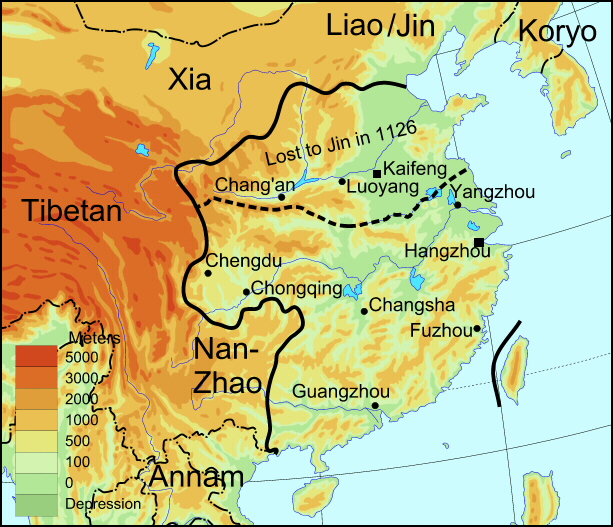
Maritime trade in East Asia began to flourish in the seventh and eighth centuries C.E. It was jump-started by Persian and Arab merchants, who traveled to and settled in ports as far from home as Guangzhou (Canton) in southern China. Later, commerce spread eastward and northward along the coast to Quanzhou, Fuzhou, Mingzhou (Ningbo), and finally Hangzhou, where merchants could gain access to the Chinese interior via the Grand Canal. Foreign trade thus became integrated to a certain extent with China's domestic economy. Although pioneered by Arabs and Persians, this route soon fell under the domination of ethnic Chinese. Meanwhile, Korean merchants established their own trade networks connecting the west coast of Silla with Laizhou, Haizhou, and other ports in north China and entering the canal system through the mouth of the Huai River. In the early ninth century, semiautonomous communities of Korean traders were scattered along much of the north China littoral.SOURCE: Gateway to Japan: Hakata in War and Peace, 500–1300, by Bruce L. Batten (U. Hawai‘i Press, 2006), pp. 111-112
These northern routes were further extended to Japan under the direction of the Korean tycoon Chang Pogo. Chang himself is said to have visited Kyushu in 824 and met with the governor of Chikuzen, although the validity of this account has been questioned. In any case Chang, acting by authorization of the king of Silla, was in charge of maritime defenses at the Ch'ŏnghae garrison on Wan Island by the late 820s or early 830s. It is probably no coincidence that the first Japanese record of "Silla merchants" in Hakata dates from 831.
However, Korean domination of the Hakata trade was short-lived, to say the least. Merchants from Tang make their first known appearance in Hakata in 842, and soon thereafter they completely replace their counterparts from Silla. Chinese merchants bypassed the Korean coastal route entirely, traveling directly across the East China Sea from locations such as Fuzhou and Mingzhou. These same ports continued to supply the bulk of foreign merchants visiting Japan after the demise of Tang (in 907), when they fell under the control, respectively, of the Wu Yue kingdom and then (after 978) the Song empire.


07 May 2007
Japanese Loanwords in Pohnpeian
During the period of Japanese rule (1914–1945) the islands of the Marianas, Palau/Belau and Ponape/Pohnpei were the most intensely colonized areas of Micronesia
The following lists are presented in my rendition of the current standard Pohnpeian spelling. My linguistic source cites the same forms in a phonemic transcription, but I want to give my readers a feel for the workings of one of the most successful orthographies in
Domestic articles
- aisara ‘ashtray’
- asi ‘chopsticks’
- dama ‘lightbulb’
- dawasi ‘Japanese brush’
- dompwuri ‘bowl’
- kadorsingko ‘mosquito coil’
- manaida ‘cutting board’
- parikang ‘hair clipper’
- samusi ‘rice paddle’
- sarasi ‘bleach’
Food items
- aiskehki ‘popsicle’
- ansu ‘star fruit tree’
- dakuwang ‘pickled radish’
- kasuwo ‘skipjack tuna’
- kiarameru ‘caramel’
- kiuhri ‘cucumber’
- pihru ‘beer’
- ramen ‘noodle soup’
- ramwune ‘marble’
- samma ‘mackeral’
- sasimi ‘sashimi’
- saida ‘soda’
- soiu ‘soy sauce’
- sukiaki ‘sukiyaki’
- anaire ‘marble game’ (sometimes araine)
- apadopi ‘long jump’
- damaski ‘pool, billiards’
- deng ‘score’
- iakiu ‘baseball’
- iakumehda ‘hundred meter dash’
- iohidong ‘ready, set, go’
- iranai ‘to pass in a card game’
- kesso ‘to run or swim the final lap in a race’
- kurop ‘baseball glove’
- lepdo ‘left field’
- masuku ‘catcher’s mask’
- pahsdo ‘first base’
- rensuh ‘to practice for an athletic event’
- sahdo ‘third base’
- sakura ‘hanafuda card game’
- sandangdopi ‘hop-skip-jump’
- sansing ‘to strike out [in baseball]’
- sensuh ‘athlete’
- suhdo ‘judo’
- angkasi ‘handkerchief’
- asmaki ‘headband’
- kamidome ‘barrette’
- kapang ‘bag’
- pwundosi ‘loincloth’
- sarmada ‘underwear’ (now women’s vs. pirihp ‘men’s underwear’)
- sohri ‘thongs’ [‘rubber slippers’]
- depwukuro ‘gloves’
Others
- aikiu ‘to ration’
- amimono ‘knitted object’
- anapi ‘fire cracker’
- apwunai ‘watch out!’
- adasi ‘to go barefoot’
- iddai, eddai, edai ‘ouch!’
- daidowa ‘World War II, old times’
- dekking ‘concrete reinforcing bar’
- dempoh ‘telegram’
- dengki ‘electricity, light’
- denso ‘ceiling’
- dendenmwosi ‘large land snail’
- dopas ‘quickly, fast, speedy’
- kairu ‘frog’
- kakko ‘showing off’
- kampio ‘to care for an invalid in the hospital’
- kasdo ‘movie’
- kenkang ‘porch’
- kisingai ‘crazy, mad’
- koiasi ‘fertilizer’
- kona ‘toothpaste’
- kukusuh ‘air gun’
- kuruma ‘cart’
- makunai ‘unskillful, not tasty’
- mangnga ‘cartoon, character’
- mai ‘skillful, good’
- mwohso ‘appendicitis’
- ompwu ‘to be carried on another’s back’
- pariki ‘to go fast’
- paiking ‘infection’
- pangku ‘flat tire, broken slipper’
- pampei ‘security guard’
- pwohsdo ‘post office’
- pwuhseng ‘balloon’
- pwuraia ‘pliers’
- rakudai ‘failure’
- sahpis ‘service’
- sidohsa ‘automobile’
- sirangkawe ‘to ignore’
- sohko ‘warehouse’
- suhmwong ‘to order’
- dampwo ‘rice paddy’
- dane ‘seed’
- dengwa ‘telephone’
- deriuhdang ‘hand grenade’
- impiokai ‘agricultural fair’
- kansohpa ‘copra drying shed’
- kikansu ‘machine gun’
- kinsipakudang ‘atomic bomb’
- osime ‘diaper’
- passai ‘to cut grass’
- pwohkungko ‘air-raid shelter’
- sendohki ‘fighter plane’
- simpung ‘newspaper’
- skohso ‘airport’
- windeng ‘to drive’
SOURCES: Kimi Miyagi. 2000. Japanese loanwords in Pohnpeian: Adaptation and attrition. Japanese Linguistics 7:114–132. Mark R. Peattie. 1988. Nan’yō: The Rise and Fall of the Japanese in
03 May 2007
Hakata: Japan's First International Border, 663
The war of 663—known in Japanese as Hakusuki-no-e-no-tatakai [白村の江の戦い 'Battle of the White Village River'] or the "Battle of the Paekchon River," after the old name for the Kŭm River—has long attracted the attention of historians and laymen alike in Japan....SOURCE: Gateway to Japan: Hakata in War and Peace, 500–1300, by Bruce L. Batten (U. Hawai‘i Press, 2006), pp. 23-25
In Kyushu ... the effects of the war were immense and long lasting.... It is no exaggeration to say that the events of the 660s and early 670s created an international boundary where none existed before. Prior to the war, there was no clear line between "us" and "them," and traffic between the Korean Peninsula and Kyushu was relatively free (although never tremendously frequent, given the dangers and the distances involved). Within a decade after Japan's defeat, such a line had come into existence (in the Korea Strait between Tsushima and Silla), and Japan had a fortified border with a single designated gateway. The gateway was Hakata, and the gatekeeper was Dazaifu, the command center south of the bay.
Of course, Yamato had long had a significant interest in northern Kyushu, and in particular Hakata, because of the area's strategic location. The most sensible way to get from Yamato to the Korean Peninsula was to go down the Inland Sea, follow the northwest Kyushu coast to Hakata, and then cut across the Genkai Sea via the islands of Iki and Tsushima. To control Hakata was thus to control access to the continent—the key to hegemony in early Japan. This is why the Iwai "rebellion" posed such a threat in the 520s, and why the court moved so swiftly to put it down. After Iwai was killed, his son offered territory near Hakata to the court (in order, according to the chronicles, to save his own skin). Soon afterward, in 536, Yamato established a line of granaries (miyake, probably best understood as supply depots) up and down the Inland Sea. Much of Fukuoka Plain was also converted into a granary at this time. In 1984, remains of sixth-century storehouses and office buildings, presumably part of this "Nanotsu Miyake," were uncovered by archaeologists working on a salvage operation near Japan Railways' Hakata Station in Fukuoka.
02 May 2007
The Tang Chinese Predecessors of Matthew C. Perry, 664
Once upon a time, residents of a fishing village in Japan watched with trepidation as a fleet of foreign warships appeared in the offing beyond their own little harbor. The main concern was their lives. What knew what strange creatures might be on board or what nefarious plans had brought them to Japan?...SOURCE: Gateway to Japan: Hakata in War and Peace, 500–1300, by Bruce L. Batten (U. Hawai‘i Press, 2006), pp. 11-14
The year was 1853 and the place was Uraga, situated near the tip of the Miura Peninsula at the mouth of Edo (now Tokyo) Bay.The foreign vessels were under the command of Matthew Calbraith Perry, an American naval officer charged by President Millard Fillmore to induce Japan to establish trade and diplomatic relations with the United States. (Not incidentally, Fillmore wanted Japan to open its ports to American whaling vessels, whaling being one of the great American industries of the era.)...
What few people realize is that Perry's arrival was not the first time that such a scenario had played out upon Japanese soil. The events of 1853 were a close replay of an equally momentous occasion some twelve hundred years earlier. The year was 664, and the location was Tsushima, a mountainous isle (actually, two isles separated by a narrow strait) about 50 kilometers south of the Korean port of Pusan and 150 kilometers west of Hakata on the Kyushu mainland.
On that earlier occasion, the visitors had been Chinese, not American. Their large junks, bearing flags of the Tang empire, had first been sighted on an early summer's day in the fourth month of the Japanese lunar calendar. The ships were slowly approaching Tsushima across the Korea Strait from the general direction of Paekche, a kingdom on the west side of the Korean Peninsula. They seemed to be making directly for the village—or more precisely, for the small harbor below, where the villagers' fishing ships lay at anchor. Those watching the approach were worried—and with good reason....
Only the previous year—663 by the Western calendar ...—a vast fleet had come from Hakata on its way to "rescue Paekche," so they said. Woe be to them! Not long afterward, some of the tattered remnants of Yamato's once-proud navy limped back to Tsushima. Few of the war veterans tarried long; they seemed afraid of who might follow in their wake. The same was true of the many refugees from Paekche—some of them members of the royal family—who accompanied the Japanese survivors. Before long, almost all the new arrivals had departed for the Kyushu mainland, or for Yamato.
01 May 2007
Anne Applebaum on the New Europeans
Looking at the French elections, Anne Applebaum defines Sarkozy's constituency as the New Europeans—those who are willing to emigrate:
Thanks to the European Union, which has opened borders and eliminated employment barriers, it is now not only possible to move, it is downright easy. And not only for the French: Something like a million Poles have left home since Poland joined the European Union in 2004, largely for England and Ireland. Unlike France, Poland is booming. But as in France, high taxes and complex regulations mean that jobs for young Poles are still too scarce and badly paid. Abroad, young Poles earn more and are treated better.
When they come back (if they come back) they'll demand no less. The plumbers in Warsaw already expect to be paid something remarkably close to what plumbers are paid in Berlin -- that is, if you can find a plumber in Warsaw at all.
All of this is, of course, precisely what previous generations of European politicians have feared. For the past decade, French, German and other European leaders have tried to unify European tax laws and regulations, the better to "even out the playing field" -- or (depending on your point of view) to make life equally difficult everywhere. The emigration patterns of the past decade -- and the past five years in particular -- prove that that effort has failed. Sarkozy's election campaign, if successful, might put the final nail in the coffin.
The political and economic consequences of this new mobility could be quite profound. Countries such as Poland and France may soon be forced to scrap those regulations and taxes that hamper employment, however much the French unions and the Polish bureaucracy want to keep them: If they don't, their young people won't come home. Leaders in those countries may also have to alter their rhetoric. Sarkozy's Socialist opponent, Ségolène Royal, now uses words such as "entrepreneurship" at least some of the time, too.
Down the road, there could be cultural consequences as well. A few weeks ago, I wrote about the European Union's failure to create anything resembling a meaningful European "Idea." Almost by accident, the European Union may have created a new kind of European citizen instead: mobile, English-speaking, Internet-using, perhaps with the same nostalgia for Krakow or Dijon that first-generation New Yorkers feel for Missouri or Mississippi but nevertheless willing to live pretty much anywhere. Sarkozy is the first European politician to appeal directly to these new Europeans. Even if he loses, he probably won't be the last.
Yeltsin, Putin, and Deng
In his retrospective on Boris Yeltsin in this week's international edition of Newsweek, Fareed Zakaria contrasts the divergent paths toward reform of China and Russia after their respective ideological houses of cards collapsed.
via Peaktalk
Boris Yeltsin ... will surely stand as a figure on the hinge of history—yet he pointed Russia in the wrong direction. Compare Russia with China. In the early 1990s, they were the two most important countries in the world that lay outside the sphere of democratic, capitalist states. Russia had by far the stronger hand. In those days it was still regarded as the second most important world power, whose blessings were needed for any big international endeavor—whether the first gulf war or Middle East peace negotiations. It had a GDP of $1 trillion (in purchasing-power parity), the world's second largest military and its second largest pool of technically trained personnel. Perhaps most significant, it had the most abundant endowment of natural resources on the face of the earth. And with Yeltsin as president, the country had a charismatic leader who could leverage this hard and soft power.Charles Krauthammer made a similar point last week.
China by contrast was an international pariah. It had just gone through the shame of the Tiananmen Square massacres. Its per capita GDP was just one third that of Russia's, making it one of the poorest countries in the world. Its educational and technological system was still in shambles, having been shut down during the Cultural Revolution. Its leaders—a group of seemingly narrow-minded engineers—were cautiously introducing reforms to a country still limping after decades of Mao Zedong's mad gambits at home and abroad....
Look at the two countries today: though the Russian economy has surged because of high oil and commodity prices, China's is now six times larger. Even more interesting is the political trajectory. Russia, in almost every dimension, has become less free over the past decade....
China, by contrast, has seen greater economic, legal and social reform every year. This year, finally, the Communist Party adopted guarantees of private property and greater government transparency. (For those who dismiss China's reforms because they are "merely" economic, recall that for John Locke and Thomas Jefferson, the right to private property was at the heart of individual liberty.)
My point is not that China is freer than Russia. It is not. But for a decade, the arrow in Russia has been moving backward, while in China it is moving—slowly—forward.
This divergence between the Russian and Chinese models has had powerful implications around the world. Russia has become an example—but a negative example. The Chinese leadership has privately admitted to having watched Yeltsin's reforms and decided that they produced economic chaos, social instability and no growth. (Russia's GDP contracted by 20 percent during the 1990s.) Instead of similar shock therapy—which Bill Clinton's Russia hand Strobe Talbott accurately characterized as "too much shock, too little therapy"—China chose a cautious, incremental path. "We must cross the river by feeling the stones with our feet," said Deng Xiaoping. Rather than shutting down state-owned enterprises, Beijing chose to grow the economy around them, so that the state-owned portion kept shrinking and its problems became more manageable.
Look around the world, from Vietnam to Egypt, and you see officials studying China's economic reforms. I have not come across a single official anywhere who has ever claimed to be emulating Russia's path from communism.
Twenty years ago, Yeltsin made a strategic choice for democracy. Putin and his KGB regime have made a different strategic choice: the Chinese model. They watched two great powers take their exits from communism -- Maoist China and Soviet Russia -- and decided the Chinese got it right.Of course, China also got a head start. Mao Zedong, the Great Ideologue who did more than anyone to discredit utopian ideologies and pave the way for brutally pragmatic realists like Deng, died in 1976.
They saw Deng Xiaoping liberalize the economy while maintaining centralized power -- and achieve astonishing economic success. Then they saw Gorbachev do precisely the opposite -- loosening the political system while keeping an absurdly inefficient communist economy -- and cause the collapse of the regime and the state.
Yeltsin's uncertain, undisciplined and corruption-ridden attempt to deregulate both the economy and the political system caused such chaos that during his tenure gross domestic product fell by half. So Putin decided to become Deng. And while Deng destroyed democratic hopes in one fell swoop at Tiananmen Square, Putin did so methodically and gradually. By the time his goons beat up opposition demonstrators in Moscow and St. Petersburg earlier this month, so little was left of Russian democracy that the world merely yawned.
via Peaktalk
27 April 2007
Rhodesia, 1940: War, Copper, and Race
There had been strikes by white workers in two of the mines in March over pay and conditions, resulting in pay rises which inflamed already tense relations with African mineworkers, who earned in a month about the same as the whites received in a day and got none of their benefits. The public beating of the wife of a black miner after an argument about rations sparked further discontent, culminating in ugly riots in which police opened fire, killing thirteen Africans and injuring many more. Copper was vital to the war effort and Northern Rhodesia was the Empire's main producer, so the mines had to be kept operating seven days a week, and Gore-Browne had been called in urgently by the Governor to mediate. Summoning up all his courage, with faithful Henry by his side as bodyguard and interpreter, he had braved thousands of angry black miners brandishing spears and broken bottles, all backed by the menacing thump of tribal drums, to enter the compound of the ringleaders on the third day of rioting. Many were Bemba, and seeing 'Chipembele' they had agreed to speak, but it had taken all his persuasive powers to get them to down arms and return to work, having wrangled them a few concessions and got the Governor's blessing to promise an official British government inquiry into conditions. I thank the Lord for my gift of getting on with people, he wrote to [his aunt] Ethel.SOURCE: The Africa House: The True Story of an English Gentleman and His African Dream (HarperCollins, 2004), by Christina Lamb, pp. 221-223
Now the Commission was under way, and, along with Sir John Forster who had come out from England to head it, and Thomas Sandford, the Secretary for Native Interests, he had been meeting managers and workers, trying to get them to work together, and going underground to see conditions in the mines. Visiting native compounds, known as the 'locations', he was shocked by the squalid shacks, describing them in his diary as so different to the neat bungalows with the square green lawns of the white workers. European employees had their own club with swimming-pool, tennis courts and golf course, and during the rainy season their residential area was full of purple bougainvillaea, red flame trees, hibiscus and white frangipani.
Gore-Browne hated the Copperbelt, finding it a queer uneasy place, perhaps because of its mixed population dominated by South Africans. Ndola, which he remembered from before the copper boom as a one street place consisting of six corrugated iron huts, was a pleasant enough town with its neat white bungalows and avenues of mahogany trees, trunks painted white to prevent them being eaten by the white ants which devoured everything in the area, though it was hardly the 'new Johannesburg' everyone had predicted when the extent of the copper mines had first been realized. The road to Nkana, following an old Arab slave trail, was lined with beautiful thick teak forest. Mine shafts and derricks dominated the skyline, and there was something about the place that created mutual mistrust and suspicion between all the people—black and white, workers and officials, management and government. Gore-Browne was convinced that the situation would never be properly resolved until African workers were put on an equal footing with their white colleagues, a heretical suggestion for the times, and told Ethel, the whole experience has left me feeling rather Bolshevik—the pettiness and narrow-mindedness of the managers (who deal in millions of pounds) is quite unbelievable. The General Manager of Roan and Mufulira mines for example refused to allow the Trade Unions a phone merely out of spite.
This is as opportune a time as any to inflict upon my dear readers the following old chestnut I first encountered in a footnote in African Language Structures, by William E. Welmers, which I read during an introduction to African linguistics course one summer at the University of Illinois at Urbana-Champaign. Chibemba, like Kiswahili and most Bantu languages, marks noun classes with prefixes that also mark singular and plural for that class. Thus, bantu is 'people', muntu is 'person' (for some speakers, this only refers to black people, like kanaka in the Pacific). Similarly, in Setswana, 'people' are batswana and 'a person' is motswana. The same principle applies to loanwords, so the singular of batenda 'bartender' is mutenda, while the plurals of kitabu 'book' and kipilefti 'roundabout, traffic circle' are vitabu and vipilefti, respectively.
26 April 2007
Disloyalty: Japan's Second Greatest Defect in the 1500s
Tokugawa Ieyasu (1542-1616) has gone down in history as one of Japan's great unifiers, the third and last of three generals who ended over a century and a half of sporadic local warfare and ushered in some two and a half centuries of unbroken peace. Yet while in hindsight we recognize in Ieyasu the first of an unbroken line of fifteen Tokugawa shoguns, the future of Tokugawa rule looked much less certain to his contemporaries.SOURCE: The Dog Shogun: The Personality and Policies of Tokugawa Tsunayoshi, by Beatrice Bodart-Bailey (U. Hawai‘i Press, 2006), pp. 10-11
"His Majesty ... has reasons to fear for his life, for there is the example of his predecessors. This kind of empire is only acquired by force of arms and is retained by the use of tyranny," mused the Spaniard Rodrigo de Vivero y Velasco (1564-1636) when he visited Ieyasu at his retirement seat at Sunpu. The future viceroy of Mexico, who had been shipwrecked in Japan en route to his appointment, marveled at the strength of the fortifications of Ieyasu's castle, only outdone by those of Edo, where Ieyasu's son, Hidetada, was conducting the government. In Edo some twenty thousand men were, in de Vivero's estimation, assigned to duty between the outer defenses ringed by the moat and the inner palace of the ruler, but he noted that Ieyasu at Suruga had a larger contingent of troops stationed nearby.
Life had presented Ieyasu with plenty of opportunity to observe the dangers befalling a ruler. Born as the son of a minor feudal lord in a period known as the "Warring States," he had spent his youth as hostage to a neighboring clan. Though the emperor was still residing in unbroken lineage at his capital of Kyoto, political authority was split between a large number of military houses, attempting to enlarge their sphere of influence or simply to survive. The bond between lord and retainer was feudal in character, but considerations of loyalty were all too often eclipsed by strategic interests. This lack of loyalty was so prominent that the Jesuit Alessandro Valignano (1539-1606) considered it one of the two greatest defects of the Japanese. He ranked it second only to their sexual promiscuity. Hence the period is characterized by the phrase gekokujou, "inferiors overthrowing superiors."
24 April 2007
Did Leopold & Loeb Inspire Myles Fukunaga?
 Just as the immense publicity surrounding Harris and Klebold's shooting rampage at Columbine in April 1999 explicitly inspired Cho Seung-hui's copycat massacre at Virginia Tech in April 2007, the "Trial of the Century" of Leopold and Loeb for kidnap and murder in Chicago in May 1924 seems to have inspired Myles Fukunaga's copycat crime in Honolulu in September 1928.
Antiquarian bookseller and publisher Patterson Smith links the two plots:
In 1924 two precocious University of Chicago students, the sons of very wealthy Chicago families, planned the perfect crime. In 1924 Richard Loeb and his close friend Nathan Leopold selected a younger boy at random from the student body of an upscale private school in their neighborhood. They lured Bobby Franks into their rented car, bludgeoned him with a chisel, suffocated him with chloroform, and left his naked body in a marsh. They notified the Franks family by telephone that their son was in their hands and would be returned unharmed if the kidnapers’ instructions were followed and the police not notified. Loeb and Leopold then sent the Franks family a special-delivery letter detailing how $10,000 in ransom should be prepared.UPDATE: The photo shows Myles Fukunaga's jarring, pseudonymous grave marker in Mo‘ili‘ili Japanese Cemetery in Honolulu. The jagged red upright stone is engraved with 因果塚 ingachou 'karma gravemound' or 'heap of misfortune'. Only Fukunaga's posthumous name is given (釈祐寛信士 Shakuyuukan shinshi lit. 'explanation/Shakyamuni-help-leniency honorific.title'), but the date of birth and death corresponds to his own: b. Meiji 42 (1909) February 4, d. Showa 4 (1929), November 19.
So far everything had gone according to plan. But the plan proved faulty. The site for disposing of the victim had been ill chosen, and the body was discovered and identified before any ransom was paid. Worse, Leopold had dropped his eyeglasses at the site. The police traced them to their owner, uncovered his connection with Loeb, and interrogated the two young men separately. Their loosely prearranged alibi fell apart and both confessed. Only ten days had passed between the commission of the perfect crime and its solution. The perpetrators were indicted on separate murder and kidnaping charges, either of which subjected them to the death penalty for which the public clamored.
Enter Clarence Darrow for the defense. He elected to have the case be heard without a jury and their guilt or innocence be decided by the judge. The prosecution had over one hundred witnesses, the confessions of the accuseds, and an airtight case. The only hope for the defense seemed to rest on an insanity plea. Darrow had his clients interviewed by psychiatrist after psychiatrist in what looked like a search for congenial experts. But Darrow had been planning an altogether different course which he kept secret until the very last moment, even from his clients. In one of the most astounding ploys in an American courtroom, Darrow changed the plea of his clients from Not Guilty to Guilty on both counts of murder and kidnaping. The prosecution was thunderstruck; as the cliché has it, reporters raced for the telephones.
Darrow’s stroke had shifted the contest from guilt or innocence to the question of the punishment. The sentence was within the judge’s discretion—death or life imprisonment. By pleading his clients guilty to both counts, Darrow had prevented the prosecutor from retrying the case on the second count should the prisoners escape hanging on the first....
Another demented kidnaper who did not escape the death penalty was Myles Fukunaga, a Japanese-American who in 1928 abducted Gill Jamieson, the ten-year-old son of a bank vice-president in Honolulu. Fukunaga, aged 19, employed the familiar call-at-the-school tactic and drove the boy away in a cab. The next day a messenger delivered to his father a rambling letter signed "The Three Kings." It demanded $10,000 in ransom, which the father paid.
The day after that a newspaper received a note from The Three Kings saying that "Gill Jamieson, poor innocent lad, has departed for the Unknown, a forlorn Walking Shadow in the Great Beyond, where we all go when our time comes." Shortly thereafter the body of the boy, who had beaten to death, was found in a shrubbed area. It lay on a couch formed of burlap and sand surmounted by a cross. A cardboard containing a misquotation from Shakespeare’s "Macbeth" lay on the boy’s chest.
The story of Fukunaga is told in The Snatch Racket, published by Vanguard in 1932 and written by Edward Dean Sullivan, a Depression-era author of two other crime books. In addition to dealing with the celebrated cases I have discussed above, it provides a good picture of many lesser-known abductions, including those of underworld figures preying on their own kind.
22 April 2007
Rhodesia, 1927: Keeping Up Appearances
She found her way along the dark corridors to the library, where a lively fire was burning. Her husband was nowhere to be seen. Instead a servant whose name she had forgotten appeared as if from nowhere and led her wordlessly downstairs to the dining-room, where the long table had been set for dinner with one place setting at either end. [Stewart] Gore-Browne was standing at the window with his back to her, one arm folded behind his back and one hand in his pocket, but turned and came forward to take her hand as she entered. He was dressed stiffly in black lounge suit and white tie and looked as if he was fighting off an urge to look at his watch.SOURCE: The Africa House: The True Story of an English Gentleman and His African Dream (HarperCollins, 2004), by Christina Lamb, pp. 143-145
Nodding to a waiter who held out a chair for her at one end of the long table, Gore-Browne took a bottle of Pol Roger from a silver bucket on a side cabinet to celebrate their first night. There was no ice in the bucket and he apologized for it not being chilled, though the cellar kept bottles fairly cool. He always opened champagne himself, as the house servants tended to get so carried away shaking the bottles that guests ended up having a shower. Popping the cork with the suavity of one who has done so many times, he wrapped a white cloth round the neck of the bottle and poured it into two crystal flutes. Taking his place at the opposite end of the table, he waited for Jackson the servant to serve them, then lifted his glass in a toast. 'Chin, chin, my dear Lorna. To life at Shiwa.'
'Chin, chin.' She raised her glass and drank, the tiny bubbles tickling her nostrils.
Another servant entered, mincing uncomfortably in the black patent shoes which Gore-Browne insisted all waiting staff wore, and bearing a silver tray in his white gloves from which he served slices of chicken liver pate on to their gold-rimmed Meissen plates. It must have made an odd scene, the husband and wife so far apart, the large silver candelabra in the centre casting shadows on the white linen cloth, the room silent except for the grind of their cutlery on the plates and the loud tick of the grandfather clock in the hall. Various oil-painted ancestors looked down on them from the walls. In the centre was Gore-Browne's grandfather, Sir Thomas Gore-Browne, Ethel's late father, who had been Governor of St Helena, New Zealand, Tasmania and Bermuda, and whose prominent nose had clearly been inherited by his grandson. Next to him was a chubby-faced man in bishop's robes, Gore-Browne's uncle Wilfred Gore-Browne, the first Bishop of Kimberley. On the other side of Sir Thomas was his wife, the beautiful raven-haired Lady Harriet, Gore-Browne's late grandmother from the Campbell family of Craigie in Ayrshire, whom he had always called Grammy.
Having cleared away the first course, Jackson and another servant entered with silver platters of wild duck in orange sauce, sweet potatoes and green peas. The servants were always forgetting to warm up the plates, to the irritation of Gore-Browne, who found cold plates a particular dislike, even noting the event in his diary. His rebuke unnerved Jackson, who was already having difficulty manipulating the serving fork and spoon with the tight-fitting gloves. Nervous herself, and not used to champagne, young Lorna must have found it hard not to giggle, but she had been warned to behave by her uncle Major Goldman, who had always complained that she was an unruly creature, and she was eager to impress her new husband and show him that she was a worthy mistress of this great house.
Rhodesia, 1922: "A Very Desirable Kind of Socialism"
The whole village had turned out to make bricks, as well as some other Bemba who, to [Stewart] Gore-Browne's delight, had returned to the lake on hearing of the 'mad English bwana' and the chance to earn a few shillings. Having never seen a building made from bricks before, they were all intrigued by the process and everyone wanted to join in. 'We had seen Europeans before and knew they liked building houses,' recalls Paramount Chief Chitimukulu, who as a young boy worked as a brick carrier at Shiwa, 'but we had never seen anything like this and it was wonderful to see right in the middle of the bush.' Already the biggest employer in the whole Chinsali District, Gore-Browne had 110 people on the work register; men at 5d a day, and women and children at 2d. Two men cut the clay out of anthills and the river bed, then others took it to a pit where it was mixed with water brought from the river by small boys. The women mixed the mud and carried it from the kneading pit to the brickmaker who cut and levelled it into a rectangular mould. Once the bricks were made, the women then carried them on their heads to the drying floor, making a jolly sight, Gore-Browne noted in his diary, walking with that classic grace which English women seem to have lost. Behind them follow the old chief and his wife, rounding them up, everyone singing all the while. By midmorning the whole place is resonant with harmony as different work-gangs go back and forth in various directions, all singing. Some came with bundles of grass for thatching, others with poles and blocks of wood which they took to Cowie and Austin who were in charge of the carpentry, building the wooden frame for the house as well as furniture. Gore-Browne smiled as he saw a group of children, none of whom looked older than five, carrying spears, returning from an expedition to search for lime. They had obviously been successful and had chalked their faces with it, causing the dogs to bark in fright.SOURCE: The Africa House: The True Story of an English Gentleman and His African Dream (HarperCollins, 2004), by Christina Lamb, pp. 86-88
I feel like a missionary but without the hymn singing, he wrote, watching the scene. He assured his aunt and uncle that he was not about to start urging the natives to copy white man's ways, and give up their beer-drinking, drumming and polygamy, though he had no qualms about dressing them in European clothes. In fact he hoped that in years to come the skills he was imparting would be passed on, so that the children and grandchildren of his workers would be building their own red-brick houses rather than primitive mud huts. He told Ethel:It seems a wonderfully right state of affairs and a very desirable kind of socialism. I am cleverer and better equipped than these people so they all work to provide me with what I want, a roof and a garden, but I get them meat and protect their crops from marauding eland and find them money for their tax and few luxuries they can't get otherwise. Also if an enemy came and burnt their houses or carried off their women, they'd expect me to take up their cause. It's a fair arrangement and we don't pretend we're all equal which we obviously aren't and when I pass through the village, they fall down and clap their hands and shout my praises. But I know that if I renege on my side of the bargain and take their crops or rape their women, they would soon rise up. In the old days they would have killed me, now I suppose they would go to the magistrate. Or maybe not.
20 April 2007
How Korea Became Illegal in 1907
In the summer of 1907, the world declared Korea illegal. The previous autumn, Emperor Kojong of Korea sent three representatives on his behalf to the Second International Conference on Peace at The Hague. Their mission was to register the emperor's protest against Japan's 1905 protectorate agreement over Korea. According to the well-known account of their travels overland to Europe, Yi Sangsol, Yi Jun, and Yi Uijong reached the Netherlands in late June 1907, during the second week of the conference. They carried a letter from their emperor detailing the invalidity of the protectorate and demanding international condemnation of Japan. Although the three young men appealed to diplomats from countries that had long-standing relations with Korea, none except the Russian envoy gave them more than a passing notice. Not coincidentally, of course, Japan's shocking military victory against Russia two years earlier made St. Petersburg eager to support any protest of Japan.SOURCE: Japan's Colonization of Korea: Discourse and Power, by Alexis Dudden (U. Hawai‘i Press, 2005), pp. 7-8
On arriving at The Hague, the Korean emissaries confronted a belief system to which even the Russians had acquiesced. According to the terms of international law—the same ones used to script the conference at The Hague and legitimate the participant states—the Koreans could not legally attend the forum. The Portsmouth Treaty of 1905 secured peace between Japan and Russia, granted Japan the privilege to "protect its interests in Korea," and garnered a Nobel Peace Prize for President Theodore Roosevelt, who orchestrated the negotiations. Shortly thereafter, the Second Japan–Korea Agreement named Korea a Japanese protectorate and gave international legal precedent to Japan's control over Korea's foreign affairs. As a result, the Koreans could not conduct their own foreign relations. Instead, all of Korea's foreign affairs would be conducted by Tokyo. According to international law, without Japan, Korea no longer existed in relation to the rest of the world.
At The Hague, the Koreans' appeal was collectively shunned by the delegates sent from the forty-three countries discussing world peace. The Koreans' attempt to protest—to tell their story—interfered with the world order that the delegates sought to legitimate. According to anthropologist Michel-Rolph Trouillot, some historical moments run so deeply against prevailing ideologies that they are "unthinkable." In these situations, Trouillot notes, "worldview wins over the facts."
Because the Korean envoys demanded rectification in the very terms that oppressed them, they were unable to bring the international community to recognize Korea as an independent country. As a result, their story was "unthinkable" to the organizers of the conference. Conversely, recognition of the Koreans' claims to independence would have dismantled the worldview that not only determined Korea's dependence on Japan but also legitimated the conference's claim to define the meaning of international peace. In practice, of course, this definition of peace meant that certain countries legally controlled and colonized others.
19 April 2007
Foreigners Purifying Islam in Indonesia
On Tuesday, Bret Stephens had another column in Opinion Journal on traditionally tolerant Islam in Indonesia, this time highlighting Arab influences.
JAKARTA, Indonesia--The headquarters of the Front for the Defense of Islam is reached by a narrow alley just off a one-lane street in a residential neighborhood near downtown Jakarta. But step inside the carpeted reception area, decorated by a mural of a desert mosque and partially open to the sky, and it's as if you've arrived in a bedouin kingdom.Robert MacNeil's series on PBS, America at a Crossroads, just concluded a segment about the rich diversity of Islam in Indonesia.
Your host is Habib Mohammad Rizieq Shihab, 41. He is dressed entirely in white, a religious conceit far from typical of most Indonesian ulama, or experts in Islamic theology. To the question, "Where are you from?" Mr. Rizieq is quick to explain that he is descended from the Quraishi tribe, from what is now Yemen. Just how he knows this isn't clear, but it's the symbolism that counts: The Prophet Mohammad was a Quraishi, and the tribe is entrusted with the responsibility for protecting God's House, the Qe'eba, in Mecca. Mr. Rizieq, in fact, is a native of Jakarta.
For the better part of the past decade, Mr. Rizieq and his Front--known by its Indonesian initials FPI--have played a prominent role in Indonesian political life, although the FPI is not a political party. It is an Islamist vigilante group, with the self-appointed mission of policing and, if necessary, violently suppressing "un-Islamic" behavior. Squads of FPI militants have forcibly shut down hundreds of brothels, small-time gambling operations, discos, nightclubs and bars serving alcoholic beverages. They have also stormed "unauthorized" Christian houses of worship, attacked peaceful demonstrators from Indonesia's renascent Communist party, trashed the office of the National Commission on Human Rights and rampaged through airports looking for Israelis to kill.
"Non-Muslims from Dar el-Harb [countries at war with Muslims], if they are in Indonesia, then it is the duty of Muslims to oppose them to the last drop of blood," he says. "George Bush can be killed, too." As for the legitimacy of attacks on American diplomats and civilians, "this is a dilemma," though after a moment's reflection he concludes that they "cannot be disturbed" since they are here with the consent of a Muslim government....
Then there is the Institute for Islamic and Arabic Studies, or LIPIA, a Saudi-funded university in Jakarta, which offers full scholarships to top students. "LIPIA was designed to create cadres," says Mr. Rahmat. Its graduates include Jafar Umar Thalib, the founder of Laskar Jihad, a terrorist group responsible for the death of thousands of Indonesian Christians in the Moluccas.
For his part, Mr. Rizieq tries to distance himself from that kind of violence--although not by much. "If I wanted to I could always bomb these places," he says. "I'd rather have a physical confrontation." He adds that he is in contact with Jemaah Islamiyah, responsible for the 2002 Bali bombing, but only in order to persuade it to change its ways. Why would he set his troops upon mere gamblers or prostitutes while conversing with murderers? "When there is universal agreement among Muslims on [the immorality of] adultery or fornication then we will act violently. When there is no agreement [on issues like terrorism] then the approach is dialogue."
It's a curious form of tolerance, conceived by a man who arrogates to himself the right to define what is and is not Islamic. Is it a harbinger for Indonesia? That will depend on whether his country seeks to remain a part of Asia, or become a satellite of the Middle East.
17 April 2007
On Cultural Explanations for Lightning Strikes
I think what depresses me most about the state of the world is not so much what happens—so much of which is out of any free society's control—as what the Politically Voiced make of what happens after the fact: the international news media, political leaders, and the blogosphere. Lightning cannot strike in the forest without someone being vilified for letting it happen—or conspiring to make it happen. What a world of Tuesday-morning totalitarians the Voiced have become.
Of course I've been following the unfolding of events at Virginia Tech, as have people in India, Kenya, Moldova, Peru, Romania, the UAE, and elsewhere around the world. This hits close to home for me for several reasons. My maternal roots go back to Southwest Virginia and the Shenandoah Valley. My maternal grandmother died at Lewis-Gale Hospital in Salem, and my mother died at Roanoke Memorial Hospital—neither of them from gunshot wounds. My mother is buried on a hillside south of Roanoke overlooking her beloved Blue Ridge Mountains. After resigning from the mission field, my father served as chaplain of Virginia Baptist Children's Home in Salem, and later as pastor or interim/supply pastor for just about every other little Baptist church between Lynchburg and South Boston, Va. And some old family friends from Honolulu (orginally from Sri Lanka) sent both their daughters to Virginia Tech after they moved to Fairfax, Va.
My heart goes out to all the victims of the shooting and their families and friends, including to the parents and elder sister of the shooter. Cho Seung-hui graduated from high school the same year as my own daughter.
The South Korean government, for what I hope to be invalid reasons, seems to expect the U.S. government to exploit the shooting for xenophobic purposes, just as the ROK government, media, and Netizens exploit every crime committed by foreigners in Korea. I don't understand why this should have any effect on Korean–American relations, or why the shooter should be considered representative of Koreans in general—or Americans in general, or immigrants in general, for that matter. Should the ROK foreign minister resign? The ROK interior minister did so in the wake of the worst spree killing on record, that of Woo Bum-Kon, a deranged policeman who killed 58 people and wounded 35 in South Korea in 1982.
Nevertheless, two Korea blogs, the Marmot's Hole and the Metropolitician have compiled lengthy examples of critical Koreanalysis, with long comment threads full of arguments and counterarguments about cultural factors. I don't think cultural explanations make much sense when one is attempting to explain individual pathologies that constitute statistical blips within huge sample populations.
Last September, a Canadian journalist of Chinese ancestry, Jan Wong (Huáng Míngzhēn), caused a huge popular outcry by suggesting cultural explanations for three notable killing sprees in Quebec: at Dawson College in September 2006, at Concordia University in August 1992, and at the École Polytechnique in December 1989. Of course, Wong is (or was) a Maoist, so perhaps she tends to see cultural traditions as the root cause of most of the world's problems—and great proletarian cultural revolutions as their solution.
A large number of spree killings around the world have occurred on school campuses, from kindergartens to universities. What is it about academic culture around the world that encourages such reactions? Or are schools just prime locations for finding large herds of sheep for the slaughter? What is it about the culture of post offices in the U.S.?
Would someone please attempt a cultural explanation for the Bath School killings in Michigan in 1927, in which anal-retentive school superintendent and tax protestor Andrew Kehoe killed 45 people and injured 58—all without the use of guns or the lure of television cameras. The Ku Klux Klan managed to blame it on Kehoe's Roman Catholicism. Those nowadays who cannot let any tragedy pass without using it to advance their political agendas are in good company.
The Wikipedia entry on school massacres also notes:
UPDATE: Liminality offers some thoughtful ruminations about differing reactions by Koreans and Americans.
Of course I've been following the unfolding of events at Virginia Tech, as have people in India, Kenya, Moldova, Peru, Romania, the UAE, and elsewhere around the world. This hits close to home for me for several reasons. My maternal roots go back to Southwest Virginia and the Shenandoah Valley. My maternal grandmother died at Lewis-Gale Hospital in Salem, and my mother died at Roanoke Memorial Hospital—neither of them from gunshot wounds. My mother is buried on a hillside south of Roanoke overlooking her beloved Blue Ridge Mountains. After resigning from the mission field, my father served as chaplain of Virginia Baptist Children's Home in Salem, and later as pastor or interim/supply pastor for just about every other little Baptist church between Lynchburg and South Boston, Va. And some old family friends from Honolulu (orginally from Sri Lanka) sent both their daughters to Virginia Tech after they moved to Fairfax, Va.
My heart goes out to all the victims of the shooting and their families and friends, including to the parents and elder sister of the shooter. Cho Seung-hui graduated from high school the same year as my own daughter.
The South Korean government, for what I hope to be invalid reasons, seems to expect the U.S. government to exploit the shooting for xenophobic purposes, just as the ROK government, media, and Netizens exploit every crime committed by foreigners in Korea. I don't understand why this should have any effect on Korean–American relations, or why the shooter should be considered representative of Koreans in general—or Americans in general, or immigrants in general, for that matter. Should the ROK foreign minister resign? The ROK interior minister did so in the wake of the worst spree killing on record, that of Woo Bum-Kon, a deranged policeman who killed 58 people and wounded 35 in South Korea in 1982.
Nevertheless, two Korea blogs, the Marmot's Hole and the Metropolitician have compiled lengthy examples of critical Koreanalysis, with long comment threads full of arguments and counterarguments about cultural factors. I don't think cultural explanations make much sense when one is attempting to explain individual pathologies that constitute statistical blips within huge sample populations.
Last September, a Canadian journalist of Chinese ancestry, Jan Wong (Huáng Míngzhēn), caused a huge popular outcry by suggesting cultural explanations for three notable killing sprees in Quebec: at Dawson College in September 2006, at Concordia University in August 1992, and at the École Polytechnique in December 1989. Of course, Wong is (or was) a Maoist, so perhaps she tends to see cultural traditions as the root cause of most of the world's problems—and great proletarian cultural revolutions as their solution.
A large number of spree killings around the world have occurred on school campuses, from kindergartens to universities. What is it about academic culture around the world that encourages such reactions? Or are schools just prime locations for finding large herds of sheep for the slaughter? What is it about the culture of post offices in the U.S.?
Would someone please attempt a cultural explanation for the Bath School killings in Michigan in 1927, in which anal-retentive school superintendent and tax protestor Andrew Kehoe killed 45 people and injured 58—all without the use of guns or the lure of television cameras. The Ku Klux Klan managed to blame it on Kehoe's Roman Catholicism. Those nowadays who cannot let any tragedy pass without using it to advance their political agendas are in good company.
The Wikipedia entry on school massacres also notes:
In contrast to Columbine, the 1927 Bath School disaster, in which 45 people died, engendered no copycat attempts. Following the forty-five deaths that resulted from the Bath School disaster in Bath, Michigan, there was much less media reporting on the event and no legislative response on any level other than local legislation to appropriate small amounts of money for the victims' families.In some respects, those were good old days.
UPDATE: Liminality offers some thoughtful ruminations about differing reactions by Koreans and Americans.
13 April 2007
Japan Focus on Ethnic Koreans in Yanbian, China
I've been preoccupied with other matters lately and slacked off blogging a bit, but I meant to excerpt a few passages from an interesting portrait of ethnic Koreans in Yanbian, China, that appeared recently in Japan Focus.
The current Korean population in China is of rather recent origin. A wave of migration from the Korean Peninsula began in the 17th century. However, most of the migrants arrived during the tumultuous decades between the middle of the 19th century and the end of the Second World War. Northeast China was first a refuge for poor peasants and later a base for Korean nationalists, who fought against the Japanese colonial rulers in the period 1910–45. After Japan annexed Northeast China in 1931, hundreds of thousands of Koreans migrated to the new Japanese-dominated state of Manzhouguo, including many forcibly sent to work in factories and mines. However, the vast majority of migrants from Korea came allured by the promise of land.via Frog in a Well
When Japan was defeated in 1945, there were 1.7 million Koreans in Northeast China. When the People’s Republic of China was established in 1949, some 600,000 Koreans returned to the Korean Peninsula, while 1.1 million remained in China. China’s ethnic Korean minority presently totals roughly two million people. Most live in Northeast China, with a dense Korean population in Yanbian on the North Korean border. The number of ethnic Koreans in Yanbian is about 200,000, 38 percent of the prefecture’s population. An estimated 80 percent of the Yanbian Koreans have their roots in contemporary North Korea, and 20 percent have their roots in South Korea....
A closer look at certain elements of Koreanness that Yanbian wished to rely on reflects the complexity of ethnic ties as a resource for promoting economic cooperation. Ethnic background or family ties do not automatically generate business. When the Yanbian Koreans won the opportunity to visit South Korea, they were surprised at not receiving a warmer welcome there. Indeed, South Koreans tended to look down on them. For political and cultural reasons, North Koreans were held in even lower esteem in South Korea. As Korean-Chinese were often mistaken for North Koreans when visiting South Korea, due to similar dialect and appearance, they often met rather harsh treatment.
As contacts between Korean-Chinese and South Koreans intensified, the differences in their habits and values also became quite clear. Korean-Chinese and South Koreans had drifted apart during forty years of separation. The resulting differences led to conflicts over values and other misunderstandings between the two groups....
Some Chinese government officials also wanted to avoid the problems which contacts with South Koreans might create. This, especially, seems to have hindered cadres of Korean origin. Due to the strong South Korean connection with Yanbian, and the pan-nationalistic activities aimed at creating a united Great Korea, including Yanbian, Yanbian was classified as one of the four sensitive regions in China where the Central Government fears separatism. The fear is that pan-nationalistic South Koreans might infiltrate Yanbian in the guise of economic cooperation. Some officials, who wished to render their career secure by avoiding all trouble, chose to block cooperation with South Koreans and other foreigners....
In addition to political ideas, religious activities spread through transnational ties. Christianity was not only perceived by the Chinese leadership as a threat to the "Chineseness" of the Yanbian Korean culture, but Christian congregations were considered to be a disguise for political infiltrators who aimed to disintegrate the country through peaceful means. South Korean missionaries worked not only among Korean-Chinese but also among North Korean migrants and refugees. While in South Korea, many Korean-Chinese encountered Christianity. Until the 1980s, the role of religion had been limited among Korean-Chinese, while in South Korea, one-third of the population were Christians. One contact assumed that the Korean-Chinese migrants were initially attracted to Christianity when they got support from South Korean believers while working under adverse social and economic conditions: Christian organisations provided practical help, like free medical treatment, as well as social and political support. Christian organisations also won support by backing Korean-Chinese demands that South Korean authorities guarantee humane treatment.
Korean churches worked among Korean-Chinese actively not only in South Korea but also in China. They sent both money and personnel to local churches and ran welfare projects. Some churches had established congregations in Yanbian and other areas of China. Many returning migrants joined a local Christian congregation. By the year 1996, the Christian community in Yanbian had grown to include nearly 10 percent of the ethnic Korean population. In addition to return migrants, these congregations also appealed to locals who looked for support in the midst of deteriorating socio-economic conditions.
In order to counteract foreign political and religious infiltrators, three measures were taken in Yanbian in the late 1990s. Firstly, education emphasizing patriotism, socialism and religious policy was intensified. Secondly, leadership was strengthened. Thirdly, control of foreign religious activities was intensified.
12 April 2007
Less Street Theater, More Thought Crime, Please
While the lemming media and political office-seekers fall all over themselves seeking to demonstrate their selectively outraged sensitivities, at least one lucid commentator steps away from the stampede: John McWhorter in the New York Daily News.
I don't have much patience with talk radio, TV talk shows, or opinion-mongering in general, but I find these tedious cycles of talk crimes followed by ginned-up public outrage, struggle sessions, and rectification campaigns in the media far too totalitarian for my tastes. I'll take thought crimes over mind control and reeducation camps any day.
What, really, is the goal of these monthly performances over something someone says in passing and usually in jest? If the goal is to stop people from ever uttering anything that can be construed as belittling to people of color, it doesn't appear to be working.What the world desperately needs now is much less street theater, many fewer witch hunts, far less name-calling, and much less street crime—but far, far, far more productive thought crime in the public sphere.
We have already succeeded in making the outright abusive wielding of racial slurs unacceptable in American society. Nicholas (Fat Nick) Minucci, the Howard Beach, Queens, twentysomething who assaulted a black man with a bat while shouting the N-word, deserved to go to prison.
However, the quest for an America where no one ever makes passing observations that are less than respectful of minority groups is futile. And why are so many of us so obsessed with chasing that rainbow anyway? The truth is that black people who go to pieces whenever anyone says a little something are revealing that they are not too sure about themselves.
Imus hosts a radio show and a lot of people listen to it. During a few seconds last week he said something tacky. The show went on, as did life. Black people continued to constitute most new AIDS cases, black men continued to come out of prison unsupervised. And we're supposed to be most interested in Imus saying "nappy-headed ho's"?
What creates that hypersensitivity is a poor racial self-image. Where, after all, did Imus pick up the very terminology he used? Rap music and the language young black people use themselves on the street to refer to one another.
What Imus said is lowdown indeed, but so is the way blacks refer to each other. And life goes on.
Street theater is not strength. It saps energy better put to other uses.
I don't have much patience with talk radio, TV talk shows, or opinion-mongering in general, but I find these tedious cycles of talk crimes followed by ginned-up public outrage, struggle sessions, and rectification campaigns in the media far too totalitarian for my tastes. I'll take thought crimes over mind control and reeducation camps any day.
11 April 2007
Exorcising Radical Islamist Demons in Indonesia
In Tuesday's Opinion Journal, Bret Stephens profiles an Indonesian who is attempting to preserve the traditions of religious tolerance and syncretism long characteristic of Indonesia.
SENDANG AYU, Indonesia--In the fall of 2005, Abdul Munir Mulkhan returned to his childhood village to exorcise a demon.
Belief in the spirit world persists in this corner of southern Sumatra, as it does throughout most of Indonesia. In this case, however, the demon took human form as an itinerant Islamic preacher named Mun Faasil. He had appeared as if from nowhere the year before and had promptly set about "purifying" the villagers' religious practices. For instance, he objected to sacrificing water buffalo (a local practice) instead of sheep (an Arab one) for the annual feast of Eid ul-Adha. He also disapproved of the villagers' custom of giving couples an envelope of cash on their wedding day, on the grounds that there was no Quranic basis for it.
What happened next is a portrait-in-miniature of the assault being waged against traditional Indonesian Islam by its totalitarian variant. "Mun Faasil's speeches created a crisis of faith," recalls a village elder. "One group started implying that the others were not true believers." Things got worse when the preacher began extolling the Prosperous Justice Party (PKS), a radical Islamist party modeled on Egypt's Muslim Brotherhood, while attacking the Muhammadiyah, the century-old, 30 million-strong, apolitical Islamic social movement to which most of the villagers belong. Soon PKS cadres started arriving in the village.
It was at this point that some of the villagers called on Mr. Mulkhan, 60, to offer a "clarification" on the true teachings of Islam. They were fortunate in their native son. A leading scholar of Islamic theology and history, Mr. Mulkhan had only recently stepped down as vice secretary of the Muhammadiyah and continues to wield influence as a reformer within the organization. It did not take much to persuade his old neighbors that good Muslims do not use narrow theological pretexts to condemn fellow Muslims as infidels. Mun Faasil and his cadres were told to go.
For Mr. Mulkhan, however, what happened in Sendang Ayu was not the end of the matter but only the beginning. If the PKS could reach a remote rural community of 150 people, he reasoned, where had they not penetrated? The problem was compounded by the PKS's use of clandestine cells to infiltrate the Muhammadiyah's institutions--hospitals, universities, schools, mosques, charities, student associations--and recruit new members. "We had a situation where people in positions of trust were suddenly revealing themselves as PKS," he says. "If we had allowed this to continue they would have consolidated their position with a purge of their opponents."
The rise of the PKS nationally is itself a thing to marvel at. Barely eight years old, it won just 7% of the vote in the 2004 elections and has made itself conspicuous with its support of radical cleric Abu Bakir Bashir. Yet it has already managed to seize key institutions of prestige and patronage throughout Indonesia, including the speakership of the national Parliament, the ministry of agriculture and key municipal posts. As with Hamas in the Palestine Authority, it has burnished a reputation for incorruptibility.
But the Muhammadiyah, with its immense network of social services, is the organization the PKS must first seize if--in the spirit of Antonio Gramsci's "long march through the institutions"--it is to achieve its longer-term political objectives. As a takeover target, it also helps the PKS that the Muhammadiyah has espoused a relatively strict form of Islam, making its members all the more susceptible to tarbiyeh, the form of Islamic indoctrination practiced by the Muslim Brotherhood and adopted by the PKS.
09 April 2007
Two Essays on Baseball in Japan and the U.S.
Frog in a Well contributor Charles W. Hayford has posted a long and interesting essay on differing perceptions of Japanese baseball entitled Samurai Baseball: Off Base or Safe at Home? An earlier version appeared in Japan Focus under the title Samurai Baseball vs. Baseball in Japan. Here are few inducements to read the whole thing.
Is the difference between the original Yankee baseball and the game in other counties the difference between the real thing and a knock off or between the narrowly conceived original and new versions creatively adapted? Is baseball franchised around the world like MacDonald’s? After all, “a Big Mac is a Big Mac is a Big Mac,” so isn’t baseball just baseball? The dispute over baseball in Japan vs. Japanese baseball involves more than whether the bats are heavier, balls smaller, and training more strenuous. Do these differences represent differences within a system or between systems? Depends on who you ask.At the same time Kyushu-resident blogger Ampontan posted a lengthy essay on Japanese major leaguers: Now as American as apple pie, with his usual caustic take on American media reporting.On one side is Robert Whiting. His books are classics of sports writing and hugely influential.
His first book, The Chrysanthemum and the Bat (1977) begins by stating that Japanese baseball “appears to be the same game played in the U.S. – but it isn’t”...In his Yale class lecture “Professional Baseball,” [Willam] Kelly agrees that some professional baseball in Japan does fit the “samurai” stereotype: “not entirely, not convincingly, not uniquely, but enough to feed the press mills and the front offices and the television analysts.” In fact, he says, this “spin” is part of the game. Our job is “not to dismiss this commentary as misguided (though much of it clearly is)” but to ask who is putting these ideas about, who is believing them, and why they are appealing: “The myths are essential to the reality….” Japanese baseball is “not a window onto a homogenous and unchanging national character, but is a fascinating site for seeing how these national debates and concerns play out – just as in the United States.”
Why did baseball in Japan develop this “samurai” self-image? Baseball in Japan was shaped by the important elements of the nation in the early twentieth century – education, industry, middle class life, the government, and above all the national project. Since baseball was an American sport but Japan was not a colony, baseball in Japan was a way of declaring independence, defiance, and creativity. From early in the century, the middle schools and colleges adopted a “fighting spirit” in athletics (recall that Teddy Roosevelt called for the abolition of college football in the United States when violence had become the hallmark of the game). In the 1930s the newly formed professional leagues adopted that spirit, which styled itself “samurai.” The government, which stepped in to shape local social institutions, used sport to train and manage its citizenry both spiritually and physically; major business corporations turned to college teams to recruit loyal executives; large commercial newspapers competed for readers by telling more and more nationalistic sports stories; transport companies bought professional teams. The Japanese public and media demanded “Japanese style” in sports to distinguish themselves from the foreigners and set models for self-sacrificing workers and citizens....
Karl Friday debunks idea of explaining modern conduct by reference to historical samurai in “Bushido or Bull? A Medieval Historian’s Perspective on the Japanese Warrior Tradition. “Hanging the label of ‘bushidō’ on either the ideology of the Imperial Army or the warrior ethic of medieval Japan,” he says, “involves some fairly overt historian’s sleight-of-hand.” Much of the modern version of bushido was “at odds with the apparent behavioral norms of the actual warrior tradition.” Even the term “bushidō” is the invention of a twentieth century Japanese, Nitobe Inazo (1862-1933), who wrote in English. Ironically, Whiting, without mentioning his role in the invention of the bushido tradition, includes in his history of the game Nitobe 1905 charge that baseball was a “pickpocket’s sport” in which players tried to swindle their opponents and steal bases. In fact, these samurai traditions are contradictory and could be equally well used to explain either “samurai” group ethic or “samurai” individualism, submission to authority or rebellion against it, innovation or traditionalism.
Major League Baseball’s 2007 season got underway last week, and while the media focused on Boston’s 50 million dollar man, Daisuke Matsuzaka, the real story is that there are now 14 Japanese players on major league rosters in such places as Pittsburgh and Tampa Bay instead of the geographically convenient Seattle or LA, or deep pocket teams like the Yankees or Mets.
While Ichiro Suzuki is headed for the Hall of Fame after batting titles, hitting records, and gold gloves, Hideki Matsui is the toast of New York, and modern Japanese pioneer Hideo Nomo is the part-owner of an American minor league team, relatively anonymous players such as So Taguchi of St. Louis and Tadahito Iguchi of the White Sox are the guys with the World Series rings, relief pitcher Shigetoshi Hasegawa has retired after a respectable but unheralded nine-year career in the States, and burnt out former Yomiuri Giants’ star Masumi Kuwata wants to hear one last hurrah, this time for the Pirates....
And here’s an article that originally appeared in the New York Times about Japanese players and their perpetual shadows—their personal interpreters. The focus here is on the Yankees and their two Japanese players: Hideki Matsui, with his interpreter Roger Kahlon, and their new import, Kei Igawa (roundly booed in his Bronx debut Saturday after a bashing by the Baltimore Orioles) with Yumi Watanabe, his interpreter.
Of particular interest is Watanabe’s bloodline. His father was another pioneer in reverse: Takamiyama, the Hawaiian who became the first American to win a Japanese sumo tournament. Before being hired as an interpreter at an annual salary of $300,000 (roughly the minimum salary for a major league rookie) Watanabe had been a Yankee security guard. Now that’s upward mobility. The idea that a person can jump from ID checker to interpreter is probably making all the professional conference interpreters feel faint.
I got the distinct impression reading this article, however, that Japanese players are being treated as if they were a new kind of royalty. The Americans seem to think everyone needs an interpreter, and that part of an interpreter’s job is being a personal assistant and valet....
Every Japanese player in the US has had six years of English by the time they graduate from high school. I’ve made that trip in reverse and acquired a driver’s license, rented an apartment, and opened a bank account in Japan. Even if those players weren’t serious students, there’s no question every one of them knows enough English to handle the daily chores of living.
I remember watching one of Ichiro Suzuki’s first games in the States on TV. He was on second base and the other team decided to change pitchers. During that break in the action, Ichiro struck up a conversation with the other team’s shortstop, a native of Venezuela. They had a high old time laughing and talking with one other, and it’s a good bet they weren’t speaking Spanish or Japanese.
07 April 2007
Japanese Loanwords in Yapese
- baru ‘crowbar’
- bata ‘batter (in baseball)’
- baydok ‘syphilis’
- beni ‘lipstick’
- benikawa/binikawa ‘type of potato’
- bokdang ‘bomb’
- chikongki ‘record-player’
- chiyoseng ‘
- chiyusa ‘shot, injection, hypodermic needle’
- chiyusa nag ‘to give a shot to someone’ (nag derives verbs, like Jp. suru)
- chumong ‘order, in the sense of a requisition’
- chungayri ‘to dive head first’
- daykusang/daykisang ‘carpenter, builder’
- dempo ‘telegram; to send a telegram’
- denchi ‘battery’
- dengki ‘electricity; flashlight; xray’
- dengkibasra ‘utility pole, power pole’
- dok ‘poison’
- doma ‘checkers, chess; a game’
- futong ‘mattress’
- gengkang ‘covered, protruding entranceway to a building’
- hang ‘seal, stamp’
- hangngo ‘small Japanese pot’
- hasra ‘utility pole, power pole’
- hyakngo ‘type of potato’
- isobing/usubing ‘type of half-gallon bottle’
- jori ‘rubber sandals, slippers, zoris’
- jubong ‘pants’
- kabang ‘handbag, purse’
- kachido ‘movie, cinema’
- kamoch ‘car, automobile’
- kangkiri ‘can opener’
- kayak ‘gunpowder’
- kayru ‘toad, frog’
- kech ‘stingy’
- kich ‘crazy’
- kitanay ‘dirty’
- komey ‘rice; type of yam’
- koyeng ‘rest house on a hilltop’
- kui ‘marker pole in sea’
- kyuri ‘type of vine, cucumber’
- mame ‘beans’
- mangwa ‘cartoon’ [a spelling pronunciation?]
- marutobi ‘hopscotch’
- merikengko ‘[American wheat] flour’
- mong ‘Japanese ornamental gate or archway’
- nappa ‘cabbage’
- nas ‘eggplant’
- nawa ‘jumprope; to play jumprope’
- negi ‘onion, green onion’
- nejimawas ‘screwdriver’
- niso ‘gallon bottle’
- nori ‘glue, paste’
- okas ‘candy, cookies’
- okinawa ‘
- osongach/isongach ‘Christmas’
- otobay /atobay ‘motorscooter, motorcycle’
- pachingko ‘slingshot’
- panchu ‘underwear, pants’
- ping ‘pin, hairpin, safety pin’
- pistor ‘pistol, gun’
- remong ‘lemon, lime, citrus’
- rengnga ‘concrete block’
- sakura ‘type of flowering tree; pink plumeria’
- sarumata ‘underpants’
- sarukang ‘swivel used to connect leader to fishline and to fishhook’
- sasing ‘photograph, picture’
- sasmi ‘raw fish, sashimi’
- sayda ‘soda, soft drink’
- semmengki ‘small washbasin’
- seng ‘wire, line’
- sensey ‘teacher; to teach’
- sensey nag ‘to teach’ (nag derives verbs, like Jp. suru)
- sentak ‘laundry; to do laundry’
- sentaksekken ‘laundry soap’
- sigobing ‘bottle about the size of a fifth gallon, the size of a shoyu bottle’
- sikato ‘skirt’
- sikidas ‘drawer’
- sikojo/hikojo ‘airport’
- sikoki/hikoki ‘airplane’
- simeng/jimeng ‘to lay out the ground for a house foundation’
- simi ‘charcoal’
- sitangi ‘women’s underclothes’
- supido ‘fast, speedy’
- tama ‘marbles, the game of marbles; light bulb’
- tamanegi ‘round, dry onion’
- tamango ‘egg’
- tanchyobi ‘birthday party, birthday celebration’
- taray ‘large washtub’
- tech ‘steel ball’
- tempra uta ‘song in different languages mixed together’
- teng ‘score, mark’
- tesange ‘purse made of pandanus leaves’
- togang ‘ash pumpkin’
- totang ‘boat made out of folded sheet of roofing [tin]’
- udong ‘noodles’
- yakyu ‘baseball’
- yasay ‘green vegetables’
- yasmi ‘vacation, holiday, rest’
- yeng ‘dollar’ (cf. piseta ‘quarter dollar’ via Span., mag ‘half dollar’ via Ger.)
To the list above I can add a few more from my own fieldwork in Yap: chichibando ‘brassiere’, hanafuda ‘hanafuda card game’, kanggof ‘nurse’, and kawanguchu ‘leather shoes’.
Subscribe to:
Posts (Atom)