“Were the Buna and Sanananda campaigns really justified?” an acquaintance asked recently. “Why didn’t you just by-pass the Japanese garrisons and leave them there to starve and rot?”
The question shows a profound ignorance of the situation as it existed in 1942. It is true that later in the war we successfully by-passed many Japanese garrisons, cut across their sea and land supply lines, and, in the words of the callous amateur strategist, left them “to starve and rot.” But that was at a time when we had secure bases from which such operations could be maintained, when we had achieved air superiority and were on the way to supremacy at sea as well.
At this same time, it should be made clear, the Allies were also dealing with another Japanese offensive in the Pacific, the drive down the Solomons. This theater of action was under Navy command with headquarters in Noumea. The area was called “South Pacific” to differentiate it from “Southwest Pacific,” where General MacArthur was Allied chief.
In the Solomons, operating on a shoestring and with heavy losses in fighting ships and planes, Americans were seeking to maintain a precarious foothold on the advanced beachhead at Guadalcanal. I still recall the dismal August day when Admiral Leary told me the results of the Battle of Savo Island. We had five heavy cruisers and a group of destroyers there to protect our Guadalcanal transports. The engagement lasted eight minutes. The Japanese had no losses. We lost four of our cruisers — the Quincy, Vincennes, Astoria, and Canberra (Royal Australian Navy). The fifth cruiser, the Chicago, was damaged. It took considerable optimism in those days to believe we were on the winning side of the fight.
It was a poor man’s war in the Pacific, from the Allied point of view, when the Battle of Buna was fought. The miracles of production managed by American factories and American labor were slow to manifest themselves Down Under. We were at the end of the supply line. There were no landing craft for amphibious operations; indeed, because the Japanese had air control in New Guinea waters, no naval fighting ship of any size was permitted to enter the area. The Japanese had gone into the war fully prepared; in 1942 it was they who had the specially designed landing craft for amphibious campaigns, the equipment, the ships, the planes, and the battle experience.
...
In battle the margin between victory and defeat is often narrow. Under the terrific pressures of combat, officers and men alike tend to forget that the enemy is hard pressed too. Sometimes just plain stubbornness wins the battle that awareness and wisdom might have lost. That’s what happened at Buna. The Japanese morale cracked before ours did. Major Schroeder was one of the brave, stubborn men. He was killed in the very attack that won us the sea.
Several days of hard fighting followed. On January 2 a coordinated attack was made by both the Urbana and Warren Forces. More tanks had come in to spearhead the Warren Force attack, and the Urbana Force had succeeded in surrounding the Mission. Before nightfall we controlled the entire coastline east of the Girua River. I find that I wrote that evening: “At 4:30 p.m. I crossed the bridge (from the Island), after C Company had passed, and I saw American troops with their bellies out of the mud and their eyes in the sun. ... It was one of the grandest sights I have ever seen.”
Organized resistance ended on January 3, but for many days thereafter our soldiers were hunting out Japanese stragglers in the jungle and swamps. Almost all resisted capture and had to be killed.
27 August 2017
Southwest Pacific Campaigns in 1942
From Our Jungle Road to Tokyo, by Robert L. Eichelberger (Gorget Books, 2017; first published 1950), Kindle Loc. 609-28, 1153-63:


Australian vs. American Military in New Guinea
From Our Jungle Road to Tokyo, by Robert L. Eichelberger (Gorget Books, 2017; first published 1950), Kindle Loc. 428-37, 1883-1904:
The attempted integration of Australian and American troops at times produced curious results. Sir John [Lavarack] laughed about the fact that he had an American officer at Toowomba who was supposed to be his operations officer. I had been told before leaving Washington that General MacArthur had asked for key American officers to assist the Australians with their staff work. The Australians didn’t think they needed much help from anyone. Many of the commanders I met had already been in combat with the British in North Africa, and, though they were usually too polite to say so, considered the Americans to be — at best — inexperienced theorists. At Camp Cable I encountered a situation that was little less than fantastic. The 32nd Division was assigned to the American I Corps for offensive training and to the Australian II Corps for defensive training. This was a military conception entirely new to me and, of course, quite impracticable. On a day when I paid a visit to observe artillery firing, Australian staff officers arrived to look over defensive techniques. The 32nd went through its paces for them too. Out of the recollections of a Sunday school boyhood there came to me a cogent bit of Scriptural wisdom: “Man cannot serve two masters.”
...
In New Guinea the fighting into the autumn was largely an Aussie show. Our Air made it possible, our Amphibs did much of the fetch-and-carry, elements of our 162nd Infantry Regiment handled themselves gallantly, but the main responsibility was borne by the 7th and 9th Australian Divisions. Because of the term “Allied Forces,” which the censors then employed, many Americans still believe erroneously that our own troops carried the burden of that back-busting advance against the Salamaua-Lae-Finschhafen sector. The Aussie advance took off from the inland village of Wau, which is about one hundred and fifty miles northwest of Port Moresby. Around Wau, which is thirty-five hundred feet high, lies one of the richest alluvial gold regions in the world. More important militarily to the Australians was the small, steeply sloping Wau airfield. An interesting and little known chapter of history was written there.
26 August 2017
1st Filipino Regiment & Battalion, 1945
From Our Jungle Road to Tokyo, by Robert L. Eichelberger (Gorget Books, 2017; first published 1950), Kindle Loc. 3745-58:
In the main, these island assaults ["52 D-Days" between Dec. 1944 and Aug. 1945] were made with small units of such divisions as the 24th, the 40th, the Americal. One of the colorful outfits which took part in the enterprise was the 1st Philippine Infantry. This was an American regiment made up of American Filipinos (most of them from California) who had volunteered to fight for the homeland. The regiment was organized as the result of a suggestion by the then President Quezon to President Roosevelt. I used the 1st Philippine Infantry also in the subjugation of Samar, and its record was excellent.
As a matter of fact, by this time I had requested that General Irving be assigned to me as the boss of what we called Eighth Army Area Command. This meant that Fred Irving would command combat activities in Samar as well as supervise military areas behind us. Fred fell heir not only to the 1st Philippine Infantry but to an entirely separate outfit of American Filipinos known as the 1st Philippine Battalion. These troops had sound training. When GHQ requested Spanish-speaking American troops to serve as military police in Manila, Irving recruited them from the 1st Philippine Battalion.
Ten amphibious landings were necessary to wipe out the Japanese positions astride the over-water route south of Luzon. Usually we sent Americans ashore for the quick capture of an island and then moved in native irregulars and guerrillas to serve as garrison troops. In this way we were able to use our combat veterans over and over again. Much of the credit for the speed and efficiency of the enterprise belongs to the motor torpedo squadrons of Seventh Fleet. By day and night raids, by constant surveillance, they disrupted interisland traffic and blocked evacuation of enemy units to Luzon.
U.S. Eighth Army in Mindanao, July 1945
From Our Jungle Road to Tokyo, by Robert L. Eichelberger (Gorget Books, 2017; first published 1950), Kindle Loc. 4450-62:
I was proud of the job the 41st Division had accomplished at Zambo when the fighting was done. They laid down their guns and went to work. They cut weeds and they cleaned out debris. They became good neighbors. The Japanese had refused to allow Catholic Filipinos — there were a good many in that Moslem area — to worship at the ancient shrine of Bien Bernido al Virgen del Pilar. The shrine was about the size of an American sandwich shop, and it was tucked into a space along a section of the Fort Pilar wall which had fallen into ruin. GIs of the 41st Signal Company (and I hope my good friend Cardinal Spellman will note this) went at the work of repair and finally put up a sign welcoming all nationalities to worship there again. Before long there were hundreds of burning candles, and the glory of Pilar’s ancient shrine was restored. Methodists, Episcopalians, Congregationalists, Presbyterians, and lads of no faith at all took part in that enterprise.
I left General MacArthur at Zamboanga. I knew now what the future held. I would take over-all command of the Philippines on July 1. Sixth Army staff would be retired to plan an invasion of the southern islands of Japan. According to GHQ plan, Sixth Army would invade Kyushu — and hold. General MacArthur told me that Eighth Army later would make the main blow along with reinforcements which were still to come from the States or the European theater. Eighth Army, with most of the armored and paratroop divisions, was to land and to proceed across the Kanto Plain to capture Yokohama and Tokyo. General MacArthur’s choice of Eighth Army to make the strike was a great compliment to my men, but I knew the Kanto Plain — and what a gamble lay ahead.
25 August 2017
U.S. General Meets Sultan of Sulu, 1945
From Our Jungle Road to Tokyo, by Robert L. Eichelberger (Gorget Books, 2017; first published 1950), Kindle Loc. 4267-90:
[General] Doe’s lads of the 41st Division had dug out most of the Japanese on the island of Jolo, and I had promised to pay a formal call on Muhammed Janail Abiri[n] II, Sultan of Jolo and spiritual leader of the three hundred thousand Mohammedans in the Sulu Archipelago. This meant a round trip of approximately a thousand miles in one day, so we departed from Tacloban early. Weather was perfect. The airstrip at Jolo was no La Guardia Field, but, after circling it several times. Downer brought us in without incident. When we returned four and a half hours later, however, the wheels had sunk so far in the soft ground that it was necessary for a pair of tractors to pull the Miss Em out on the runway.
Colonel Moroney, thin and hard-bitten commander of the 163rd Infantry, veteran of Sanananda and Biak and other battles, met us, while his soldiers kept back the great crowd of Moro spectators who wanted to surge across the airstrip. First we drove through Jolo City, an ancient and once beautiful town which had been known as the “Jewel of the Sulus,” and as the “Shrine City of the Moros.” It was in ruins. The Japanese had put it to the torch when American PT boats attacked shipping in the harbor as a preliminary to invasion.
Then we started our drive inland. This was a country of great beauty, of teak and mahogany forests and dark low mountains. I knew the patriarchal Sultan (who had surrendered to Captain Pershing in 1913 at the end of the Moro War) had remained loyal to the United States during the Japanese occupation and had surreptitiously flown the Stars and Stripes at his hideout camp. When Moroney’s men came ashore he brought out the tattered old flag.
The Sultan of Jolo — sometimes called the Sultan of Sulu — had once been a wealthy man. The Japanese had stripped him (he told me) of most of his possessions; he keenly felt the loss of a saber presented to him by General Pershing and a rifle presented to him by General Leonard Wood. I was somewhat surprised by the simplicity of his living. Around his compound there was a fine bamboo fence thickly woven to keep out Jap infiltrators. Inside the compound there was a sunken fort where the women could stay in safety while the men manned the barricades. The Sultan's unpretentious house stood on a raised bamboo platform well off the ground.
The Sultan was a gaunt, dignified old man with sunken cheeks. The room where we were received by the Sultan and his datus (leaders) seemed to be tapestried on ceilings and walls; I believe now that the tapestries actually were Persian rugs. After some diplomatic talk through interpreters, I presented him with the most modern type of American carbine and a scroll thanking him for his services to the American cause. In his presence I affixed a gold seal with ribbon to the document. I also presented him with a handsome roll of cloth as a tribute to the ladies of his household. The ladies did not appear, but during the visit we glimpsed them peeping out at us from doorways. I was told that the Sultan had eight wives and was, at seventy-two years of age, the recent father of a twenty-sixth son.
Gen. Yamashita's Surrender, 1945
From Our Jungle Road to Tokyo, by Robert L. Eichelberger (Gorget Books, 2017; first published 1950), Kindle Loc. 4619-68, 4674-83:
The headquarters of the 38th Division, which had been assigned the job of cleaning up central Luzon, was on a ridge only about an hour’s ride east of Manila. Major General William G. Chase, division commander, met me at Nielson Field, and we made the inspection trip to the front together. From a high hill. Chase and General Bill Spence pointed out to me the Ipo Dam area and other battlefields of the 38th; although the tempo of the fighting was now slowed, two hundred and fifty-nine Japanese were killed between dawn and dusk the day I visited there, and twenty-nine were captured. The 38th and elements of the 43rd Division inflicted appalling losses on the enemy during a six-week period. Some sixty-three hundred Japanese were killed or found dead and more than nine hundred were made prisoners. Much of this slaughter was accomplished by combined artillery fire and aerial attack. Losses of the 38th Division and 43rd Division were small.
That evening at Chase’s headquarters I wrote General MacArthur that I had inspected the combat-active divisions on Luzon and found morale very high. My own morale was high. I was convinced that the back of Japanese opposition was broken and that the enemy was incapable of effective resistance. I might not have been so optimistic if I had known that, considerably after the official Japanese capitulation. General Yamashita was to come out of the mountain wildernesses to the northeast of Baguio and surrender forty thousand well-disciplined troops. Although negotiations with Yamashita for surrender were completed after Eighth Army had relinquished control of Luzon, the story should be told here. It must be remembered that Japanese forces at this period had little or no communication with the homeland. On August 7 — the day of the fall of the first atomic bomb — an American pilot was forced to abandon his disabled plane and parachute behind the Japanese lines in northern Luzon. He was picked up by an enemy patrol the next morning and taken after five days of forced marches to General Yamashita’s headquarters, then southwest of Kiangan.
There he was subjected to vigorous and prolonged interrogation. He was threatened with physical violence when he steadfastly refused to answer questions. On August 16 — the Emperor first offered to capitulate on August 10 — the attitude of the Japanese interrogators abruptly changed. The pilot received medical treatment for his parachute-jump injuries and was extended many small courtesies. The next day the American was guided toward the American lines; when the Japanese soldiers had gone as far as they dared, they gave the flier a letter, written by Yamashita himself, which explained the circumstances of the pilot’s capture and commended him for his military spirit and devotion to duty.
On August 24 the same pilot flew an L-5 liaison plane over the area in which he had been held and dropped a message of thanks to General Yamashita and two signal panels of great visibility. The message, written by General Gill of the 32nd Division, suggested that if Yamashita were in the mood for surrender negotiations he should display the two signal panels as evidence of his willingness to parley. The following morning another pilot found the panels staked out according to instructions; also on the ground were many cheering, hand-waving Japanese soldiers, who beckoned the plane to land. Instead, a second message was dropped. It suggested that Yamashita send an envoy to the American lines to receive detailed instructions for his surrender. Late in the afternoon of August 26 a Japanese captain, carrying Yamashita’s answer, entered the American lines under a flag of truce. The letter, which was written in English, follows:
GENERAL HEADQUARTERS
IMPERIAL JAPANESE ARMY IN THE PHILIPPINES
August 25, 1945
TO: General W. H. Gill, Commanding General
Kiangan-Boyombong Area
United States Army in the Philippines
1. I have the honor to acknowledge receipt of your communication addressed to me, dropped by your airplane on August 24th as well as your papers dropped on August 25th in response to our ground signals.
2. I am taking this opportunity to convey to you that order from Imperial Headquarters pertaining to cessation of hostilities was duly received by me on August 20th and that I have immediately issued orders to cease hostilities to all units under my command insofar as communications were possible. I also wish to add to this point the expression of my heartfelt gratitude to you, full cognizant of the sincere efforts and deep concern you have continuously shown with reference to cessation of hostilities as evidenced by various steps and measures you have taken in this connection. To date of writing, however, I have failed to receive order from Imperial Headquarters authorizing me to enter into direct negotiations here in the Philippines with the United States Army concerning the carrying out of the order for cessation of hostilities, but I am of the fond belief that upon receipt of this order, negotiations can be immediately entered into. Presenting my compliments and thanking you for your courteous letter, I remain, yours respectfully,
/s/ T. Yamashita
Tomoyuki Yamashita, General, Imperial Japanese Army, Highest Commander of the Imperial Japanese Army in the Philippines.
This message was the first of a series exchanged between Yamashita and General Gill. The exquisite courtesy of the exchanges probably has for the average reader something of the quality of Through the Looking-Glass; these same troops and same commanders had been fighting each other in the same area with no quarter whatever and in a completely barbaric manner.
...
Eventually an American radio group, escorted by a Japanese safe-conduct party, moved into Yamashita’s headquarters to take over communications. Details of the surrender were worked out. On the morning of September 2 General Yamashita and a party of twenty-one, which included Vice Admiral Okochi (“Highest Commander of the Japanese Naval Forces in the Philippines”), entered American lines at Kiangan. The party was escorted to Baguio where the formal instrument of the surrender of all Japanese Army and Navy personnel in the Philippines was signed in my former headquarters.
I was sorry that General Griswold who had directed XIV Corps operations could not be there to accept Yamashita’s sword. But it was entirely fitting that the 32nd Division should receive the vanquished enemy. Three years before at Buna they had won the battle that started the infantry on the jungle road to Tokyo.
General Yamashita was tried for “crimes against humanity” by an American Military Court in Manila. He was sentenced December 7, 1945, and hanged on February 23, 1946.
15 August 2017
Wordcatcher Tales: Gomou, Togakushi, Kamoigi
We encountered a few interesting placename etymologies on our recent travels in Japan.
五毛 Gomou ‘Five Hairs’ < 胡麻生 Gomau ‘Sesame Growth’ - I spent my high school years in a dormitory atop Nagamine-dai (‘longridge-heights’) below towering Maya-san in Nada-ku (‘opensea-ward’), Kobe. The neighborhood at the base of our hillside was called Gomou, written as if it meant ‘Five Hairs’ (五毛). I never paid attention to how it got its odd name until I went back by there on this trip. According to its short Wikipedia article, the name Gomou originated as Gomau (胡麻生 ‘sesame-grow’) because the area was not suitable for paddy fields, so the farmers grew sesame instead. (The city in Gunma Prefecture called Kiryu—桐生 < kiri-u ‘Paulownia-grow’—must have got its name for similar reasons.) Over time, the pronunciation of Gomau changed to Gomou, the sesame fields disappeared under dense urban growth, and someone devised entirely new kanji, with no etymological continuity at all, to match its new pronunciation.
戸隠 Togakushi ‘door-hiding’ - In northern Nagano Prefecture, we explored the lovely mountain forests of Togakushi, site of an extensive old Shinto Shrine complex that also served as training grounds for ninja. Togakushi used to be called Togakure, using the shape of the verb kakureru ‘hide’ that appears in the name of the game kakurembo ‘hide-and-seek’. One of the many schools of ninja tradition is called Togakure-ryu. We looked for ninjas, but of course they remained well hidden. (Bears, however, had left many signs of their presence, including claw marks on tree trunks and chewed up patches of their favorite 水芭蕉 mizubashou ‘skunk cabbage’.)
神居木 Kamoigi ‘god-dwell-tree’ - While walking a woodsy stretch of the old Nakasendō (中山道 ‘Central Mountain Route’) between Magomejuku in Gifu-ken and Tsumagojuku in Nagano-ken, we came across signage about some old, famous sawara cypress trees, one of which had acquired the name 神居木 Kamoigi ‘god-dwell-tree’ because a god supposedly rested in it long ago. I wonder where the -o- came from. The morpheme written 木 ‘tree’ is pronounced -ki in Tochinoki ‘horsechestnut-POSS-tree’ but -gi in the prefecture name Tochigi ‘horsechestnut-tree’. In native Japanese placenames, the kanji 神 ‘god’ is most often pronounced either kami- as in Kamiyama 神山 ‘god-mountain’ or kan- as in Kanda 神田 ‘god-paddy’, but it is also pronounced kō- in Kōbe 神戸 ‘god-door’. The kanji 上 ‘upper’, which appears in many placenames old and new, shows similar variation, ranging from 上山 Kamiyama ‘upper-mountain’ to the ancient province names 上総 Kazusa (now Chiba Prefecture) and 上野 Kōzuke (originally 上毛野, now Gunma Prefecture). In such cases, the long -ō- replaces the earlier -am- or -an-; it does not follow after kam- or kan-. So I suspect the -o- somehow comes from the 居 i(ru) ‘reside, dwell’ (as in 居酒屋 izakaya lit. ‘dwell-sake-shop’), which is pronounced o(ru) in several regional dialects of central and southwestern Honshu. In fact, I wonder if the earlier name for the tree might have been pronounced Kami-o(ru)-gi ‘god-dwell-tree’.
13 August 2017
Hue 1968: Round 2, March 1975
From Hue 1968: A Turning Point of the American War in Vietnam, by Mark Bowden (Atlantic Monthly Press, 2017), Kindle Loc. 8377-8420:
The city of Hue fell again and for good in March 1975, and Saigon followed a month later, as US helicopters scrambled to evacuate remaining American personnel and as many South Vietnamese officials as they could carry. The final images of desperate civilians clinging to the skids of American choppers as they lifted off framed the futility of the decade-long effort.
Nevertheless, in the nearly half century since, some American military historians and many American veterans have insisted that the Battle of Hue was won, and that, indeed, the entire Tet Offensive was an unqualified American victory. Westy certainly felt that way. Eight years later, in his autobiography A Soldier Reports, he was still insisting that he had not been surprised by the Tet attacks—he said he had forecast the attacks on the city but that word apparently did not reach the MACV compound in Hue. He conceded at long last that on the morning of January 31, 1968, “the MACV advisory compound was under siege and most of Hue was in enemy hands, including much of the Citadel.” Yet the battle to win back the city warranted only two pages in his 566-page book. He portrayed it in perfunctory terms, complimenting the American and South Vietnamese commanders on their excellent leadership, exaggerating enemy deaths, and underreporting the number of Americans killed by nearly a third. He lamented the destruction of the historic city, and effectively lay blame for all civilian losses on Hanoi, citing only those killed in the purges. He makes no mention of civilians killed by American and South Vietnamese bombing and shelling. If your knowledge of the Battle of Hue came from Westy alone—from his public statements at the time and from his memoir—you would view it as a thumping American victory.
You have to give the general credit for consistency. On the day after the Saigon flag was run back up the pole at Ngo Mon, he gave a long interview to reporters in Saigon, in which he again declared that the Tet Offensive had been a “military defeat” for Hanoi. He was still anticipating the big attack at Khe Sanh and did not even mention Hue. Even the fact that the enemy had surprised him (slightly) by the number of forces they deployed, to him this was not a setback but an opportunity: “In a very real sense, when he [the enemy] moved out of his jungle camps he made himself more vulnerable and gave us an opportunity to hurt him severely.” He denied that his official casualty estimates were inflated and said that the enemy’s offensive was a sign of desperation. Westy added that many NVA and VC had fought “halfheartedly.”
This was certainly not the experience of those who fought them in Hue. To a man, the American veterans I interviewed told me they had faced a disciplined, highly motivated, skilled, and determined enemy. To characterize them otherwise is to diminish the accomplishment of those who drove them out of Hue. But taking the city back qualifies as a “victory” only in a narrow sense—they achieved their objective. In any larger sense the word hardly applies. Both sides badly miscalculated. Hanoi counted on a popular uprising that didn’t come, while Washington and Saigon, blindsided, refused to believe the truth. Both sides played their roles courageously, and to terrible effect. In sum: Hanoi’s troops seized the city and were then forced at tremendous cost to relinquish it, while the city itself was leveled in the process. The status quo was upheld but greatly diminished, and it lasted for only a few more years. How is this victory? It takes a determined act of imagination for either side to make that claim. It makes more sense to consider the ways both sides lost.
If we use Westy’s favorite measure, the body count, the battle’s clearest losers were the citizens of Hue. In the city today, where memories of that nightmarish month are still bitter, it is said that there is a victim under every square meter of ground. It remains a shameful fact in the Socialist Republic of Vietnam that many hundreds, perhaps thousands, of its citizens were dispatched deliberately by their “liberators.” The ruling Communist Party labors to promote national unity by remembering the conflict not as a civil war but strictly as a struggle for independence, so reprisals against its own countrymen are an inconvenient memory. The party has never named or punished those responsible, not least because they were following clear orders from above. Many of those who carried out the purges have been celebrated as heroes of the state. The official position is that while there were some excesses, some “mistakes,” the numbers have been exaggerated by Vietnam’s enemies.
Of those who perished, by far the greatest number were killed by accident, either in the cross fire or by allied shelling and bombing. Accidental deaths do not equate morally to mass execution but, as the writer Tran Thi Thu Van has pointed out, the effect is the same. Today we rightly weigh the cost in civilian lives whenever violent action is taken, but I found very little concern expressed in 1968, not in any of the official papers I reviewed, not in contemporary press accounts or the dozens of books and papers written since, and not, for that matter, in any of the interviews I conducted. Vietnamese civilians, when they do come up, are described as a nuisance, even though the battle, like the war, was ostensibly about them. Nearly every marine I interviewed recalled seeing dead civilians in the streets, inside buildings, and in bunkers underneath those buildings. The Citadel, in particular, was a confined area, where escape was all but impossible. Nearly all the civilians I interviewed who survived the battle described losing family members, most often to shells and bombs. The survivors described, without hesitation, bombardment as the most terrifying memory, even those who’d had family members executed. If Hanoi did not win many new friends by taking Hue, neither did the allies in taking it back.
Hue 1968: Winning and Losing
From Hue 1968: A Turning Point of the American War in Vietnam, by Mark Bowden (Atlantic Monthly Press, 2017), Kindle Loc. 8484-8494:
Still, there is no question that the Vietnamese people lost something precious when Hanoi won the war. One young woman from Ho Chi Minh City, born decades after the war ended, told me that her generation looks at Seoul and at Tokyo and asks, “Is this what we would have been if we hadn’t chased the Americans away?” And while the Communist Party has relaxed its hold on the economy, to great effect, Vietnam remains a strictly authoritarian state, where speaking your mind, or even recounting truthful stories from your own experience, can get you in trouble. Researching the Battle of Hue was tricky. In telling the story I was revisiting a heroic chapter in the national struggle, but I was also reopening old wounds. The purges in 1968 left many citizens with profound grievances against the state that they remain frightened to voice. Many were reluctant to speak candidly to me, particularly those with sad stories.
On my first visit I worked with an independent translator and guide, Dang Hoa Ho, a former Vietnamese military officer (he is too young to have fought in the American War and served in Vietnam’s modern army), who was skilled at putting people at ease and who fully understood my desire for uncensored memories. On my second trip, against my expressed wishes, Hoa was nudged aside by Dinh Hoang Linh, deputy director of Hanoi’s Foreign Press Center, part of the country’s Ministry of Foreign Affairs. Linh proved to be unfailingly helpful and charming, and a skilled translator, but his presence had a chilling effect.
12 August 2017
Hue 1968: Viet Cong Girls in the Fight
From Hue 1968: A Turning Point of the American War in Vietnam, by Mark Bowden (Atlantic Monthly Press, 2017), Kindle Loc. 6259-6275:
Che spoke no English, but she had been warned that when she heard the Americans shout “VeeCee,” it meant they needed to move fast, they had been spotted. She exchanged fire with the marines but never took careful aim. There were too many of them coming. When she used the rifle, she would just spray fire in the general direction of the enemy. After one skirmish she recovered a newer, more lightweight American rifle, an AR-15, which she preferred. Teams of the young people brought her ammo for it, looted from ARVN depots.
Whenever Lien fired her B-40 they would immediately run to a different trench, because it gave away their location and drew a hail of return fire. It took seven seconds for the launched grenade to explode. For some kinds of grenades it was only three seconds. For days they shot and ran, shot and ran. They moved so fast they rarely had a chance to see if they hit anything.
At the nearby Cong Market, her friend Hoang Thi No was engaged in a similar running street fight. She found the marines easy targets, because they were big and because they did not move confidently in the streets the way she and her team members could. She was very familiar with the blocks where she fought, so she knew which way to run when the shooting came close. To her, the Americans with all their heavy equipment were like men who had fallen from the sky to a strange planet. She picked them off individually, and when she found them in a group, she and her comrades threw grenades. The carnage she saw around her did not so much frighten as enrage her. Hoang resolved to fight to the death. She expected she would be wounded or killed because so many others had been. She didn’t think about it. She just fought. She was seventeen and excited and filled with pride and she did not tire easily. At night she and the others in her squad took turns sleeping for an hour or two. Four of those in her group were killed before they were finally ordered to withdraw to the forest and regroup.
Hoang’s team lasted longer than Che’s, which was in the path of Lieutenant Smith’s company. It held its own until the air and artillery bombardments started, which were unlike anything the girls had ever experienced.
Hue 1968: Sensations of Battle
From Hue 1968: A Turning Point of the American War in Vietnam, by Mark Bowden (Atlantic Monthly Press, 2017), Kindle Loc. 6136-6148:
Men learned firsthand how to gauge the severity and type of wounds. Shrapnel burned. It was hot metal. If you were hit by shrapnel it felt like someone touching you with fire. With a bullet the first thing you felt, after the shocking impact but before the pain, was wetness. Shrapnel cauterized the wound instantly, but bullets made you bleed. You tried not to think too hard about it. Thinking about it was tempting fate. And fear? Fear was just the air you breathed.
Most kept going. The sun would rise and they would form up and wait to be told to run across another street, climb through another wall, barge through another door, knowing each time it might be their turn to pay the price. Art Marcotte, a private from Boston, would feel sick to his stomach with fear when he was ordered to step out into a street or run across a courtyard under fire. But he went.
Hygiene was a memory. Since many had been plucked from the field and sent directly to Hue, they had not washed in weeks. At night they shared a toothbrush. All of the men gave off a pungent odor. One of Connelly’s jobs as corpsman was to find a safe spot to dig a latrine, a trench. He would find a chair and knock the seat out of it to serve as a commode. One day in his second week Fox Company passed through a wastewater treatment facility near the canal. It had large circular vats made of concrete divided into reeking pie-shaped segments where human waste settled out before the water was drained off for the next step in its purification. A rocket blast knocked three marines into one of them, and because they were loaded with gear, there was a danger they might drown. Connelly and another corpsman had to plunge in to pull them out. They hadn’t thought it possible for men to smell worse, but after that, they did.
11 August 2017
Hue 1968: The People, Trapped
From Hue 1968: A Turning Point of the American War in Vietnam, by Mark Bowden (Atlantic Monthly Press, 2017), Kindle Loc. 4739-4764:
NHAN DAN, THE people, had nowhere to go. Far from being liberated by the invading Communist army, they had been trapped by the Tet Offensive in a nightmare of bloodletting. For some it began on the first day, but as the battle entered its second week, it encompassed all.
At first there were enough eager converts to swell the sails of the true believers. The young commissars proclaimed the war all but won. Citizens were rising up not just in Hue, they said, but throughout South Vietnam. Independence and reunification were at hand! For Xuan, the poet propagandist, these first days were like a dream. Small red flags came out and flew from dwellings up and down the crowded streets. Even some of his old friends who had shown no enthusiasm for the revolution were now active recruits. At his political headquarters in the post office inside the Citadel, there were three lines of people waiting to sign confessions about their past sins and to enlist in the righteous cause. Some told him they had been inspired by his rhetoric, that he had spoken to their hearts.
Nguyen Van Quang, the local organizer who had smuggled arms into the city and then led troops through Chanh Tay Gate, moved in with a local family. They prepared celebratory feasts with food they had collected for the holidays and shared freely.
It felt right that the revolution in the city’s streets was being led by Hue’s own youth. After all, in China the zealous young Red Guards were upending their own society with Mao Zedong’s “Little Red Book.” All over the world in 1968, like some global fever, young people were challenging authority and demanding change. While in the United States and Europe “revolution” was an excuse to sell pop music, stage protests, and hold festivals, it was being played for keeps in Asia. Young people were not just challenging their elders but pushing them aside, expelling, imprisoning, and in many cases executing them, all the while extolling the young as the righteous vanguard, their very youth a badge of purity. They were, by definition, forward-thinking. And in Hue they were armed.
In stories and songs and lectures the commissars celebrated the people as the wellspring of all power and virtue, but there was, nevertheless, need for instruction and guidance. Some things would have to change. Decadent Western influences were everywhere, and not just in politics. The modish hairstyles and short skirts favored by the more fashionable girls, for instance . . . these were unseemly and un-Vietnamese, as were wealth and corrupting ideas. With an army behind them, the commissars were hastily remaking Hue in their own image.
The first priority was the city’s defense, and for this everyone able was put to work. Then there was the business of correcting errant thinking. For this there were public lectures on the seven tasks of all party members and on the slogans of Uncle Ho, which were to be memorized and shouted in unison. The Front had issued stern prohibitions on looting, but the commissars and their local militias had a different understanding. They saw strong revolutionary logic in confiscating whatever was needed—food, shelter, supplies . . . or those things that caught their eye. They took cars, scooters, and bicycles. Boys and girls in Hue were amused by the young rebels trying to ride them. There was prudent acceptance of this plunder.
Hue 1968: Vietnamese Strategy
From Hue 1968: A Turning Point of the American War in Vietnam, by Mark Bowden (Atlantic Monthly Press, 2017), Kindle Loc. 4314-4330:
[Viet Cong Lt. Hoang] called his strategy for resisting the coming counterattack bam vao that-lung dich (“hold on to the enemy’s belt”). It was how he hoped to overcome the Americans’ overwhelming firepower. The marines would typically hammer an enemy line with bombs and shells before advancing. By “clinging to their belt,” Hoang meant keeping his men so close to marine lines that it would be too risky for them to shell—he did not believe reports that Americans would not use heavy weapons in the city. His battalion was arrayed in two flexible and irregular defensive lines, one directly across the street from the marines and another two blocks back. During an attack the front line could bend in one place and hold in another. It would hold off an assault for as long as possible, and then fall back to the second line. If the attacking marines failed to occupy and hold the block they had just taken, as had mostly been the case so far, Hoang’s men would move back up at night, always staying directly across the street. If things worked out as he planned, this would force the marines to advance with small arms alone, evening the fight. In that kind of fight, Hoang believed his men had the advantage. Most were veterans with far more experience than the marines, and so long as their lines of supply stayed open they could resist for days, maybe even weeks, bleeding the marines for every square foot.
By necessity, military commanders are realists, and to Hoang it was already apparent that the “general uprising” part of the Tet plan was not happening. While some had rallied to the cause, and others seemed willing to follow orders to help dig and carry and cook (keeping their true feelings to themselves), there had been no swell of popular support. The citizens of Hue had either fled or dug in. What he saw were people in shock over the violent disruption of their lives. Refugees ran to the countryside, if they could get there, or huddled in places they hoped would be safe: in churches, behind his defensive lines, or behind the American ones at the compound and now the university. They were not rallying to one side or the other; they were trying to stay alive. They hung close to the front lines for the same reason that he stayed close to the marines, to escape bombardment. So Hoang had no illusions about keeping Hue permanently. But he was going to make the Americans pay to take it back.
05 August 2017
Wordcatcher Tales: AmePote, Shutsubotsu, 'Pork Wombs'
During this year’s summer visit to Japan, the Outliers once again encountered a few remarkable new words of interest.

アメポテ Amepote ‘American potato’ - On the shelf of a conbini (convenience store) we encountered a new acronym created from the initial two syllables of a longer pair of words. The katakana label on a package of “American Potato Chips” reads Amepote ueebukatto (‘Amer. Pota. wave-cut’), comparable to Amefuto for ‘American football’. This is a very common pattern of abbreviation in Japanese, one we also encountered in a Japanese TV biography about Amekei (雨敬 < Amemiya Keijiro 雨宮敬二郎), a Meiji-era businessman who first persuaded the Japanese government to build the Chūō (中央 Central) railway line into his native Yamanashi Province to enable farmers to get their produce out to the coastal markets.
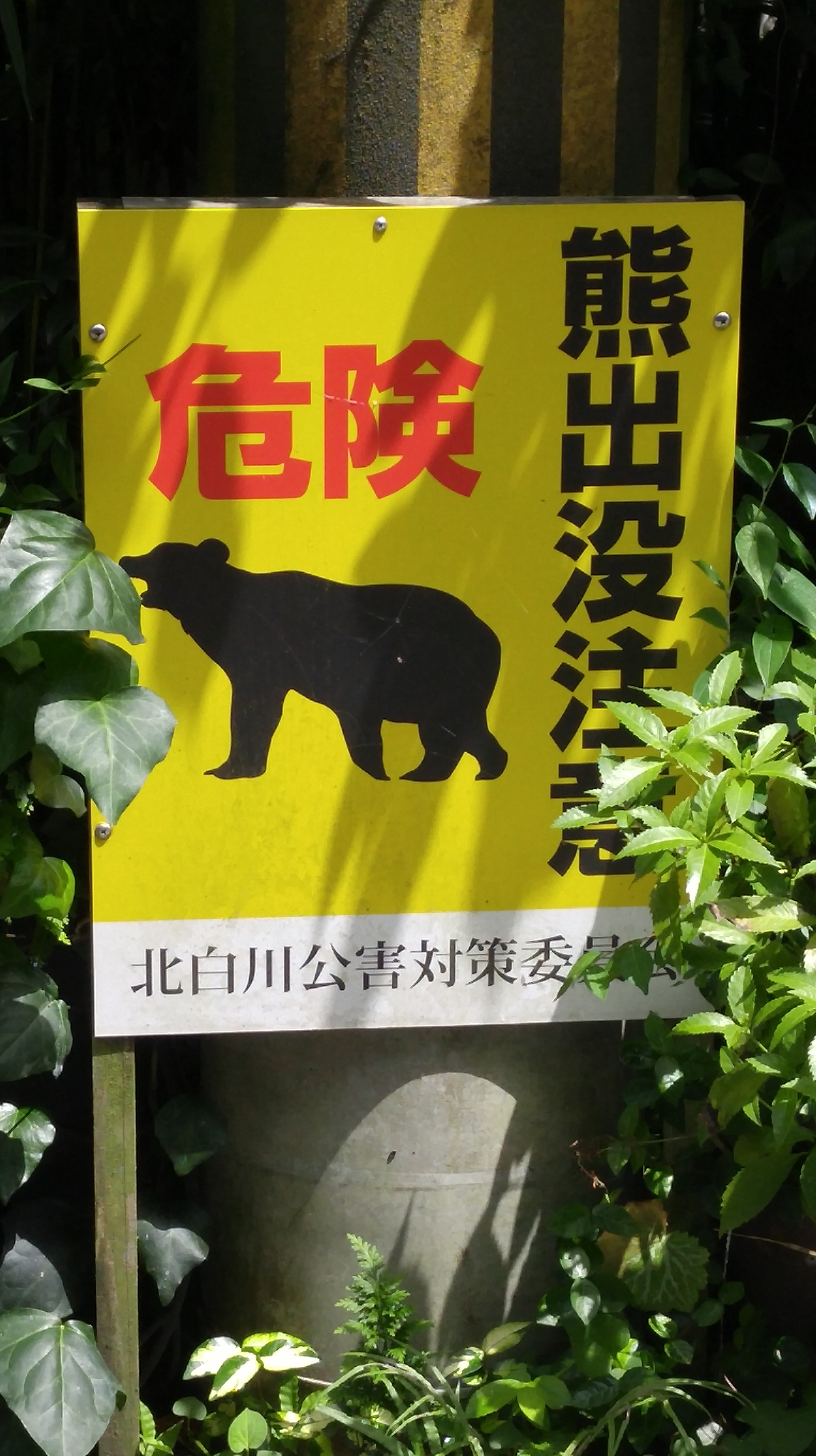
出没 shutsubotsu ‘haunt, infest, frequent’ - We were not surprised to find signs warning of bears while hiking in the forests of rural Togakushi in Nagano Prefecture, but I was quite surprised to see this sign right next to the Japan Baptist Hospital in Kyoto, warning of bears in the very mountains I used to climb during my childhood there (at the foot of Mt. Hiei). The sign reads 危険 熊出没注意 Kiken: Kuma shutsubotsu chuui ‘Danger: Bear infestation alert’. Such signs are very common along Japanese mountain trails these days. When we hiked a very well-traveled section of the old Nakasendō (中山道 ‘Central Mountain Route’) we saw many such bear warnings near small brass bells that travelers were encouraged to ring to scare the bears away.
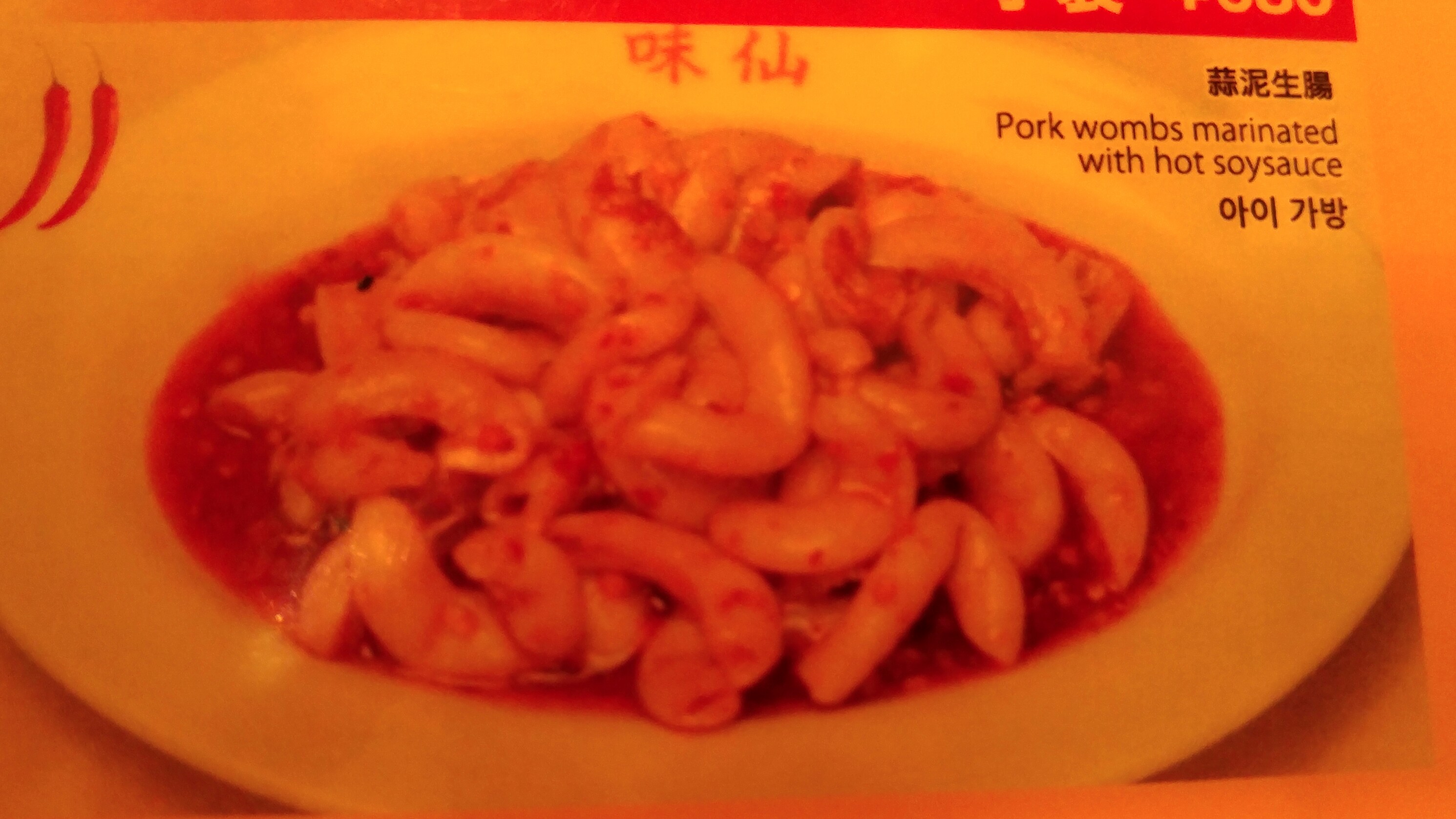
蒜泥生肠 “Pork wombs marinated with hot soysauce”! - In a Chubu Airport (Nagoya) restaurant specializing in Taiwanese food, we encountered a menu item that even this experimental gastronome shied away from. It appears to be a dish unique to Singapore and Taiwan. The Chinese menu item is 蒜泥生肠 suànní shēngcháng ‘garlic-mash birth-intestine (= birth canal/fallopian tube)’. (The kanji 蒜 or 大蒜 can be used to write ninniku ‘garlic’ in Japanese.) I couldn’t find shēngcháng 生肠 in my DeFrancis (1996) ABC Chinese-English Dictionary, and whoever translated it into Japanese and Korean seems not to have known the anatomical term for ‘uterus’ (neither did I), which is 子宮 ‘child-shrine = womb’ (Ch. zǐgōng, Ko. jagung, Jp. shikyuu). So the Japanese menu label for the dish is 子袋 ko fukuro ‘child bag’ and the Korean menu label is ai kabang ‘child bag’. I don’t know how the English translator came up with “marinated in hot soysauce” except by looking at the photo.
アメポテ Amepote ‘American potato’ - On the shelf of a conbini (convenience store) we encountered a new acronym created from the initial two syllables of a longer pair of words. The katakana label on a package of “American Potato Chips” reads Amepote ueebukatto (‘Amer. Pota. wave-cut’), comparable to Amefuto for ‘American football’. This is a very common pattern of abbreviation in Japanese, one we also encountered in a Japanese TV biography about Amekei (雨敬 < Amemiya Keijiro 雨宮敬二郎), a Meiji-era businessman who first persuaded the Japanese government to build the Chūō (中央 Central) railway line into his native Yamanashi Province to enable farmers to get their produce out to the coastal markets.
出没 shutsubotsu ‘haunt, infest, frequent’ - We were not surprised to find signs warning of bears while hiking in the forests of rural Togakushi in Nagano Prefecture, but I was quite surprised to see this sign right next to the Japan Baptist Hospital in Kyoto, warning of bears in the very mountains I used to climb during my childhood there (at the foot of Mt. Hiei). The sign reads 危険 熊出没注意 Kiken: Kuma shutsubotsu chuui ‘Danger: Bear infestation alert’. Such signs are very common along Japanese mountain trails these days. When we hiked a very well-traveled section of the old Nakasendō (中山道 ‘Central Mountain Route’) we saw many such bear warnings near small brass bells that travelers were encouraged to ring to scare the bears away.
蒜泥生肠 “Pork wombs marinated with hot soysauce”! - In a Chubu Airport (Nagoya) restaurant specializing in Taiwanese food, we encountered a menu item that even this experimental gastronome shied away from. It appears to be a dish unique to Singapore and Taiwan. The Chinese menu item is 蒜泥生肠 suànní shēngcháng ‘garlic-mash birth-intestine (= birth canal/fallopian tube)’. (The kanji 蒜 or 大蒜 can be used to write ninniku ‘garlic’ in Japanese.) I couldn’t find shēngcháng 生肠 in my DeFrancis (1996) ABC Chinese-English Dictionary, and whoever translated it into Japanese and Korean seems not to have known the anatomical term for ‘uterus’ (neither did I), which is 子宮 ‘child-shrine = womb’ (Ch. zǐgōng, Ko. jagung, Jp. shikyuu). So the Japanese menu label for the dish is 子袋 ko fukuro ‘child bag’ and the Korean menu label is ai kabang ‘child bag’. I don’t know how the English translator came up with “marinated in hot soysauce” except by looking at the photo.
03 July 2017
Hawaiians in Canada, Canadians in Australia
On Canada Day, the Globe and Mail published a column about two forgotten Canadian diaspora communities, Hawaiians in British Columbia and Canadian exiles in Australia. Here are a few excerpts:
Indigenous Hawaiians, who crewed transpacific ships, had been settling the Vancouver and Victoria areas since the 1780s, jumping ship to take jobs in the burgeoning fur and later mining and timber industries; in the 19th century, they were recruited and imported by the Hudson’s Bay Company.
In the 1830s, Hawaiian Canadians were the single most populous ethnic group employed by the company on the West Coast. By 1851, half the working-age population in Fort Victoria was native Hawaiian. By 1867, according to Tom Koppel’s history of their community, the Hawaiians had become farmers, landowners and fishermen, and were known, sometimes derisively, as “Kanaka” (the Pacific Island word for “man”). There was a substantial “Kanaka Row” shack town in Victoria, and sizable districts in Vancouver and on Salt Spring Island. They had their own schools and preachers, and while they taught their children English, some subscribed to Hawaiian-language newspapers....
Unlike the large populations of Chinese, Japanese and Sikhs who’d settle in the late 19th century and the first decade of the 20th, the Kanaka weren’t subject to exclusionary laws, race riots and the restrictive white-nationalist politics that defined Canadian citizenship policy during most of the country’s first century....
Canada is defined even more by the diasporas it creates elsewhere – after all, there is nothing more Canadian than being forced to leave Canada to succeed. Nowhere is this more evident than on the southeast coast of New South Wales, Australia, where an influential Canadian immigrant community reshaped reality in the middle of the 19th century.
The Canadians were not voluntary immigrants. They were political dissidents, 58 francophones and 82 English-speakers, well-educated and influential men who were convicted of fighting for democracy, public education and free trade in the 1837 rebellions. They avoided the executions and dismemberments meted out to others, and instead were shipped to the Australian prison colony aboard the HMS Buffalo.
There, the Canadians proved popular. The Bishop of Sydney sympathized with them and assigned many to serve as free labourers in Sydney, where they played a significant role in building the community physically and politically. Their presence is remembered in the names of Canada Bay, today a major suburb of Sydney, and nearby Exile Bay. And, according to Australian historian Tony Moore, they also proved politically influential, helping advance the causes of labour rights and governance (which, as a result of their defeat in the rebellions, lagged behind in Canada).
Most were eventually freed and returned (though some stayed and started families), but their exile cost Canada many of its best minds.
15 June 2017
St. John's Day, 1908, in High Albania
From High Albania, by M. Edith Durham (Enhanced Media, 2017; originally published 1909), Kindle Loc. 2903-2957:
The evening of the twenty-third of June was quite exciting. The Primæval had spent most of the previous evening filling blank cartridges to greet guests. The Franciscans of Berisha, Shoshi, and Toplana arrived in turn. Each hailed him of Dushmani from a distance, and greeted him with revolver shots. Out we rushed, the Primæval dancing and shrieking like a demon, with a revolver in each hand, both of which he fired at once. We had the liveliest supper – four Franciscans, Marko, and myself. The Padre of Toplana had brought a wonderful attendant with him – an elderly, most wiry creature, brave in a red djemadan, gayer and even more voluble than the Primæval. The two, who were supposed to wait at table, were inimitable – entered into the conversation, corrected their “masters,” smoked, joked, laughed, and had drinks. Old Red Coat talked every one down, and boasted incessantly of his own merits, the chief being his stainless honour. He had shot four men in its defence, had his house burnt down four times, and flourished greatly, and was ready any day to shoot four more. He had rewarded his Martini for its part of the work, with four silver coins driven in between the stock and the barrel. He got on very well with his Padre – was not his servant, but his comrade. Outside, crowds of guests were arriving at various houses near, from Shlaku and Berisha and distant parts of Dushmani, all greeted by volleys of rifle and revolver shots, to which the Primæval replied with a revolverful of blank, and Old Red Coat with ball cartridge out of window, and both with piercing yells. And the little brothers of St. Francis sang songs at the top of their powerful voices. I thought how dull London dinner-parties are, and wondered why people ever think they would like to be civilised. This was as good as being Alice at the Mad Hatter’s Tea-party. And so passed the Eve of St. John. No bonfire-burning took place, and I was assured that the custom is unknown in the mountains, though practised by some of the Scutarenes, which seems to show that it is not an Albanian custom, but brought in from abroad.
A great crowd came to church next day. There were stacks of rifles outside, and within their owners sang “Et in terra pax hominibus.” The Padre of Berisha preached. I could not understand him, but reflected he could have no better subject than “The Voice of One crying in the Wilderness.”
After mass there was a rush for the shooting-ground – the mark was a white stone, and the range short. The Primæval hit often, and a man with a Mauser every time he tried. Those that missed were very close. But it was not difficult, for I hit it myself, with the Primæval’s beloved Martini, which he pressed upon me, adorned as it was with silver coins, to reward it for the lives it had taken.
Drunk with noise, excitement. and the smell of burnt powder, he drew out the hot empty cartridge-cases and breathed in their odour with ecstasy, gasping, “By God, it is good!” It was like blood to a tiger, and made him wild to kill his cousin’s murderer, who had got safe away a year ago, was now in prison in Scutari on another charge, and to be released soon. I asked why he did not tell the Scutari authorities of the murder and let them punish him, but was told he would only get ten years, “and he deserves shooting, as the poor deserve bread.” At this tense moment a rumour spread suddenly that the enemy had been released, and had been seen coming to the feast.
The Primæval dashed off with Martini and revolver, in spite of the shouts of the Franciscans, but it was a false alarm, and he returned unappeased and disappointed – his enemy was still in prison. “Never mind,” said he, “he must come out some day.” And he sat and nursed his Martini, crooning a song, in which he addressed it as his wife and his child, for he wanted no other – his life and his soul—”Not your soul,” said the Padre sharply. “All the soul I want,” said he, incorrigible. His “well-beloved” had cost twelve napoleons, the price of an ordinary wife, and he spent eighty guldens a year – exactly half his income – “feeding” it.
The company discussed weapons. The accuracy and repeating power of the Mauser were admitted, but its bullets were too small to be of any use. “They just go through you and don’t hurt. You can go on fighting all the same.”
A Mirdite had recently taken part in a general squabble, and walked home a long distance. He drank the usual cup of black coffee, and was about to drink a second, when he uttered a cry, collapsed, and died shortly. It was found that he had been shot clean through the body (through the stomach, I believe, from the account); the wound had closed, and there was scarcely any external bleeding. Presumably he was unaware that he had been hit.
To prove the harmlessness of small bullets, a man clapped his right hand against a tree and begged me to fire through the palm with a Mauser pistol; it would make no sort of difference to him. He was quite disappointed at my refusal.
The afternoon passed in paying visits – sitting on heaps of fern in dark dwellings, drinking healths in rakia, chewing sheep-cheese, and firing rifles and revolvers indoors; a noisy joy that peppers oneself and the refreshments with burnt powder and wads. In one yard two girls were slowly turning a whole sheep that, spitted lengthwise, was roasting over a large wood fire. It was stuffed with herbs and sewn up the belly, and of all ways of cooking mutton, this is the most excellent.
By night-time we were all too sleepy to do much sing-song. The Primæval had emptied all his cartridges, and was again busy refilling them.
We had passed a true Albanian day, said the Padre of Toplana: “Duhan, rakia, Pushke, dashtnia” (Tobacco, brandy, guns, and love). I suggested that dashtnia should come first, because maxima est caritas. But they said, not in Albania. And so ended St. John’s Day.
13 June 2017
The Albanian Vocal Telegraph, 1908
From High Albania, by M. Edith Durham (Enhanced Media, 2017; originally published 1909), Kindle Loc. 1627-1635:
Telegraphing in Albania was far quicker than in any other land. Which is a fact. All news is shouted from hill to hill. “Shouting” gives no idea of it. The voice, pitched in a peculiar artificial note, is hurled across the valley with extraordinary force. Any one that catches the message acts as receiver and hurls it on to its address. And within an hour an answer may be received from a place twelve hours’ tramp distant. The physical effort of the shout is great. The brows are corrugated into an expression of agony, both hands often pressed tight against the ears – perhaps an instinctive counterpressure to the force with which the air is expelled from within – the body is thrust forward and swayed, face and neck turn crimson, the veins of the neck swell up into cords. There are few places where it is harder to keep an event secret than in the mountains of Albania. News spreads like wildfire. The fact that a man has been shot upcountry reaches Scutari next day at latest, often with many details.
“Theft is impossible in Kilmeni,” said the Padre, laughing; “the whole tribe hears the description of an article as soon as it is missed. Every one knows if some one has a few more sheep than yesterday.”
09 June 2017
Cross-cutting Tribes, Languages, Religions in Albania
From High Albania, by M. Edith Durham (Enhanced Media, 2017; originally published 1909), Kindle Loc. 1159-1176:
Early marriages make generations rather shorter in Albania than in West Europe.
“The tribe of Hoti,” said the old man, “has many relations. Thirteen generations ago, one Gheg Lazar came to this land with his four sons, and it is from these that we of Hoti descend. I cannot tell the year in which they came. It was soon after the building of the church of Gruda, and that is now 380 years ago. Gruda came before we did. Gheg was one of four brothers. The other three were Piper, Vaso, and Krasni. From these descend the Piperi and Vasojevichi of Montenegro and the Krasnichi of North Albania. So we are four – all related – the Lazakechi (we of Hoti), the Piperkechi, the Vasokechi, and the Kraskechi. They all came from Bosnia to escape the Turks, but from what part I do not know. Yes, they were all Christians. Krasnichi only turned Moslem much later.”
Of these four large tribes, of common origin, Piperi and Vasojevich are now Serbophone and Orthodox. Piperi threw in its lot with Montenegro in 1790, but whether or not it was then Serbophone I have failed to learn. Half of Vasojevich was given to Montenegro after the Treaty of Berlin, the other portion still remains under Turkish rule. Vasojevich considers itself wholly Serb, and is bitter foe to the Albanophone tribes on its borders. Krasnich is Albanophone and fanatically Moslem; Hoti is Albanophone and Roman Catholic.
What turned two tribes into Serbs and two into Albanians, and which was their original tongue, I cannot say; but probably they were of mixed Serbo-Illyrian blood, and their language was influenced by the Church to which either chose to adhere. It is said that the Albanophone Krasnichi were Catholic before turning Turk.
The date three hundred and eighty years ago gives us 1528. In 1463 the Turks conquered and killed the last king of Bosnia; but the whole land was not finally incorporated in the Turkish Empire till 1590 (about). The traditional date of emigration falls well within the period when the Turkish occupation was spreading, so is probably approximately correct. A large communal family, with flocks, would be some time on the way.
One-sided Albanian Exogamy
From High Albania, by M. Edith Durham (Enhanced Media, 2017; originally published 1909), Kindle Loc. 400-430:
Descent is traced strictly through the male line, and the tradition handed from father to son through memories undebauched by print.
The head of each fis is its hereditary standard-bearer, the Bariaktar. The office passes from father to son, or in default of son to the next heir male. The standard is now a Turkish one. Only the Mirdites have a distinctive flag with a rayed-sun upon it.
Some large tribes are divided into groups, each with its own Bariaktar. A division thus marching under one standard (bariak) is called a bariak. Such a bariak may be descended from a different stock from the rest of the tribe, or the division may have been made for convenience when the tribe grew large.
The men and women descending from a common male ancestor, though very remote, regard one another as brother and sister, and marriage between them is forbidden as incestuous. Though the relationship be such that the Catholic Church permits marriage, it is regarded with such genuine horror that I have heard of but one instance where it was attempted or desired, when against tribe law. Even a native priest told me that a marriage between cousins separated by twelve generations was to him a horrible idea, though the Church permitted it, “for really they are brothers and sisters.”
The mountain men have professed Christianity for some fifteen centuries, but tribe usage is still stronger than Church law. A man marries and gives his daughter in marriage outside his tribe, except when that tribe contains members of a different stock, or when it has been divided into bariaks considered distant enough for intermarriage. But in spite of this exogamy, it would appear that, through the female line, the race may have been fairly closely in-bred. For a man does not go far for a wife, but usually takes one from the next tribe, unless that tribe be consanguineous. If not so debarred, he takes a wife thence and marries his daughter there. Kastrati, for example, usually marries Hoti, and Hoti Kastrati. The bulk of the married women in one were born in the other. A perpetual interchange of women has gone on for some centuries.
Even educated Scutarenes reckon relations on the mother’s side but vaguely.
A man said to me, “She is a sort of relation of mine. Her mother and mine were sisters.”
“Then she is very near. She is your first cousin.”
He considered and said doubtfully, “Yes. Like a first cousin certainly, but on my mother’s side.”
His third cousins on his father’s side he reckoned as brothers. One very near and dear cousin was so remote I never quite placed him.
The Catholic Church prohibits marriage to the sixth degree, and the law is now enforced. But among the Moslem tribes, I am told, female cousinship is not recognised. Male blood only counts. That male blood only counted under old tribe law seems fairly certain. In Montenegro, where the tribal system is not yet extinct – under the “old law,” which prevailed till the middle of the nineteenth century, though marriage was prohibited so long as any drop of blood of male descent was known of – I am told relationship through the female was but slightly, if at all, recognised.
Albania's Competing Alphabets, 1908
From High Albania, by M. Edith Durham (Enhanced Media, 2017; originally published 1909), Kindle Loc. 243-264:
One must live in Scutari to realise the amount of spying and wire-pulling carried on by the Powers under pretence of spreading sweetness and light.
The Alphabet question will suffice as a sample. In early days an alphabet was made by Bishop Bogdan, and used by the Jesuits for all Albanian printed matter required by the church. Briefly, it is the Latin alphabet with four additional fancy letters. The spelling used is otherwise as in Italian. Help from without had enabled Greek, Serb, and Bulgar under Turkish rule to have schools in their own tongues. The natural result has been that each in turn has revolted, and, so far as possible, won freedom from Turkish rule. And those that have not yet done so look forward, in spite of the Young Turk, to ultimate union with their kin.
Albania awoke late to the value of education as a means of obtaining national freedom, and demanded national schools. But the Turks, too, had then learnt by experience. They replied, “We have had quite enough of schools in national languages. No, you don’t!” and prohibited, under heavy penalty, not only schools, but the printing of the language.
The only possible schools were those founded by Austria and Italy, ostensibly to give religious instruction. These used the Jesuits’ alphabet. Ten years ago some patriotic Albanians, headed by the Abbot of the Mirdites, decided that the simple Latin alphabet was far more practical. They reconstructed the orthography of the language, using only Latin letters, and offered their simple and practical system to the Austrian schools, volunteering to translate and prepare the necessary books if Austria would print them – neither side to be paid. A whole set of books was made ready and put in use. Education was at last firmly started; it remained only to go forward. But a united and educated Albania was the last thing Austria wished to see. Faced with a patriotic native clergy and a committee striving for national development, Austria recoiled. Three years ago the simple Latin alphabet was thrown out of the Austrian schools and a brand new system adopted, swarming with accents, with several fancy letters, and with innumerable mute “ee’s” printed upside down – a startling effect, as of pages of uncorrected proofs!
It was invented by an influential priest. Its adoption enabled Austria to split the native priesthood into two rival camps, and – as it was not adopted by the Italian schools – to emphasise the difference between the pro-Italian and pro-Austrian parties; and that it was expressly introduced for these purposes no one who has heard all sides can doubt.
Nor can Albanian education make any progress till it has schools in which no foreign Power is allowed to intrigue. Such are now being started.
31 May 2017
Soviet Reinvention of Siberian Exile
From The House of the Dead: Siberian Exile Under the Tsars, by Daniel Beer (Knopf, 2017), Kindle Loc. 7532-7558:
It is one of the ironies of 1917 that the revolution should have overwhelmed the exile system that the autocracy had for so long wielded as a weapon against subversion. Warders, exile officials and guards suddenly found themselves stripped of their authority and vulnerable to the vengeful retribution of their former captives. What little semblance of order remained in Siberia’s exile and prison system by the end of 1917 was torn up by the civil war that engulfed the continent between 1918 and 1920. Exiles, prisoners, their families and officials were sucked into a maelstrom of battles, refugee columns, famine and epidemics. It was a fittingly ignominious end to a system that had achieved so little at such a colossal expense.
Yet Siberia surrendered its prisoners only temporarily. After 1917, exile and penal labour would be reinvented and punishments would be revamped for an age of science, rationality and industrialization. The Bolsheviks did not inherit a functioning penal system from their tsarist predecessors, but they did inherit a very similar set of practical dilemmas: how to extract the vast and valuable mineral resources from the far-flung frozen expanses of the taiga and tundra and, also, how to contain crime and subversion within the Soviet state. After 1917, the Bolsheviks rose to meet these challenges with a zeal and a brutality all their own.
No longer would deportation to Siberia be primarily about the enforced isolation and penal settlement of criminals and dissenters, with forced labour reserved for a particularly dangerous minority. It would now involve the ruthless exploitation of convict labour on an industrial scale justified by the need for a “purification of society” and by the prospect of “individual rehabilitation.” Far-flung tsarist-era exile settlements such as Sredne-Kolymsk and prisons like Omsk were expanded into major centres of forced labour. The Gulag was celebrated in the press as a workshop of the new citizenry, and its camps were hailed as “curative labour camps.”
As part of the Bolshevik Party’s cultural campaigns to consolidate its own legitimacy and to sanctify the October Revolution, state publishing houses in the 1920s and 1930s produced a stream of hagiographical texts commemorating the martyrdom of pre-revolutionary political prisoners. Memoirs, historical studies and archival documents established an inspiring genealogy of tsarist oppression and revolutionary heroism—a genealogy that stretched back in time, linking the Bolsheviks with their revolutionary forebears and representing the victory of Soviet power as the culmination of a century-old struggle with tyranny. The experience of Siberian exile formed an important thread of continuity linking the new rulers of the lands of the Russian Empire with cohorts of illustrious radicals from the 1860s like Nikolai Chernyshevsky, and, ultimately, with the Decembrists of the 1820s. The Society of Former Political Penal Labourers was established in 1921 and began to publish a journal, Penal Labour and Exile, devoted to recording the experiences of political exiles and penal labourers. Yet ironically, at the very moment when the Bolsheviks were emphasizing the martyrdom of Siberian exiles and the cruel tyranny of the tsarist state, they were casting their own rivals, dissenters, and the human detritus of the ancien régime into forced labour camps on a scale that would have defied the imagination of tsarist penal administrators.
30 May 2017
Siberian Exile Pioneer Hero Tsybulenko
From The House of the Dead: Siberian Exile Under the Tsars, by Daniel Beer (Knopf, 2017), Kindle Loc. 6436-6460:
On the afternoon of 19 November 1877, an undistinguished-looking 17-metre schooner named Dawn dropped anchor alongside the Customs House on the bank of the Neva River in St. Petersburg. An excited crowd of onlookers had gathered to catch a glimpse of the ship. The Dawn had just completed the first successful maritime voyage from the Yenisei River in Eastern Siberia to St. Petersburg. It had crossed the Kara and Barents seas, before circumnavigating Scandinavia by way of Vardø, Christiania (Oslo), Stockholm and Helsingfors (Helsinki) to finally reach the Russian capital. By common consensus both in Russia and abroad, this was a prodigious feat of seamanship: a half-decked sailing boat without a keel and with a crew of only five had navigated the ice floes and storms of the barely charted, and notoriously dangerous, Arctic seas. The ship had already enjoyed a triumphal passage through the coastal towns and cities of Norway, Sweden and the Grand Duchy of Finland, where it had been enthusiastically received by crowds of well-wishers; its crew had been celebrated in the national press and treated to feasts in its honour.
By the time the Dawn reached the Customs House on Vasilevsky Island, however, it bore only four of the five crew members who had set out from the Yenisei on 9 August. Andrei Tsybulenko was absent, as the daily St. Petersburg News drily noted, “for reasons beyond his control.” Tsybulenko had been arrested that morning when the ship docked in the naval base of Kronstadt, following a tip-off from the Russian consul in Christiania. Tsybulenko was, it had emerged, an exile from Yenisei province who had illegally made the passage from Siberia back to European Russian and was, therefore, a fugitive from justice. On orders from the minister of the interior, Aleksandr Timashev, he had been taken into custody and detained in the Kronstadt fortress. The authorities intended to deport Tsybulenko back to Yenisei province, where he would remain in exile for the rest of his life, but by January 1878, Tsybulenko had been released from custody and had received an official pardon from Alexander II and even awards and commendations from both the influential Imperial Society for the Advancement of Russian Merchant Shipping and the Ministry of Trade.
Tsybulenko’s remarkable reversals in fortune—from exile in Eastern Siberia, to member of a celebrity crew of intrepid seamen, to prisoner of the state in Kronstadt, and finally to pardoned fugitive—reflect mounting public opposition to the use of Siberia as a penal colony. From the 1850s, leading figures in Russia’s scientific, commercial and political elites began to challenge the established view of Siberia as a frozen, inhospitable wasteland, suitable only as a place of banishment for the empire’s criminals. They argued for a re-imagining of Siberia as a rich economic colony, one which had been neglected by the state and crippled by the exile system but which harboured, in fact, a wealth of natural resources awaiting exploration and development. These strategic criticisms of the government’s use of Siberia as a continental prison joined the rising tide of moral opposition to a system characterized by brutal floggings, by destitution and degradation of the blameless wives and children of convicts and by the martyrdom of revolutionaries.
29 May 2017
Wordcatcher Tales: 難得糊塗
I just came across a handwritten four-character Chinese phrase on a souvenir magnetic bookmark from Taiwan that leaves me uncertain about its meaning, despite many attempts to parse it.
The first character of what turned out to be 難得 (simplified 难得) nándé ‘rare(ly)’ was written with the more complicated (11-stroke) bird radical 鳥 (called tori in Japanese) on its right, rather than the simpler (9-stroke) 隹 (called furutori ‘old bird’ in Japanese). I searched and searched both the common and rare (難得!) sections of the Rikai Unicode Kanji Tables but couldn't find a copy to cut and paste into this post. The two ‘bird’ shapes can be combined into one character (in either order, 鵻 or 䳡), but both kanji appear to be obsolete. (According to my old Canon Wordtank Kanjigen, the kanji 鵻, pronounced sui in Sino-Japanese, once named a kind of squab with a short tail.)
The second pair of characters, 糊塗 (simplified 胡涂) hútu, means ‘muddled, confused, bewildered’ or ‘stupid, foolish’ as an adjective in Chinese. But the Japanese verb 糊塗する koto suru means ‘gloss over, patch up’, literally ‘coat with glue’, from 糊 nori ‘starch, paste’ (with the ‘rice’ radical 米) and 塗 nuru ‘paint, daub’ (as in 塗物 nurimono ‘lacquerware’ or 塗工 tokou ‘painter, plasterer’).
So, the four characters on the bookmark probably intend to praise the astute reader as ‘rarely bewildered’, but they could also suggest that the reader is ‘rarely plastered’, is ‘rarely pasty’, or even perhaps ‘rarely [reads] glossy [magazines]’.
27 May 2017
Vagabonds of Siberia, 1800s
From The House of the Dead: Siberian Exile Under the Tsars, by Daniel Beer (Knopf, 2017), Kindle Loc. 4293-4327:
A bird’s eye view of the Siberian taiga in the nineteenth century would have revealed a steady trickle of figures, stooped under heavy bundles, trudging westwards either alone or in small groups. The “hunchbacks,” as the peasants called them, were escaped convicts who had fled the marching convoys, the mines, the prisons and the penal settlements and were making their way across the forests in the direction of European Russia. Answering the spring call of the migrant cuckoo and taking advantage of the warmer weather, thawed waterways and thickening vegetation that provided them with camouflage and with food, the fugitives set forth. These were the foot soldiers of what became known as “General Cuckoo’s Army.”
The numbers of fugitives told a sobering tale. Abandoned and imprisoned in penury and squalor and with quite literally nothing to lose, Siberia’s convicts absconded from every single prison, factory, settlement and mine in their thousands. Between 1838 and 1846, the authorities apprehended almost 14,000 male and 3,500 female fugitives in Siberia (figures that probably represented just half of those convicts who were at large). In the second half of the nineteenth century, the numbers of escapes only increased as the overall exile population expanded. One government report on the state of exile in Eastern Siberia in 1877 recorded that, in three districts surveyed in Irkutsk province, half of the more than 20,000 prisoners had run away, their “whereabouts unknown.” By 1898, a quarter of the exiles assigned to Yenisei province, 40 per cent of those assigned to Irkutsk province and 70 per cent of those assigned to Primorsk province in Eastern Siberia were unaccounted for. Purpose-built penal labour sites witnessed a similar exodus. Such figures would suggest that, by the last quarter of the nineteenth century, anywhere up to a third of Siberia’s 300,000 exiles were on the run in what ethnographer Nikolai Yadrintsev termed “an endless perpetuum mobile from Eastern Siberia to the Urals.”
The tsarist government was populating Siberia not with industrious colonists but with hordes of destitute and desperate exiles who roamed Siberia as beggars, at best, and petty thieves and violent brigands, at worst. Their victims were the Siberians themselves, both the indigenes and the migrant peasant settlers from Russia. Brutalized by the conditions of their captivity, fugitives visited a plague of theft, arson, kidnapping, violent robbery, rape and murder on Siberia’s real colonists. Seeking strength and protection in numbers, they sometimes formed armed gangs capable of terrorizing not just isolated villages but entire towns and cities. The exile system had transformed Siberia into Russia’s “Wild East.”
Some exiles known as brodiagi, or vagabonds, made for themselves a life of escape, recapture, spells in prison and then escape again. Overwhelmingly male, the brodiagi embraced a semi-nomadic existence in Russia, fuelled by a combination of charity and criminality. Like most pre-industrial societies, the Russian Empire had a rich variety of migratory traditions and a large diaspora encompassing fugitive peasants, Cossacks, peddlers, gypsies, migrant hunters, pilgrims, peripatetic sectarians, travelling merchants and the nomadic tribes of the taiga, steppe and tundra. These migratory peoples had played a significant role in Russia’s expansion across Siberia in the sixteenth and seventeenth centuries. In 1823, the state criminalized vagrancy in European Russia, a fact which accounted for a large part of the sudden upsurge in the numbers exiled to Siberia over subsequent decades. Between 1827 and 1846, the almost 50,000 vagrants constituted 30 per cent of all those exiled. Most of those convicted of vagabondage in Russia in this period were deserters from the army and fugitive serfs, and they presented in either case a direct challenge to Nicholas I’s cherished vision of a disciplined society. The numbers arrested for vagabondage declined in European Russia after the abolition of serfdom effectively decriminalized the unauthorized movement of people. In Siberia, however, the exile system gave vagabondage a new lease on life.
26 May 2017
Polish Rebels Exiled to Siberia
From The House of the Dead: Siberian Exile Under the Tsars, by Daniel Beer (Knopf, 2017), Kindle Loc. 2746-2776:
The Polish rebels shared the republican ideas of the Decembrists; theirs was a political and cultural nationalism that saw itself working in concert with the progressive nations of Europe, especially France and Italy. They sought to replace the autocratic “Holy Alliance of Monarchs” born of the Congress of Vienna in 1815 with a “Holy Alliance of Peoples.” Wysocki and his comrades rebelled under the slogan “For our freedom, and yours!”—making clear that their enemy was the Russian Empire, not its people. In Warsaw, the ceremonial dethronement of the Romanovs was preceded by a ceremony in honour of the Decembrists, organized by the Polish Patriotic Society. Five empty coffins, symbolizing the five executed ringleaders of 14 December 1825, were paraded through the streets of the Polish capital, and a religious service was held in the Orthodox Church, after which Wysocki addressed the crowd in front of the Royal Castle.
If the Poles had looked abroad for inspiration, their own insurrection catapulted them to the forefront of the European republican movement. There was an outpouring of support in the European press for the “French of the North” and calls (resisted by Louis Philippe I) for France to intervene in support of the rebels. French republicans, such as Godefroi Cavaignac and his fellow members of the Society of the Rights of Man, acknowledged their own debt to the Poles for having deflected Nicholas’s armies from intervention in France itself. The French general and hero of both the American War of Independence and the July Revolution, the Marquis de Lafayette, pushed unsuccessfully for France to recognize Poland. In Britain, there was a surge of indignation, followed by meetings and rallies in support of Poland, denouncing Russia and pushing for British intervention in the conflict. In July 1831, The Times fulminated: “How long will Russia be permitted, with impunity, to make war upon the ancient and noble nation of the Poles, the allies of France, the friends of England, the natural, and, centuries ago, the tried and victorious protectors of civilized Europe against the Turkish and Muscovite barbarians?” Across the Atlantic, there was also a tide of American public sympathy for the Polish rebels.
The November Insurrection, as it became known, quickly erupted into a full-scale military confrontation between the Poles and the Russians, with both sides fielding the largest armies Europe had witnessed since the Napoleonic Wars. The insurgents had, however, overplayed their hand. They faced the might of the Imperial Russian Army while they were internally divided and commanded by hesitant men who could not decide whether to fight the Russians or negotiate with them. On 25 February 1831, a Polish force of 40,000 repelled 60,000 Russians on the Vistula to save Warsaw but managed to secure not a decisive victory but only a postponement of defeat. As Russian reinforcements poured into Poland, the rebels found themselves outnumbered and overwhelmed. After months of stubborn Polish resistance, tsarist troops ground their way back towards Warsaw and finally retook the city in October 1831.
Russian retribution fell heavily on the prostrate Polish provinces. A government edict of 15 March 1833 reassigned 11,700 Polish officers and soldiers to penal battalions and fortress labour at a variety of remote and unattractive locations throughout the Russian Empire. Several thousand more were sentenced to penal labour and settlement in Siberia. The tsar was especially vengeful in the Western Borderlands of Russia, in today’s Lithuania, Belarus and Ukraine, which were better integrated into the empire than the Kingdom of Poland. The insurgents there, many of them Polish noblemen, were tried by field courts martial and summarily shot. Russian allies of the Poles were singled out for especially brutal treatment.
19 May 2017
Aboard a Zeppelin to Africa, 1917
From African Kaiser: General Paul von Lettow-Vorbeck and the Great War in Africa, 1914-1918, by Robert Gaudi (Caliber, 2017), Kindle Loc. 6233-6255, 6268-6280, 6300-6317, 6404-6408:
L59, pushed by a tailwind from the direction of the German Reich, rumbled south from Jamboli in the freezing dawn of November 21, 1917, at speeds in excess of fifty miles per hour. The great lumbering airship cast her shadow over Adrianople in Turkey at nine forty-five a.m., and over the Sea of Marmara’s chop a short time later. At Pandena, on the southern shore, she picked up the railroad tracks to Smyrna, a steel ribbon barely visible after sunset. At seven forty p.m., L59 pulled free of the Turkish coast at the Lipsas Straits. Now the Greek Dodecanese Islands—Kos, Patmos, Rhodes—passed below, nestled like dark jewels in the black Mediterranean waters, notoriously stormy this time of year. But tonight, the Zeppelin surged forward beneath a clear sky and brilliant stars. [Lieutenant Commander Ludwig] Bockholt, who had made his life in the navy, had long ago learned to steer by them when necessary.
L59’s crew of twenty—excluding Bockholt and [medical doctor Max] Zupitza—included twelve mechanics to service the five Maybach 240-horsepower engines (one in the forward control car, two opposed on the belly one-third of the way back, and two aft, each driving a single, massive twenty-foot propeller); two “elevator operators” (the elevators, movable flaps at the tail, controlled the upward or downward incline of the nose cone); a radio operator; and a sailmaker, whose job it was to sew up tears in the muslin envelopes affixed within the belly filled with the flammable hydrogen/oxygen mixture that kept the massive airship afloat.
As in the seaborne navy, watches divided the day into four-hour increments. As L59 approached the island of Crete at eight thirty p.m., a quarter of the crew just gone off watch opened their dinnertime cans of Kaloritkon, a bizarre sort of self-heating MRE. These undigestible, oversalted tubes of potted meat literally cooked themselves via a chemical reaction when exposed to air—heating food over open flame and smoking being strictly verboten aboard the flammable airship. The Kaloritkons, which everyone hated, took much water to wash down, and water was scarce, with barely 14 liters allotted per man for the duration of the voyage. At ten fifteen p.m., L59 passed above Cape Sidero at Crete’s eastern extremity at 3,000 feet. Then the stars by which Bockholt had been guiding the Zeppelin to Africa suddenly disappeared, blotted out by a solid mass of black, churning clouds, shot through with bright veins of lightning. The Zeppelin headed into this cloud bank and, buffeted by thunderclaps and driving rain, was also suddenly consumed by a strange, vivid flame, cool to the touch, that seemed to dance across every surface of the doped canvas envelope.
“The ship’s burning!” called the top lookout—alarming, but no cause for alarm: This was St. Elmo’s fire, named after Erasmus of Formia, the patron saint of sailors. Technically a luminous plasma generated by coronal discharge in an atmospheric electrical field, it burned a vivid violet-blue and, in nontechnical terms, was entirely beautiful....
At five fifteen a.m., the sun cracked the rim of earth and the huge airship passed over the African continent at Ras Bulair on the Libyan coast. Miles of desert lay ahead; no Zeppelin had flown across such a landscape before. Now the level wastes of sand and rock stretched monotonously below L59’s keel, from horizon to horizon. Soon, the sun, blazing down, began to dry her canvas skin, still drenched and heavy from the storm. The airship grew lighter as the watery sheen evaporated; lighter still as fuel consumption continued apace. Then the gas in her envelopes, expanding with the heat, blew out the automatic valves into the atmosphere and soon, L59 became dangerously light and increasingly difficult to handle. To compensate, Bockholt flew her “nose down” throughout the day, shifting 1,650 pounds of ballast aft as a counterbalance.
In the late morning, hot desert air rose in bubbles of buoyancy, alternating with heavy downdrafts of cooler air. This caused a roller-coaster effect that made most of the crew violently airsick. Even the hardened navy veterans among them, used to storms at sea, were not immune to the stomach-churning sensation of weightlessness as L59 plunged into the downdrafts and precipitously rose again. Despite all this, L59 plowed ahead and made the Farafra Oasis around noon. This incandescent patch of green slid by below, its date palms rustling in the hot wind....
Flying a Zeppelin is a difficult undertaking under the best conditions: Gas expands and contracts according to changing temperatures; lift and buoyancy fluctuate; all must be counterbalanced ceaselessly by the release of ballast water, the measured shifting of cargo, the canting of nose or tail via clumsy elevator flaps—and all this becomes doubly difficult over the desert. Bockholt had lightened his airship by 4,400 pounds of ballast in the last full heat of day and had even tossed some boxes of supplies overboard. He knew the rapidly cooling temperatures of the desert at night would contract the gas, causing the Zeppelin to sink. To counterbalance this sinking effect, he had planned to fly the ship at four degrees “nose up” on her four remaining engines.
But he had not counted on the humid, dense air of the Nile Valley. Even at 3,000 feet, ambient temperatures had reached sixty-eight degrees by ten p.m.; they rose steadily after midnight and still L59’s lift capacity gradually diminished. Finally, at three a.m., L59 began to lose altitude precipitously. The engines stalled. Forward thrust gone, the Zeppelin sank through the atmosphere from 3,100 feet to just under 1,300, not high enough to clear a looming desert escarpment; a minute later, her main radio antennae sheared off upon contact with an outcropping of red rock.
Now Bockholt ordered his crew to lighten the ship even further. With all engines stopped, 6,200 pounds of ballast and ammunition went overboard. The crew watched cases of ammunition, much needed by the Schutztruppe, shatter and explode on the ragged slopes below. But this sacrifice had its desired effect: Gradually, the sinking super Zeppelin stabilized; slowly, she rose into safer atmospheres:
“To fly steadily at 4 degrees heavy at night can easily be catastrophic, especially with sudden temperature changes in the Sudan, as at Jebel Ain,” Bockholt later confided to L59’s war diary, “particularly if the engines fail from overheating with warm outside temperatures. . . . Ship should have 3000 kg of 4 percent of her lift for each night to take care of cooling effect.”
Clearly, it was a complicated business.
L59, now less than 125 miles west of Khartoum, had two-thirds of the perilous journey behind her. But presently, to the dismay of all aboard, Bockholt turned the great airship around and pointed her nose cone due north ....
At last, at seven thirty a.m. on November 25, 1917, L59 made her docking station at Jamboli. Her mooring ropes dropped, the ground crew drew her down and walked her into the long shed. China Show had ended in failure. The twenty-two aeronauts, wobbly-legged, nearly deafened by the droning Maybachs at close quarters, stumbled down the ladders to the ground in the gray Balkan morning. They had been in the air for almost four days and had covered 4,200 air miles—the longest distance in the shortest time of any airship to date.
15 May 2017
German East Africa Import Substitutions
From African Kaiser: General Paul von Lettow-Vorbeck and the Great War in Africa, 1914-1918, by Robert Gaudi (Caliber, 2017), Kindle Loc. 3843-3870:
The British blockade of German East Africa—challenged briefly by Königsberg before she hightailed it up the Rufiji—was nearly a complete success. Shortages of basic necessities made themselves painfully felt everywhere. The colonists soon lacked adequate supplies of soap, toothpaste, candles, fuel, beer, booze, rubber, cloth, chocolate, castor oil, and, most important, quinine, without which life in the tropics became impossible for Europeans. One or two blockade runners reached the Swahili Coast after many ha[r]dships—notably the Krönborg-Rubens and the Marie von Stettin—but these were heroic exceptions. The aim of any blockade—complete starvation of the enemy—seemed within reach of the British Royal Navy for the first few months of 1915.
Then, with the begrudging help of Governor Schnee, still stewing away at Morogoro, von Lettow organized the colony to produce some of the most needed items. German East Africa, rich in natural resources, mostly lacked the necessary infrastructure—factories, refineries, laboratories, warehouses—to turn these resources into commercial goods. But presently, the colonists took it upon themselves to manufacture a variety of products for both civilians and Schutztruppe—now reaching its peak popularity as patriotic enthusiasm, fueled by the victory at Tanga, swept the colony.
Planters’ wives revived the neglected art of spinning using native cotton; African women, given scratch-built looms, wove bolts of cloth. Between them, they more than made up for the lack of imported fabric. Leather torn from the backs of native buffalo herds and tanned using chemicals extracted from the colony’s plentiful mangrove trees got cobbled into the boots so critical for the Schutztruppe—soon to march unimaginable distances over rough landscapes, much of which could not be traversed barefoot. Candles materialized from tallow; rubber from tapped trees: carefully dripped along rope, the raw, milky stuff was then hand-kneaded into tires for GEA’s few automobiles, including von Lettow’s staff car. A kind of primitive, homemade gasoline called trebol powered these vehicles—it was a by-product of distillates of copra, which also yielded benzene and paraffin. Soap came from a combination of animal fat and coconut oil. Planters and small businessmen eventually produced 10,000 pounds of chocolate and cocoa and 3,000 bottles of castor oil. Meanwhile, new factories sprang up in Dar es Salaam to make nails and other metal goods, including some ammunition. Rope woven from pineapple fiber proved both durable and less susceptible to rot than hempen rope from Germany; cigars and cigarettes rolled from native-grown tobacco made their way into every soldier’s kit. At Morogoro and elsewhere, home brewers distilled schnapps and moonshine. The latter, at 98 proof and optimistically labeled “whiskey,” was issued to the troops as part of their basic rations.
All this ingenuity, however, would be rendered useless without quinine. Before the war, the colony had gotten its supply from distributors in the Dutch East Indies, now cut off by the blockade. Dwindling supplies meant European populations of the colony would have no defense against their greatest enemy—not the British or rebellious natives but the malaria-bearing anopheles mosquito. At von Lettow’s urging, the famous biological research center at Amani turned its chemists to developing a quinine substitute in their laboratories. The chemists researched furiously, tried formulations of this and that, and at last came up with an effective type of liquid quinine distilled from cinchona bark. Called “von Lettow schnapps” by his men, this foul-tasting, much-reviled elixir nevertheless met most of the army’s needs for the next year or so.
Subscribe to:
Posts (Atom)