26 September 2005

A Visit to Japan's "Little Brazil"

Recently, we set out from Ashikaga for 大泉 Ôizumi, Japan's "Little Brazil" in neighboring Gunma Prefecture's fanhandle to our southwest. At 太田 Ota ('Widefield'), we transferred to a 2-car, 2-stop, infrequent shuttle train running back toward the southeast to Higashi Koizumi ('East Littlespring'). There we had to transfer to yet another 2-car, 2-stop, infrequent shuttle train running back southwest to the end of the track at Nishi Koizumi ('West Littlespring'). The fare adjustment official at Ota described Nishi Koizumi as the most bustling (にぎやか) of the three Littlesprings (East, Middle, and West) that make up Bigspring.

Well, wherever the bustle was, we didn't see it. The tracks ended where the single platform ended at Nishi Koizumi. We walked straight south from the train station, crossed over a highway busy enough to warrant a pedestrian overpass, past a small fountain (maybe the 'littlespring' itself) that marked the beginning of a very long and pleasant walkway and bikepath (the Izumi 緑道 'Greenway') shaded by a great variety of trees and bushes, most of them labeled, so that I repeatedly stopped to punch the katakana names into my little electronic dictionary to find the English equivalents.

To our right ran the kilometer-long fence punctuated by gated driveways enclosing a quiet but huge Sanyo electronics factory. To our left ran sleepy Hanamizuki-dori 'Dogwood Avenue', which hosted occasional trucks and vans making deliveries. Hardly anyone but a few stressed-out middle managers was making use of the jogging path. Across the road were a variety of smaller enterprises: a few stores, a few restaurants, and a preschool teacher-training school followed by Santa Clara (聖クララ) preschool.

The name of the school and the distant sounds of Portuguese rather than Japanese coming from its parking lot were among the few signs of the town's large Brazilian population. Other clues were: a cardboard sign next the train ticket vending machine at the station that listed all the destinations in a Portuguese-friendly transcription; a small shop near the station that sold goods imported from Brazil, Peru, and Bolivia; and the Primavera Restaurant, which we noted for our return. It was nearing lunchtime.

Primavera was an interesting oasis, like a midwestern truck stop in many ways. The kitchen help spoke mostly Japanese, the customers spoke mostly Portuguese, and the menus and wait help were bilingual in Japanese and Portuguese. The music was mostly Country & Western in style, but with the lyrics in Portuguese. The featured buffet (バイキング [Viking] = smorgasbord) was discounted from ¥1600 to ¥1000 because it had run out of most of the grilled meats--and also the feijoada, I discovered after I ordered it. My wife went for just the salad bar portion. At the register, I asked the European-looking owner (in Japanese) how long he had been in Japan. He said 2 years this time, but 5 years in all. (Nikkei Brazilians can easily get work visas for 3-year stints.) His soft-spoken Japanese was even more limited than mine. He estimated the local population was at least 10% Brazilian, maybe 15%.

On our way back to the station, we stopped in at the small import shop, whose owner greeted all his customers with "Tudo bem?"--followed by "Konnichi wa!" if they looked Japanese. He looked to be Nikkei, and his Japanese was very fluent. He said he had been in Japan 7 years in all. He said the local population was 15% Latin American, with 10% from Brazil alone.

When we got back to the sleepy station, we found that we had a 45-minute wait until the next train, so we east headed down the line of shops beside the main highway (National Route 354), finding nothing at all. When we stopped to ask, we were directed to the Mos Burger, with its American southwestern decor, and sipped our tall ice coffees until it was time for the zigzag sequence of short train hops back home.

There are no doubt many North American equivalents of Nishi Koizumi, but it reminded me of the hidden charm and factory-sequestered bustle of an Austin, Minnesota--the Hormel company town that hosts the Spam Museum--especially if Austin had a little larger Hispanic population.

25 September 2005

Bonner F. Fellers, Hirohito's Guardian General

Brigadier General Fellers had joined MacArthur's Southwest Pacific Command in Australia in late 1943, after having worked for a year in the Office of Strategic Services (OSS), predecessor of the CIA. Immediately on landing in Japan (in the same plane that carried MacArthur), Fellers went to work to protect Hirohito from the role he had played during and at the end of the war. Fellers's overriding goals were to confirm the effectiveness of his own wartime propaganda program, and, at the same time, to shield Hirohito from standing trial.

Fellers conducted private interrogations of about forty Japanese war leaders, including many who would later be charged as the most important Class A war criminals. His interrogations were carried out mainly in visits to Sugamo Prison in Tokyo over a five-month period--September 22, 1945, to March 6, 1946--through two interpreters. Fellers's activities placed all the major war criminal suspects on alert as to GHQ's specific concerns, and allowed them to coordinate their stories so that the emperor would be spared from indictment. Thus, at the same time the prosecuting attorneys were developing evidence to be used in trying these people, Fellers was inadvertently helping them. Soon the prosecuting attorneys found the war leaders all saying virtually the same thing. The emperor had acted heroically and single-handedly to end the war. This theme (unknown to them) coincided with Fellers's goal of demonstrating the effectiveness of his own propaganda campaign against Japan....

MacArthur's truly extraordinary measures to save Hirohito from trial as a war criminal had a lasting and profoundly distorting impact on Japanese understanding of the lost war.
SOURCE: Hirohito and the Making of Modern Japan, by Herbert P. Bix (HarperCollins, 2000), pp. 582-583, 585

Bix on Judge Radhabinod Pal

The Indian appointee to the [Tokyo war crimes] court was sixty-year-old Radhabinod Pal of the High Court of Calcutta. Pal had been a supporter of the pro-Axis Indian nationalist, Chandra Bose, and a longtime Japanophile. Unlike most Indian elites, who condemned both British and Japanese imperialism and never embraced the ideology of the Greater East Asia Coprosperity Sphere, Pal was an outright apologist for Japanese imperialism. Arriving in Tokyo in May, he accepted his appointment under the charter in bad faith, not believing in the right of the Allies to try Japan, let alone judicially sanction it any way. Determined to see the tribunal fail from the outset, Pal intended to write a separate dissenting opinion no matter what the other judges ruled. Not surprisingly he refused to sign a "joint affirmation to administer justice fairly."

Thereafter, according to the estimate of defense lawyer Owen Cunningham, Pal absented himself for 109 of 466 "judge days," or more than twice the number of the next highest absentee, the president of the tribunal, Sir William Webb himself (53 "judge days"). Whenever Pal appeared in court, he unfailingly bowed to the defendants, whom he regarded as men who had initiated the liberation of Asia. Pal, the most politically independent of the judges, refused to let Allied political concerns and purposes, let alone the charter, influence his judgment in any way. He would produce the tribunal's most emotionally charged, political judgment. Many who repudiate the Tokyo trial while clinging to the wartime propaganda view of the "War of Greater East Asia," believed that the main cause of Asian suffering was Western white men--that is, Pal's "victors." They would cite Pal's arguments approvingly. So too would others who saw the war primarily in terms of the "white" exploitation of Asia.
SOURCE: Hirohito and the Making of Modern Japan, by Herbert P. Bix (HarperCollins, 2000), pp. 595-596

Japan's Television Wasteland

I was going to post something about the wasteland that is Japanese network television, but Jeff at Conbinibento has captured it much better than I could.
For the most part, Japanese network television is pretty darn unremarkable. If one were to flip through the channels at any time of day, one would likely find:
  • A variety show featuring a roomful of mindless “talents” who are completely and utterly devoid of any actual talent whatsoever
  • A cooking program
  • A cooking program featuring a roomful of mindless talents who watch food being cooked and then sample it and loudly and repeatedly exclaim “OISHII!!!“
  • Some kind of quiz show
  • A quiz show featuring a roomful of mindless talents demonstrating just how mindless they truly are
  • A sappy documentary about someone somewhere in the world who faces some sort of adversity (e.g., is looking for a job, is living in a brutal war zone, was born without legs, a combination thereof, etc.) and who Tries His/Her Best® to overcome the hardships of their situation
  • A variety show featuring a roomful of mindless talents watching a sappy documentary and providing their horribly forced reactions to the hardships (tears) and the overcoming of the hardships (more tears) for the sake of the television viewers at home who have to be instructed how to react since they have neither souls nor a capacity for empathy
via Japundit

I just have one tiny correction: Males are more likely to exclaim "UMAI!" instead of "OISHII!!!"

And one minor addition: NHK's lecture channel (Ch. 2 in my area), where a professorial talking head addresses his (sometimes her) dry monologue at the camera hour after snoring hour.

24 September 2005

The "Big Bang" of Modern Keigo Ideology

Ask Japanese speakers on the street today if they know what keigo is, and the answer will be a resounding yes. A hundred years ago, the response is more likely to have been no, or at the very least, "What?" The word "keigo" was invented by Meiji scholars to describe something that presumably already existed but had never been named. Along with that naming came keigo ideology. In some sense keigo is a modern construct that serves an important ideological function. Its contemporary identity is a product of historical processes that begin in what I call the "Big Bang" of keigo ideology: kokugo seisaku 'language policy', which began with the Kokugo Chôsa Iinkai of 1902.

If keigo ideology did not exist before Meiji, how did it come to exist today? What was the cloud of raw materials out of which it formed? What stages has it passed through? How is its contemporary shape different from the primordial mass from which it emanated? And how did it happen that the primordial mass has passed from a timeless state of perfection to a state of decline?

If one presses modern Japanese speakers to talk a little more about keigo, they will probably indicate that it is an important component of what it means to function as an adult in society, that they wish they could use it more skillfully, or that they wish the younger generation could use it more skillfully--that keigo today is midarete iru 'in a state of disarray'. They will talk about keigo in terms of the social fabric within which it functions. Their views are echoed and elaborated in a self-help, "how-to" genre. Keigo how-to takes its place alongside other kinds of Japanese how-to, and makes use of the same images, the same constructs, and the same view of the Japanese cultural landscape as do other kinds of how-to in Japan.
SOURCE: Keigo in Modern Japan: Polite Language from Meiji to the Present, by Patricia J. Wetzel (U. Hawai‘i Press, 2004), pp. 1-2

21 September 2005

The PsyOps Quaker Who Helped Reinvent Hirohito

Within this early occupation period [from September 1945], MacArthur's "military secretary" and former head of psychological warfare operations, Brig. Gen. Bonner F. Fellers, reestablished personal ties with two Japanese Quakers. One, Isshiki (Watanabe) Yuri, he had known from his days at Earlham College in Richmond, Indiana; the other, Kawai Michi, a former secretary-general of the YWCA and founder in 1929 of Keisen Girls School in Tokyo, he had met on his first visit to Japan in 1920. During their initial reunion meetings, Fellers spoke frankly of his urgent concern to prove that no grounds existed for holding the emperor responsible for the Pearl Harbor attack. With Kawai acting as his consultant and collaborator, Fellers was soon put into contact with her acquaintance, Sekiya Teizaburô, the high palace official who, since late Taishô, had played a leading role as a liaison between the court and government ministries. Sekiya too wanted to prove that the emperor was a "lover of peace."

An entirely new, binational stage in the movement to protect Hirohito now began. Out of the interplay of efforts by GHQ, the emperor, Japanese government leaders, and Japanese Christians with prewar ties to influential Americans, came the shielding of Hirohito from war responsibility, his "humanization," and the reform of the imperial house. Henceforth, in the process of utilizing Hirohito's authority for their own respective purposes, MacArthur and the Japanese leadership would have to misrepresent a vital side of Hirohito's life and identity, just as they [had] been misrepresented before the war....

Between April and July 1945, MacArthur and Fellers had worked out their own approach to occupying and reforming Japan. In their view the principles of psychological warfare that Fellers had implemented in the Battle of the Philippines and elsewhere were solidly correct. They had played a key role in lowering Japanese morale, hastening surrender, and preparing the Japanese for occupation. Japanese military leaders alone bore responsibility for the war, and the emperor, the "moderates" around the throne, and the people had been totally deceived by them. All Japanese trusted the emperor. U.S. psychological warfare should build on their trust and turn it against them. These ideas, the "common sense" of American psychological warfare experts in the Pacific, not to mention Chinese and Japanese Communist leaders in North China, had become MacArthur's fixed principles and were woven into his initial occupation plan.

Code-named Operation Blacklist, the plan turned on separating Hirohito from the militarists, retaining him as a constitutional monarch but only as a figurehead, and using him to bring about a great spiritual transformation of the Japanese people. Because retaining the emperor was crucial to ensuring control over the population, the occupation forces aimed to immunize him from war responsibility, never debase him or demean his authority, and at the same time make maximum use of existing Japanese government organizations. MacArthur, in short, formulated no new policy toward the emperor; he merely continued the one in effect during the last year of the Pacific war, then drew out its implications as circumstances changed.
SOURCE: Hirohito and the Making of Modern Japan, by Herbert P. Bix (HarperCollins, 2000), pp. 542-545

Japan's Missed Opportunities to Surrender, 1945

In his chapter entitled "Delayed Surrender" Bix identifies three major blown opportunities when Hirohito and his Supreme War Leadership Council "could have looked reality in the face and acted decisively to sue for peace":

(1) February 1945, when Japan's tentative negotiators determined that "the Soviet Union would not hesitate to intervene militarily in the Far East once the situation turned favorable in Europe" (despite its earlier Neutrality Treaty with Japan)

(2) Early June 1945, "when the showdown Battle of Okinawa had been lost, when government analyses indicated that the war effort could soon continue no longer, and when General Umezu unveiled for the emperor the bleak results of his personal survey of the situation in China"

(3) Late July 1945:
Their third missed opportunity was July 27-28, when the Potsdam Declaration arrived and the Suzuki cabinet, after careful deliberation, twice publicly rejected it. At the time no member of the "peace faction" came forward with a proposal for accepting the Potsdam terms. Pinning their hopes on Konoe's not-yet-arranged mission to Moscow, the emperor and Kido [lord keeper of the privy seal, his closest advisor] waited and waited for a response from Moscow--a response that Ambassador Satô and others repeatedly stated would never come. Only after Hiroshima had been bombed did the emperor say, "We must bow to the inevitable;" now "is a good chance to end the war." More than ten thousand Japanese people died from conventional air raids during this eleven-day interval.

The Japanese "peace" overtures to the Soviets, which had followed Germany's capitulation, were vague, feeble, and counterproductive. They certainly never constituted a serious attempt to negotiate an end to the war. The thinking behind those maneuvers never progressed beyond decisions reached by the inner cabinet in mid-May 1945. As Konoe rightly suspected it would, the emperor's attempt to end the war via Moscow turned out to be a complete waste of time, and amounted to an imperial decision to postpone facing reality.
SOURCE: Hirohito and the Making of Modern Japan, by Herbert P. Bix (HarperCollins, 2000), pp. 521-522

Did the U.S. also miss an opportunity by continuing to insist on unconditional surrender? Here's what Bix has to say (p. 518).
If the conservative [former ambassador to Japan] Joseph C. Grew and the "Japan crowd" had gotten their way and the principle of unconditional surrender had been modified in advance, it is highly unlikely that Japan's postsurrender leaders, now the "moderates" around the throne, would ever have discarded the Meiji constitution and democratized their political institutions. Grew and those who took his position had very little understanding of the Japanese body politic, no faith in the capacity for democracy of ordinary Japanese people, and certainly no desire whatsoever to see the social foundations of the monarchy dismantled.

19 September 2005

Japan Signs the Tripartite Pact, 1940

On September 27, 1940, Japanese representatives in Berlin signed the Tripartite Pact with the dictatorships of Germany and Italy. The affiliation of fascist Rumania and Hungary followed. By the terms of the pact, Japan recognized the leadership of Germany and Italy in "the new order in Europe" while they recognized Japan's dominance in "Greater East Asia." The three powers pledged "to assist one another with all political, economic, and military means" if "attacked by a power at present not involved in the European War or in the Sino-Japanese conflict." This last article was intended to check Britain and keep the United States out of the war....

[O]n October 4, Prime Minister Konoe issued a belligerent statement at a press conference in Kyoto declaring that, "If the United States does not understand the positions of Japan, Germany, and Italy, and regards our pact as a provocative action directed against it, and if it constantly adopts a confrontational attitude, then the three countries will fight resolutely." Few Japanese leaders at the time understood the tremendous ideological significance of the Tripartite Pact for the United States, or how the Roosevelt administration would now use it to deepen anti-Japanese feeling....

The following month the entire nation celebrated the 2,600th anniversary of the founding of the state by the mythical Emperor Jimmu. Preparations for this kigensetsu had been underway since 1935. One day before the start of the official commemorative events, on November 9, a government regulation established an "Office of Shinto Deities" within the Home Ministry to further the "spiritual mobilization" of the nation in preparation for total war. Started by the first Konoe cabinet at the beginning of the China war, the campaign sought the participation of youth about to be sent to war, exhorting them to "respect the Shinto deities," "serve the state," and rush forward to victory in the war against China....

Britain's reponse to the Axis military alliance was to reopen the Burma Road, which earlier it had agreed to close, and to look for ways "to cause inconvenience to the Japanese without ceasing to be polite." President Roosevelt's response was to make another small loan to Chiang Kai-shek, and give assurances of further American support to keep China in the war. In November, Roosevelt assented to Adm. Harold Stark's "Dog" plan for the recasting of America's defense strategy on the premise that Germany was the main enemy. Henceforth the United States would follow a defeat-Germany-first strategy, focusing on the European front and aid to Britain. If war should come in the Pacific, the United States would initially wage a defensive campaign but not turn its full weight against Japan until after Germany's downfall. In China, Chiang Kai-shek resolved to continue fighting Japan alone, without benefit of full-scale Anglo-American aid, but confident that war in the Pacific was only a matter of time.
SOURCE: Hirohito and the Making of Modern Japan, by Herbert P. Bix (HarperCollins, 2000), pp. 380, 383-385

Attitudes Toward Separatism in China and Canada

The sample issue of Singapore University Press's new China: An International Journal, now in Project Muse, has an interesting article by Wayne Bert about different attitudes toward separatism in China and Canada. Here's the conclusion (minus footnotes).
The level of modernisation, commitment to democracy and particular historical and cultural experiences can explain the divergent Chinese and Canadian attitudes on separatist territories. Whereas Canada has acclimatised to living next to its superpower neighbour, absorbed the values of a virtual state and discarded the traditional expectations of the importance of territory, China is a rising power with an acute sense of grievance from the way it has been treated historically, or at least the way it perceives it has been treated. This strong inferiority complex has stimulated an intense desire to do something about what many Chinese believe is their misfortune, to occupy an international position that conforms to traditional power politics and emphasises the value of territory. Canada's attitude is reinforced by its commitment to democracy and interdependence, and to the granting of the wishes of the people of Quebec, whatever they may be. The Chinese, on the contrary, lacking both a commitment to democracy and self-determination or the status of a developed state, view Taiwan not as an area containing a population that should have some say in how they are governed, but as a geopolitical object to be manipulated to maximise the glories of a greater China. The gulf between the norms and conventions regarding democracy and self-determination held respectively by the West and China show few signs of disappearing. The figurative combat over Taiwan will continue, since each side in the dispute "has reached its bottom line" and is not interested in serious negotiation. If the conflict can be kept rhetorical rather than military, it will be a major accomplishment. Meanwhile, the Canadians will eventually reconcile their differences, either in the short- or long-run, either raucously, or quietly, but almost certainly, peacefully.

The slavish Chinese commitment to the very Western concept of sovereignty fits well with a realist's definition of the international system, albeit a system more closely aligned with the 19th century than with the 20th. The Chinese view of the world, however, is one that very slowly, but surely, is being replaced by a view more akin to the world of interdependence and industrialised democracies. While Canada may represent an extreme view on the question of secession, even in the West, it is one that is gaining ground as the culture and objectives of the virtual state become increasingly dominant. Other Western countries still have their minorities and groups demanding independence, but increasingly it is being realised in the developed world, that some kind of concessions must be made for either autonomy or secession in democracies. It is the developed world that is transforming the international system, which in turn puts pressure on other states and institutions to adopt more modern attitudes and structures. Even Indonesia, a relatively poor and fledgling democracy, has taken big strides in that direction since 1998 even in the face of nationalist counter-pressures. It has wisely granted independence to East Timor and offered greater autonomy to regions. In its pre-democratic period, it had long resisted compromise on East Timor.

So far there is little evidence, however, that the Chinese intend to follow suit. Their stance on Taiwan continues to be intractable, in the face of plenty of evidence that the majority of the Taiwanese have little interest in de facto, or even de jure, joining the Mainland. The main hope for resolution of the Taiwan problem is the fashioning of some kind of face-saving deal that will allow China to claim Taiwan while guaranteeing the people there that this will have no effect on their lives. The prospects of effecting such a feat will grow increasingly remote unless major changes take place in the PRC. Lacking such developments, the Strait of Taiwan will be volatile for years to come.

18 September 2005

A Visit to International Ota City

Ota City (太田) in Gunma Prefecture is just two train stops southwest from Ashikaga City on the private Tobu line. Ota English School's website brags that
Ota itself is quite an international town. The neighboring town [Ôizumi] has one of the largest Brazilian populations in Japan. Ota itself has one of the largest Asian communities outside of Tokyo. This means that, as well as all the usual non-Japanese restaurants (Italian, French, Chinese) there are many Indian, Pakistani and Brazilian restaurants a short walk or drive from the school.
Purdue University's The Exponent Online is rather more modest when it compares Ota City to Lafayette, Indiana.
The populations are almost the same, both cities were changed from agricultural centers to industrial centers, both cities are on a river, and for the most part, both are flat cities.
What moved a Purdue student reporter to compare Lafayette and Ota? Well, West Lafayette, Indiana, is home to Purdue's main campus as well as to Subaru-Indiana Automotive, Inc. Fuji Heavy Industries and Subaru are among the largest employers in Ota, a commercial cluster development center dating back to the days of textiles and then military aircraft.

So, is Ota really as international a city as these websites suggest? The Far Outliers got a skewed impression when we set out to find a Brazilian restaurant to eat dinner at last Saturday evening. We headed south from Ota train station zigzagging between the two widest streets we could find, asking policemen, passers-by, shopkeepers, and even employees at the main post office (open on Saturdays) if they knew of any Brazilian restaurants in the city. No luck. Even those who took the trouble to look through the restaurant listings in the telephone book couldn't find any Brazilian restaurant. A few people recommended we go instead to neighboring Ôizumi--Japan's "Little Brazil." (Been there. Done that. More later.)

We did find a few tiny Filipino restaurants (none yet open) scattered along one of the longest strips of seedy strip joints, hostess bars, and member clubs that I've seen in a while. (I've never been to Las Vegas.) It went on for at least a full kilometer. It was still early when we walked its length, encountering no more than a few bouncers loitering outside a few doorways. When we retraced a portion of the strip on our way back to the station later that night, there were a lot more drunken males and leggy females on the sidewalks. Judging from the streetside advertising, some portion of Ota City's international Asian population would seem to be women from China and the Philippines. (A Japanese customer I was chatting with at a yakitori shop in Ashikaga last week demonstrated his few words of "French" by saying Magandang gabi! That's Tagalog for 'Good evening!')

After the trail went cold in that direction, we headed back for the station on a main drag with more vehicle traffic. It was a much more family-oriented strip mall, with a huge shopping center, and plenty of parking, car dealers, tire shops, and the most amazing site entirely dedicated to weddings that I've yet seen, the Royal Chester Ota (for "The Brilliant European Wedding"). (Again, I've never been to Las Vegas.) We saw plenty of chain restaurants, but nothing representative of Ota City's large foreign community.

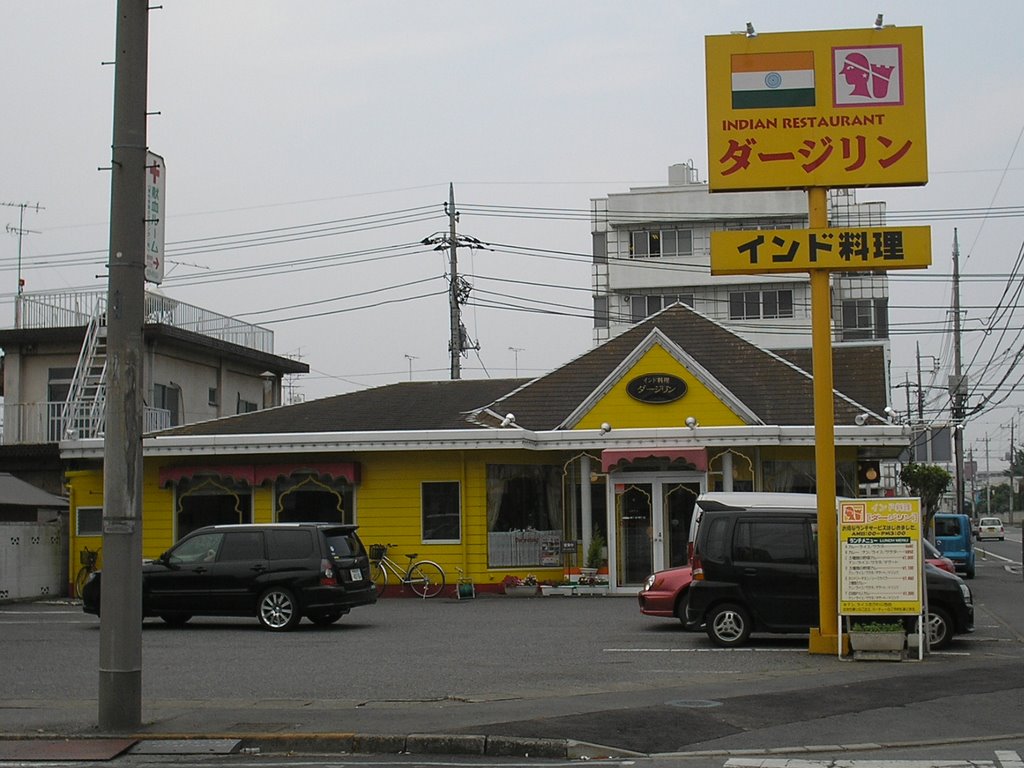
We couldn't find a clue until a couple hours later when, after circling a few blocks north of the station, we asked at Rana, an "International, Halal" food store run by some Iranians. The only other customer was a Nepali who not only owned an Indian restaurant named Darjeeling, but offered to drive us there, and even to drive us back to the station if his place wasn't too busy by the time we finished eating. We readily accepted, and had a wonderful meal of chicken tandoori, mutton masala, nan bread, and salad vegetables, washed down with a couple of beers unusual for Japan: Everest and Grolsch. The proprietor came to Japan ten years ago, and his restaurant has been successful enough for his elder brother to open a branch in Tokyo.

Except for a few words of English, he and I communicated entirely in Japanese, quite informally and comfortably. Neither of us had done enough formal study to command formal registers very well anyway. After dinner, we insisted on walking back to the train station, and he came out to the street to confirm his earlier directions and we parted in typical Japanese fashion, with bows and thank yous. On the way back, we passed the Civic Center, with a range of social support facilities for both citizens and foreigners, including an office that handled passports and visas.

The 1 May 2005 issue of Pakistan's Dawn has more about unskilled foreign workers in Ota.
Kimio Matsudaira, an official at Hello Work, a public labour office in Ota city, Gumma prefecture, 60 kilometres north of Tokyo, said there is now a special programme to help and support foreigners working in the area. Ota has a population of about 200,000 people. The irony is that more than sixty per cent of its people are over 60 years of age, in a city where the economy is dependent on manufacturing. Without doubt, Ota really needs foreign workers badly. To support the city’s automobile and electronic industries, Ota is now host to more than 30,000 Japanese Latin Americans, descendants of Japanese who emigrated to South America in the early 20th century seeking a better future. In the late eighties Japan launched a policy of accepting third and fourth generation Japanese Latin Americans to support a labour shortage in its factories stemming from the bubble economy at that time. More recently, Asians, mostly from South-east Asia, have also arrived to work in factories, comprising a total of 45,000 registered workers in Ota city. Matsudaira said foreign workers are vital to the survival of Ota’s economy.

Kiryu's Changing Industries: From Silk to Pachinko

Kiryu (桐生), in Gunma Prefecture's southeast fanhandle, was an early center of silk manufacture, a later pioneer in textile manufacturing, and now home to Gunma University's Faculty of Engineering, which offers this glimpse at its industrial transitions.
Kiryu is often referred to as "the Eastern Kyoto". Like Kyoto, Kiryu has over 1,000 years of history behind it and owes its wealth and tradition to the silk textile industry. Even now, Kiryu is a major centre for the manufacture of kimonos (traditional Japanese wear). The precise origins of the silk industry in Kiryu have been lost in the mists of time, but according to local legend a young man from Kiryu won the heart of a princess at the Imperial Court in Kyoto with his exquisite poetry. They eventually married and returned to Kiryu, where she taught the local inhabitants the art of weaving. There are records of silk production in Kiryu dating from the 10th century. Over the years, the silk industry grew and flourished in Kiryu. Kiryu silk was sent to the Imperial Court and was used by the Tokugawa Shogun for his army's battle banners in 1600. Kiryu became the site for a major silk market which drew merchants from all over Japan.

However, in recent years the kimono was been largely replaced by Western-style suits and dresses. The golden age of the silk industry has now passed.

With the decline of the silk industry the people of Kiryu adapted themselves to new industries, mainly the production of automotive parts, electronics and related industries. However, Kiryu has become a major producer of another typically Japanese product--pachinko machines! (Pachinko is a type of pinball which is extremely popular in Japan.)
An article by Tomoko HASHINO entitled "Power-looms and the factory system: the relation between production systems and technology choice in the silk textile industry in Kiryu in the 1910s" has more about the early transition from hand looms to power looms. The abstract from Socio-Economic History, vol. 63, no. 4, follows.
Recent studies have clarified some special features regarding the introduction of power-looms, especially in pre-war Japan. One of the more important findings was the close relationship between particular production systems and technologies, for example the factory system and power-looms and the putting-out system and hand-looms.

The purpose of this paper is to investigate the above relationship in the silk textile industry on the basis of the hypothesis that the factors leading to the introduction of power-looms are independent from those leading to the introduction of the factory system. Kiryu is one of the oldest silk textile industry districts in Japan. In the early Meiji period (1870s-80s) it showed a positive response to the introduction of new foreign technology, such as the batten and the Jacquard machine, and helped to spread them to other areas. But Kiryu was slower than other areas in introducing power- looms. The putting-out system was widely adopted in Kiryu and had a long history. It has been assumed that this acted as an obstacle to the introduction of power-looms.

In the 1910s, there were four types of factory in Kiryu: factories with power-looms only, factories with hand-looms only, those with both, and those with none, which were often called orimoto (clothiers). Neither the production systems nor the technology dramatically changed in Kiryu in the 1910s; however, some factories began to introduce power-looms.

There were some reasons that promoted the adoption of the factory system. OJT (on-the-job-training), which played a role in maintaining the quality of goods, was an important reason in Kiryu in the 1910s. As past studies point out, institutional, technological and market factors were other reasons that promoted the introduction of power-looms there. While both electrification and the establishment of domestic and local power-loom suppliers were very important, it appears that the change in raw material from raw silk to rayon in the 1920s was the decisive factor in accelerating mechanization. The fact that hand-loom factories have often been categorized as "manufacture" has been a controversial issue among historians. But we must recognize the significance of their role in controlling workers and turning them into a skilled labor force.

15 September 2005

Watching Sumo in Real Time

During my later elementary school years in Kyoto, I used to come home from school and watch sumo matches on our new black-and-white television (Sharp-brand, if I recall correctly). At that time, my favorite wrestlers were Taiho and Asashio, the latter a bit hairy, muscular, and not very fat. (Wakachichibu was the fattest one at the time.) I knew Taiho hailed from Hokkaido, but didn't know that he was born on Sakhalin of mixed Japanese and Russian parentage.

This week has been the first time since childhood that I've had the chance to watch a sumo tournament unfold in real time. The first day of the current Aki Basho ended with a dramatic upset, as newly promoted komusubi Futeno caused a blizzard of zabutons to fly toward the ring by defeating the domineering yokozuna Asashoryu.

The Japan Times described the state of play after Day 5:
Grand champion Asashoryu overwhelmed Kakizoe on Thursday, while Bulgarian Kotooshu claimed the sole lead at the Autumn Grand Sumo Tournament.

Mongolian Asashoryu was all business in the day's final bout at Tokyo's Ryogoku Kokugikan when he deployed several powerful arm thrusts to send the No. 2 maegashira over the straw ridge.

Asashoryu, who is gunning for his sixth straight Emperor's Cup, won his fourth straight bout and improved to 4-1 while Kakizoe dropped to 1-4.

Sekiwake debutante Kotooshu continued his impressive form when he swatted down top maegashira Miyabiyama to remain undefeated and in the lead at 5-0.

Miyabiyama, who was no match for the lanky Bulgarian, dropped to an unflattering 1-4.
There are also two Russian rikishi in this basho, but the Bulgarian is the one to watch (not to mention easier on the eyes). And his demeanor at this point is far classier than that of Asashoryu, who tends to glare defiantly and even pump his fist in triumph after each win.

UPDATE, Day 8: "Kotooshu large and in charge"
Bulgarian sekiwake Kotooshu continued to leave a trail of destruction in his wake at the Autumn Grand Sumo Tournament as he bumped out Kyokushuzan on Sunday to remain the sole leader with a perfect 8-0 record.

Kotooshu appeared nervous at the face off but faced little resistance from Kyokushuzan (4-4) and with a firm grip on his belt, he quickly worked the Mongolian maegashira to the edge of the ring before ushering him over the straw bales at Tokyo's Ryogoku Kokugikan.

Kotooshu stayed one win clear of grand champion Asashoryu with a week of the 15-day tournament left to go but he sensibly played down his chances of becoming the first European to win the Emperor's Cup.

"I've got a winning record now but it's far from over yet. There is still another week to go," said Kotooshu.
TV sports reporters are saying that Kotooshu's perfect string of wins is the best performance by a newly promoted sekiwake since Taiho, Chiyonofuji, and other sumo greats.

Tatsuo Yoshida at Asahi.com explains what's wrong with Asashoryu these days, and what's right with Kotooshu. Hint: Asa's work ethic let's him down.

UPDATE, Day 13: After much hype of the big face-off between the twice-thrown yokozuna Asashoryu and the upstart Kotooshu on his 12-bout winning streak, hype that included many profiles of Kotooshu, his family in Chiba, the country of Bulgaria, and even Meiji Dairy's Bulgaria-brand yoghurt, Asashoryu managed to bust Kotooshu's winning streak, keeping his own hopes alive for winning his 6th Emperor's Cup in a row.

UPDATE, Day 14: Another young upstart, Kisenosato, managed to "preserve his three losses" (3敗を守る) and hand Kotooshu a second loss, making the latter even with Asashoryu (both 12-2) going into the final day of the Aki ('Fall') Basho. I hope Kotooshu regains his confidence, preserves his two losses, and then manages to beat Asashoryu for the expected playoff on the final day. Even better would be for overconfident Asashoryu to add another loss to his total, so that Kotooshu wins the tournament outright with a record of 13-2.

UPDATE, Day 15: What a disappointment! The big face off, the ketteisen 'deciding match', between Asashoryu and Kotooshu was much too short and sour (to me). It was a great tournament, though, with a lot of upsets. All the more so watching a good bit of it in real time. Just now, waiting in the wings to come out and receive the Emperor's Cup, the swaggering, puffed-up, belligerent Asa actually broke down and wept for a brief moment. Fascinating. So now he joins the great Taiho in winning 6 Emperor's Cups in a row.

Japan Abandoned, 1939

On July 26, 1939, the United States, having repeatedly protested Japanese actions in China, notified the Hiranuma government that it intended not to renew the U.S.-Japan Treaty of Commerce and Navigation, scheduled to lapse in January 1940. Up to that point the Roosevelt administration had pursued a policy of gentle appeasement of Japan, but its basic Asian policy had always been to maintain the imperialist status quo embodied in the Washington treaty system. Thus it had consistently refused to recognize any changes Japan had brought about by force in China. Roosevelt had also propped up China's national currency by making regular silver purchases--a policy that would eventually lead him to join the British in providing foreign exchange so that Chiang Kai-shek could stabilize his currency, counter the proliferation of Japanese military currencies in occupied areas, and go on fighting. Now, however, anticipating that war would soon break out in Europe, the United States put Japan on notice that serious economic sanctions could follow further acts of aggression. Thereafter, if Japan's leaders were to continue the war in China, they would have to take more seriously the reactions of the United States, on which they depended for vital imports needed to wage war.

"It would be a great blow to scrap metal and oil," Hirohito complained to his chief aide-de-camp, Hata Shunroku, on August 5, shortly after the American move:
Even if we can purchase [oil and scrap] for the next six months, we will immediately have difficulties thereafter. Unless we reduce the size of our army and navy by one-third, we won't make it.... They [his military and naval leaders] should have prepared for something like this a long time ago. It's unacceptable for them to be making a commotion about it now."
But of course Hirohito did not enjoin his chiefs of staff to end the China war, or to reduce the size of anything; he simply got angry at them for not having anticipated the American reaction.

A few weeks later, on August 23, 1939, while the Japan-Soviet truce to end the fighting on the Mongolia-Manchukuo border was being negotiated in Moscow, Germany signed a nonaggression pact with its ideological enemy, the Soviet Union--which contravened the 1936 Japan-German Anti-Comintern Pact. After a fruitless three-year quest for "collective security" with the West against Germany territorial expansion in Europe, Stalin had declared Soviet neutrality and, in a secret protocol attached to the pact, made a deal with Hitler to take over the Baltic states and eventually partition Poland. Stunned by this diplomatic reversal, and unsure how to interpret the enormous strengthening of both German and Soviet power that Hitler's alliance with Stalin portended, the Hiranuma cabinet resigned on the morning of August 28.
SOURCE: Hirohito and the Making of Modern Japan, by Herbert P. Bix (HarperCollins, 2000), pp. 353-354

The latter half of this book seems much better than the first, probably for two reasons: (1) The documentation is far richer, so Bix doesn't have to overinterpret thinly sourced material. (2) Parts of it have been published before, so it is likely to have undergone more revision in response to referee comments. The chapter entitled "Prologue to Pearl Harbor" is excellent, but I think I'll refrain from excerpting it.

14 September 2005

Russian Repatriates from Hawai‘i, 1917

A reader, John Wilmer, sent a link to a website full of long lost far outliers that immediately sucked me in. Here are a few excerpts from the introduction and translated applications for repatriation from Hawai‘i to Russia in 1917.
At the beginning of the 20th century Hawaii sugar plantation owners began to recruit laborers of European background. Former Secretary of the Territory of Hawaii and Director of the Bureau of Immigration, Alatau L.C. Atkinson, and a somewhat questionable Russian entrepreneur A. V. Perelestrous, traveled to Harbin, Manchuria to recruit Russian workers, primarily from the area around Vladivostok. Perhaps as many as 2,000 Russians and Ukrainians came to Hawaii.

The idea for repatriating Russians living aboard began right after the February Revolution in Petrograd. Vil'gel'm Vasil'evich Trautshold, a career diplomat who had served as a Vice Consul in Hakodate (1906-12), as a Consul in Dairen and General Consul in Harbin (1914-17), was sent to Hawaii from September 1917 to March of 1918. The costs of repatriation to Russia were borne by the new government....

Podrez Sergei Konstantinovich. Born Oct. 6, 1878. He was a peasant from the village of Dubki IUzhno-Ussuriisk uezda Primor'ye oblast. In Harbin he was a tailor's shop and worked as an agent for the Singer Co. In 1910 he came with his family to Hawaii. Before repatriation from Honolulu he was a construction worker on the local prison. He left Hawaii alone in 1918 after he divorced his wife Elena Ermolaevna, 33 yrs. old (she was a mid-wife). They had four daughters ages two to sixteen, and had refused to leave with him. The court in Honolulu told the husband to pay $6 wk in alimony.

Kolesnichenko Demid (Dmitrii) Borisovich. Born Aug. 16, 1883 in the village of Kotliarka Kiev guberniia. In Nikol'sk-Ussuriisk he was the owner of a workshop were he considered that he "received more money for his work." (than Hawaii) He was a reserve junior non-commissioned officer in 1905. He came to Hawaii through Harbin on the ship Korea in 1910. His wife Pelageiia Nikiforovna, b. 1889 and three children from the ages of 4 to 8. Two of these were born in Honolulu. He mostly worked on sugar plantations on Oahu, but his last work was as repairman for horse-carriages ($4.75 day). He wanted to return to his parents in Nikol'sk-Ussuriisk. Trautshold noted: "drinks."

Riazantsev Fedor Petrovich. Born in 1865. He was a peasant in the village of Orlovka Tifilissk guberniia. Dukhobor Minister (Svobodnik). In 1899 he finished three years of exile to Tifiliisk for publicly destroying weapons (a religious principle). After that he emigrated with his parents to Canada and lived in British Columbia. In Feb. 1917 he came to Honolulu with his family. His wife ("spiritual sister"--Dukhobors don't get married) Pelageia, b. 1872, and their two sons aged 12 and 23 yrs. old returned to San Francisco because it was difficult to find work in Hawaii. In Honolulu Fedor was a temporary worker for building the water-works ($2 day). He said to Trautshold: "I know about freedom [i.e., the revolution] in Russia, and the Dukhobors want to ask the government to give us land to settle where we can live without animals." Dec. 16, 1917 he returned to Russia.

Legacies of Japan's Biochemical Warfare

By May [1939], when the major transport center of Hsuchou fell, the Japanese army was using chemical weapons whenever they could be effective in turning the tide in closely fought battles. "Imperial Headquarters Army Order Number 301," sealed by Hirohito on May 15, 1939, authorized the carrying out of field studies of chemical warfare along the Manchukuo-Soviet border. What the content of those studies was remains unclear. In July 1940 Hirohito approved Prince Kan'in's request to authorize the use of poison gas by the commander of the Southern China Area Army. A year later, however, in July 1941, when the army moved into the southern part of French Indochina, Army Chief of Staff Sugiyama issued a directive explicitly prohibiting the use of gas. Presumably Hirohito and the high command were concerned that gas not be used against Western nations that could retaliate in kind. Their well grounded fear of American possession (and forward stockpiling) of chemical weapons continued to deter them from using such weapons down to the end of World War II.

Hirohito also sanctioned during 1940 the first experimental use of bacteriological weapons in China. It is true that no extant documents directly link him to bacteriological warfare. But as a methodical man of scientific bent, and a person who questioned what he did not clearly understand and refused to put his seal on orders without first examining them, he was probably aware of the meaning of the orders he approved. Detailed "directives" of the Imperial Headquarters that the army chief of staff issued to the Kwantung Army command in charge of biological warfare, Unit 731, were as a rule shown to the emperor; and the Army Orders of the Imperial Headquarters--Army, on which such directives were based, were always read by him. Biological weapons continued to be used by Japan in China until 1942, but the full consequences of this Japanese reliance on both chemical and biological warfare would come only after World War II: first, in the Truman administration's investment in a large biological and chemical warfare program, based partly on transferred Japanese BC discoveries and technology; second, in the massive American use of chemical weapons in Vietnam.

Though no documents directly tie him to it, another feature of the brutal Chinese war for which Hirohito should be charged with individual responsibility was the strategic bombing of Chungking and other cities, carried out independently of any ground offensives, and using many types of antipersonnel explosives. Starting in May 1938 and continuing until the beginning of the Pacific War, the Japanese naval air force initiated indiscriminate bombing against China's wartime capital of Chungking and other large cities. The bombing campaign was uncoordinated with the army's strategic bombing of Chinese cities. First studied by military historian Maeda Tetsuo, the navy's air attacks on Chungking anticipated the German and Italian bombing of cities and strategic bombing of Japan's own cities that the United States initiated during the last stage of the Pacific War. At the outset the navy deployed seventy-two bombers (each with a seven-man crew) and dropped incendiary as well as conventional bombs. In their first two days of raids, they reportedly killed more than five thousand Chinese noncombatants and caused enormous damage. Two months later, in retaliation for this indiscriminate bombing, the United States embargoed the export of airplane parts, in effect imposing its first economic sanctions against Japan.
SOURCE: Hirohito and the Making of Modern Japan, by Herbert P. Bix (HarperCollins, 2000), pp. 362, 364

The aerial bombing of Guernica took place on 26 April 1937, almost exactly a year before the first Japanese bombing of Chungking.

13 September 2005

Watching the Japanese Elections

Jonathan Dresner at Frog in a Well has a nice summary of how effective Japan's Postal Savings system has been since it was first created back in the Meiji era.
The Postal Savings system was a fundamental institution in the Meiji modernization, enabling reliable low-cost long-distance transactions (including remittances from overseas, which is where my research comes in) and accumulating small deposits into a pool of capital that was agressively used for investment in railroads and other heavy industrial development.
I know I've been relying on the post office ATMs while I've been in Japan these past six weeks, since a lot of combini don't give equal access to accounts overseas.

My first comment on the recent election is that it provided me a great opportunity for language-learning that kept listening and reading skills in synch. The constant repetition of restricted sets of visual and oral clues with each new set of results (enough to keep me watching) gave me time to look stuff up in my handy-dandy new Canon WordTank: 当選の当 (short for 'elected')、確実の確 (short for 'called')、比例の比 (short for 'proportion[ally elected]')、圧勝 ('pressure=overwhelming victory')、plus a lot of surnames and placenames that I'm always a little shaky on.

Two more points: (1) Koizumi seems to be creating the equivalent of Blair's New Labour or Clinton's DLC (which is where I feel most comfortable on the political spectrum). Can we call the current LDP the New Tories? (Please, not Neocons!) (2) The DJP really got wiped out in Greater Kanto. I'm right now in Ashikaga, on the border of Tochigi and Gunma, where all but one out of maybe 18 wards went for the LDP. You can see the economic growth (industrial parks, tract housing, strip malls, big box retailers, lots of cars and parking) all around the edges of the Kanto plain.

12 September 2005

Japan: A "Third Beer" Country

This summer, the major Japanese brewers have all been pushing their new "third beer" products. I was motivated to sample them by the relative price--about ¥600 for a six-pack, as opposed to at least ¥1200 for malt beer.
The "third beer" boom was sparked by Sapporo, which launched a beverage called Draft One in February 2004. Made with protein extracted from peas, Draft One's selling point is its light taste and drinkability. Meanwhile, Kirin's Nodogoshi Nama, made with soybean protein, touts its good flavor and crispness. Asahi's Shin Nama, which uses soy peptide and a yeast that the company also employs in beer making, offers a dry finish. And Suntory's Super Blue, which contains low-malt beer mixed with liquor distilled from wheat, has a crisp, refreshing taste.

Determined to avoid the high taxes imposed on beverages made using malt as a raw ingredient, the brewers went to a lot of trouble to find alternatives. Sapporo, the pioneer in this market, experimented for four years with a series of ingredients that included two types of millet and corn before hitting on pea protein as a raw ingredient.
I've now sampled all of the above-listed "third beers"--plus Sapporo's new low-calorie, "high fiber" Slims--and the only six-packs I could finish were Sapporo's Draft One and Asahi's Shin Nama. And if the weather hadn't been so hot and muggy, I'm not sure I could have accomplished even that much.

Now I guess I'll have to sample a couple of Japan's "second beers"--the low-malt happoshu. But, except in really hot weather, I prefer my beers flat, dark, and bitter, not sudsy, pale, and yeasty. I could drink Guinness for breakfast, lunch, and dinner if I never had to get any work done.

Bix on Irresponsible Japanese Decisionmaking

At the imperial conferences Hirohito presided over and approved decisions impacting not only the destiny of Japan but of China and other countries affected by Japanese policy. Since these conferences were usually convened after the liaison conferences [between the top government and military leaders], at which all the interested parties had reached decisions in which the emperor shared [passively or actively?--J.], he already knew the contents of the matters to be "decided." Essentially the imperial conference was designed to allow him to perform as if he were a pure constitutional monarch, sanctioning matters only in accordance with his advisers' advice but not bearing responsibility for his action [so in this context "sanctioning" = rubberstamping--J.]. At these meetings, civilian ministers wore morning clothes and military officers full-dress uniforms. The theatrical element of these affairs should not obscure their great importance, however. Nor were all imperial conferences the same, and the emperor's lips were not sealed at all of them [so they *were* sealed at most of them?--J.].

The imperial conference was the device for legally transforming the "will of the emperor" into the "will of the state." And because everyone who participated in its deliberations could claim to have acted by, with, and under the unique authority of the emperor, while he could claim to have acted in accordance with the advice of his ministers of state, the imperial conference diffused lines of responsibility. In that sense it was the perfect crown to the Japanese practice of irresponsibility, for it sustained four separate fictions: (a) that the cabinet had real power; (b) that the cabinet was the emperor's most important advisory organ; and (c) that the cabinet and the military high command had reached a compromise agreement on the matter at hand, providing the emperor with a policy that he (d) was merely sanctioning as a passive monarch [so here too "sanctioning" = rubberstamping--J.]. Reality was quite different: a powerless cabinet, an emasculated constitution, and a dynamic emperor participating in the planning of aggression and guiding the process, by a variety of interventions that were often indirect but in every instance determining. [Notice any actors missing from the "reality"? That's right! A dynamic military planning its own aggressions--not just "participating in" the planning--and directly or indirectly forcing the government to react with new policies that ranged from bad to worse.--J.]
SOURCE: Hirohito and the Making of Modern Japan, by Herbert P. Bix (HarperCollins, 2000), pp. 328-329

Look, I have no interest in excusing Hirohito for his manifest sins of omission, and am fully prepared to believe that he exercised malignant leadership on many occasions. (Nor do I care one way or the other whether the Japanese imperial throne is preserved or abolished.) But I just find Bix's arguments to be more tendentious than convincing when he tries to make the case that Hirohito was a more active than passive sinner.

POSTELECTION AFTERTHOUGHT: It's interesting how much criticism newly (and overwhelmingly) reaffirmed Prime Minister Koizumi gets for *not* making decisions in the unaccountable backroom manner described above, which has long characterized Japanese politics.

10 September 2005

Reckless Japanese Admirals in Shanghai, 1932

Tensions in Shanghai had begun after Japanese residents took umbrage at a Chinese newspaper article, on January 9, decrying the failure of the assassination attempt on the Shôwa emperor. Nine days later army Maj. Tanaka Ryûkichi, hoping to divert foreign attention from the army's operations in northern Manchuria, instigated an attack by a Chinese mob on a group of Japanese Nichiren priests. The Imperial Navy found this incident a tempting chance to demonstrate its prowess to the army. The Shanghai fleet was quickly reinforced and on January 28, 1932, marines under Rear Adm. Shiozawa Kôichi went ashore and that night challenged China's Nineteenth Route Army--a 33,500-man force stationed in the vicinity of the International Settlement, which ran along the waterfront. In the ensuing battle the Chinese gave the Japanese marines a good thrashing. Unable to retrieve the situation despite reinforcements from the fleet, the navy had to call on the army for help. But the Chinese army still held firm and again inflicted heavy losses. The high command in Tokyo then organized a full-fledged Shanghai Expeditionary Force under General Shirakawa and reinforced it with two full divisions. Intense fighting ensued; the Chinese finally fell back, and Japan was able to announce a face-saving cease-fire, followed by an armistice, negotiated with British participation on May 5, 1932, which also ended the Chinese boycott.

The Shanghai Incident should have awakened Hirohito to the recklessness and aggressiveness of his senior admirals--the very officers he and the court group regarded as sophisticated, cosmopolitan men of the world. Driven by service rivalry, they had deliberately sought a confrontation with Chinese forces in the heartland of China, knowing that problems with the United States and Britain were sure to result. Equally important, this incident was an unlearned lesson for both military services. Neither army nor navy drew any new conclusions from the heavy losses they incurred in this first large battle with a modern Chinese army. They continued as before--utterly contemptuous of the Chinese military and people, whom they saw as a rabble of ignorant, hungry peasants, lacking racial or national consciousness, that could easily be vanquished by one really hard blow. Hirohito himself may have held that view privately. But the emperor was more aware than his commanders of Japan's vulnerability to economic blockade. Going out of his way, he told Shirakawa to settle the Shanghai fighting quickly and return to Japan. At Shanghai, Hirohito acted decisively to control events; in rural Manchuria, on the other hand, he was pleased to watch passively as his empire expanded.

At Shanghai, both during and after the fighting, Japanese officers and enlisted men alike exemplified the pathological effects of the post-1905 battlefield doctrine of never surrendering. Captured by the Chinese in February 1932, Capt. Kuga Noboru was returned to Japan in a prisoner exchange; he committed suicide to atone for his capture. Praised for his martial spirit by Army Minister Araki, Kuga was later enshrined at Yasukuni. From this time on, officers who survived were openly pressured to commit suicide. A plethora of books, movies, and stage dramas glorified the "human bombs" and "human bullets" who fave their lives on the Shanghai front. These tales heightened the popularity of the army at home, while also reinforcing its mystique abroad. [Bix later (p. 346) notes that Japanese combat casualties numbered, on average, twice as many dead as wounded during the China war.]
SOURCE: Hirohito and the Making of Modern Japan, by Herbert P. Bix (HarperCollins, 2000), pp. 250-252

So much for the conventional wisdom that the Imperial Japanese Navy was much less inclined toward war than the Imperial Japanese Army.

09 September 2005

Hirohito's Role in Military Adventures, 1927-28

On March 24, 1927, soldiers of China's Nationalist Revolutionary Army pillaged the Japanese Consulate in Nanking and assaulted the consul; they also attacked buildings housing the American and British Consulates. Later that same day British and American warships on the Yangtze River bombarded the city. The Japanese press immediately sensationalized the Nanking Incident, in which six Westerners died, Japanese rights were violated, and no Japanese troops had been dispatched. Against this background, in the middle of the official mourning period for the Taishô emperor, Hirohito sanctioned Japan's first military interventions in China's civil war. Twice, on May 28 and July 8, he gave his consent to the army's dispatch of troops to China's Shantung Province, ostensibly to protect Japanese residents from assaults by Kuomintang soldiers on their way north toward Peking. Less than a year later, on April 19, 1928, he consented to another deployment: this time five thousand troops of the Sixth Division, under Gen. Fukuda Hikosuke, to the port of Tsingtao, Shantung, a center of Japanese textile capital and once a Japanese protectorate. He did so after first asking Chief Military Aide Nara whether the intervention would lead to another massacre of Japanese lives such as had occurred in the Russian city of Nikolaevsk (now Pugachev) in 1920. Nara said that it would not.

When Gen. Fukuda arrived in Tsingtao, however, he decided on his own initiative immediately to proceed inland (by rail) to Tsinan. There, a few days later, the first of several clashes occurred between Japanese and Nationalist soldiers. Later, on May 8, Hirohito sanctioned without hesitation the dispatch of reinforcements to Tsinan. The Tsinan affair dragged on into early 1929, during which time seventeen thousand Japanese troops unleashed a reign of terror on the Chinese citizens of the city, wrecking chances for Sino-Japanese rapprochement. For Hirohito this incident was yet another example of Tanaka's inadequacy as a prime minister.

Less than a month after Hirohito had sanctioned a fourth deployment of troops to Shantung Province, on June 4, 1928, senior staff officers of Japan's Kwantung Army, led by Col. Kômoto Daisaku, assassinated the Chinese warlord and territorial sovereign, Chang Tso-lin, on whom Prime Minister Tanaka had based his Manchurian policy. This incident (and the prime minister's alleged mishandling of it) pulled Manchuria into the turmoil of Japanese and international politics. For the young emperor and his entourage, it provided the opportunity they had long been seeking to remove Tanaka and his entire Seiyûkai cabinet.
SOURCE: Hirohito and the Making of Modern Japan, by Herbert P. Bix (HarperCollins, 2000), pp. 214-215

This passage illustrates what I find so frustrating about Bix's central argument: that Hirohito wielded actual power as commander in chief of the Japanese military--or, more weakly, that he could have if he had decided to! But it also shows why I'm determined to keep plodding through the remainder of the book. (I'm roughly halfway through its 688 pages of text.)

Notice the verbs (which I've boldfaced) that Bix uses to describe Hirohito's 'actions'. He sanctioned and consented, and once even asked a question before consenting. Sanctioned is one of those verbs that can mean anything from 'strongly advocated' at one extreme, to 'rubberstamped' at the other. It is by far the most common 'action' that Bix attributes to Hirohito during his involvement in key decisionmaking. In most cases, Bix is reduced to accusing the emperor not of acting wrongly, but of failing to act--more specifically, of failing to rein in a military that was out of control by calling for the punishment of criminal behavior by its officers. Note the unsanctioned actions of Gen. Fukuda and the Kwantung Army officers, which I've italicized in the passage cited above.

Despite Bix's repeated, often tendentious, explications of the silent emperor's thought processes and intentions at each indirectly documented event, Hirohito never seems to be the initiator of any military action. Instead, he comes across as an irresolute, squeaky nag on his ceremonial white steed, who on nearly every occasion accepts the recommendations of his advisors. His most aggressive actions seem to be directed at civilians, when he dissolves the cabinets of unsuccessful prime ministers. Meanwhile, the military literally gets away with murder. Instead of a commander-in-chief, Hirohito acts more like a nagging national mother-in-law to each new prime minister.

On the other hand, Bix does a thorough and convincing job of answering the question, "What did the emperor know and when did he know it?" Hirohito was well informed about all key events. And Bix's narrative also recaps clearly the step-by-step road to war between Japan and the U.S., countering two prevalent myths along the way: (1) That the U.S. pushed Japan into war while Japan was willing to compromise. In truth, every escalation of U.S. sanctions was in response to new levels of Japanese aggression in China, and Japanese refusal to compromise on China. (2) That Chiang Kai-shek's army saved its ammo while Mao's communists bore the brunt of the anti-Japanese resistance. If anything, it was the reverse during the 1920s and 1930s. The Nationalist army fought well against the Japanese in a number of earlier engagements, even besting them on occasion. If China had had an air force that could bombard the Japanese homeland the way the Japanese bombarded Chinese cities, it might at least have fought Japan to a draw.

At least those are my impressions after reading the first half of Bix's tome.

07 September 2005

The Wild Pigs of Ashikaga

One day last weekend, an early morning walk turned into a full morning's hike along mountain trails near our apartment. We started at Ashikaga's Orihime Jinja, a textile industry shrine established in 1937.

FIRST DETOUR: Orihime is 織姫 'weaving princess'; textiles are orimono 織物 'woven things'. Orihime is the heroine of the Tanabata story. "The legend was probably imported from China in the Heian Era (794-1185), and its associated Tanabata Festival has developed through the centuries. The story involves the stars of Vega and Altair and their apparent proximity to the Milky Way." Although July 7 marks Tanabata in much of Japan, Ashikaga and other northern cities follow Sendai in celebrating it on August 6-8.

Behind the shrine's parking lot were markers of several trailheads, and we saw some old folks setting out for hikes. So we kept going. The first sign we saw as the trail left the parking lot was a warning about イノシシ (inoshishi 猪 'wild boar') on the mountain trails. We hesitated for a moment, but then forged ahead. Near the top of the first crest, near the upper parking lot, we encountered an old lady who was so excited about having seen two wild pigs that she had to tell the first people she met, even if they were foreigners. (My Japanese is just good enough to get people talking, but not good enough to follow more than the gist once they get wound up. I need subtitles when the vocabulary gets away from me.)

"I saw two inoshishi," she said, "They were so cute. Don't worry. They're used to people and won't attack."

"What do they eat?" I asked.

"They live on fresh roots, fallen fruit, and the food left on graves."

SECOND MEANDER: Sure enough, a few days later, we saw another sign warning about inoshishi, this time at Hôrakuji (1294), a temple that served as a model for the much more famous Ginkakuji (1460) in Kyoto, both built by Ashikaga clan leaders, as was the more spectacular Kinkakuji (1397). It asked people not to put food on the graves in the large cemetery behind the temple that climbed halfway up the same hillside we had hiked.

We thanked the lady for her advice and set out on a well-traveled trail. We never saw any inoshishi, nor did the other people we queried as they were returning. But once we got to the shrine at the top and decided to take a less travelled path back, we began to see constant signs of pigs rooting beside the trail. We never saw--nor even heard--the pigs themselves, but when the path turned out to be a little less well beaten than we had hoped, we were sometimes heartened to see that at least the pigs recognized it as a human thoroughfare likely to attract the odd bit of food waste. Near the end of the mountain trail, as we slowly approached civilization by way of overgrown cart trails past overgrown vegetable gardens, we even saw a real pig wallow at a bend in the road, with the water still murky from recent use.

It's good to see that even larger Japanese animals are making a comeback, even if they do make pests of themselves from time to time.

FINAL TRAIL OFF: According to an abstract in PubMed, there are two subspecies of wild pig in Japan, Sus scrofa leucomystax and S.s. riukiuanus (the latter from the Ryukyus), both more closely related to the Far Eastern (S.s. ussuricus) than to the Middle Asian (S.s. nigripes), Transcaucasian (S.s. attila) and European pigs (S.s. ferus).

06 September 2005

Nichiren and Japan's National Spirit, 1924

Seeking to resist the democratic current and build up the waning imperial authority, on November 10, 1923, the Kiyoura cabinet adopted a "cultural policy" based on the regent's [i.e., Crown Prince Hirohito's] Imperial Rescript on the Promotion of the National Spirit. Prime Minister Kiyoura thereupon formed, in February 1924, a Central Association of Cultural Bodies in response to Hirohito's call for the improvement of thought and "the awakening of the national spirit." Invited to the association's convocation meeting to discuss a national campaign against "dangerous thoughts" associated with the labor movement and the Left were representatives from Shinto, Christianity, and Buddhism, including the leaders of Nichiren.

The sect, founded in the thirteenth century, was enjoying its golden age of influence and growth, and two of its leading proseltyzers--Honda Nisshô and Tanaka Chigaku--immediately seized upon this "national spirit" campaign to draw up an appeal asking the court to issue a rescript conferring on Nichiren, the founder of their religion, the posthumous title of "Great Teacher Who Established the Truth," so that they could then use it for prosletyzing purposes. After the court granted Nichiren the title, Imperial Household Minister Makino is alleged to have declared: "This decision was due to the emperor's benevolent awareness that the present ideological situation in Japan requires better guidance by sound thought, and especially, firm religious belief."

In fact the imperial house, controlled by Makino and Hirohito, awarded the title because it considered the social situation bad enough to warrant the services of the most passionate enemies of Taishô democracy, the Nichiren believers. When Honda went to the Imperial Household Ministry to receive the award, he met Makino and told him that the Nichiren religion "is the banner of an army on the offensive in the 'ideological warfare' of the present day." Honda also expressed his patriotism and boasted about the Nichiren sect's antidemocratic, anticommunist nature." That Buddhism (or the faith of Nichiren believers, many of whom were upper-echelon military officers and civilian right-wing ideologues) had to be called on to supplement emperor ideology indicates that the official creed was never able to exercise a controlling influence on all groups in Japanese society.
SOURCE: Hirohito and the Making of Modern Japan, by Herbert P. Bix (HarperCollins, 2000), pp. 163-164

05 September 2005

Guidance: Welcome it is all of you!

The following sign at Shin Sapporo Station Bus Terminal no. 22 was helpful and befuddling at the same time.
Guidance: Welcome it is all of you!

A visitor going to "a village of reclamation" takes a bus for "Kaitaku no mura" of the 22nd number from a departure home of here and please take it to a terminal.

Because I can be more late by traffic circumstances from the departure time, please understand it. Then please spend pleasant time.

Ha Jin on Settling the POW Hunger Strike

In addition to the issue of repatriation, our leaders also accused the American side of some other serious violations of the [Geneva] convention. To be fair, I didn't feel that our captors treated us badly. At least we were sheltered and had food. Most of the wounded prisoners had access to medical treatment, though conditions still had room for improvement. About six thousand people had been crowded into a small compound, with no disease springing up, because sanitation had been adequately maintained. Some inmates had even gained a little healthy color, especially some cooks whose cheeks had grown thicker. We often joked that the latrines in the compound were better equipped than those in our barracks back in China. Seats had been installed in them, and at the centers of the rooms were washing facilities--faucets for running water and metal basins set into round concrete tables. On the whole, I had to admit that the Americans were generous, at least materially. Besides food, each POW was given at least one pack of cigarettes a week, and sometimes two packs. I saw with my own eyes that American medical personnel treated injured civilians at the Pusan prison hospital. Here in every compound the United Nations had set up a program for civilian education that distributed books among the inmates, offered courses in mechanics, science, and Christianity, and often showed movies. Unfortunately our compound, controlled by the Communists, wouldn't have anything to do with such a program. Whenever a prisoner reported that he had lost his blanket or mat, he would be issued another one, since there was always a surplus of these things within the compound. Sometimes this would even apply to uniforms. Such replenishment was unthinkable in our own army, in which you would be disciplined for the loss. Back in China I had never heard of a soldier losing his bedroll.

[Chinese POW leader] Chaolin had a sharp tongue. The moment the [American] major finished reading [the Geneva Convention booklet], Chaolin said, "Obviously our treatment falls short of the standard set by the convention. For example, we Chinese don't eat barley, which is fed to livestock back home. But you have made barley the staple of our diet, and most of the time there isn't enough barley for everyone. Each man can have only two bowls a day, and the calories are way below the minimum need of the body. What's worse, there's very little vegetable in our diet, and meat is absolutely a rarity. If your country has difficulties, please notify our country. I'm sure China will send over shiploads of rice, meat, and eggs to keep us from starving.

What he had said about barley wasn't wasn't true. No Chinese would feed animals barley, which we didn't like as much as rice but which tasted better than corn or sorghum, the principal foodstuffs in northern China. Having heard my translation, General Bell reddened and said, "I will take your unusual Chinese dietary habits into consideration and try to solve this problem. If you always feel hungry, I suggest that you stop the hunger strike now, which will increase your fellow men's misery and waste food. As for the medical conditions, I will see what I can do."
War Trash, by Ha Jin (Vintage, 2004), pp. 157-159

04 September 2005

The Parking Lots of Ashikaga

On the few times when we took long car trips in Japan during the 1960s, ours was one of the few private passenger cars on the highway. My impression is that no more than 20% of the vehicles on the highways back then were private passenger cars. And there were very few expressways, so it was like driving the old two-lane national highways in the U.S. during the 1950s. And taking the business route through each town, since bypasses for almost any major town would involve either cutting through the mountain behind it or filling in the sea in front of it.

Well, Japan's construction state has now done that for cities and towns all over the archipelago. Roads and highways are now full of private cars--and flanked by strip malls with hectares of parking where fields and paddies used to be. It doesn't strike you so much when you're traveling around on a rail pass, but if you look carefully out the window of the train, you'll notice that in the smallest towns, the pachinko parlor has a bigger parking lot than the train station; or that many small cities have an Ito Yokado with ample parking. In the sprawling suburbs, even the combini have parking lots. (Ito, the largest shareholder of 7-Eleven Japan, has just merged the two firms to form Seven&i Holdings.)

I thought I'd look at the public transport and parking situation in Ashikaga, a small city of historic importance, whose similar-sized sister cities include Springfield, the capital of Illinois, and Kamakura, the capital of the Kamakura shogunate (1185-1333), which preceded the Ashikaga shogunate (1333-1573). Its Chinese counterpart is Jining in Shandong, which embraces the hometowns of both Confucius and Mencius.

This gives a sense of the city's cultural pretensions, which are not hard to understand. Its cultural legacy dates back to the Heian period (794-1185) and Minamoto no Yoshikuni, progenitor of the Ashikaga clan famous for its shoguns. So it has many traces of old money, namely, plenty of well-maintained shrines and temples; a flourishing tourist industry; several art museums (including a world-class porcelain museum); and lots of streets and sidewalks paved with granite or brick flagstones near the tourist sites.

The oldest part of Ashikaga, the original castle town (本城), lies on the hillslopes north of the Watarase River. The JR railway also runs north of the river, and main street (中央通り or just plain 通り) runs parallel north of that. But, while the nicer restaurants, bars, and souvenir shops near the tourist attractions are thriving, a lot of main street storefronts are closed. Nearly half the storefronts on some blocks remain unleased, so that I've learned a new kanji combination, boshuu, as in テナント募集 'tenants invited', or 'space available'. Shop hours are also short during the week, often just 11:00 to 18:00, with longer hours on the weekends, when more tourists as well as locals are on the streets. Exactly two Ashikaga city buses run such long routes far out into the country side, mostly to accommodate old people and hikers, that they can only complete four runs in each direction, at intervals of at least two hours.

Most of the retail action is happening south of the river, which is served by the private Tobu Line railway, with over 60 trains per day in each direction to the JR's 30. The park-and-ride lot on the south bank of the river is normally jammed with cars, while the north bank always has plenty of spare room. National route 293 north of the river is flanked by city offices and parks, schools, and historic temples. South of the river, it's flanked by strip malls: big-box retailers, fast-food outlets, and discount specialty stores. As pedestrian consumers trying to stock a semi-furnished Japanese apartment for a year, my wife and I have been thrilled to have within a 20-minute walk such big-box retailers as Yamada Denki and Kojima for home appliances and electronics, Shimachu for home and garden furniture and supplies, and Ito Yokado (now Seven&i Holdings) and Apita department stores, and--most of all--the big Daiso 100-yen store (Japan's equivalent of the old "five-and-dime" stores).

Except for the well-stocked Fressay Supermarket (now hiring!) down the street, we don't do any major shopping on our side of the river. We hike to the strip mall, where we could find a Chinese-made rice cooker and an iron for a third the price of their counterparts in the customer-free Panasonic or Sanyo outlets on main street.

But the old north side of town is fighting back with three weapons, two old, one new.

First, it is going back to what once made the town famous even before those Ashikaga shoguns--education. The Ashikaga Gakko is billed as the first university in Japan. Contemporary Ashikaga north is just littered with schools, public and private, from preschools to an Institute of Technology. In the evening, the old town is awash in cram schools, now more elegantly named zemi (ゼミ 'seminar') than juku (塾). Other than scattered restaurants and bars, there's not much happening after dark in old Ashikaga except cramming to get into a better class of school, with mothers lined up at the curb to pick up the younger students after class.

Second, the north side of the Watarase river offers a heavily publicized, dense network of hillside shrines and temples connected by tree-shaded hiking trails, which offer nature lovers a much wider range of flora and fauna--especially insects--than do the flat Kanto plains on the south side. The Ashikaga ハイキングコース ('hiking course') attracts a lot of visitors, especially retirees. Many of the temples and shrines have little boxes where pilgrims can get their guidebook "passports" stamped so they don't forget where they've been.

Third, the northside merchants have become keenly aware of the importance of offering parking to their customers. It's amazing how many tiny eateries and storefronts on bigger thoroughfares have a big "P" or "P あり" or "駐車所" ('parking lot') out front, usually with an arrow pointing around back to where a small house or vegetable garden used to be. If you walk the back streets, you see the same thing, plus a lot more small parking lots where houses or shops used to be. Some of them are for customers, others for car owners who rent them by the month. The Ashikaga sightseeing information page also gives a lot of parking information, including the number of car and bus slots at each temple or shrine.

All in all, I'm glad to be on the older and more walkable north side, but close enough to the river to walk to the strip mall and back in a couple of hours.

(Chopstick Sensei has some related thoughts from Gunma Prefecture, which borders Ashikaga to the south.)

UPDATE, 24 September: Well, another exploratory walk to the far side of Ashikaga's little Higashiyama rise has revealed the vastest parking lot yet, and on the north side of the Watarase River! The lot serves both the huge Torisen supermarket--which broadcasts some in-store messages in Japanese, English, Chinese, and Urdu/Hindi (I think, in any case not Portuguese), and carries among other things "non-oil" tuna, whale meat, Skippy peanut butter (a rare find in Japan), and fair selection of foreign wines in the ¥750-1500 range--and the even more gigantic Keiyo D2 (ケーヨーデイツー), the latter as big as any WalMart I've ever seen. Ashikaga's D2 branch was built in March 2004, most likely to serve the community employed by Sanyo and other businesses in the new Otsuki Sukedo Industrial Park (大月助戸工業団地), which stretches up the nicely treelined east bank of a confluence of rivers that drain the mountain valleys of northern Ashikaga City. Big strip malls stretch up the other side of the river, with chain stores such as a Home Center, Off House (used goods), and Denny's. Here's a summary of what an International Market Research report concludes about the growth of home centers and changing domestic markets in Japan.
The continuing growth of Japanese home centers was confirmed by recent official government data. The number of home centers in 2002 increased 27.9% from the 1999 Survey, and the number of employees working at home centers increased 51.6% over the same period. Due to the steady growth of the Japanese do-it-yourself industry and the recent boom in pets and gardening, both sales and numbers of home centers have increased in Japan. Japan's large-scale home center market offers good potential for U.S. products.
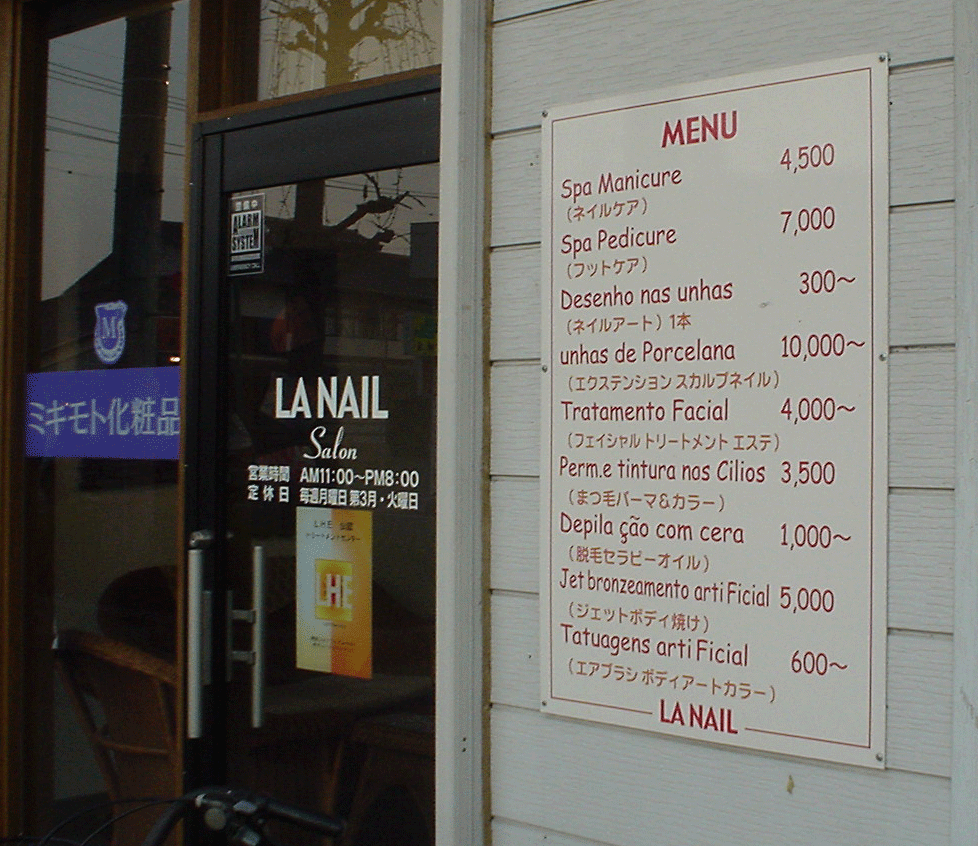
02 September 2005

Hirohito as a New Father, 1925

On December 25 Hirohito became a father. He ordered [Imperial Household Minister] Makino to arrange a series of court lectures for him and [Empress] Nagako on child rearing and child psychology. Four years before, on becoming regent, Hirohito had put Makino on notice that someday he and Nagako intended to rear their children in the palace and not entrust them to servants [as emperors had previously]. His mother, Makino, and genrô Saionji had resisted, but by persisting Hirohito had gotten his way, making clear to Makino and others that he had no higher priority than his own "household." He now had the satisfaction of seeing Nagako breastfeed their own children, starting with daughter Teru no miya, and raise them until the age of three. And because the wedding had been used as the occasion to reform the old system, whereby women of the inner court household lived in the palace instead of merely serving there during the day, Nagako was not surrounded by uneducated ladies-in-waiting who Hirohito feared might exert a harmful influence on her, not to mention leaking to outsiders any improper remark he might make.

In this way Hirohito secured a sphere of private life free of constant surveillance. This achievement came about through his total ending of the practice of imperial concubinage and cutting back the numbers of ladies-in-waiting. These actions did not make him a court reformer, however, any more than his public performances during the regency made him a "child of Taishô democracy." Even in his young manhood Hirohito was a champion of nationalism and tradition against Taishô democracy. This was true also in his attitude toward the three wars Japan had fought since 1894. Though proud of those victories, he was open to the viewpoints of those in his entourage who had attended the Paris Peace Conference at the end of the Great War, and understood the dangers of renewing a naval race and expanding too vigorously in China.
SOURCE: Hirohito and the Making of Modern Japan, by Herbert P. Bix (HarperCollins, 2000), pp. 145-146

01 September 2005

A Glimpse of Life Upriver from New Orleans

Here's the beginning of an email message broadcast to a list of retired Baptist missionaries to Japan (and some of their offspring). It originates from central Mississippi, about halfway between Memphis and New Orleans.
My telephone was out until today so I have been unable to send information about the storm. Electricity is off and will be off for several days, but I am now using my generator. I share it with my cousins during the daytime but use it at night. I can keep it going if I can purchase gasoline tomorrow.

Our area has many trees down (especially old oak trees), but little damage otherwise. Our church is home for about 150 evacuees from New Orleans and other areas. About fifty others come to eat at our food line. Since they do not expect to return to their homes for several days, we will not have Sunday School on Sunday. Each family has a private Sunday School room and the kitchen serves three meals a day. We will have only Sunday morning worship service that day.