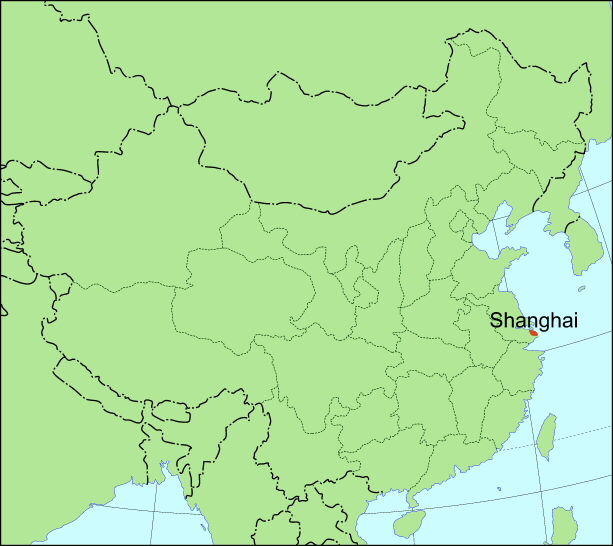
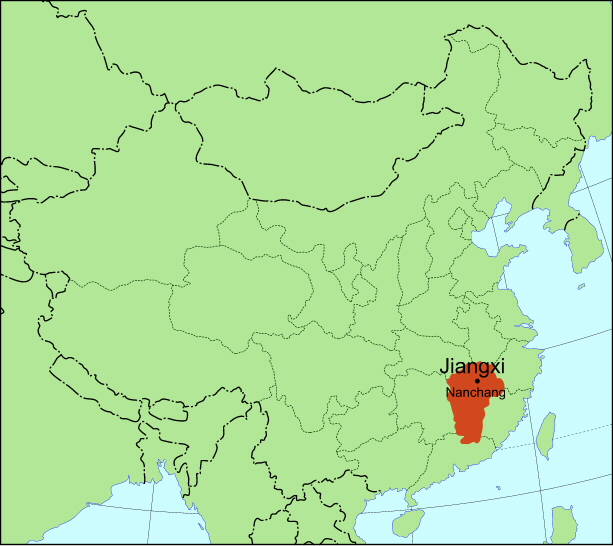
The rough dividing line between North and South China (at least "China Proper") is the Yangtze River, officially referred to as the Changjiang ('Long River') in Chinese. Unlike the Mason-Dixon line in the U.S., this division in China is the result of natural geological forces, not the result of any artificial human compromise. Like the Mason-Dixon line, however, the boundaries get fuzzier the farther you go west. (See maps; scroll down.)
South of the Yangtze, people depend mostly on rice as their staple, they prefer black tea, and they generally get by without heating their houses during the winter. (The coldest winter I ever spent was in one of those unheated houses in South China. Another foreign family there made the same claim--and they were from Winnipeg, Manitoba!) The old southern capital, Nanjing ('South Capital') lies on the south bank of the Yangtze. (See maps and photos; scroll down.)
North of the Yangtze, people grow a variety of hardy staples such as wheat, corn (maize), sorghum, and millet, which they make into pastas, breads, or gruel. They prefer green tea, and they generally do a better job of heating their houses during the winter. (See maps and photos; scroll down.)
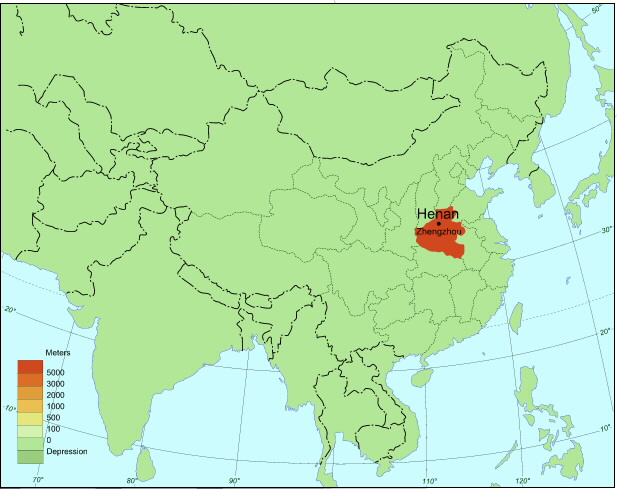
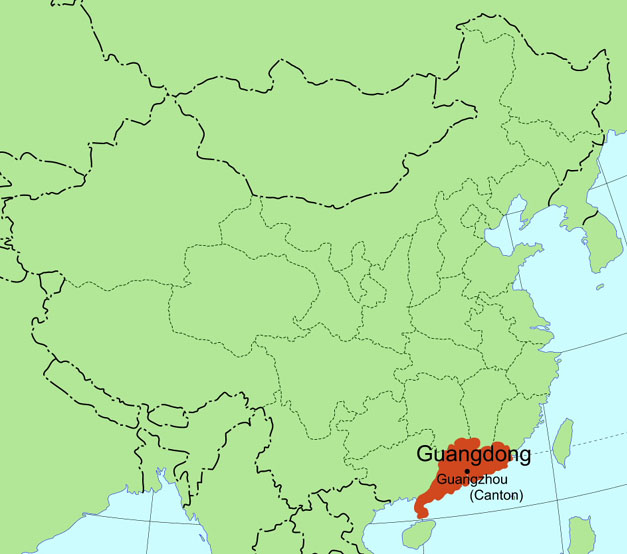
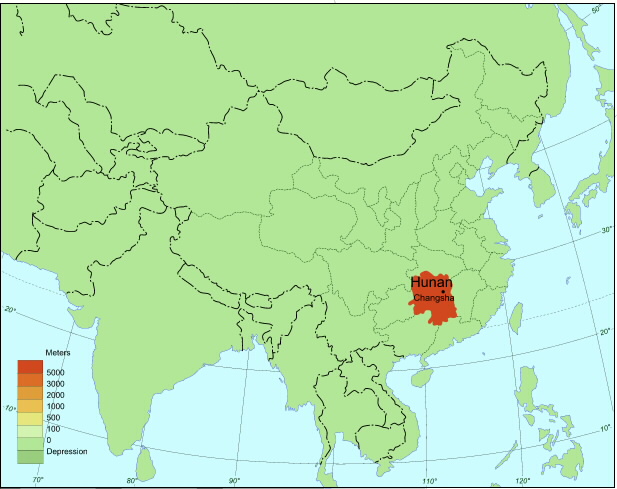
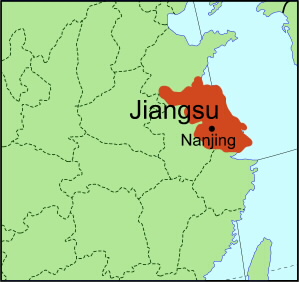
In popular stereotype, the North has more than its share of hardheaded ideologues, while the South has more than its share of unprincipled pragmatists. However, the pragmatic leader Zhao Ziyang was a northerner from Henan (although he rose to prominence in Guangdong), while the arch-ideologue Mao Zedong was a southerner from Hunan. The smooth diplomat Zhou Enlai was from Jiangsu, which straddles the Yangtze. (See maps of major provinces.)
If bureaucratic Beijing ('North Capital') is the northern archetype, hustling Guangzhou ('Wide State') is its southern counterpart. (See map of major cities.) Shanghai, at the mouth of the Yangtze, has a reputation for combining both ideological and mercantile hustle. Shanghai literally means 'rise-up sea', which may originally have meant 'the beginning of the sea' (and the end of the river), but I can't find any confirmation.
Unfortunately, many Cantonese seem to think that the North starts at the northern border of Guangdong Province--or that you have to speak Cantonese to be a southerner. Several of the teachers at the brand new college we taught at in Zhongshan City, Guangdong, were from Jiangxi Province, which stretches from Guangdong north to the Yangtze. They were frequently dismayed to be identified as beifangren 'northerners' when they spoke their southern dialect of the national language (putonghua, or Mandarin) rather than Cantonese. To Cantonese, they were just not southern enough. It was like Georgians calling Virginians--or Mississipians calling Tennesseans--"Yankees"! (Hmm. Come to think of it ...)
Recommended Browsing: A Visual Sourcebook of Chinese Civilization.
19 January 2004


17 January 2004
Asian Acronyms: Did you teach at GWYX or at Guangwai?
Discriminating linguists sometimes distinguish between acronyms pronounced as if they were a word, like NATO and UNICEF; and initialisms pronounced as a series of letters, like IBM or the UN. This distinction breaks down in orthographies that write whole syllables at a time, like Chinese.
In Chinese, for instance, acronyms are composed of the initial syllabic characters of (usually) two-syllable words. So, Peking (= Beijing) University, or Beijing Daxue [lit. 'NorthCapital BigSchool'] becomes Beida [lit. 'NorthBig']. In Korean, Korea University, or Koryo Taehak [lit. 'HighBeautiful BigSchool'] becomes Kodae [lit. 'HighBig']. In Japanese, it's a bit more complicated. Chinese characters can be pronounced not just in their Chinese loan forms, but as native Japanese words that mean (more or less) the same thing. This is what makes Japanese far and away the most complex, least efficient writing system on earth. In either case, each character is usually pronounced as two syllables, since Japanese had to add final vowels to one-syllable Chinese roots in order to pronounce any final consonants, most of which have been lost in modern Mandarin Chinese. (The same thing happens to current Japanese borrowings from English: ranchi < lunch, setto < set, beisubouru < baseball, and so on.) So the acronym for Hiroshima University, or Hiroshima Daigaku [lit. 'WideIsland BigSchool'] becomes HiroDai [lit. 'WideBig']. The name Hiroshima is native Japanese (the Sino-Japanese pronunciation would be Koutou = Ch. Guangdao), but Daigaku is Sino-Japanese [= Ch. Daxue].
After China adopted the supplementary Latin-based alphabetic pinyin writing system, which is increasingly used in computer input, you could begin to see alphabetic abbreviations, some of them rather alarming and most of them quite unpronounceable. Very few Chinese syllables start with vowels: a- is not uncommon, but e- and o- are rare, and i- and u- are nonexistent. Even worse, initial q-, x-, y-, and z- are way too common.
So, if you were to take the first pinyin letter of each syllable, Guangzhou Foreign Language Institute would be abbreviated GZWGYYXY < GuangZhou WaiGuo YuYan XueYuan [lit. 'WideState OutCountry SpeechTalk LearnYard']. You would do better to take the first letter of each two-syllable word rather than the first letter of every single syllable, in which case the same school would end up as GWYX < Guangzhou Waiguo Yuyan Xueyuan [lit. 'Guangzhou Foreign Language Institute']. However, most Chinese acronyms are more economical than that. The common name for this particular school was equivalent to "GuangFor" (Guangzhou Foreign), namely, GuangWai [lit. 'WideOut']. (It has now merged into GDUFS, the Guangdong University of Foreign Studies, which would still qualify for the acronym GuangWai in Chinese. The unfortunate English acronym must certainly be guh-doofs.)
These syllabic acronyms aren't unique to Chinese. Indonesian (or Malay) uses a Latin-based alphabetic writing system, but is chock full of syllabic as well as alphabetic acronyms (and initialisms). Acronyms seem to proliferate under big bureaucracies--especially if the military has a free hand. Examples of syllabic acronyms in Indonesian include the names of provinces like Sulsel < Sulawesi Selatan ['south'], Sulut < Sulawesi Utara ['north'], and Sulteng < Sulawesi Tengah ['central'] on the island of Sulawesi (Celebes); schools like UnHas < Universitas Hasanuddin in Sulawesi and UnPatti < Universitas Pattimura in Maluku (Molucca); and terms like tapol < tahanan politik ['political prisoner'].
UPDATE: Like Japanese and Korean, Vietnamese used to be written in Chinese characters and has lots of Chinese loanwords. Judging from the website of Vietnam National University - Ho Chi Minh City, Vietnamese seem to abbreviate by taking the first letter of each separately written syllable. Thus, (ignoring diacritics) Dai hoc Quoc gia Thanh pho Ho Chi Minh [lit. 'University National City Ho Chi Minh'] is abbreviated DHQG-HCM. Ho Chi Minh City is also abbreviated TP.HCM, which I'm pretty sure is often pronounced Saigon. Otherwise, I don't have a clue how these abbreviations are pronounced.
FURTHER UPDATE: Korean usage of taehak seems to be diverging from that of its cognates in Japanese (daigaku) and Chinese (daxue). While each term applies to a variety of institutions of tertiary education, Korean now distinguishes between taehak 'college' and taehakkyo 'university' very much along the lines of American usage. Taehakkyo indicates a larger institution that offers graduate education. So Kodae now stands for Koryo Taehakkyo, as the Chinese characters and Korean title on their homepage shows. I don't think the cognate forms, Jp. daigakkou and Ch. daxuexiao, even exist, much less serve a similar function.
In Chinese, for instance, acronyms are composed of the initial syllabic characters of (usually) two-syllable words. So, Peking (= Beijing) University, or Beijing Daxue [lit. 'NorthCapital BigSchool'] becomes Beida [lit. 'NorthBig']. In Korean, Korea University, or Koryo Taehak [lit. 'HighBeautiful BigSchool'] becomes Kodae [lit. 'HighBig']. In Japanese, it's a bit more complicated. Chinese characters can be pronounced not just in their Chinese loan forms, but as native Japanese words that mean (more or less) the same thing. This is what makes Japanese far and away the most complex, least efficient writing system on earth. In either case, each character is usually pronounced as two syllables, since Japanese had to add final vowels to one-syllable Chinese roots in order to pronounce any final consonants, most of which have been lost in modern Mandarin Chinese. (The same thing happens to current Japanese borrowings from English: ranchi < lunch, setto < set, beisubouru < baseball, and so on.) So the acronym for Hiroshima University, or Hiroshima Daigaku [lit. 'WideIsland BigSchool'] becomes HiroDai [lit. 'WideBig']. The name Hiroshima is native Japanese (the Sino-Japanese pronunciation would be Koutou = Ch. Guangdao), but Daigaku is Sino-Japanese [= Ch. Daxue].
After China adopted the supplementary Latin-based alphabetic pinyin writing system, which is increasingly used in computer input, you could begin to see alphabetic abbreviations, some of them rather alarming and most of them quite unpronounceable. Very few Chinese syllables start with vowels: a- is not uncommon, but e- and o- are rare, and i- and u- are nonexistent. Even worse, initial q-, x-, y-, and z- are way too common.
So, if you were to take the first pinyin letter of each syllable, Guangzhou Foreign Language Institute would be abbreviated GZWGYYXY < GuangZhou WaiGuo YuYan XueYuan [lit. 'WideState OutCountry SpeechTalk LearnYard']. You would do better to take the first letter of each two-syllable word rather than the first letter of every single syllable, in which case the same school would end up as GWYX < Guangzhou Waiguo Yuyan Xueyuan [lit. 'Guangzhou Foreign Language Institute']. However, most Chinese acronyms are more economical than that. The common name for this particular school was equivalent to "GuangFor" (Guangzhou Foreign), namely, GuangWai [lit. 'WideOut']. (It has now merged into GDUFS, the Guangdong University of Foreign Studies, which would still qualify for the acronym GuangWai in Chinese. The unfortunate English acronym must certainly be guh-doofs.)
These syllabic acronyms aren't unique to Chinese. Indonesian (or Malay) uses a Latin-based alphabetic writing system, but is chock full of syllabic as well as alphabetic acronyms (and initialisms). Acronyms seem to proliferate under big bureaucracies--especially if the military has a free hand. Examples of syllabic acronyms in Indonesian include the names of provinces like Sulsel < Sulawesi Selatan ['south'], Sulut < Sulawesi Utara ['north'], and Sulteng < Sulawesi Tengah ['central'] on the island of Sulawesi (Celebes); schools like UnHas < Universitas Hasanuddin in Sulawesi and UnPatti < Universitas Pattimura in Maluku (Molucca); and terms like tapol < tahanan politik ['political prisoner'].
UPDATE: Like Japanese and Korean, Vietnamese used to be written in Chinese characters and has lots of Chinese loanwords. Judging from the website of Vietnam National University - Ho Chi Minh City, Vietnamese seem to abbreviate by taking the first letter of each separately written syllable. Thus, (ignoring diacritics) Dai hoc Quoc gia Thanh pho Ho Chi Minh [lit. 'University National City Ho Chi Minh'] is abbreviated DHQG-HCM. Ho Chi Minh City is also abbreviated TP.HCM, which I'm pretty sure is often pronounced Saigon. Otherwise, I don't have a clue how these abbreviations are pronounced.
FURTHER UPDATE: Korean usage of taehak seems to be diverging from that of its cognates in Japanese (daigaku) and Chinese (daxue). While each term applies to a variety of institutions of tertiary education, Korean now distinguishes between taehak 'college' and taehakkyo 'university' very much along the lines of American usage. Taehakkyo indicates a larger institution that offers graduate education. So Kodae now stands for Koryo Taehakkyo, as the Chinese characters and Korean title on their homepage shows. I don't think the cognate forms, Jp. daigakkou and Ch. daxuexiao, even exist, much less serve a similar function.
16 January 2004
Soviet Koreans vs. Volga Germans: Deportation Smackdown
Prof. Lee Chai-mun of Kyungpook (North Kyôngsang) University published an article in the June 2003 issue of The Review of Korean Studies entitled "The Lost Sheep: The Soviet Deportations of Ethnic Koreans and Volga Germans":
Nadira Artyk, a London-based Uzbek journalist, describes the ebbing of that flood of deportations many decades later, after the collapse of the Soviet Union, in the wonderful Czech journal Transitions Online, in an October 1998 article entitled "An Exodus of Minorities":
The goal of this paper is to compare the forced deportations of two Soviet minorities, Soviet Koreans and Volga Germans in the early [20th] century. Most existing Korean studies tend to emphasize the uniqueness of Korean expulsion, thereby missing crucial factors which explain the origins of forced Soviet Korean deportations in 1937. In this comparative study, first, histories of Soviet Koreans and Volga Germans and their forced deportation processes were reviewed, and then the motives of the deportations were examined. The result of this comparative study gives credibility to the espionage theory for the forced deportations. It also strongly suggests that ethnic conflicts over land issues during collectivization as one of the most important motives for the forced deportations of the Soviet Koreans and Volga Germans.The published PDF version of the article generates errors, but a more easily accessible earlier draft is online. In it, Prof. Lee notes that individuals and groups from both minorities were deported earlier on for a variety of reasons, such as resistance to collectivization and various other counterrevolutionary activities, but the mass deportations directly followed the outbreak of war in each region. War between Japan and China became official after the Marco Polo Bridge Incident in July 1937. Over 170,000 Koreans in the Soviet Far East were deported to Central Asia beginning in October that year--after they had a chance to bring in the harvest. Germany's Operation Barbarossa attack on the Soviet Union began in June 1941. About 450,000 Volga Germans were deported to Central Asia in September that year. In all, more than 1 million Soviet Germans were deported.
Nadira Artyk, a London-based Uzbek journalist, describes the ebbing of that flood of deportations many decades later, after the collapse of the Soviet Union, in the wonderful Czech journal Transitions Online, in an October 1998 article entitled "An Exodus of Minorities":
Central Asia has a variety of minority groups, including European settlers (predominantly Slavic), diaspora minorities indigenous to the region (such as Tajiks in Uzbekistan and Kyrgyz in Tajikistan), and people forcibly deported to the area under Josef Stalin (such as Crimean Tatars, Germans, and Koreans).Under Soviet rule, people who belonged to completely different ethnicities and different religions were put together. But in Uzbekistan, for example, Russians and Uzbeks always remained largely separate communities. There was no tension between them simply because they led different lives. They even resided in different places--Russians in apartment blocks, Uzbeks in traditional makhallyas.Among the ways Koreans "adapted successfully" was to abandon their native language and to achieve educational levels second only to Soviet Jews. Among the most prominent are the government official Georgy Kim, who attained one of the highest levels of any non-Russian in the former Soviet Foreign Ministry and now serves as Minister of Justice in the Republic of Kazakhstan; and the writer Anatoly Kim.
The collapse of the Soviet Union heralded a rebuilding of national identities in all Central Asian states, which used to be subjected to merciless Russification. By reviving national language, culture, and history, the Central Asian governments tried to restore their nations' pride. Ethnic groups had to adopt to the dominating nation or leave.
Thus, after more than 70 years under the Soviet roof, many nonindigenous ethnic minorities chose to return to their historic homelands.
There has been widespread emigration of Germans, Russians, Ukrainians, Jews, Crimean Tatars, and Meskhetiyan Turks. Some other groups (such as Koreans) have shown little desire to leave Central Asia. [Well, sure, if the alternative is North Korea--ed.]
Kazakhstan and Kyrgyzstan, countries with significant Russian-speaking minorities, tried to strike a balance between restoring their predominant national cultures and not upsetting other ethnic groups. Kazakhstan's President Nursultan Nazarbayev guaranteed equal rights to all ethnic groups, but there are clear signs of power being concentrated in Kazakh hands. Until last year, non-Kazakhs held one-third of all ministerial posts in the country's cabinet. Now only a quarter of the government consists of Russians and representatives of other ethnic groups....
Of the ethnic groups, deported to Central Asia by Stalin before and during World War II (Volga Germans, Crimean Tatars, Koreans, Poles, Greeks, Chechens, Meskhetiyan Turks, the Ingushe, and so on), only Koreans and Germans adapted successfully [emphasis added]. Others, such as Chechens and the Ingush, after Stalin's death returned in large numbers to their homelands at the earliest opportunity, in the late 1950s.
Until the age of eight, Anatoly Kim spoke only Korean. Then he learned Russian and unlearned his native language forever. Studying painting and later literature in Moscow, Kim's short-stories and novellas have as varied geographical backgrounds as his own life. In some narratives, Kim alluded to the Korean community on Sakhalin or in Kazakhstan, but he never told of the horrible events of 1937. And only when he was in his fifties--after the Soviet Union crumbled--could he visit Korea for the first time. This voyage, as well as his subsequent stay there for a number of years as a professor of Russian, proved a veritable revelation. For Anatoly Kim's discovery of the real Korea was that same "voyage in search of a continent," only that it was not an entirely new one. It was the continent of his roots.One of the most interesting developments now is the attempt by South Korean religious, linguistic, and cultural evangelists to reclaim these "Lost Sheep." Recent Fulbright scholar Steven S. Lee has some very interesting observations on identity questions in his Koryo Saram archive.
My project has narrowed to two specific foci: (1) the growing body of literature (mostly in Russian) by Korean Central Asians, and (2) interactions between the Koreans here with Koreans from elsewhere in defining ethnic identity. For this second focus, my driving question is: Who is claiming authority in delineating what it means to be Korean? According to my adviser, German Kim, the South Koreans doing business and mission work here were at first welcomed with open arms by local Koreans, but gradually, these outsiders were perceived as arrogant and condescending, i.e. they considered themselves as the proper purveyors of Korean cultures. Of course, one could hardly call South Korea during the past 50 years as a vacuum for cultural preservation, and more and more, I find it useful to regard ethnicity and tradition as invention, as fiction. This is where my focus on literature comes into play: what I'm searching for is literature that defines ethnic identity--slyly and subtly, I'm hoping.Lee is far from impressed after translating Anatoly Kim's story "A Cry About a Mother in Seoul":
On this note of ethnicity as fiction, it's interesting how well Koreans seem to blend in with Kazakhs. I am ethnically Korean, and yet I've been mistaken for Kazakh. Accordingly, Koreans here are said to be more contented than Koreans in Uzbekistan, partially because they can blend in more easily. Although Almaty is a wonderful and quite liveable city, I certainly hope to be able to compare the Koreans here with those in Tashkent, where they are a more conspicuous and perhaps less integrated minority group....
Considering current attempts at religious awakening within the Korean community, this story is somewhat interesting. The author clearly intends to associate religiousness with ethnic identity; religion as both provoking and salving the dilemmas of ethnicity. Death (the ultimate displacement) provokes the narrator’s (inherent, insufferable) sense of alienation, which is exacerbated further when he visits his historic “motherland,” where, for some reason (probably to make a clever mother-mother connection, one lost figuratively and one lost literally), he can’t stop thinking about his deceased mother. His unstated dilemma (alluded to at the party) is one of faith--the aspersions cast on Providence and ancestors by his displacement and, perhaps, by his saintly mother’s death. The funeral scene serves as the uneasy nexus of spirituality and ethnicity, the deceased mother all alone in a sea of Russian names, the bow as a futile attempt to recoup loss; the mound of snow may be a reference to traditional Korean graves. The dog doesn’t quite work as a symbol.
In lieu of subtlety, the author resolves these conflicting threads with vague promises of Providence, love, the future, and cultural reawakening (that rice field), and I don't think this works; in fact, this strikes me as an attempt at auto-exoticization. It's interesting how the mother doesn't at all raise the point of ethnic alienation. Her prayers and death are essentially commandeered by the narrator, who crudely hammers in ethnic questions....
My adviser, German Kim, returned from some conferences in East Asia last week, and was not at all amused when I began panning Anatoliy Kim. Apparently, he's a respected Russian author, but according to German, his speciality is surreal "Russian-soul" questions rather than ethnic writing. I'm now translating a longer, much more promising story by a Lavrentii Son, and I'll post whatever I've done by next week then. Sadly, I've been told that after a period of euphoria in the early '90s, interest in ethnic literature and cultural reclamation has waned; people have a hard enough just making ends meet.
Which leads me to the Association of the Koreans of Kazakhstan, once dominated by scholars, but now headed by wealthy businessmen, suggesting an interrelation between ethnic identity and fiscal aspirations. It's interesting to note that the Korean geh [or kye], in which a group of entrepreneurs regularly pool their money and rotate its distribution (one reason why so many Korean-Americans own small businesses), does not exist here in Kazakhstan. However, some Korean-Kazakhstanis have made a pretty penny by acting as intermediaries between S. Korean conglomerates (eg LG and Samsung) and local markets. LG is the most visible electronics company in Almaty....
Before independence, the Koryo saram had ties to North Korea only, and while in Tashkent, I examined magazines distributed by Pyongyang, propagating their version of Korean culture—for instance, presenting socialist realist art as traditional Korean. By many local accounts, South Korean contacts with the Koryo saram have also been dubious at times. In April I translated an unpublished satire by Almaty writer/director Lavrentii Son, recounting how he was duped by two South Korean professors into providing copies of his films....
I don’t know if Son's charges are true, and I hope that nobody in the surprisingly politicized field of Koryo saram studies will take offense that I'm posting the satire on this site. I wonder if he’ll satirize me someday...
15 January 2004
The Bonin Islanders: Ethnogenesis and Exodus
A lot of people have heard of Iwo Jima, the subject of a recent bestseller by James Bradley about one of the bloodiest battles in the Pacific War. But far fewer people know much about the Bonin (or Ogasawara) Islands, the next cluster to the north in the chain of volcanic islands that comprise Japan's Nampo ('southward, austral') Islands, which stretches between Tokyo and Tinian. (See map). However, Bradley wrote an earlier book, Flyboys, about the air war over Chichi Jima ['Father Island'], the main island in the Bonins. According to the Book of the Month Club blurb:
In June 2003, an Asian studies conference in Japan devoted a panel to Exploring the Rich History and Culture of the Ogasawara (Bonin) Islands. A sampling of the abstracts follows.
The Bonin Islanders: Ethnogenesis and Exodus - Before the Japanese administration took over the Bonins in 1875, the 70-odd residents there were a motley crew of diverse heritage tracing back to Europe, North America, Africa, and various Pacific Islands ranging from Hawai‘i and Tahiti to Guam and Pohnpei. But, vis-à-vis the Japanese, they abruptly became Bonin Islanders, an ethnic minority subject to the Emperor, like the Ainu in Hokkaido. It was a classic case of ethnogenesis. Until 1945, it behooved the Islanders to identify themselves as Japanese, to intermarry with Japanese settlers, to move to the main islands to pursue educational or business opportunities, even to serve in the military. But when the Americans took over after the war, residual English language skills and non-Japanese heritage conferred more advantage. When the Americans offered them the opportunity to choose U.S. citizenship when the Bonins reverted to Japan, more than a few grabbed the chance and joined the exodus to Guam, Hawai‘i, or California, where they dissolved into the larger population, as did those who remained behind as Japanese. Only subtle traces now remain of their unique, but ephemeral, common heritage.
UPDATE: Prof. Daniel Long of Tokyo Metropolitan University, perhaps the world's foremost Boninologist, was kind enough to suggest a few corrections and elaborations, which have been incorporated into the text above. He assures me that the farflung former Bonin Islanders hold worldwide reunions every year or two.
I should also have mentioned that Tom Tyler credits Danny Long for his electronic text and reproductions of photographs from Cholmondeley's work. Prof. Long has also compiled a website on Bonin language and culture that includes a very extensive bibliography of sources (at least when the TMU server is working, which seems to be every other week).
Amritas notes an earlier novel by Hank Searls (author of Overboard) inspired by Bonin history, Kataki: A Novel (McGraw-Hill, 1987), sort of a "Chichi Jima Candidate" tale:
As the U.S. prepared for the final assault on Japan one key to success was knocking out the heavily fortified monitoring station on Chichi Jima, an island about the size of Central Park. But in the course of their daring mission, eight flyboys were shot down. Only one pilot could be rescued--his name was George H. W. Bush. His fellow fliers were not as lucky. They were captured and subjected to a fate so horrible that the records had been sealed until now.Another recent book, Sorties into Hell: The Hidden War on Chichi Jima, is rather more explicit about that horrible fate.
In October 1946, Colonel Presley Rixey arrived by destroyer at Chichi Jima to repatriate 22,000 Japanese who had been bypassed during the war in the Pacific. He discovered that the downed flyers had been captured, executed, and eaten by certain senior Japanese officers. This is the story of the investigation, the cover-up, and the last hours of those Americans who disappeared into war's wilderness and whose remains were distributed to the cooking galleys of Chichi Jima.There also appears to have been a long-running cover-up involving U.S. nuclear weapons on Chichi Jima and Iwo Jima during the 1950s and 1960s. But I'd like to focus on the what happened to the first permanent settlers in the Bonins. (The Sino-Japanese characters for Bonin--actually Bunin, now usually pronounced Mujin--mean 'absence [of] people'.) Here's one rough summary that bobbles a few details.
The Bonin Islands might have been an American possession if President Franklin Pierce's administration had backed up Commodore Matthew Calbraith Perry. Chichi Jima was first settled from Honolulu in 1830 by two New Englanders -- Aldin B. Chapin and Nathaniel Savory -- a Genoese [Matteo Mazarro], and 25 Hawaiians [more accurately, Pacific Islanders mostly unnamed on the ship manifest], who made a living raising provisions for sale to passing whalers. Commodore Perry called at Port Lloyd on 14 June 1853, next day purchased for fifty dollars a plot of land on the harbor, stocked it with cattle brought over in U.S.S. Susquehanna, set up a local government under Savory, promulgated a code of laws, and took possession for the United States. He intended to make Chichi Jima a provisioning stations for the United States Navy and American mail steamers. But this action was repudiated by the Pierce administration in Washington. Thus, in 1861 Japan was able to annex the Bonin Islands without opposition. The government did not disturb the American colony, and serious colonization of the group by Japanese did not start until the arrival of Japanese fisherman and sulfur miners in 1887. Kazan Retto was formally annexed by Japan in 1891 and administered as part of the Tokyo prefecture....The lengthiest, but still sketchy, account of the earliest years is by the Rev. Lionel Berners Cholmondeley, an Anglican prelate whose book bears the quaint, 19th-century title, The History of the Bonin Islands from the year 1827 to the year 1876 and of Nathaniel Savory, one of the original settlers, to which is added a short supplement dealing with the islands after their occupation by the Japanese (London: Constable, 1915). (Kudos to Tom Tyler at the University of Denver for mounting complete Project Gutenberg editions of this and many other early 19th-century nautical works, including Melville's Moby Dick and Richard Henry Dana's Two Years Before the Mast.)
Following the loss of the Marianas (Guam, Saipan, Tinian, etc.) in June 1944, Iwo Jima was heavily fortified as part of Japan's inner ring of defenses. The Peace Treaty of 1951 recognized Japan's "residual sovereignty", but the United States maintained its occupation and control from 1945 to 1961 [actually 1968] when the island were formally returned to Japanese control.
In June 2003, an Asian studies conference in Japan devoted a panel to Exploring the Rich History and Culture of the Ogasawara (Bonin) Islands. A sampling of the abstracts follows.
Daniel Long (Tokyo Metropolitan University), The Unknown Linguistic Heritage of the Ogasawara (Bonin) Islands - The Ogasawara (Bonin) Islands are unique throughout not only Japan (of which they are part) but indeed throughout the world. They were settled in the early 19th century by a mixed band of settlers speaking European, Polynesia and Micronesian languages (among others). The descendents of these settlers remain on the islands today and speak English (ranging from Standard English to a more local variety) and Japanese as well as a Japanese-English Mixed Language. These linguistic abilities play a large role in the formation of the Bonin Islander identity, and in turn this sense of a unique identity reinforces language usage.If I had presented a paper there, my imaginary abstract would read something like this:
Robert Eldridge (Osaka University), The U.S. Naval Administration of Ogasawara Islands, 1945-1968 - The United States occupied and administered the Ogasawara, or Bonin, Islands from 1945 until 1968, when the islands were returned to Japan.... While the occupation was undertaken for strategic reasons, much like that over Okinawa, there were several differences in the way that the administration was organized. Firstly, the actual direct administration did not begin until 1951. Secondly, the Navy was in charge. Thirdly, only islanders of Western descent were allowed to return to the islands and former residents of Japanese descent were denied permission to return throughout the period. Fourthly, education and local government was undertaken in English (and not Japanese as was the case in Okinawa). Finally, there was a strong effort by some U.S. Naval officials to encourage the permanent separation of the islands from Japan and the adoption of U.S. citizenship by the islanders.
Junko Konishi (Shizuoka University), The Adoption of Micronesian Song and Dance by Ogasawara Islanders - It was the Oubeikei ['Euro-American heritage'] Islanders of Ogasawara who brought the Micronesian-Japanese songs and the Nanyou odori ['South Seas dance'] to Ogasawara. The original forms of these songs and dance were the product of a cultural syncretism between Japanese and Micronesian cultures under the Japanese administration (1914-1945). Oubeikei-Ogasawarans adopted these cultural forms, which reflected the ambiguous identity of the Japanese-educated Micronesians. Soon after it was introduced into Ogasawara in the 1930s, the Nanyou odori spread among Japanese-Ogasawarans as well, and was transformed into its Japanese form with respect to melodic movements, the pronunciation of the lyrics, and body movements. The Micronesian-Japanese songs, on the other hand, were sung mostly in private by some Oubeikei-Ogasawarans until 1988 when a cassette tape of island songs (including these) was released to commemorate the 20th anniversary of Ogasawara's return to Japan. Songs on the tape, distributed among the villagers, maintained their distinct forms, especially in melodic movements.
The Bonin Islanders: Ethnogenesis and Exodus - Before the Japanese administration took over the Bonins in 1875, the 70-odd residents there were a motley crew of diverse heritage tracing back to Europe, North America, Africa, and various Pacific Islands ranging from Hawai‘i and Tahiti to Guam and Pohnpei. But, vis-à-vis the Japanese, they abruptly became Bonin Islanders, an ethnic minority subject to the Emperor, like the Ainu in Hokkaido. It was a classic case of ethnogenesis. Until 1945, it behooved the Islanders to identify themselves as Japanese, to intermarry with Japanese settlers, to move to the main islands to pursue educational or business opportunities, even to serve in the military. But when the Americans took over after the war, residual English language skills and non-Japanese heritage conferred more advantage. When the Americans offered them the opportunity to choose U.S. citizenship when the Bonins reverted to Japan, more than a few grabbed the chance and joined the exodus to Guam, Hawai‘i, or California, where they dissolved into the larger population, as did those who remained behind as Japanese. Only subtle traces now remain of their unique, but ephemeral, common heritage.
UPDATE: Prof. Daniel Long of Tokyo Metropolitan University, perhaps the world's foremost Boninologist, was kind enough to suggest a few corrections and elaborations, which have been incorporated into the text above. He assures me that the farflung former Bonin Islanders hold worldwide reunions every year or two.
I should also have mentioned that Tom Tyler credits Danny Long for his electronic text and reproductions of photographs from Cholmondeley's work. Prof. Long has also compiled a website on Bonin language and culture that includes a very extensive bibliography of sources (at least when the TMU server is working, which seems to be every other week).
Amritas notes an earlier novel by Hank Searls (author of Overboard) inspired by Bonin history, Kataki: A Novel (McGraw-Hill, 1987), sort of a "Chichi Jima Candidate" tale:
The descendants of 19th century American settlers on one of Japan's Bonin Islands are caught up in WW II. Though loyal to the emperor, they are suspect. When 12-year-old Matt Bancroft's mother is killed by a strafing American plane, he vows kataki (revenge). In the confusion of Japan's collapse, Matt assumes the identity of a dead son of missionaries and is "repatriated" to America. Forty years later, he is manipulated by a rabid Japanese secret society into thinking that Vice-President Bush was the "murdering" pilot.Gotta watch out for those missionary kids.
14 January 2004
Kobayashi Kiyochika: Woodblock Print War 'Photographer'
I can't leave the subject of woodblock print artists without mentioning Kobayashi Kiyochika (surname first), a woodblock print artist trained in Western art and photographic techniques. After fighting as a low-level samurai for the Tokugawa shogunate against the successful restoration of the Meiji emperor, he found himself at loose ends after the fighting stopped.
In the beginning he tried to keep his neck above water-level with some odd jobs. Later from about 1875 on, he tried his luck as self-taught painter. He had met Charles Wirgman, an English painter, cartoonist and correspondant for a British newspaper in Yokohama. Kobayashi studied arts with him for a short period. He also met Shimooka Renjo, a photographer, from whom he learned the principles of photography.The Boston Museum of Fine Arts mounted an exhibition of late Meiji prints in 2001, and still has many such prints online. Among the most striking of Kobayashi's prints are:
From 1876 on Kobayashi Kiyochika created his first woodblock prints, scenes from Tokyo. Although his prints were basically kept in traditional Japanese style, [he] used Western elements like perspective, the effect of light and the graduations of shadows. By that time he probably had read about the French impressionists and seen photographs of their works in newspapers.
After 1880 [his] style became more traditional. He also turned to satirical cartoons and illustrations for newspapers and magazines. During the Sino-Japanese war the artist made about 80 war prints. War prints were like a last commercial resurgence of the old ukiyo-e business. Kobayashi's war prints are regarded as among the best in this genre - with a masterly play on the effects of light.
- Illustration of Lieutenant-General Yamaji Leading the Japanese Second Army during its Landing on the Jinzhou (Kinshu) Peninsula [Liaodong Peninsula]
- Illustration of Our Naval Forces in the Yellow Sea Firing at and Sinking Chinese Warships
- Illustration of the Second Army's Assault on Port Arthur
- Our Troops Landing in Taiwan in the Dead of Night
- The Army Advancing on the Ice to Attack Weihaiwei (Ikaiei)
13 January 2004
Karhu and Jacoulet - Foreign Japanese Woodblock Print Artists
The two most famous exponents of the art of the Japanese woodblock print in [the 20th] century are not Japanese. Clifton Karhu, whose views of Kyoto's traditional architecture can be seen on the walls of European galleries and American museums, was born in Duluth, Minnesota in 1927. Paul Jacoulet, creator of a gold and platinum Asia that existed mostly in the artist's fantasy-filled imagination, came to Japan at an early age from France.For me, Jacoulet the Liar is the more interesting, for the following reason.
At first glance, other than being foreign woodblock print artists, these two men would seem to have little in common. Karhu carves his own blocks and adheres to the relatively new Sosaku Hanga (Creative Print) school. Jacoulet, on the other hand, adopted the style of the Shin Hanga (New Print) movement, whose members followed in the footsteps of such ukiyo-e (floating world picture) masters as Utamaro and Hiroshige, who designed and directed the production of their prints, leaving the carving of blocks and pulling of paper to master craftsmen.
Jacoulet earned himself a place in history not just as an artist but as a source of information on Micronesia under Japanese rule. He was one of very few foreigners trusted enough by Japanese officials to be allowed to travel through a vast area of mandated territory in the Western Pacific which the Japanese military was fortifying illegally in preparation for war. Jacoulet's disdain for the real world of political and economic forces seems to have been well known. As Yun Hwa Rah put it, "The sensei [master] made a point of not reading any newspapers. He said they were full of lies." In contrast to his postwar prints, which are almost entirely the product of fantasy, his pre-World War II work is grounded in real experiences. In his 1928 watercolor, Talaos Boy, Jacoulet meticulously records his young fisherman subject's sunken chest and distended belly, signs that life in the South Seas fell far short of the paradise depicted by Gaugin and other European painters.These quotes are from an article by Andrew Horvat entitled Karhu and Jacoulet: Western Artists Working in an Eastern Medium, a revised version of an article that appeared in the 40th anniversary issue (October-December 1994) of The Japan Quarterly, published by Asahi Shimbun. Jacoulet's depictions of Yapese will illustrate his blend of accuracy, especially in props, and fantasy, especially in colors and faces.
- Belle de Yap et orchidees, Ouest Carolines (1934) accurately depicts a traditional woman's hairdo, tattoos, betelnut-stained lips, grass skirt, and neckcord indicating a woman who has passed puberty, but goes a bit overboard on the decorative cloth strips.
- Un homme de Yap, Ouest Carolines (1935) accurately depicts a traditional Yapese man's hairdo, three-pronged comb (or pick), pierced and distended earlobe, betelnut-stained lips, and starfruit hanging in the background, but goes overboard in the necklace decorations.
- Femme tatouee de Falalap, Ouest Carolines (1935) accurately depicts tattoos, shells, Ulithian lavalava patterns, and even windswept hair, but the face is right off the kabuki stage.
- Fleurs violettes, Tomil, Yap (1937) accurately depicts a woman's hairdo, neckcord, betelnut-stained lips and teeth, and hanging flowers. (This is my personal favorite. Tomil is where I first learned to chew betel nut.)
- Sur le sable, Rhull, Yap (1937) accurately depicts a married woman's sitting posture, neckcord, and possibly even bracelet, but makes the woven frond basket look too much like canvas, and the grass skirt look too much like vinyl.
- Yagourouh et Mio, Yap, Ouest Carolines (1938) accurately depicts the grass skits, lack of neckcord, and perhaps unruly hair of two pubescent girls, but makes the faces look too much like the Japanese moga (< 'modern girl', roughly equivalent to 'flapper') of that era.
- Le betel, Yap (1940) accurately depicts a man's loincloth, decorative comb, leaf armband, bamboo betel lime dispenser, and pepper betel leaf, but makes the hair look too much like a Japanese moga.
- La jeune chef Saragan et son esclave Forum, Tomil, Yap (1948) accurately recognizes the caste system of Yap, but fakes the colors and the decorative carvings.
- La tresseuse de paniers, Remoue, Yap (1948) fairly accurately depicts a woman weaving basketlike objects, but fakes both the color and the weave, so she looks like she's weaving giant peapods.
- Le fille du chef, Mogomog [Ulithi] (1953) is almost as much pure fantasy as his mermaid (1951).
Order Read to the Dutch at Edo Castle, 1677
For generations it has been ordered that the Dutch shall trade with Japan, and that every year they shall land at Nagasaki. As before we order that under no circumstances shall you be in contact with the Portuguese and their Christian sect. Should we hear from any country that you are on intimate terms with them, we will stop you coming to Japan. Consequently, you shall under no circumstances bring anything of their sect to Japan and, of course, you shall not carry any objects of the sect on your ships.SOURCE: Beatrice Bodart-Bailey, ed. and tr., Kaempfer's Japan: Tokugawa Culture Observed (U. Hawai‘i Press, 1999), p. 231.
If you want to continue to cross the seas and trade with Japan, you must report anything you hear about the Christian sect. You must report to the Nagasaki magistrate if there is a new location where the Portuguese sect has entered and also anything you see or hear on your routes crossing the seas.
You must not capture any Chinese ships crossing over to Japan. If among the countries frequented by the Dutch there is one where you meet the Portuguese, you shall under no circumstances communicate with them. You must write down in detail the name and location of any country where you meet the Portuguese, and the Nagasaki magistrate must be informed annually by the kapitan when he arrives.
Addendum: The inhabitants of the Ryukyus are people that submit to Japan, and you shall not capture them regardless of where you come across them.
Empo 5 [1677], the year of the serpent, 2nd month, 25th day
Study question: Did the Dutch VOC [East India Company] compromise itself as much to maintain access to Tokugawa Japan as CNN did in Saddam's Iraq?
A Shogun Examines Dutchmen
On 20 April 1692, a party of Dutchmen from Nagasaki had an audience with the shogun. Engelbert Kaempfer (1651-1716), a German doctor in attendance, narrates:
The shogun asked [the translator] to welcome us, have us sit upright, take off our coats, state our name and age, get up and walk, first act and dance, and then sing a song and pay compliments to each other, punish each other, get angry, prevail upon a guest, and hold a conversation. Then he had us act like two people close to each other, such as a father and his son, like two friends parting and arriving, or friends meeting again, a husband parting from his wife, people hugging children and carrying them, and so forth....SOURCE: Beatrice Bodart-Bailey, ed. and tr., Kaempfer's Japan: Tokugawa Culture Observed (U. Hawai‘i Press, 1999), pp. 408-409.
We had to play husband and wife, and the women laughed heartily about the kiss. Then we had to show how we saluted people of lesser rank, women, nobles, a king. After that, they said I was to sing another piece by myself, and I did this to their satisfaction by singing two, which all liked so much that they asked whether one had to learn this as an art. Then we had to take off our coats, and one after the other step in front of the blinds and bid farewell in the most exuberant fashion, as we would to a king in Europe, and after that we left. Judging from people's expressions and laughter, they were all very pleased.
Meiji Village Museum
I've been concentrating a lot on people of ambiguous national or cultural affiliations, but architecture is another rich area to explore. A nice example is the architecture of the Meiji Village Museum in Japan.
Beautifully located on a hillside facing Lake Iruka, it occupies an area of 1,000,000m2, where currently over sixty Meiji buildings have been brought and rebuilt. Meiji was a period in which Japan opened her doors to the outside world and laid the foundation for Modern Japan by absorbing and assimilating Western culture and technology. Along with the Asuka-Nara period (553-793 A.D.) it is a very important era in the history of Japanese culture. Architecture was no exception. In addition to following the accumulation of excellent traditional wooden architecture from the Yedo period (1615-1867), builders adopted styles, techniques and materials of Western style stone and brick achitecture.I can't give direct links to the images, but let me recommend a few of the most striking buildings to view. Just click on "Architectures list" and then work your way down the list. Here are a dozen favorites among the 60+ bastard buildings:
- Saint John's Church in Kyoto (built 1907): Its brick exterior is a beautiful blend of Romanesque and Gothic design, the interior features distinctively Japanese designs appropriate to Kyoto's climate, such as the bamboo blind in the ceiling.
- Reception Hall of Marquis Tsugumichi Saigo House in Tokyo (built 1877): This was built to entertain guests. The interior is decorated with imported French furnishings.
- Dr. Shimizu's Office in Nagano (built 1897): Although this is a house built in a godown style with a Kiso white cedar shingle roof, Western designs are also imitated.
- No. 25, Nagasaki Foreign Settlement (built 1889): The external walls are double boarded for soundproofing and dampproofing.
- A Foreigner's House, Kobe Foreign Settlement (built 1887): This building more accurately captures the atmosphere of a westerner's residence in the cosmopolitan port of Kobe during a period of rapid development.
- Japanese Immigrant's House, Registro, Brazil (built 1919): Although it is built from locally grown wood, Japanese carpenters took part in the construction and Japanese methods were used.
- Japanese Immigrant's Assembly Hall, Hilo, Hawaii (built 1889): It was originally a church constructed for the Japanese by Japanese minister Jiro Okabe. [Are those cherry blossoms?]
- Uji-yamada Post Office in Mie Prefecture (built 1909): This one-story wooden building with copper roofing has a conical domed roof at its center, and its facing is in a half-timber style.
- St. Paul's Church in Nagasaki (built 1879): In contrast to the farmhouse-style exterior, the interior is Gothic, with a crossing ribbed vault ceiling, called "umbrella ceiling."
- Central Guard Station and Ward, Kanazawa Prison (built 1907): Five wards are arranged radially around the octagonal central guard office. [Shades of Bentham's Panopticon!]
- Kikunoyo Brewery, Aichi Prefecture (built 1868): This building is a Japanese-style tile-roofed storehouse, and it consists of a two-storied section with a mud-coated outer wall, and an open eaves section.
- Main Entrance Hall and Lobby, Imperial Hotel, Tokyo (built 1923): The main finish is Greenish tuff (volcanic rock) carved in geometric patterns, and yellow brick, while ferro-concrete is used to provide structural strength. [The Frank Lloyd Wright-designed hotel survived the 1923 Great Kanto Earthquake.]
11 January 2004
Korean-Japanese Cyberwarfare over Dokdo/Takeshima
The Marmot has a depressing post about a bizarre outbreak of cyberwarfare between South Korean and Japanese netizens over the issue of Dokdo (Takeshima in Japanese) in the wake of South Korea's "highly provocative" issuance of postage stamps featuring Dokdo. Sheesh.
Sakhalin Koreans and Business Development
On 1 September 2002, the New York Times published a story datelined Yuzhno-Sakhalinsk about a tug-of-war between South Korea and Russia over the labor potential of the Sakhalin Koreans. (The text of the story is preserved in a news archive at Arizona State University.)
The picture I come away with is one of much better economic times ahead for the descendants of the long-suffering Sakhalin Koreans, although they will face a new round of cultural adjustments very similar to those faced by the many Latin American Nikkeijin now working in Japan.
A map of the Sakhalin region and a list of the languages there is available online, and the Sakhalin Museum also has a website. (Warning: glacier-powered server!)
UPDATE: James J. Heinis compiled a long travelogue about his visit to Alaska in 2000. Here's what he had to say about economic development plans in Sakhalin, looking from the other direction, with a hint about some of the difficulties, too. (I've embedded his links and updated two of them.)
On one end of the tug-of-war, South Korea is combating a labor shortage by loosening work-visa rules to attract overseas ethnic Koreans, members of the Korean diaspora who are sprinkled from Sakhalin to Uzbekistan. But Sakhalin is also desperate for trained and bilingual workers. The demand is stoked by plans of foreign energy companies to invest $13 billion in Sakhalin through 2006. In Russia's largest capital investment project of the decade, gas and oil reserves are being developed for export, largely to Japan and South Korea.A year later, on 1 September 2003, another story datelined Yuzhno-Sakhalinsk appeared in the Seattle Post-Intelligencer. It paints the Sakhalin Koreans as helpless pawns of the Russians and Japanese, most of whom desperately want to leave.
Pavel Park, 16, paused from remodeling work at the school to say that he was learning Korean so he could work for a Korean company, as well as talk with his grandparents. Taking a view that once was heresy, he added: "But we were born here, our parents are here, this is our home. We don't want to go live in South Korea."
For half a century, the Koreans of Sakhalin - now numbering 40,000 - were a stateless people, inhabiting this desolate island against their will. At the height of World War II, imperial Japan brought them from Korea, then a Japanese colony, to work as slave laborers in coal mines. When Japan lost the war, the Soviet Union expelled the Japanese, but Stalin still needed coal miners. With few Russians living on what was once a czarist penal colony, he refused to release the Koreans.
Thousands of Koreans such as Chen went to Sakhalin before and during World War II, sometimes voluntarily -- lured by promises of good wages -- but often at gunpoint. When the war ended, they were abandoned here. Decades later, they are still waiting to return to their homeland, a tragedy they blame on the Japanese government.At about the same time, on 9 October 2003, the Korea Herald ran a story about the revival of Korean language on Sakhalin, suggesting mainly cultural, rather than economic, reasons.
"I've always dreamed about moving home," said Chen, who was overworked and underfed for much of his life. Wiping tears away from his eyes as he spoke in his house on the outskirts of Yuzhno-Sakhalinsk, he added: "I don't know if I'll die here or not."
The young generation, born into a Russian culture, are interested in their homeland thanks to the success of the 2002 FIFA World Cup.It's easy to focus on the painful history of the Sakhalin Koreans. That's the dominant perspective of the "mournful and elegaic" 1995 video entitled A Forgotten People: The Sakhalin Koreans, produced by Dai-Sil Kim Gibson, who has produced other films about Koreans victimized abroad. This video does suggest, however, that it is primarily the old people who want to return to Korea. The younger people are more likely to feel that Sakhalin is their home.
The picture I come away with is one of much better economic times ahead for the descendants of the long-suffering Sakhalin Koreans, although they will face a new round of cultural adjustments very similar to those faced by the many Latin American Nikkeijin now working in Japan.
A map of the Sakhalin region and a list of the languages there is available online, and the Sakhalin Museum also has a website. (Warning: glacier-powered server!)
UPDATE: James J. Heinis compiled a long travelogue about his visit to Alaska in 2000. Here's what he had to say about economic development plans in Sakhalin, looking from the other direction, with a hint about some of the difficulties, too. (I've embedded his links and updated two of them.)
At the hostel, back in Anchorage, I talked with a woman who was involved in the Alaska-Russia small business exchange. There is a lot of interest in Alaska about working with the Russians on Sakhalin because of oil. Investors include such companies as Shell, Mitsui, Mitsubishi, and Marathon (all in Sakhalin-II), Exxon (Sakhalin-I and Sakhalin-lll), and Mobil and Texaco (Sakhalin-III). There is a website on Sakhalin-Alaska development [where a search on "Sakhalin" returns a long list of links] and also one on Sakhalin which is also known as Karafuto in Japanese. The island's southernmost coast (visible on a clear day from the northern tip of Japan), barely gets warm enough for a chilly late summer dip. The northern half of the island is arctic and is often rocked by seismic activity. Commercial development began in 1977. A large earthquake in 1995 killed approximately 2,000 people on Sakhalin (total island population is about 680,000). Winter brings huge, moving ice floes so the weather is terrible at best: The Sea of Okhotsk is subject to dangerous storm winds, severe waves, icing of vessels, intense snowfalls and poor visibility. The average annual extreme low ranges between -32 deg C and -35 deg C. Ice sheets of up to 1.5 meters thick move at speeds of 1-2 knots. By the way, Dad [a retired botanist] was on the Sea of Okhotsk while in Japan, see [his homepage with 2 dozen travelogues].
The future director of the exchange was upset because she was going to direct the University of Alaska-Anchorage Russia Business Training Center in Yuzhno-Sakhlinsk, Russia. This training center jointly coordinates the dissemination of Western businesses and technical know-how to the management and employees of Russian companies. The previous American directors were deported. In Russia, when you are deported, they wait until the visa is expired and they then put you on a plane going out. Taxes are on 70% of a person's salary and the only ones who pay taxes are American who are hired part time and have two different jobs to cut down on taxes. The local newspaper made it appear that her predecessors were spies. Russians from Sakhalin do a lot of buying in Alaska of very specific items because it is cheaper.
10 January 2004
Sukarno's Sweet Breads
"Now I must admit in my youth I was so terribly handsome that I was almost girlish-looking. Because there were so few female intellectuals in those days, there weren't many girl members and when Young Java put on a play I was always given the ingènue role. I actually put powder on my face and red on my lips. And I will tell you something but I don't what foreigners will think of a President who tells such things ... Anyway, I will tell it. I bought two sweet breads. Round breads. Like rolls. And I stuffed them inside my blouse. with this addition to my shapely figure, everybody said I looked absolutely beautiful. Fortunately my part didn't call for kissing any boys on stage. I couldn't waste my money so after the show I pulled the breads out of my blouse and ate them. Watching me on stage, spectators commented that I showed a definite talent for playing to audiences. I concurred wholeheartedly."SOURCE: Sukarno: An Autobiography, as told to Cindy Adams, as quoted in Nigel Barley, The Duke of Puddledock: Travels in the Footsteps of Stamford Raffles (Henry Holt, 1992).
Anglo-Indian Convention in Australia
Radio Australia carries a report of a recent Anglo-Indian convention in Melbourne.
They've survived generations of negative stereotypes and mistrust, often finding themselves ostracised by both mainstream Indian society and their British colonial masters.Yet another category of TCK/Global Nomads. I wonder what percent of the world population we're up to now.
But today, Anglo-Indian communities around the world say they're ready to reclaim the best of both sides of their ancestry....
There are about 125,000 Anglo-Indians living in India today, with almost as many living abroad - many in Australia.
They're the descendants of people who had a European father and an Indian mother - a mainly Christian community first established about 400 years ago in Kolkata - formerly Calcutta.
08 January 2004
Iranian Journalist Credits Blogs
The Online Journalism Review (OJR) has an article by Mark Glaser today about how an Iranian journalist credits blogs for playing a key role in his release from prison.
The conservative Islamic government is forced to take notice of the broad coverage given to Sina Motallebi's arrest and the ensuing online petition drive demanding his freedom. In a wide-ranging interview, he tells OJR about the 23 days spent behind bars, and how the events led to his leaving his homeland and moving to Holland.My question: What happened to Amnesty International?
Japanese Brazilians in Japan: Japanese, Brazilians, or ...?
Faced with an aging workforce, Japanese firms are hiring foreign workers in ever-increasing numbers. In 1990 Japan's government began encouraging the migration of Nikkeijin--overseas Japanese--who are presumed to assimilate more easily than are foreign nationals without a Japanese connection. More than 250,000 Nikkeijin, mainly from Brazil, now work in Japan.... Considered both "essentially Japanese" and "foreign," nikkeijin benefit from preferential immigration policy, yet face economic and political strictures that marginalize them socially and deny them membership in local communities.Several university presses have recently published books on this phenomenon: Brokered Homeland: Japanese Brazilian Migrants in Japan (whose promo blurb appears above), by Joshua Hotaka Roth (Cornell U. Press, 2002); Strangers in the Ethnic Homeland: Japanese Brazilian Return Migration in Transnational Perspective, by Takeyuki Tsuda (Columbia U. Press, 2003); No One Home: Brazilian Selves Remade in Japan, by Daniel T. Linger (Stanford U. Press, 2001).
Japanese Peruvians are also coming to work in Japan in large numbers. Nikkeijin who work in Japanese factories can earn 5-10 times what they can earn as white-collar workers back in Brazil or Peru. However, rather than assimilate back to their ancestral culture, many appear to react by accentuating their Latin American culture. In the language of these academic studies, they are "negotiating identities" and "constructing discourses." Identification with Japan is enhanced by emphasizing the "narrative of suffering and overcoming"--a very powerful narrative for both parties. But countervailing tendencies also come into play.
Elderly Japanese immigrants in Brazil have often constructed Japan as an object of nostalgic longing.... Once in Japan, however, [their offspring] soon begin to construct Brazil as the object of their patriotic identification. [Roth, p. 35]The new, modernizing Meiji government allowed the first Japanese emigrants to leave for work in Hawai‘i, Guam, and California as early as 1868, but the first official emigration to Brazil didn't happen until 40 years later. Many early emigrants thought of themselves as sojourners, not permanent settlers, and were able to hang on to many aspects of Japanese language and culture.
In the latter 1930s, however, the Vargas government's assimilationist policies forced the closure of Japanese language schools and newspapers throughout Brazil. Along with the start of the Pacific War and spread of Japanese ultranationalist propaganda, a backlash arose among Japanese propagandists in Brazil .... The restrictions placed on the Japanese community, the spread of nationalist ideology, and the lack of Japanese language media coverage created conditions that fostered a millenarian movement among the Japanese migrants and their children. Many within the Japanese community supported the ultranationalist kachi-gumi ['win faction'], which refused to acknowledge Japan's defeat until several years after World War II. Members of this group cowed skeptics into silence by murdering numerous leaders of the realist make-gumi ['lose faction']....Karen Yamashita's novel Brazil Maru (Coffee House Press, 1992) vividly portrays this period.
At different points before and after the war, however, many first-generation migrants developed a strong sense of themselves as distinct from Japanese in Japan even while continuing to value their ties with Japan.... They no longer thought of themselves negatively as Japanese displaced to Brazil, but positively as the parents and ancestors of Brazilians. Even some who had been Japanese ultranationalists in the 1940s became ardent patriots of Brazil. [Roth, pp. 22-23]
Nikkei Brazilians and Peruvians working in Japan have hung onto the language and culture of their own homelands, helping to make Japan a bit more multicultural. A trilingual news portal illustrates how linguistically diverse this community is. Of course, amid the ups and downs of cross-cultural accommodation, there is always a horror story.
Arab Influence on the Italian Renaissance
I don't recall ever learning that the name [Betelgeuse] came from the Arabic bayt al jauza, meaning "in the house of the twins," referring to the Heavenly Twins, Castor and Pollux, hanging out right above Orion.One nice thing about keeping in touch with farflung friends at least once a year is that you get to find out what they have to show for all the time they wasted over the past year. Un amico vecchio (e antico!) della famiglia who lives and teaches in Naples started a peripatetic web log Around Naples that is morphing step-by-step into an online encyclopedia of local history and color. The quote above is from an entry about the considerable Arab influence on the Italian Renaissance, thanks in no small measure the efforts of Frederick II of Hohenstaufen, who ruled the domain later known as the Kingdom of the Two Sicilies. (There can never be a second Naples!)
Among my favorite features are the etymological droppings one steps in now and then, such as how bologna came to mean 'baloney', and what that has to do with mortadella; as well as the judicious name droppings, as in the piece about a famous cowboy's visit to Naples in 1890. There's also an interesting post about how Southern Italians identify with the losers in the American Civil War. Will the Mezzogiorno rise again?
07 January 2004
Africa and the Atlantic Islands Meet the Garden of Eden
Christopher Columbus's vision of the world beyond Europe was deeply influenced by what he gleaned from written sources such as Marco Polo and the Bible. Yet he also had a great deal of personal and practical experience from travels in the Atlantic Islands and costal regions of West Africa. Upon his arrival in the Caribbean, he expected to find the Asia described by Marco Polo. Initially, he considered establishing a series of factories and trading posts, similar to those of the Portuguese in West Africa, from which Europeans could tap into local trade networks. When he discovered that brisk trading relations would not likely come about in the near future, he advocated the establishment of mining and agricultural enterprises, such as those the Portuguese and Castilians had founded in the Atlantic islands. Thus his experience in Africa and the Atlantic islands helped shape his responses to the conditions he unexpectedly encountered in the Caribbean.SOURCE: William D. Phillips, Jr., "Africa and the Atlantic Islands Meet the Garden of Eden: Christopher Columbus's View of America," Journal of World History, vol. 3 (1992).
A few of the other articles in the same issue look rather interesting, too, judging from the abstracts.
UPDATE: Jim Bennett leaves a fascinating comment about something else Columbus learned from earlier experience.
Another effect of Columbus's experiences in sailing the eastern Atlantic was his understanding of the Atlantic wind system, particularly if you accept his own account of having sailed to Iceland and the seas to its north. Rather than argue over exactly how much credit Columbus deserves for discovering the Americas (an endless and problematic exercise) perhaps it's worth focusing in Columbus as the discoverer of the mid-Atlantic wind system. This was the underlying reason for his intuitive leap of departing from the Canaries, rather than the Azores, unlike previous expeditions. A Canaries departure puts one into the mid-Atlantic wind system bound west; an Azores departure usually results in fighting the wind system, harder in those days with rigs that couldn't sail close to the wind.
The Hikayat Abdullah on the Englishmen in Old Malacca
'At that time [c. 1810], there were not yet many English in the town of Malacca and to see an Englishman was like seeing a tiger, because they were so mischievous and violent. If one or two English ships called in at Malacca, all the Malacca people would keep the doors of their houses shut, for all round the streets there would be a lot of sailors, some of whom would break in the doors of people's houses, and some would chase the women on the streets, and others would fight amongst themselves and cut one another's heads open ... Moreover, a great number were killed owing to their falling in the river, owing to their being drunk; and all this made people afraid. At that time, I never met an Englishman who had a white face, for all of them had "mounted the green horse," that is to say, were drunk. So much so, that when children cried, their mothers would say, "Be quiet, the drunken Englishman is coming," and the children would be scared and keep quiet.'SOURCE: The Hikayat Abdullah, as quoted in Nigel Barley, The Duke of Puddledock: Travels in the Footsteps of Stamford Raffles (Henry Holt, 1992).
More extracts from the Hikayat Abdullah are available on the National University of Singapore's Resources for Literary Study website.
The author of the Hikayat Abdullah, Abdullah bin Abdul Kadir, grew up in Malacca at a time of British Imperial expansion into the Malay world, and was present in Singapore from the time of Raffles' arrival in the 1820s onwards. A prolific writer and translator, he is also known as the author of Kesah Pelayaran Abdullah (The Story of the Voyage of Abdullah), an account of a voyage up the east coast of the peninsular in 1837. Abdullah finished his autobiography, the Hikayat Abdullah, in 1843.
The Ningpo: A Chinese Ocean-going Junk
Not all the China trade was in Yankee clipper ships. There was an enormous amount of almost entirely undocumented coastal and ocean-going shipping in Chinese junks plying the seas between China, Southeast Asia, and even North America. One of the few surviving ships of the so-called Junk Trade is the Ningpo, "one of a handful of large old junks that crossed the Pacific and ended up on the West Coast of the United States."
The Ningpo, 138 feet in length and 31 in beam, was a medium-sized (300 ton) three-masted Fujian style ocean-going ship, very similar to what's called the Fuzhou pole junk design. Her upper works were teak, with a hull and numerous bulkheads of camphor wood and ironwood hull. The ornately carved oval stern, complete with bird motif and images of the immortals, is typically Fujianese in character. If historical sources can be believed, she was built originally as the Kin Tai Fong, either in 1753, or maybe 1806. And here is where things start to get really interesting.Or so the story goes. Hans Tilburg, a maritime historian and underwater archaeologist at the University of Hawai‘i has a fuller account--with photos--in the online journal Explorations in Southeast Asian Studies.
Apparently, soon after being launched, the Kin Tai Fong soon turned smuggler and slaver, taking part in a rebellion against the government in 1796, a time when pirates were particularly active in Southern China. Next, she was seized for smuggling (silk and opium) and piracy in 1806, and again in 1814, and again in 1823. In 1834, the Kin Tai Fong was reportedly confiscated by Lord Napier for smuggling and carrying slave girls to Canton. In 1841, she began her seven year stint of serving the imperial government as a prison ship. Reportedly, 158 rebels were summarily executed during this time, hence the blood in the scuppers and heads bouncing across the decks. In 1861, she was seized by Taiping rebels and converted into a fast transport. Retaken by English forces, her name was changed (by "Chinese" Gordon?) to Ningpo ...
In 1911 she was sold to Americans for $50,000. After having been damaged in a couple typhoons, abandoned by a mutinous crew, and rowed 320 miles back to port after yet another storm, the Ningpo finally sailed across the Pacific to San Pedro, California in a fast 58 days. There she began her career as floating attraction and museum of bizarre torture implements in Los Angeles, Long Beach, and San Diego. By 1917, the Ningpo was towed to Catalina Island, where she eventually began to sink (literally) into oblivion but not before appearing in the background of several Hollywood adventure films. In fact, it was during one of these Hollywood productions that a prop replica of a fire ship drifted out of control when the winds shifted and ran into the slumbering hulk of the Ningpo, burning the topsides to the waterline. What is left of the ship is covered with mud off Ballast point at Cat Harbor, along with an assortment of artifacts at the Casino in Avalon on Catalina Island.
06 January 2004
Scenes of Old Batavia
"In June 1775, C. P. Thunberg dined with a party of fifteen, on the eve of his departure for Japan. On his return at the beginning of 1777, he found that eleven of the fifteen were dead. Von Wollzagen found in 1792 that all his friends had died within a period of sixteen months. Of one hundred and fifty soldiers who arrived with the ship Morgenstern in 1770, only fifteen were alive four months later. Dysentery, typhus, typhoid and malaria were the principal diseases."In 1811, the British took control of Batavia. The Dutch resumed control in 1816.
"In Batavia everybody drank a bottle of wine a day as a manner of course, quite apart from the beer, sake, spirits and so on which were consumed on the side. Heavy drinking was customary at parties. Visitors were given a toast with each glass of wine, principally no doubt to compensate for the lack of intelligent conversation. Official parties were punctuated with a numerous and official toast list, sometimes accompanied by cannon shots and three cheers. The widow of Governor-General van der Parra, about 1780, who according to contemporary witnesses was an exceptionally sober and strait-laced man, died long after her husband but still left forty-five hundred bottles of wine and over ten thousand bottles of beer."
"Today an average international gathering in the Far East would probably greet with amused incredulity the statement that a British government, of all groups, should have had a lightening, gay effect upon any society whatever, but so it was in 1811. In those days and by comparison with the slow Dutch, the British looked like tearing, merry madcaps."SOURCE: Emily Hahn, Raffles of Singapore, as quoted in Nigel Barley, The Duke of Puddledock: Travels in the Footsteps of Stamford Raffles (Henry Holt, 1992).
John Howard Named Pacific Man of the Year
Pacific Islands Monthly has named Australian PM John Howard its Pacific Man of the Year for 2003. Why? Primarily for taking the lead in trying to solve the crisis in the Solomon Islands.
In the Pacific Islands, Australia and New Zealand are entrenched in the region by a dint of history, geography, trade and considerations of political and military strategies, capped by full membership of the Pacific Islands Forum of independent states. Save for the last, all those factors apply to Australia's relationship with Asia. Whereas Asia could dispense with Australia, how many of the Pacific Islands Forum member states, although they do not like such dependence, could enjoy the reasonable degree of sovereignty they have without Australian and New Zealand support?On the eve of the intervention, The Rt. Rev’d Terry Brown, Bishop of Malaita, Church of Melanesia (Anglican) outlined ten ways that Australia and New Zealand could help rebuild shattered institutions in the troubled Solomon Islands. The BBC has more on Australia's "new taste for intervention." The intervention "coalition of the willing" (which also includes Papua New Guinea, Tonga and Fiji) has already begun talking about scaling back its military force. The Sydney Morning Herald covered the initial launch of Operation Helpem Fren and the first disarmament efforts.
Australia, to our minds, is part of the South Pacific (except perhaps the bits fronting the Indian Ocean) and that is why Howard is presented appropriately as the Pacific's Man of the Year.
There will be some who will be taken aback and irritated by this year's nomination. Even Howard may be taken aback.
Some Pacific Islands leaders view Australia's dominant role in the region with suspicion and resentment, just as in other regions the United States presence is so viewed.
Whatever the motives, who can seriously rebut the notion that Australia's intervention in the Solomon Islands in July, requested by that sad but now happily reviving country, was a pivotal event in the region's history? We hope that it is not an event that will ever need to be replicated in any Forum country, but that possibility cannot be ruled out.
In Honiara [the capital on Guadalcanal], Howard was received with relief by people on the streets as a liberator from the shameful misrule of their own leaders and their hooligan accomplices. That, tellingly, is food for thought for critics of Australia's policy. The Bali bombing in which so many Australians died would have partly motivated the capture of Howard's attention by the Solomon Islands failure. Of course, Australia has its own national interests to pursue in the region, not all of them benevolent, but now having captured Howard's attention, the islands would be foolish to let it slip. They have too much to lose.
Alaskan Ghost Village
Alaska blogger Ben Muse has an interesting post about an Alaskan ghost village on King Island off Nome in the Bering Sea that includes links to an absolutely priceless photographic travelogue from the time when the town was still a thriving community.
A Pacific Islands eyebrow flash to Geitner Simmons of Regions of Mind
A Pacific Islands eyebrow flash to Geitner Simmons of Regions of Mind
04 January 2004
Context for the Missionary Killings in Palau
Shortly before Christmas, three Seventh Day Adventist (SDA) missionaries were slain in Palau. The Republic of Palau is as close as anywhere in Micronesia to two hotspots of radical Islamist guerrilla violence against Christians: the southern Philippines, where Abu Sayyef has "kidnapped foreigners for ransom, often killing them in grisly fashion" since the 1990s; and eastern Indonesia, where the Laskar Jihad waged holy war against the numerous Christian communities there during 1999-2002. (Laskar Jihad reportedly disbanded in the wake of the Bali bombing, but it appears to have simply relocated to West Papua.)
Do these killings mark the spread of terrorist groups into Palau? Apparently not. Instead they signal the spread of another scourge already well-known in urban parts of Asia and the Pacific: crystal meth. Palau has an ice problem, and the killing seems to fit the all too typical pattern of a crackhead burglar surprised in the act.
More on international borders: The DePaiva family members killed were SDA missionaries from Brazil by way of Andrews University in Michigan. Their memorial service was held in Texas, where DePaiva relatives live. Justin Hirosi, the person charged with the killing, is a Palauan whose surname comes from the Japanese given name of one of his paternal ancestors (a pattern common in Micronesia). Audy MacDonald Maldangasang, the fugitive "ice" dealer wanted in Palau who was just arrested in Saipan had arrived there from South Korea in 2002 after fleeing Palau in 2001.
More on international religions: The Micronesian states allow admirable freedom of religion. The State Department's latest Religious Freedom Report gives the following breakdowns for the Republic of the Marshall Islands (RMI), the Federated States of Micronesia (FSM: Kosrae, Pohnpei, Chuuk, Yap), and the Republic of Palau.
In round numbers, about 55% of the population of the RMI belongs to the United Church of Christ (formerly Congregational), and about 25% belong to the Assembly of God. Fewer than 10% are Roman Catholic, about 2% are Mormon, and fewer than 1% each are SDA, Full Gospel, and Baha'i. Just under 3% belong to another Assembly of God church, Bukot Nan Jesus. There is a large Marshallese community in Arkansas, where the Assembly of God is "over-represented" and its adherents are more likely than others to migrate between Arkansas and the RMI.
Do these killings mark the spread of terrorist groups into Palau? Apparently not. Instead they signal the spread of another scourge already well-known in urban parts of Asia and the Pacific: crystal meth. Palau has an ice problem, and the killing seems to fit the all too typical pattern of a crackhead burglar surprised in the act.
More on international borders: The DePaiva family members killed were SDA missionaries from Brazil by way of Andrews University in Michigan. Their memorial service was held in Texas, where DePaiva relatives live. Justin Hirosi, the person charged with the killing, is a Palauan whose surname comes from the Japanese given name of one of his paternal ancestors (a pattern common in Micronesia). Audy MacDonald Maldangasang, the fugitive "ice" dealer wanted in Palau who was just arrested in Saipan had arrived there from South Korea in 2002 after fleeing Palau in 2001.
More on international religions: The Micronesian states allow admirable freedom of religion. The State Department's latest Religious Freedom Report gives the following breakdowns for the Republic of the Marshall Islands (RMI), the Federated States of Micronesia (FSM: Kosrae, Pohnpei, Chuuk, Yap), and the Republic of Palau.
In round numbers, about 55% of the population of the RMI belongs to the United Church of Christ (formerly Congregational), and about 25% belong to the Assembly of God. Fewer than 10% are Roman Catholic, about 2% are Mormon, and fewer than 1% each are SDA, Full Gospel, and Baha'i. Just under 3% belong to another Assembly of God church, Bukot Nan Jesus. There is a large Marshallese community in Arkansas, where the Assembly of God is "over-represented" and its adherents are more likely than others to migrate between Arkansas and the RMI.
In the FSM, most Protestant denominations, as well as the Roman Catholic Church, are present on the four states of the country. On the island of Kosrae, 99 percent of the population are members of the United Church of Christ. On the island of Pohnpei, clan divisions mark religious boundaries in some measure. More Protestants live on the Western side of the island, while more Catholics live on the Eastern side, and most immigrants are Filipino Catholics. There is a small group of Buddhists on Pohnpei. On Chuuk and Yap, approximately 60 percent are Catholic and 40 percent are Protestant.
In Palau, there are 19 Christian denominations. The Roman Catholic Church is the dominant religion, and approximately 65 percent of the population are members. There are Bangladeshi Muslims in the country, and a primarily Catholic Filipino labor force (approximately 3,700 persons).
03 January 2004
Mori Koben, Japanese Pioneer in Chuuk (Truk)
Mori Koben was born in 1869, the son of a samurai from Tosa (now Kochi) in Shikoku, Japan, and died "King of the South Seas" in Chuuk (Truk), Micronesia in 1945.
SOURCE: Mark R. Peattie, Nan'yo: The Rise and Fall of the Japanese Empire in Micronesia (U. Hawai‘i Press, 1988), pp. 26-33, 195-197, 299-300.
It is said that as a young man, Mori was a fervent admirer of his fellow Tosa countryman, Itagaki Taisuke, the melodramatic champion of the People's Rights Movement of early Meiji and an early advocate of an aggressive Japanese influence on the Asian continent, particularly in Korea. If true, this may explain how Mori in his youth became criminally involved in the so-called Osaka incident of 1885. In brief, this dramatic political scandal centered on the plans of Japanese political dissidents, frustrated by their government's abandonment of the reformist cause in neighboring Korea, to cooperative with the members of a Korean reform party for the overthrow of the Korean government and its replacement by a "progressive" regime. The leader in the conspiracy was Oi Kentarô, a former samurai, in whose person was combined an explosive mixture of explosive liberalism and unrestrained chauvinism.... Young Mori was caught up in a police dragnet, but, as a minor, was quickly released.After further misadventures, he signed on to become the Micronesian trading representative of the Ichiya Company. In 1892, he arrived in Moen, Chuuk [Truk] aboard the Tenryû Maru after a stop in the Bonin Islands. He was 22, all alone, and armed only with a sword and two daggers.
Perceiving that the islands, particularly Moen, were in a continual state of internecine warfare, Mori soon offered his services as military advisor to Manuppis, the most important chief on the island. Armed only with a spear, Mori led the complete rout of an opposing Trukese clan, a victory that earned him the lifelong friendship of Chief Manuppis and, eventually, the chief's daughter in marriage.They prospered and had twelve children. When the Germans took over in 1900, Mori was the only Japanese trader in Chuuk to escape expulsion for trading in guns and liquor. A Japanese trading ship ended his isolation in 1907.
By the time Japanese ships dropped anchor there in the huge lagoon at Truk in the autumn of 1914, Mori, by character and exploit, was already a legend among the small Japanese community there.By 1940, the Japanese press was referring to him as "King of the South Seas" and the government awarded him the Order of the Sacred Treasure. However,
Mori had little use for the aggressive bombast of Japanese propagandists, and he genuinely feared the coming of the war. Yet, fiercely loyal to his country, he had actively assisted in the military preparations and had drawn upon decades of goodwill among Trukese relatives and friends to help muster labor and support for the war effort. But he was an old man with failing powers, and by the time the war broke out he had suffered a stroke that paralyzed his right side and left him unable to walk. He became a convalescent at his home on Tol, cared for there by his family. In the summer of 1943, he began to have hallucinations in which he saw his country's utter defeat. His mind began to wander and, by the time American planes roared over the reefs to launch their devastating attack on Truk in 1944, Mori had slipped into senility.By August 1945, he had slipped into a coma. He died on the evening of the 23rd, 8 days after Japan had surrendered.
SOURCE: Mark R. Peattie, Nan'yo: The Rise and Fall of the Japanese Empire in Micronesia (U. Hawai‘i Press, 1988), pp. 26-33, 195-197, 299-300.
Koreans in Indiana
I'd say that in the Michiana area -- we're really close to Michigan, so we're called Michiana for MICHigan and indIANA -- there's close to about 100 Korean families. Many of the Korean families come together through the two churches, Michiana Korean Church and Korean Grace Baptist. A lot of families and students come and go because they're either students or professors at the University of Notre Dame. To give you an idea about my life among Koreans … I don't have one. In my high school graduating class of 700, I was the only Korean. But although I mostly hang out with non-Koreans, my two best friends are Korean. Outside of organized gatherings, such as church, there really isn't a large youth and teenage or adult community of Koreans.The focus of this post is not entirely in jest. The article linked here makes a few points worth emphasizing about the current Korean diaspora in the U.S., which just finished celebrating its centennial in 2003. While the first Korean immigrants came in groups to work on Hawaiian plantations, and later waves filled the Koreatowns of big cities like LA, NYC, or Honolulu, many are scattered across small-town America, arriving as G.I. wives, individual adoptees (who now have their own magazine, Korean Quarterly), or the relatively isolated families of academics at small, rural colleges or pastors of small, rural, "entry-level" churches. It's a different story now, of course, at large American universities, like Indiana University, where Korean and Korean American students are amply represented.
The other reason for the focus on Indiana is that it provides an excuse to profile a dear departed friend, K.C. Kim, a doctor who spent most of his career at Indiana University Hospital before retiring to Hawai‘i, but who was born in the far northeast (near Ch'ôngjin) of a unified but Japanese-occupied Korea, close enough to Russia that the words for 'bread' and 'matches' were borrowed from Russian rather than from Japanese. K.C.'s first memorable glimpse of European women swimming (not in the nude!) was near the resort run by the Russian emigres named Yankovsky not far from where he grew up. His father was a merchant who was able to send his son to the Japanese medical school in Taegu, in the southeast, where he boarded with a rich family that not only had many servants, but treated them in a high-handed manner that scandalized K.C. The class structure was far more rigid in the south than it was on the northeastern frontier. He also found the kimchee rather hot for his taste. (Just as in the U.S., Korean food is blandest in the northeast and hottest in the southwest.) After 1945, he fled into the mountains, but was shot at, captured, and escorted north. He finally managed to escape south during the Korean War, and then find refuge in the U.S., where he not only completed medical school a second time in a third language (in Chicago), but also acquired a Ph.D. (in anesthesiology, IIRC).
K.C. showed up one day at the Korean studies center where I used to work, offering to help organize the periodicals in its small library. He and I quickly became friends. To a certain extent, we had shared the experience of growing up "in Japan"--although in vastly different eras and circumstances. But he has been educated in Japanese, not Korean, and he read Japanese newspapers and magazines with greater interest and facility than he did those in his "own" language. I would often watch the (subtitled) Japanese news on a local TV channel, and we would discuss current events in Japan and Korea, arguing regularly about one of his favorite topics, "Asian values"--which, like "family values," I saw more as a political agenda than a uniquely possessed value system). Both us shared a distaste for traditional Confucian class structure and for excessive nationalism. I preferred rice for lunch, while he would always opt for a ham or turkey sandwich with mustard--no doubt conditioned by his many years of eating in hospital cafeterias. He was amazingly devoid of false pride--especially for a Ph.D. or an M.D.--and never hesitated to help with whatever menial task we were doing. Although he and I both suffered many indignities and insults at the hands of the nasty secretary there at the time, he never retaliated or complained to her boss (as I regularly did). Even when stricken with pancreatic cancer, he managed to take a detached scholarly as well as intense personal interest in an experimental new treatment program run by colleagues in LA.
At K.C.'s memorial service, his son remembered how on weekends during his childhood in the 1960s, K.C. would get the kids up early, bundle them into the family car, and drive all the way to Chicago to enjoy dim sum. I wonder how far you'd have to drive from Bloomington nowadays.
02 January 2004
Jose Rizal: Liberated by Language?
Dean Jorge Bocobo's Philippine Commentary has an interesting take on a national hero.
Ein Handkuß zu El Filibustero Wretchard at Belmont Club.
JOSE RIZAL is a strange kind of national hero. He ... was basically a highly educated Spaniard of the late 19th Century. He was born and raised in the Philippines to a prominent indio family who were nevertheless tenants of a land-owning religious order near Calamba, an old Spanish colonial town on the southern shores of Laguna de Bai, south east of Manila. He was educated by Jesuit priests of the Ateneo de Manila (a Catholic school and university still considered among the creme de la creme of Philippine education; and by Dominicans of the famous Royal Pontifical University of Santo Tomas--established a decade before Harvard University, though slightly less, err, endowed)....Rizal's two most famous novels are Noli Me Tangere (Latin for 'touch me not') and El Filibusterismo (Spanish for 'subversion', but a word of many etymological twists and turns; scroll down at the link). The links at the titles are to a website containing the 1987 English translation printed in the Philippines of a 1983 work in German by an Austrian wartime exile about Ferdinand Blumentritt, another Austrian who was "Jose Rizal's closest friend and companion."
Jose Rizal was freed by his mastery of the Spanish language, and several other modern languages, from the purposive obscurantism of the colonial friars and their dogmatic theocracy. He escaped the intentional benighting of the Philippines and her people by absorbing the best of Western culture and civilization to finally see Spain and the Philippines in the total context of the past and present, and also, of future possibilities. That is what made Rizal dangerous, and sealed his fate at the Spanish Taliban's hands--he had become a Prometheus for a people that had long suspected the existence of fire, from ancestral memories and sentiments inherent to the human genome.
Almost all of Rizal is in Spanish, though he also competently wrote in French, German, English, Italian, though his output in these languages was minimal compared to his obras Español. But even in translation, Rizaliana surpasses every other Filipino who calls himself a writer. BAR NONE! ... And Rizal wrote all the time, about everything. Like an obsessive blogger in the Nineteenth Century with the only blogspot in the archipelago--the only one who could read, write and publish with panache and nobility and courage and surpassing mastery of the tools available to him.
Ein Handkuß zu El Filibustero Wretchard at Belmont Club.
01 January 2004
The Era of Big Business in Micronesia
The cash economies of small Pacific Island states these days are generally based on MIRAB, that is, a combination of Migration, Remittances (from those migrants), Aid (from donor nations), and Bureaucracy (salaries funded by that aid). However, this was not always so. A photo essay added in December 2003 to the Micronesian Seminar's splendid website provides a glimpse of The Era of Big Business, when the government of Micronesia was self-supporting.
SOURCES: [above] Mark R. Peattie, Nan'yo: The Rise and Fall of the Japanese Empire in Micronesia, 1885-1945 (University of Hawai‘i Press, 1988). [below] Lin Poyer, Suzanne Falgout, Laurence Marshall Carrucci, The Typhoon of War: Micronesian Experiences of the Pacific War (University of Hawai‘i Press, 2001).
EPILOGUE: Some Palauans "credit their reputation as hard-working entrepreneurs to what they learned from watching Japanese business success" (p. 345), but on a larger scale a whole generation of Micronesian leaders educated under the Japanese was sidelined.
It may be hard to believe, but there was a time when the islands had a favorable trade balance and turned a sizeable profit. In the 1930s, under Japanese administration, Micronesia was doing a booming business. There was the giant sugar industry and phosphate mines, but its exports also included katsuobushi [dried bonito flakes], starch, pineapples, and marine products like shell and pearls. This was a period when island exports paid the cost of running the colonial government. Thousands of Japanese immigrants provided the bulk of the labor, while islanders watched the marvels worked on their islands.There was a high price to pay, however. Micronesians ended up Strangers in Their Own Land. Most of the immigrants to Micronesia came not from the main islands of Japan, but from the Ryukyus (Okinawa).
After 1925, the Okinawans came to constitute not merely the largest bloc within the Japanese colonial population, but an absolute majority of Japanese settlers, whose growth outran even the ballooning rate of overall Japanese immigration into Micronesia.Most of the Okinawans worked in the sugar industry on Saipan and Tinian in the Marianas, where by 1940 they constituted about 90% of the population of nearly 50,000. Immigrants also accounted for about two-thirds of the population of Palau, where the phosphate mines were. By 1940, the population of Micronesia was less than 50% of Micronesian origin. As war approached, large numbers of Koreans also arrived in labor battalions to fortify the islands against attack.
SOURCES: [above] Mark R. Peattie, Nan'yo: The Rise and Fall of the Japanese Empire in Micronesia, 1885-1945 (University of Hawai‘i Press, 1988). [below] Lin Poyer, Suzanne Falgout, Laurence Marshall Carrucci, The Typhoon of War: Micronesian Experiences of the Pacific War (University of Hawai‘i Press, 2001).
EPILOGUE: Some Palauans "credit their reputation as hard-working entrepreneurs to what they learned from watching Japanese business success" (p. 345), but on a larger scale a whole generation of Micronesian leaders educated under the Japanese was sidelined.
Those who came of age in 1940 looked forward to participating in a thriving economy and a global network as part of the Japanese empire. By 1945 ... many discovered they were too old to participate in the new order: too old to learn English in the new schools, too old to be selected for the programs the U.S. Navy set up to train leaders who would identify with American interests and turn to American culture as a guide to how they wanted to live. It was a difficult time for these mature and ambitious men and women who were approaching the peak of their productive years. [p. 326]
Subscribe to:
Posts (Atom)