According to a popular but rather humorless Pakistani joke, "all countries have armies, but here, an army has a country." Indeed, even when civilian governments have nominally been in charge in Pakistan, there has never been much doubt about who actually makes decisions there. In addition to holding political power, the Pakistani army controls vast commercial and industrial interests and owns massive rural and urban properties. As Cohen remarks, "regardless of what may be desirable, the army will continue to set the limits on what is possible in Pakistan."
General Pervez Musharraf, the country's current chief executive, seized power in a bloodless coup in 1999, and there have since been several attempts on his life. After each, the media has warned of a nuclear state careening out of control, with radical Islamists fighting to get into the driver's seat. Cohen rightly dismisses this view as alarmist. If the general were killed, the army establishment would quickly replace Musharraf with another senior officer, and various measures-the installation of former Citibank executive Shaukat Aziz as prime minister, most notably-have recently been undertaken to protect against a leadership crisis. Cohen also breaks with Musharraf's staunchest international backers, who "see him as a wise and modern leader, a secular man who is not afraid to support the West or to offer peace to India, and a man who can hold back the onrush of demagogues and Islamic extremists." Cohen notes that "no serious Pakistani analyst sees Musharraf in these terms. ... If he resembles any past Pakistani leader, it is General Yahya Khan-also a well-intentioned general who did the United States a great favor."
The question of why the warrior class was never tamed by civilian rule points back to the founding of the Pakistani state. As the respected Pakistani scholar Eqbal Ahmad has emphasized, the civilian system of power was never regarded by Pakistan's citizens as just, appropriate, or authoritative. And despite Jinnah's declarations, the idea of Pakistan was unclear from the start. Lacking any clear basis for legitimacy or direction, the state quickly aligned with the powerful landed class: the army leadership and the economic elite joined forces to claim authority in a nation without definition or cohesion. In subsequent years, the government maintained the feudal structure of society and entered into a manifestly exploitative relationship with Pakistan's poor eastern wing (which became Bangladesh in 1971 after a short but bloody war). Even now, bonded labor is common, and many peasants live in conditions close to slavery. Politicians, with the exception of the mercurial demagogue Zulfiqar Ali Bhutto, have made no attempt at reform, ignoring the hearts and minds of the masses in favor of cultivating elite favor and pursuing quick financial gain.
The result has been ideological confusion, civilian helplessness, and an environment eminently hospitable to putsches. Indeed, no elected government has completed its term in Pakistan's 57-year history. Pakistani generals express contempt for the civilian order and steadfastly hold that "what is good for the army is good for Pakistan," and Pakistani society is thoroughly militarized. Bumper stickers read, "The Finest Men Join the Pakistan Army"; tanks parade on the streets of Islamabad while jet aircraft screech overhead; discarded naval guns, artillery pieces, and fighter aircraft adorn public plazas. It is even a criminal offense to "criticize the armed forces of Pakistan or to bring them into disaffection."
The military is only one (albeit the most important) component of the wider "establishment" that runs Pakistan. Cohen calls this establishment a "moderate oligarchy" and defines it as "an informal political system that [ties] together the senior ranks of the military, the civil service, key members of the judiciary, and other elites." Membership in this oligarchy, Cohen contends, requires adherence to a common set of beliefs: that India must be countered at every turn; that nuclear weapons have endowed Pakistan with security and status; that the fight for Kashmir is unfinished business from the time of partition; that large-scale social reforms such as land redistribution are unacceptable; that the uneducated and illiterate masses deserve only contempt; that vociferous Muslim nationalism is desirable but true Islamism is not; and that Washington is to be despised but fully taken advantage of. Underlying these "core principles," one might add, is a willingness to serve power at any cost.
26 November 2004
Pakistan: An Army with a Country
Pervez Hoodbhoy reviews The Idea of Pakistan by Stephen Philip Cohen (Brookings Institution Press, 2004) in the November/December issue of Foreign Affairs. Here's an excerpt about the role of the all-important army.


25 November 2004
Kashmir at Partition, 1947
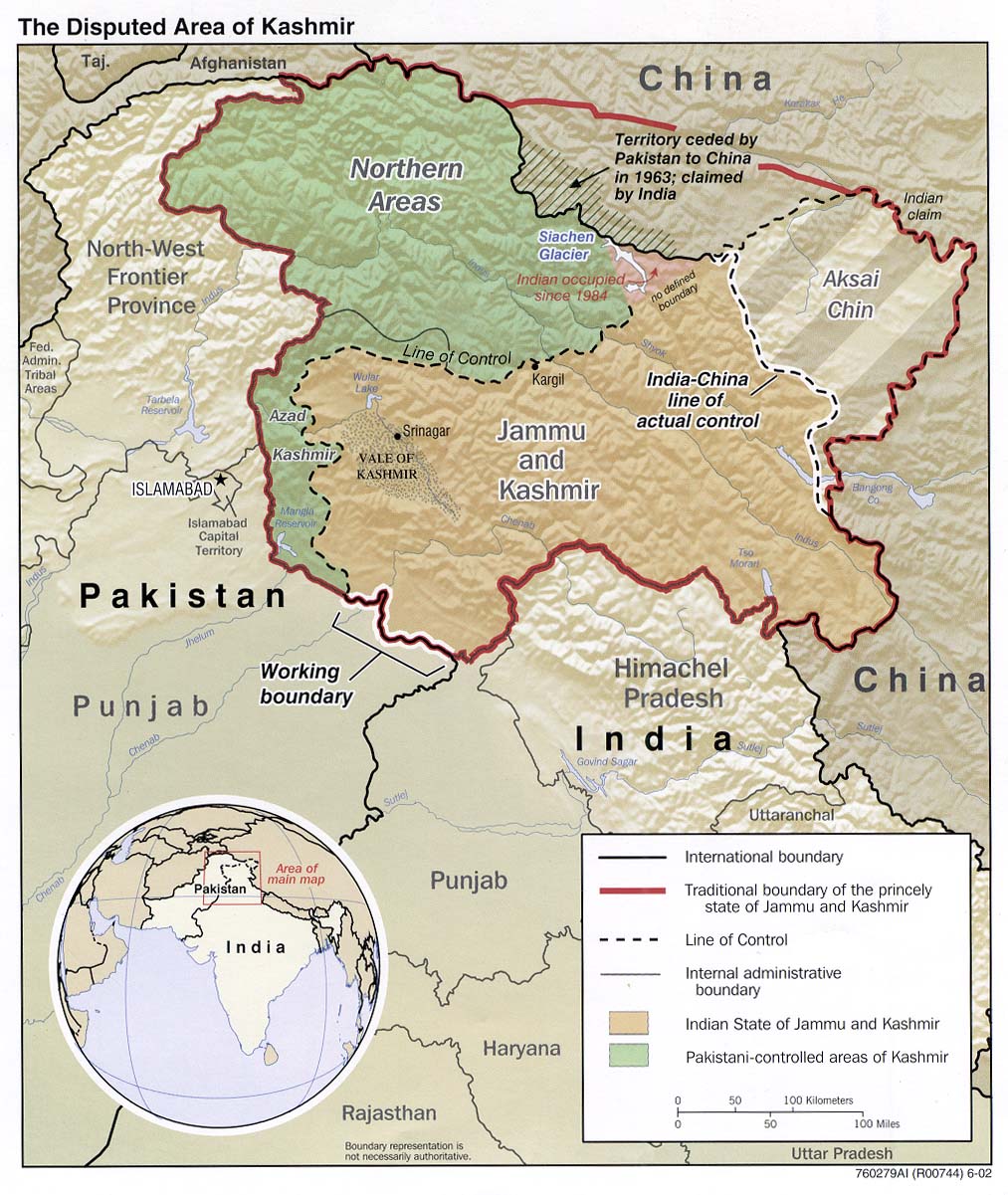
In August 1947, Kashmir's autocratic ruler, His Highness Maharaja Sir Hari Singh Indar Mahindar Bahadur Sir Hari Singh, was faced with a momentous decision. The imperial government in London had always allowed some major landholders on the subcontinent a degree of autonomy and, technically, Kashmir had never been part of British India. The maharaja's antecedents had secured the right to govern some of their own affairs by recognising the paramountcy of the British Crown. The compact between the British and the maharaja's family was symbolised by the payment of a tribute: each year Hari Singh had to provide the British government with a horse, twelve goats and six of Kashmir's famous shawls or pashminas.SOURCE: Pakistan: Eye of the Storm, 2nd ed., by Owen Bennett Jones (Yale Nota Bene, 2002), pp. 56-57
When the British left, the maharaja had three options: Kashmir could become independent or join either India or Pakistan. The rulers of over 550 Princely State rulers faced the same decision but in the case of Kashmir the issue was especially sensitive. Its large population and proximity to both China and Russia gave the state considerable strategic importance. The matter was further complicated by religion: Kashmir was one of a handful of Princely States in which the ruler did not practise the same religion as most of his people. While the maharaja was a Hindu, over three-quarters of his subjects were Muslims. The fact that Kashmir was not only predominantly Muslim but also congruous with Pakistan convinced Mohammed Ali Jinnah that the maharaja's decision would go in his favour. 'Kashmir', he said at the time of partition, 'will fall into our lap like a ripe fruit.' It was a naive misjudgement of Himalayan proportions.
The maharaja had most of the foibles associated with India's decadent aristocracy. He was a hedonist and a reactionary whose main interests were food, hunting, sex and, above all else, horse racing. As his own son put it: 'Quite clearly, my father was much happier racing than administering the State ...' On one occasion, he had been tricked by a prostitute in London's Savoy Hotel who proceeded to blackmail him. He showed a similar lack of judgement in matters of state. In July 1947, with the transfer of power just weeks away, he took the view that 'the British are never really going to leave India'!
The maharaja's ancestors had been blessed with greater political acumen. The State of Jammu and Kashmir had been established in the first half of the nineteenth century by a relatively minor Jammu chieftain, Gulab Singh. A combination of adept military conquests and astute financial deals enabled him to create one of the largest Princely States on the subcontinent. By 1850 he had moved on from Jammu (with its Hindu majority population) and had added Ladakh (Buddhist majority), Baltistan (Muslim majority) and the Kashmir Valley (Muslim majority). In the latter half of the nineteenth century, Gulab Singh's successors extended their control to another Muslim majority area, Gilgit.
Hyderabad and Junagadh at Partition, 1947
Once again, however, Jinnah failed to explore all the options open to him. One possibility was to make compromises over another Princely State, Hyderabad. The Muslim ruler or nizam of Hyderabad faced the same dilemma as Maharaja Hari Singh. He wanted independence but was far from sure he could achieve it. Jinnah understood that it was never realistic to expect the nizam to accede to Pakistan: Hyderabad was entirely surrounded by Indian territory. But he always hoped that the nizam could pull off independence. He considered Hyderabad to be the 'oldest Muslim dynasty in India' and hoped that its continued existence as an independent state right in the heart of India would provide a sense of security for those Muslims who didn't move to Pakistan. Once again, however, Jinnah was thinking in terms of legally possible options rather than political realities. In the long term the independence of Hyderabad, while constitutionally proper, was never going to happen. The new Indian leadership saw the issue clearly enough and when the nizam tried to strike a deal which would allow him to hang on to some degree of autonomy, Delhi flatly refused to consider the idea.SOURCE: Pakistan: Eye of the Storm, 2nd ed., by Owen Bennett Jones (Yale Nota Bene, 2002), pp. 68-69
In retrospect most Pakistanis would agree that it would have been worth abandoning the aspiration for an independent Hyderabad if it had meant securing Kashmir's accession to Pakistan. Furthermore, Jinnah had good reason to believe that such a deal could have been struck. In late November 1947 Nehru and Liaquat Ali Khan met to discuss the situation in Kashmir. To understand their conversation it is first necessary to consider briefly what had happened in yet another Princely State, Junagadh.
The Muslim nawab of Junagadh ruled over a million people, 80 per cent of them Hindus. Junagadh was located in western India and, even though it was not strictly contiguous with Pakistan, its coastline offered the possibility of sea links to the Muslim state that was just 200 miles away. The nawab of Junagadh, guided by his pro-Pakistani chief minister Sir Shah Nawaz Bhutto (the father of Zulfikar Ali Bhutto), decided to ignore the feelings of his Hindu population and acceded to Pakistan. It was the mirror image of the situation in Kashmir. The Indian government did not accept the decision, blockaded Junagadh and then invaded it. Delhi then imposed a plebiscite and secured the result it desired: Junagadh became part of India.
When Liaquat Ali Khan met Nehru at the end of November he exposed the illogicality of India's position. If Junagadh, despite its Muslim rulers' accession to Pakistan, belonged to India because of its Hindu majority, then Kashmir surely belonged to Pakistan. When Liaquat Ali Kahn made this incontrovertible point his Indian interlocutor, Sardar Patel, could not contain himself and burst out: 'Why do you compare Junagadh with Kashmir? Talk of Hyderabad and Kashmir and we could reach agreement.' Patel was not alone in this view. On 29 October 1947 officials at the American embassy in Delhi had told the US State Department: 'the obvious solution is for the government leaders in Pakistan and India to agree ... [to the] accession of Kashmir to Pakistan and the accession of Hyderabad and Junagadh to India'. British officials in London concurred.
Russian Perspectives on Ukraine
All About Latvia, who fervently supports democracy but is not keen on either Yanukovich or Yushchenko, offers an interesting roundup of Russian views on the Ukrainian elections, including a translation of a cynical op-ed in Komsomolskaya Pravda.
The gloomiest predictions are about to be proven true. Ukraine once again is divided in half. The president of all-Western and Central Ukraine--Victor Yushchenko and the president of all-Eastern and Southern Ukraine--Victor Yanukovich both demand coronation.Apart from Russia, the list of firm Yanukovich supporters is not very impressive.
Lenta reports that Belorussian president Lukashenko congratulated Victor Yanukovich with his presidential victory. So, officially or not, three leaders expresed their support for Yanukovich: Russian President Vladimir Putin, Lukashenko and the leader of the Trans-Dienstr breakaway Moldovan Republic Igor Smirnov.The official status of the Russian-supported Transnistrian portion of the former Moldovan SSR is still unresolved.
Beyond the control of any strong national government, the region has become an international transit center for smuggled goods. A Russian-sponsored peace plan for the region was rejected by Moldova in Nov., 2003, after Moldovan demonstrations against it; the deal would have permitted Russian troops to remain until 2020.UPDATE: The Head Heeb has an interesting take on the reactions of Ukrainian Jews, in general cautiously favoring 'the devil you know'. Zackary Sholem Berger elaborates further. Also see the Head Heeb's earlier post, which opens with a segue I feel sure has never, ever been uttered before:
As most of you are no doubt already aware, French Polynesia is no longer the only country with two presidents.UPDATE: Now China, Kazakhstan, and Armenia are reported to have joined the list of countries recognizing Yanukovich as president. And Economist.com has an update that concludes on a cautionary note.
International pressure may also have a significant effect on the outcome. As well as the pressure from America and the EU, a key determining factor will be the attitude of Mr Putin. The crisis in Ukraine is bound to overshadow his summit with EU leaders this week (see article [with map!]) and he risks serious difficulties in his relations with both Europe and America if he backs Mr Yanukovich in repressing the protests. Towards the climax of the Georgian revolution last year, Mr Putin seemed to lose patience with Mr Shevardnadze, perhaps contributing to his downfall. Does the Russian leader's even-handed call for both candidates in Ukraine’s conflict to obey the law suggest he has already begun to hedge his bets?Siberian Light asks Why is Russia afraid of democracy? In his answer he acknowledges:
All along, both Russia and the West have been taking a close interest in Ukraine’s election, not just because it is one of eastern Europe’s largest countries, with 49m people, but because the outcome could have important consequences for the whole region. Mr Yushchenko presented himself as a pro-western, free-market reformer who would clean up corruption and enforce the rule of law. Mr Yanukovich, in contrast, stood for deepening Ukraine’s close links with Russia. If Mr Yushchenko had gained the presidency and led Ukraine towards becoming a westernised democracy with European-style prosperity, voters in Russia and elsewhere in eastern Europe might have begun to demand the same. Thus a win by Mr Yushchenko would have been a huge blow to Mr Putin, whose attempts to exert control over former Soviet states would be greatly diminished.
Though Mr Yushchenko is now hoping for a Georgian-style bloodless revolution to deliver him the presidency, there are also some less promising precedents among the former Soviet states: only two months ago, Belarus’s president, Alexander Lukashenka, “won” a rigged referendum to allow him to run for re-election. The EU decided this week to tighten its sanctions against those in his government it blames for the “fraudulent” ballot. But so far there is no sign that Mr Lukashenka will be dislodged from power. Azerbaijan and Armenia also held flawed elections last year: in Azerbaijan, there were riots after the son of the incumbent president won amid widespread intimidation and bribery, but these were violently put down; and in Armenia, voters reacted with quiet despair at the re-election of their president amid reports of ballot-stuffing. If Ukraine follows these precedents, hopes for change there, and in other parts of the former Soviet Union, may be dashed.
Russia has plenty of legitimate interests in Ukraine. It has a massive naval base in the Crimea, there is a large ethnic Russian population, and a big chunk of Russia's oil and gas exports go through Ukraine.And of course this rarely causes even a ripple of protest in the West.
Time and again Russia meddles in the affairs of its neighbours. It almost never supports democratic opposition groups, preferring to prop-up regimes, good or bad (mostly bad). It seems pretty clear that Russia has made the decision that its interests are best served by opposing the spread of democracy through the Former Soviet Union.
24 November 2004
Some Backgrounders on Ukraine
Ukraine-based Le Sabot Post-Moderne explains how the system works there:
You have to understand the situation in Ukraine. The country is run by a series of oligarchic clans that actually found their beginnings in the Soviet Union, and then grew fabulously rich during the early days of "privatization".Ukraine-based TulipGirl quotes an essay by Ukrainian novelist Oksana Zabuzhko in Monday's print edition of the Wall Street Journal.
Compare the situation to Russia, where an authoritarian Putin faced off against corrupt oligarchs. In Ukraine, authoritarianism and oligarchy are fused. Yanukovych isn't just another unscrupulous candidate, he's the main man of Akhmetov -- the duke of Donetsk and the richest man in Ukraine. The current president, Kuchma, is the head of a different clan, Dnepropetrovsk. The presidential administrator is Medvedchuk, who happens to run the Kiev-based Medvedchuk-Surkis clan. He also owns the two biggest Ukrainian TV stations, which is awfully convenient.
While there is jockeying for control among these clans, the overall effect is for them to sustain one another in power. They all depend on the same system for survival, and actively collaborate to keep it in place.
A good example of the clan system in action was the recent privatization of the Kryvorizhstal factory. Western firms offered 2.1 billion dollars. It was sold to the presidents son-in-law for 800 million. His son-in-law is Pinchuk, the head of the Pinchuk-Derkach clan.
Do you start to see how life works here? This isn't about a few stolen votes. It's about an entire system of fine control over the political, social and economic life of the people. Economics and politics are incestuously fused here in a way that is difficult to imagine for those in the West.
Never before -- even 13 years ago, on the eve of the collapse of the Soviet Union -- has Ukraine witnessed such a massive upsurge of national solidarity. People who've always remained politically indifferent and had missed voting in all previous elections, were disseminating self-printed leaflets from the Internet (samizdat is back -- any piece of information was voraciously devoured on the spot!) in public places, and volunteering to monitor the elections on behalf of opposition candidate Viktor Yushchenko. At a peasant food market a merchant first asked who you're voting for -- the right answer (with which you could count on a generous discount) was "Yushchenko," while incumbent Prime Minister's Viktor Yanukovych's supporters were more than likely simply refused service. In the playgrounds children were playing a game called "Yushchenko beats Yanukovych." To quote my seven-year-old neighbor, "in our class Irka alone stands for Yanukovych, and no one wants to play with her." The slogan chanted by protesting students at demonstrations reads in English as "We're together! We're many! We won't fall!" And just how may of "us" there are, one can easily see in the streets. These days Kiev, as well as other major Ukrainian cities, is defiantly demonstrating its political sympathies by wearing orange, the campaign color of opposition candidate Yushchenko.Chicago-based international relations professor Dan Drezner is more pessimistic:
A special term has come into use -- "The Orange Revolution." It looks like people have dragged all shades of orange, from yellow to vermilion, out of their wardrobes and adorned themselves with them simultaneously -- vests and sweaters, scarves and purses, coats and umbrellas. Orange ribbons flutter everywhere -- on trees, fences, lanterns, and cabs. Drivers joyfully beep to each other, and pedestrians (traffic police included!) salute them with smiles and raised fists. It feels like the capital of three million has been transformed into a sea of brotherly love! The windows of shops are lavishly decorated with things orange. Among my favorites is the stunt of my neighborhood coffee shop -- its windows glow with pyramids of oranges! ...
Here I have to clarify one important point. A widespread cliche used by many Western journalists to describe the major collision of our dramatic elections is that the establishment candidate, Viktor Yanukovych, is "pro-Russian," and that opposition candidate, Viktor Yushchenko, is "pro-Western." This version has as little to do with the feelings of an average Ukrainian voter as with those of the belligerents of the Trojan war. Mr. Yanukovych is perceived not so much as being "pro-Russian," but as, first and foremost, being "pro-criminal" -- a Ukrainian Al Capone, who has under his belt two prison sentences for robbery and assault, and publicly uses criminal argot compared to which even the boorish tongue of retiring President Leonid Kuchma sounds as innocuous as a school textbook. A former governor of Donetsk, Mr. Yanukovych in power represents the so-called "Donetsk fellas" -- a business clan with a notorious criminal background. That the latter have close ties with similar mafia clans in Russia seems to be the most immediate explanation for the pre-election outburst of a passionate love between Russian and Ukrainian leaders, an affair of which Yanukovych-as-president had been designed as a mutually satisfying offspring.
A few years ago there were sizeable protests in Kiev because of "Kuchmagate," in which tapes came to light suggesting that President Leonid Kuchma played a role in the disappearance of Ukrainian journalist Georgy Gongadze in September 2000. There was tangible evidence that Kuchma personally ordered Gongadze -- who was investigating corruption in Kuchma's administration -- to disappear. Despite months of protests, however, Kuchma stayed in office (click here for an exhaustive World Bank study [PDF] on this case).Canada-based Randy McDonald weighs in on Ukraine's Underestimated Strength.
Not to put a damper on what's going on right now in Ukraine, but that example should be kept in mind when speculating whether the protests at the rigged election results in Ukraine will actually cause a change in government a la the Rose Revolution in Georgia [Quickly: opposition leader/reformer/nationalist Viktor Yushchenko led by double digits in Western-run exit polls over Kuchma stalwart/Russophile Viktor Yanukovich. However, the preliminary election results had Yanukovich winning by three percentage points. Outside observers are pretty much unanimous in their belief that there was massive vote fraud].
The two most salient facts in assessing what will happen are that:a) Leonid Kuchma wants Yanukovich to win;I would love to be wrong about this, but it doesn't look good for Yushchenko.
b) Vladimir Putin really wants Yanukovich to win.
I'm skeptical, in short, that Ukraine is at real risk of splitting apart along ethnolinguistic-cum-political lines. And yet, I can't help but remember Andrew Wilson's The Ukrainians: Unexpected Nation, which suggested that the most likely and the most stable course for Ukraine would be a broadly centrist position, relying on slow Ukrainianization and a Ukrainian balancing act between the European Union and Russia. Going to one extreme (a strongly Ukrainianizing regime intent on immediate European integration) or another (a strongly Russophile regime intent on Eurasian integration) could, Wilson suggested, disturb the equilibrium. Mass secessions wouldn't be the result so much as growing alienation, the formation of more coherent ethnic groups with stricter frontiers. This would be a problem for Ukraine, needless to say.
23 November 2004
The Periscope on Ukraine
The Periscope blog has Victor Katolyk live and reporting up a storm in Lviv, Ukraine. Fistful of Euros is also compiling threads from all over.
via The Argus
via The Argus
22 November 2004
The Meanings of Kamikaze
Language Hat has an interesting discussion thread about how kamikaze came to mean 'suicide attack'. I'll elevate my comment there to a blogpost here.
I suspect kamikaze 'divine wind' was probably first no more than an inscription on the hachimaki 'headband' that is still worn by many Japanese on a special mission, whether or not that mission is likely to be fatal. Other hachimaki can have other motivational slogans like 'Victory', 'Success', or 'Fighting Spirit'. (Too bad there aren't old Confucian slogans that literally translate as 'Exceed Sales Target' or 'Constantly Innovate'!)
There is nothing intrinsic in kamikaze that suggests suicide (less than there is in an American slogan like "Remember the Alamo!"), but there is a strong suggestion of a devastating air attack on shipping. I wonder if the suicide submarine Kaiten Tokkoutai ('Turn Heaven Special Attack Force') also wore hachimaki with kamikaze written on them. I can't quite make out the characters on the hachimaki in the photos at the link, but I doubt they say 'Safety First'. Like the original kamikaze, the suicide submarines and airplanes both aimed to destroy ships at sea.
There were at least two varieties of "special attack" planes: Thunder Gods and Kamikaze. 'Thunder god' may translate kaminari 'thunder', now written with a single Chinese character but clearly derived from something like 'god-sound'. The Kaminari Ohka ('thunder cherry-blossom') "was a piloted glider bomb released from beneath a mother plane and used in suicide attacks on Allied ships." Cherry blossoms in samurai culture connote the transience of life--therefore death, and frequently death in battle.
To end off on a lighter note: I'm sorry, but the much rarer Chinese reading of kamikaze--shinpuu--just makes me think of a divine wind of the odiferous (though hardly suicidal) kind!
I suspect kamikaze 'divine wind' was probably first no more than an inscription on the hachimaki 'headband' that is still worn by many Japanese on a special mission, whether or not that mission is likely to be fatal. Other hachimaki can have other motivational slogans like 'Victory', 'Success', or 'Fighting Spirit'. (Too bad there aren't old Confucian slogans that literally translate as 'Exceed Sales Target' or 'Constantly Innovate'!)
There is nothing intrinsic in kamikaze that suggests suicide (less than there is in an American slogan like "Remember the Alamo!"), but there is a strong suggestion of a devastating air attack on shipping. I wonder if the suicide submarine Kaiten Tokkoutai ('Turn Heaven Special Attack Force') also wore hachimaki with kamikaze written on them. I can't quite make out the characters on the hachimaki in the photos at the link, but I doubt they say 'Safety First'. Like the original kamikaze, the suicide submarines and airplanes both aimed to destroy ships at sea.
There were at least two varieties of "special attack" planes: Thunder Gods and Kamikaze. 'Thunder god' may translate kaminari 'thunder', now written with a single Chinese character but clearly derived from something like 'god-sound'. The Kaminari Ohka ('thunder cherry-blossom') "was a piloted glider bomb released from beneath a mother plane and used in suicide attacks on Allied ships." Cherry blossoms in samurai culture connote the transience of life--therefore death, and frequently death in battle.
To end off on a lighter note: I'm sorry, but the much rarer Chinese reading of kamikaze--shinpuu--just makes me think of a divine wind of the odiferous (though hardly suicidal) kind!
Takeru Kobayashi, All-American Glutton
Tokyo Times blog notes that Takeru Kobayashi, the diminutive 4-time winner of the Coney Island hotdog-eating contest has now conquered another All-American peak, Chattanooga's hamburger-eating contest.
via Simon World
His pulsating performance of 69 hamburgers in 8 minutes, was so stunning that it prompted David Baer of the International Federation of Competitive Eating to trumpet, "Kobayashi is, without a doubt, the greatest eater ever to live upon planet Earth."His T-shirt shows Uncle Sam above the motto "Eat All That You Can Eat" but maybe "A Mess Hall of One" would be just as appropriate.
via Simon World
New Zealand's Market Reforms
Tyler Cowen of Marginal Revolution asks Have New Zealand's Market Reforms Failed?
New Zealand moved from being perhaps the most socialized OECD economy to the freest. The country now has free trade, 0-2 percent inflation, no agricultural subsidies, free labor markets, free capital markets, low marginal tax rates, a reasonable fiscal position, and it conducted substantial privatizations, mostly with success. The reforms started about twenty years ago, but the country is not sweeping the world ...UPDATE: Tyler Cowen posts a response from a Kiwi who maintains that NZ's domestic economy is laden with a regulatory environment that heavily discourages private capital accumulation and investment, including foreign investment.
What gives?
First, New Zealand without the reforms would have fallen apart and become insolvent; that is the relevant counterfactual. Second, the country is small. The population is just a bit over 4 million; for purposes of comparison the Philadelphia metropolitan area is over six million.
Michael Porter nailed it over ten years ago. New Zealanders have few if any industries [one being electric fencing] where they control market conditions or lead with innovations. For the most part they are at the mercy of world prices and broader conditions. The country's earlier crisis was precipitated in the early 1970s, when the UK ended "imperial preference" for New Zealand agricultural exports. Another shock will come if Australia passes its free trade agreement with the U.S.; New Zealand exports will face a new and tough competitor.
Finally, the brain drain has not gone away ...
21 November 2004
Jan Hus: Spelling Reformer, Religious Heretic
The quiet and scholarly Prague canon Matej criticized the cult of saints and their relics, and anticipated the Hussites in his advocacy of communion in both kinds (sub utraque specie; i.e., with both bread and wine) for laity as well as priests. Tomas Stitny was a southern Bohemian squire who sought to popularize Milic's ideas. His metier was not theology but books of practical moral education, and he was no rebel. But he was a layman writing about religious affairs, and he wrote, moreover, in Czech. Both, from the point of view of the Church, were threatening transgressions. Around the same time, in the 1370s to 1380s, the Bible was first translated into the Czech vernacular.SOURCE: The Coasts of Bohemia: A Czech History, by Derek Sayer (Princeton U. Press, 1998), pp. 36-37
Jan Hus himself was born around 1370 in Husinec in southern Bohemia. He studied at Prague university, becoming a master of arts in 1396 and lecturing there from 1398, the same year he was ordained a priest. From 1402 he began to preach in Prague's Bethlehem Chapel, a church in the Old Town [Stare mesto] founded in 1391 expressly for the delivery of sermons in Czech. Hus rapidly gained a large popular audience for his attacks on the vices and abuses of the Church. A follower of the English reformer John Wyclif, he enunciated many tenets of what was to become the Protestant Reformation a century before Luther. Wyclifism was a bone of contention in the university from the 1380s, and the theological conflict soon turned into a national one, dividing Germans and Czechs on the faculty. In 1403, under a German rector, the university banned all Wyclif's books as heretical, a stance reiterated by Archbishop Zbynek z Hazmburka in 1408. The following year Vaclav IV's Kutna Hora decree gave the Czechs a majority in the university's government, and Hus himself became its rector. Many German professors and students left Prague in protest, to found new universities at Leipzig and Erfurt. In 1410 the archbishop publicly burned Wyclif's works and pronounced an anathema on Hus, who continued preaching at Bethlehem regardless and organized a public defense of Wyclif at the university. The Papal Curia itself now excommunicated Hus as a heretic. Undeterred, he began to preach in 1412 against the sale of papal indulgences. When the Bethlehem Chapel was threatened by Prague Germans in the autumn of that year, Hus fled the city for southern Bohemia. Here he continued to preach and write, evidently to good effect, since the region subsequently became a bastion of the Hussite movement. Beside penning religious tracts, he found the time to reform Czech spelling; it was he who introduced diacritical marks into the written language.
In 1414 Hus was summoned to answer charges of heresy before the Council of Konstanz. Trusting to the safe conduct issued him by Vaclav's brother Emperor Zikmund (Sigismund), king of Hungary, he complied. On his arrival in Konstanz he was swiftly imprisoned. When he refused to recant before the council, he was burned at the stake on 6 July 1415. His ashes were scraped from the ground and thrown into the Rhine, so that nothing of him should get back to Bohemia. It was a superfluous gesture. The Czech nobility had already condemned Hus's arrest; now they assembled in Prague and sent a blistering protest to Konstanz. They defended Hus as "a good, just and Christian man," who "faithfully preached God's law of the Old and New Testaments." As significantly, they portrayed Hus's immolation as a national insult. There were 452 seals attached to the letter, including those of the highest officials in Bohemia and Moravia. The council is accused, repeatedly, of "bringing into disgrace and humiliation our kingdom and margravate." The Czechs remind the prelates that "in times when almost every kingdom of the world often wavered and supported schism in the Church and papal pretenders, our most Christian Czech Kingdom and Moravian Margravate always stood solid as a rock and never ceased to adhere to the Holy Roman Church, giving her unblemished and sincere obedience ever since we first accepted the Christian faith of Our Lord Jesus Christ."
20 November 2004
Pakistan's Barelvis and Deobandis
I've started reading Pakistan: Eye of the Storm, 2nd ed., by Owen Bennett Jones, a worthy successor to Ahmed Rashid's Taliban under the Yale U. Press Nota Bene imprint. I'll refrain from excerpting Jones's original reporting, like his enthralling chapter on the 1999 coup that brought Musharraf to power, but I'd like to share a few passages of the rich background history he includes in the book.
The conflicting views of the modernists and the radicals are reflected in the different schools of Islamic thought on the sub-continent. While some 75 per cent of the Pakistani population are Sunni Muslims [20% are Shi'a], there are significant fissures within the Sunni community. Some Sunnis in Pakistan describe themselves as Barelvis; others say they are Deobandis. It is an important distinction.SOURCE: Pakistan: Eye of the Storm, 2nd ed., by Owen Bennett Jones (Yale Nota Bene, 2002), pp. 9-11
Deoband is a town a hundred miles north of Delhi and a madrasa was established there in 1867. It brought together many Muslims who were not only fiercely hostile to British rule but also committed to a literal and austere interpretation of Islam. The founders of the madrasa saw modern technology as nothing more than a method by which the people of the West kept Muslims in subjugation. They argued that the Quran and Sunnah (the words and deeds of the Prophet) provided a complete guide for life that needed no improvement by man. Despite the fact that most leading Deobandi clerics were strongly opposed to Jinnah's call for the creation of Pakistan, many Deobandi teachers moved to the new country in 1947. They have been a vocal, and often militant, element of Pakistani society ever since.
Talibs (religious students) from Deobandi madrasas formed the backbone of the Taliban movement that swept to power in Afghanistan in 1996. Some leading Deobandi clerics, such as Sami ul Haq from the famous Haqqaniya madrasa at Akhora Khattak in NWFP [Northwest Frontier Province], have freely admitted that whenever the Taliban put out a call for fighters they closed down their schools and sent their students to Afghanistan. The Deobandi talibs have also tried to impose their views within Pakistan. In December 1998, for example, just before the onset of Ramadan, some Deobandis began a campaign to purge the Baloch capital Quetta of video rental shops, video recorders and televisions. The campaign has continued periodically ever since. In late 2000 young religious students encouraged by madrasa teachers and local mullahs ordered the burning of television sets, video players and satellite dishes in a number of villages in NWFP. 'This is an ongoing process,' said one mullah who helped organise a TV bonfire. 'We will continue to burn TV sets, VCRs and other similar things to spread the message that their misuse is threatening our religion, society and family life.'
General Musharraf has never shown any sympathy for the Deobandi mindset. His claim that only around 10 to 15 per cent of the Pakistani people opposed his decision to align Pakistan with the US rested on the fact that some 15 per cent of Pakistan's Sunni Muslims would consider themselves part of the Deobandi tradition. A far greater number, some 60 per cent, are in the Barelvi tradition. Compared to the Deobandis, the Barelvis have a moderate and tolerant interpretation of Islam. They trace their origins to pre-partition northern India. There, in the town of Bareilly, a leading Muslim scholar, Mullah Ahmad Raza Khan Barelvi, developed a large following. Barelvi and his followers felt there was no contradiction between practising Islam and drawing on the subcontinent's ancient religious practices. The Barelvis regularly offer prayers to holy men or pirs, both dead and alive. To this day, many Pakistanis believe that pirs and their direct descendants have supernatural powers and, each year, millions visit shrines to the pirs so that they can participate in ceremonies replete with lavish supplies of cannabis and music. The Deobandis shun such practices as pagan, ungodly distractions.
Ever since Pakistan was created, the Barelvis have been the Islamic radicals' most effective obstacle. In a fascinating study, an American academic, Richard Kurin, has illustrated why that is the case. Kurin went to live in a small Punjabi village so that he could assess attitudes to Islam in a typical Barelvi community. He found that two men in the village were trying to propagate Islam: the local syed (descendant of the prophet) and the mullah. The syed's chosen method was to commandeer the loudspeaker of the village mosque at dawn and deliver a lecture on the merits of following the ways of the Quran and the Prophet. He would speak for several hours at a time. Much to his frustration, however, the villagers failed to show much interest in his exhortations and he regarded most of them as uneducated cheats. In private, the villagers would talk about the syed as a man who took life too seriously and who got worked up about issues that didn't really matter.
The second Islamic figure in the village, the mullah, was expected to preside over the daily prayers, teach the Quran to young boys and generally, as the villagers put it, 'do all the Allah stuff'. Like the syed, the mullah felt he had to put up with a somewhat wayward flock. Only a handful of the villagers would say their prayers five times a day and in the month of Ramadan most only managed to fast for five to ten days rather than for the whole month. Worse still, around a dozen villagers were having adulterous affairs that were the subject of much idle gossip. The villagers did, however, show considerable enthusiasm for attending the many shrines in the area. Virtually every man in the village had a pir who would offer him spiritual guidance.
The picture presented by Kurin is true of many villages throughout Pakistan. Clearly there are important cultural distinctions that affect attitudes in different parts of the country. In many Barelvi communities in Sindh, for example, any hint of adultery would be taken far more seriously and could well lead to the murder of those involved. Such conduct, however, is more a reflection of cultural as opposed to religious conservatism. The situation is complicated by the fact that in many parts of the country a Deobandi-style interpretation of Islam is used as an excuse to justify regressive cultural practices. Separating Deobandi orthodoxy from traditional practice is not easy not least because, to some extent, the two feed off each other. It is nonetheless important to remember that most Pakistanis are loyal to the Barelvi tradition. That fact has had an important bearing on the nature of the Pakistani state.
The dispute between the modernists and the radicals predates Pakistan's creation. As he advanced the arguments for a separate Muslim state, Mohammed Ali Jinnah relied in part on an appeal to Islam. Indeed, religious identity provided the basis for his demand. The argument that Jinnah presented to the British was that the Muslims and the Hindus of the subcontinent constituted two separate nations that could not live together. In 1947 his arguments prevailed and Pakistan was created as a Muslim homeland. But what did that mean? Was it simply a country for Muslims to live in or was it, in fact, a Muslim country? Was Jinnah the founding father of an Islamic state or merely a state in which Islam could be practised without fear of discrimination? Ever since 1947 the modernists and the Islamic radicals have fiercely contested these questions.
Reformist Muslims vs. Militant Secularists
Irshad Manji, author of The Trouble with Islam: A Muslim's Call for Reform in Her Faith, contrasts European and North American attitudes toward religion in a New York Times op-ed:
What then gives me the sense that even modern Muslims can't be modern enough for Western Europe? It's precisely that, from Amsterdam to Barcelona to Paris to Berlin, people incredulously ask me one type of question that I'm never asked in the United States and Canada: Why does an independent-minded woman care about God? Why do you need religion at all?via a Rainy Day commentator
I'll answer in a moment. To get there, allow me to observe key differences between the debate over Islam in Western Europe and North America. In Western Europe, the entry point for this debate is the hijab - the headscarf that many Muslim women wear as a signal of modesty. By contrast, the entry point in North America is terrorism.
Some might say that difference is understandable. After all, Sept. 11 happened on American soil. But March 11 happened on European ground, yet the hijab remains the starting point for Europeans. Meanwhile, it makes barely a ripple in North America.
This difference speaks to a larger gulf in attitudes toward religion. To a lot of Europeans, still steeped in memories of the Catholic Church's intellectual repression, religion is an irrational force. So women who cover themselves are foolish at best and dangerous otherwise.
Not so in North America. Because it has long been a society of immigrants seeking religious tolerance, religion itself is not seen as irrational - even if what some people do with it might be, as in the case of terrorism. Which means Muslims in North America tend to be judged less by what we wear than by what we do - or don't do, like speaking out against Islamist violence....
As one young Turk told me, "If Western values are tolerance, democracy, justice, equality and freedom, then I live in a Western country: Turkey." Try explaining that to those Europeans who want to impose their baggage from the Vatican onto Muslim immigrants. Their secularism can be zealous, missionary - dare I say it, religious.
Which brings me back to the question of why I, an independent-minded woman, bother with Islam. Religion supplies a set of values, including discipline, that serve as a counterweight to the materialism of life in the West. I could have become a runaway materialist, a robotic mall rat who resorts to retail therapy in pursuit of fulfillment. I didn't. That's because religion introduces competing claims. It injects a tension that compels me to think and allows me to avoid fundamentalisms of my own.
19 November 2004
Who Was Buried in Pol Potters' Fields?
The vast and terrible experience of [Pol Pot's Cambodia] still defies complete understanding. Analysts can provide a range of answers as to why a group of Cambodians who were fervent followers of what they understood to be Maoist thought presided over the death through execution, forced labour and starvation of up to two million of their compatriots. Disgust at the corruption of Sihanouk's regime and its successor under Lon Nol certainly was important, as was fear their control over Cambodia might suddenly be wrested from the Khmer Rouge by 'counter-revolutionary forces'. For the followers drawn from the lowest and most impoverished levels of Cambodian society, the opportunity to lord it over those who had once considered themselves their betters also played a part. But ultimately the enormity of the leaders' policies defeats rational analysis. To talk to former Khmer Rouge soldiers, as I did in 1980 in the Sa Keo refugee camp not far from the Thai border with Cambodia, did little to resolve one's bafflement. Young men barely out of their teens would speak with blank faces about their part in executions, without remorse for what they clearly saw as a routine duty.SOURCE: The Mekong: Turbulent Past, Uncertain Future, by Milton Osborne (Grove Press, 2000), pp. 211-212
There should no mistake about who were the victims of the Pol Pot regime. Contrary to the views offered by Western sympathisers while the regime was still in power between 1975 and early 1979--and even more shockingly after Pol Pot's regime had been overturned--the Cambodians who suffered were not 'only' members of the Phnom Penh bourgeoisie. Those linked to the former Lon Nol regime or classified as 'educated' may have been among the more prominent early victims, but before the Vietnamese finally drove the Khmer Rouge out of Phnom Penh in January 1979 the reign of terror that had lasted nearly four years had become quite classless in its choice of who should die, as Pol Pot held up the ancient glory of the Angkorian empire as a model for what the Cambodian people could achieve.
What's Happening in North Korea?
NKZone has assembled a long compilation of fodder for speculation about a variety of unusual happenings in North Korea. Kim Jong-il seems to be in seclusion, and there are reports of both clampdowns and protests. Hard to know what it all means.
Hitchens on Arafat
Christopher Hitchens, writing in Slate, evaluates Arafat.
There was a time when the Palestinian cause, throughout the Middle East, was generally identified with larger causes than itself. Its diaspora, made up of thousands and thousands of intelligent and educated and ironic people, was on the whole a force for good in the Gulf states, in Jordan, in Lebanon, and elsewhere. If you voyaged to some dark and decrepit state in the region, and could get rid of your clinging official "minder," it was in some Palestinian apartment that music would play, drinks be served, books be passed around, and humorous remarks made with courage. It became the fashion among some Arabist reporters at this time to allude to the Palestinians as "the Jews of the Middle East."In the 20th century, the age of so many national icons turned destroyers of their own nations, history has far too often turned out to be the biography of great and horrible men: Amin, Arafat, Bokassa, Castro, Ceausescu, Chiang Kai-shek, Duvalier, Franco, Hitler, Khomeini, Kim Il-sung, Mao, Marcos, Mengistu, Milosevic, Mobutu, Mugabe, Mussolini, Ne Win, Niyazov, Noriega, Pinochet, Pol Pot, Saddam, Stalin, Suharto, Videla, Zia ul Haq. Lucky are the nations who rarely have to rely on great men or women to save them, or who just happen to be blessed with a Havel, a Mandela, a Ramos-Horta, or a Sadat when the need arises.
Well, Arafat certainly destroyed that dream. His grandiose death-or-glory campaigns made life infinitely harder for the Palestinian populations of Jordan (in 1970) and in Lebanon. Even those conflicts had at least some tincture of revolutionary ardor, in which some Palestinians--not of Arafat's faction--played a role. But the nadir was reached in 1990, when "the Chairman" ranged himself on the side of Saddam Hussein and stayed with him on the obliteration and annexation of Kuwait. Suddenly, the PLO was implicitly and sometimes explicitly in favor of the erasure of an existing Arab and Muslim state, a member of the Arab League and of the United Nations.
There were two results of this. First, the enormous Palestinian population of Kuwait--numbering between 300,000 and 400,000 people--was abruptly subjected to another nightmare. It suffered from Saddam Hussein's aggression, and it suffered again from Kuwaiti fury at a perceived Palestinian "fifth column." Second, the stupidity of Arafat's bet on the wrong Iraqi horse was compounded further. In order to recover his lost credit with the Saudis and others, he began increasingly, and corruptly, to sound the note of the "Islamist" trumpeter. (Twenty percent of Palestinians are formally Christian, and a large number are secular, but I think it is pretty safe to say that the "Al-Aqsa Martyrs Brigades" and other surrogate groups would not care much to be called "the Jews of the Middle East," in any tone of voice.)
18 November 2004
Kyushu Grand Sumo Tournament
After 5 days of the Kyushu Grand Sumo Tournament, veteran ozeki Musoyama (Hawai‘i yokozuna Musashimaru's old stablemate) has decided to retire after losing 3 in a row, while fellow ozeki and Fukuoka hometown favorite Kaio (4-1) has recovered nicely after losing his first bout. But the only rikishi with perfect records are: the Mongolian yokozuna Asashoryu, and Japanese veteran Kotonowaka.
More at That's News to Me.
UPDATE, Day 10: Asashoryu remains 10-0, but Kotonowaka has faded to 6-4. Sekiwake Wakanosato and Mongolian maegashira #1 Hakuho are both at 9-1, while ozeki Kaio and the Russian and Bulgarian rookies Roho and Kotooshu are at 8-2.
UPDATE, Day 11: The very next day after toppling Kaio, Hakuho upset the superman himself, Asashoryu. Fans hurled their zabutons toward the ring in celebration. (No drink cups. Sumo wrestlers often topple into the front rows, but never attack their audience.) Now three rikishi are tied at 10-1--Asashoryu, Wakanosato, and Hakuho--with Kaio only one win behind at 9-2.
More at That's News to Me.
UPDATE, Day 10: Asashoryu remains 10-0, but Kotonowaka has faded to 6-4. Sekiwake Wakanosato and Mongolian maegashira #1 Hakuho are both at 9-1, while ozeki Kaio and the Russian and Bulgarian rookies Roho and Kotooshu are at 8-2.
UPDATE, Day 11: The very next day after toppling Kaio, Hakuho upset the superman himself, Asashoryu. Fans hurled their zabutons toward the ring in celebration. (No drink cups. Sumo wrestlers often topple into the front rows, but never attack their audience.) Now three rikishi are tied at 10-1--Asashoryu, Wakanosato, and Hakuho--with Kaio only one win behind at 9-2.
How the Japanese Changed Colors
History blogger Rhine River notes an article by Rotem Kowner in Ethnohistory 51.4(2004):751-778 (on Project Muse), entitled "Skin as a Metaphor: Early European Racial Views on Japan, 1548–1853" from which I'll quote a few passages (omitting footnotes).
The Europeans divided Asians at this period [before the Enlightenment] into three types of color: black, shades of brown, and white. The Japanese and Chinese were evidently white, and this color judgment was related to their habits and abilities. Whereas the "black people" of Asia were regarded as inferior, suggests Donald Lach, "the whitest peoples generally meet European standards, may even be superior in certain regards, and are certainly good prospects for conversion." Indeed, in contrast to European explorers in other parts of the globe, the Jesuits did not express any racial superiority toward the Japanese. Some may have felt a certain cultural superiority, but this did not prevent them from admiring the Japanese for their dignity, courtesy, sense of honor, and rationality....
Linne's followers maintained his focus on color as a major component of their racial classification: The Scottish anatomist John Hunter (1728–1793) depicted Mongoloids as brown, whereas Johann Blumenbach was apparently the first to depict the peoples of East Asia as yellow. This color better suited the Japanese, for whom the designation brown was frequently far from reality. The Europeans could easily see yellow in others' skin color because it is so vague, and it was enough that a few members of a group were perceived as such to generalize the characteristic to the whole group.
In 1775, the year Blumenbach's book was published, the Swedish botanist and Linne's disciple Charles Peter Thunberg (1743–1828) left for Japan. Thunberg, who worked as a physician at the Dutch mission for one year, was the first naturalist of the new school to examine the Japanese. A decade later, when Thunberg wrote his own account of his experience in Japan, he depicted the Japanese as having "yellowish colour over all, sometimes bordering on brown, and sometimes on white." ...
The most influential testimony on late Tokugawa Japan, however, was the writings of the German physician and naturalist Philipp Franz von Siebold (1796–1866). The erudite von Siebold, who was employed by the Dutch mission in Nagasaki in the 1820s as Kaempfer had been over a century earlier, took special interest in the origins of the Japanese. Reviewing previous writings on the theme, von Siebold examined four notions regarding Japanese ancestry: they were descendants of the Chinese, of the so-called Tartaric race, of a mixture of more Asian races, or of the aborigines of the archipelago. Like Kaempfer, von Siebold disputed the Chinese hypothesis because of historical evidence, differences in language, and physical traits. He noted, curiously, that the hair color of young Japanese ranged from brown to blond and that among the higher classes the skin color was white and pinkish red ("as among our European women"), whereas the lower classes ranged from copper red to sallow earthlike colors.
17 November 2004
Robert Kaplan's "Modest Degree of Fatalism"
On 14 November 2004, Robert Kaplan published an op-ed piece (filed from Guam!) in the New York Times headlined Barren Ground for Democracy.
I certainly share Kaplan's "modest degree of fatalism"--if not downright pessimism--but I think he overstates his case as a result of his unfortunate inclination toward historical and cultural determinism (and essentialism), which I don't share to the same degree. In fact, I'm adamantly antiessentialist. That's why I like to focus on exceptions and outliers.
For one thing, Hungary, Czechoslovakia, and Poland did not "promptly" transform themselves into respectable democracies. They started rather painfully well before 1989. Hungary revolted very bloodily in 1956, Czechoslovakia more peacefully in 1968, and Poland all during the 1980s. Each led eventually to very modest reforms and tiny cracks through which civil society could begin to sprout.
Romania, Bulgaria, and Albania didn't get the same headstart. I remember a Romanian telling me in 1983-84, "We're not the Poles. When trouble comes, we take our sheep up into the mountains until it passes." Maybe this only supports Kaplan's case for cultural determinism--or essentialism.
A second issue is Kaplan's claim that Bosnia and Kosovo are now within the "Western orbit." That doesn't speak too well for the Western orbit. Remember the exit strategy? It was just around the corner in 1998, and still just a few corners away in 2002. I'm sure European wisdom will prevail eventually, perhaps before the next fin de siècle.
Finally, I think Kaplan underestimates the power of redemptive suffering. I suspect redemptive suffering might help explain how Japan and Germany overcame their catastrophic militarism after World War II, and even how Afghans have begun to overcome their self-defeating fractiousness--at least enough to complete a national election of historic import. But perhaps my notions of redemptive suffering just betray the determinative cultural legacy of my Judaeo-Christian heritage. Or perhaps it was my Shiite, or Hindu, or Buddhist, or Plains Indian Sundance heritage in a prior life.
After the Berlin Wall fell in 1989, communist satellites like Poland, Czechoslovakia and Hungary promptly evolved into successful Western democracies. This transition was relatively easy because the countries boasted high literacy rates, exposure to the Enlightenment under Prussian and Hapsburg emperors, and strong industrial bases and middle classes prior to World War II and the cold war. In retrospect, it seems clear that only the presence of the Red Army had kept them from developing free parliamentary systems on their own.via Oxblog
But the idea that Western-style democracy could be imposed further east and south, in the Balkans, has proved more problematic. Beyond the Carpathian mountains one finds a different historical legacy: that of the poorer and more chaotic Ottoman Empire. Before World War II, this was a world of vast peasantries and feeble middle classes, which revealed itself in Communist governments that were for the most part more corrupt and despotic than those of Central Europe.
Unsurprisingly, upon Communism's collapse, Romania, Bulgaria and Albania struggled for years on the brink of anarchy, although they at least avoided ethnic bloodshed. Of course, Yugoslavia was not so lucky. Though democracy appears to have a reasonably bright future there thanks to repeated Western intervention, it is wise to recall that for 15 years it has been a touch-and-go proposition.
Undeterred, Wilsonian idealists in the United States next put Iraq on their list for gun-to-the-head democratization. But compared with Iraq, even the Balkans were historically blessed, by far the most culturally and politically advanced part of the old Turkish Empire. Mesopotamia, on the other hand, constituted the most anarchic and tribalistic region of the sultanate.
In addition, the Balkans are affixed to Central Europe, and were thus a natural extension of it as NATO expanded eastward. Iraq is bordered by Iran and Syria, states with weakly policed borders and prone to radical politics, which themselves have suffered under absolutism for centuries.
Western intellectuals on both the left and right underplayed such realities. In the 1990's, those supporting humanitarian intervention in Yugoslavia branded references to difficult history and geography as "determinism" and "essentialism" - academic jargon for fatalism. In the views of liberal internationalists and neoconservatives, group characteristics based on a shared history and geography no longer mattered, for in a post-cold war world of globalization everyone was first and foremost an individual. Thus if Poland, say, was ready overnight for Western-style democracy, then so too were Bosnia, Russia, Iraq - and Liberia, for that matter.
That line of thinking provided the moral impetus for military actions in 1995 in Bosnia and in 1999 in Kosovo: interventions that reclaimed the former Yugoslavia into the Western orbit. But the people who ordered and carried out those interventions, liberal Democrats in general, were canny. While they agreed with the idealists' moral claims, they realized that it was the feasibility of the military side of the equation that made the interventions ultimately worth doing. Yes, they also favored democracy in places like Liberia, but they were wise enough not to risk the lives of Americans in such endeavors. They intuited that a modest degree of fatalism was required in the conduct of international affairs, even if they were clever enough not to publish the fact.
I certainly share Kaplan's "modest degree of fatalism"--if not downright pessimism--but I think he overstates his case as a result of his unfortunate inclination toward historical and cultural determinism (and essentialism), which I don't share to the same degree. In fact, I'm adamantly antiessentialist. That's why I like to focus on exceptions and outliers.
For one thing, Hungary, Czechoslovakia, and Poland did not "promptly" transform themselves into respectable democracies. They started rather painfully well before 1989. Hungary revolted very bloodily in 1956, Czechoslovakia more peacefully in 1968, and Poland all during the 1980s. Each led eventually to very modest reforms and tiny cracks through which civil society could begin to sprout.
Romania, Bulgaria, and Albania didn't get the same headstart. I remember a Romanian telling me in 1983-84, "We're not the Poles. When trouble comes, we take our sheep up into the mountains until it passes." Maybe this only supports Kaplan's case for cultural determinism--or essentialism.
A second issue is Kaplan's claim that Bosnia and Kosovo are now within the "Western orbit." That doesn't speak too well for the Western orbit. Remember the exit strategy? It was just around the corner in 1998, and still just a few corners away in 2002. I'm sure European wisdom will prevail eventually, perhaps before the next fin de siècle.
Finally, I think Kaplan underestimates the power of redemptive suffering. I suspect redemptive suffering might help explain how Japan and Germany overcame their catastrophic militarism after World War II, and even how Afghans have begun to overcome their self-defeating fractiousness--at least enough to complete a national election of historic import. But perhaps my notions of redemptive suffering just betray the determinative cultural legacy of my Judaeo-Christian heritage. Or perhaps it was my Shiite, or Hindu, or Buddhist, or Plains Indian Sundance heritage in a prior life.
16 November 2004
The Early 1940s Japanosphere
On 12 December 1941 Japan's media announced that the four-day-old hostilities in the Pacific and Southeast Asia, together with the four-year-old China Incident, were henceforth to be referred to as the Greater East Asia War (Dai Toa senso). During the next three and a half years, the word "Greater East Asia" reverberated through radio broadcasts, newspapers, magazines, academic monographs, Diet speeches, classrooms, and barracks. No other term so frequently surfaced in discussions of Japan's war aims. Imperial forces were waging a "holy war" to cleanse Greater East Asia of Chiang Kai-shek, communism, and Anglo-Saxons in order to build a Greater East Asia Co-Prosperity Sphere in which Asians could live and prosper under Imperial Japan's benevolent tutelage.SOURCE: Hawaii Under the Rising Sun: Japan's Plans for Conquest After Pearl Harbor, by John J. Stephan (U. Hawai‘i Press, 1984), pp. 135-137
So closely was Greater East Asia identified with wartime propaganda that the term abruptly dropped out of sight in 1945 and has since been shunned. Japanese writers are loathe to employ something so tainted with emotional associations. Consequently, they have adopted the American nomenclatures: "World War II," and "Pacific War." Neither is very satisfactory. The former is too broad, because Japanese forces did not participate in the Soviet-German conflict, nor did they operate in Europe. The latter is too narrow, because it suggests that the war was basically oceanic and in doing so fails to reflect the major fighting that took place on the Asiatic continent. Despite its awkward connotations, "Greater East Asia War" remains the most accurate designation for a struggle that in Japan's perspective encompassed the Indian and Pacific oceans, East and Southeast Asia.
How far did the Greater East Asia Co-Prosperity Sphere extend? From the moment the term made its public debut at an August 1940 press conference called by Foreign Minister Yosuke Matsuoka, its magnitude remained vaguely defined. Conceptions of the Sphere varied in accordance with individual inclinations and external circumstances. Available evidence clearly suggests, however, that the entire Hawaiian archipelago consistently fell within its envisioned boundaries, both before and after 7 December 1941.
Before 7 December public discussions about Greater East Asia usually referred to Hawaii indirectly through the term Nan'yo (South Seas). Nan'yo, which was said to lie within Japan's "lifeline" (seimeisen) and "life sphere" (seimeiken) had its nucleus in the Micronesian mandated islands, but at times was said to include Melanesia and Polynesia. Before 7 December mention of Hawaii as part of Nan'yo was usually done indirectly. For example, early in 1941 a book on Hawaii translated into Japanese by former University of Hawaii instructor George Tadao Kunitomo appeared in the "New Japan Sphere Series" [Shin Nipponken sosho] of a Tokyo publisher. There were also, to be sure, more direct intimations of Hawaii's position. In a booklet published in September 1941 the retired army officer and ultranationalist Kingoro Hashimoto explicitly included Hawaii in the Greater East Asia Co-Prosperity Sphere.
Hashimoto's public identification of Hawaii with Greater East Asia was consistent with a classified study prepared several months earlier in the Research Section of Navy General Staff. Dated 29 November 1940 and entitled "Draft Outline for Construction of the Greater East Asia Co-Prosperity Sphere," this secret (it was stamped gokuhi) report cast Hawaii's future disposition in sharper focus than did any public document that appeared before the Pearl Harbor attack.
Authors of the "Draft Outline" stated that the objective for establishing a Sphere was: "... to create a new culture by the sharing of respect, by mutual good neighborliness, friendship, joint defense, and economic cooperation in an area with Japan [literally "kokoku" or "imperial country"] as the nucleus and including [a list of nations] ... Hawaii."
The Sphere was to be divided geographically into three concentric subspheres: inner, middle, and outer. The inner subsphere would consist of the Japanese archipelago, Korea, and Manchuria. The middle subsphere would be formed by most of China and all of Nan'yo, "including Hawaii." The third, outer subsphere, would include "such outer areas as are necessary for the complete economic self-sufficiency of Greater East Asia."
Defining political relationships within the Sphere, the document enumerated four categories: lands to be annexed outright by Japan; autonomous protectorates; independent states with "unbreakable" defense and economic ties with Japan; and independent states with close economic ties with Japan. Australia, New Zealand, and India fell into the final category. Hong Kong, Thailand, and the Philippines (with the exception of Mindanao, which had a J apanese population of twenty-six thousand) were put in the third category. Indochina and the Dutch East Indies were in the second category. The first category included Guam, Mindanao, and Hawaii. In other words, a Navy General Staff research report recommended, over a year before the outbreak of hostilities with the United States, that the Hawaiian Islands be incorporated into the Japanese Empire.
15 November 2004
South Vietnamese Resentment of the North
Saigon, now renamed Ho Chi Minh City, emerged in the years immediately after the end of the Vietnam War with remarkably little physical change. The colonial-era buildings that gave the place its distinctive character still stood in the centre of the city untouched by anything like the madness that had occurred in Phnom Penh. In 1981 what was immediately apparent to a visitor who had known the city before was the absence of the chaotic traffic of yesteryear in this early period of communist rule. It was not hard to see other changes, from the police drafted down from the north in their ill-fitting uniforms, to the drabness of daily dress, particularly among the women on the street. Except on Sunday; when fashion consciousness triumphed over communist austerity; or in private homes, there were almost no women to be seen wearing the distinctive and graceful ao dai.SOURCE: The Mekong: Turbulent Past, Uncertain Future, by Milton Osborne (Grove Press, 2000), pp. 217-219
Yet beneath the clear signs that this was a city being ruled by a very different government, it was not hard to detect remnants of attitudes that harked back to the recent pre-communist past. Perhaps the most obvious, one that has been remarked on by many who visited at this time, was the determination of the city's inhabitants to continue calling it Saigon. In doing so they enshrined the feeling of distinctiveness that cut across political boundaries. It was not surprising that Madame Nguyen Phuoc Dai, the former South Vietnamese lawyer, senator and renowned owner of the Bibliotheque Restaurant, insisted that the city's name was Saigon. In a city where standards of service and cuisine had sharply declined, a visit to Madame Dai's was almost de rigeur in the early 1980s, not least because she was ready to give free rein to her feelings about rule from the north. But to hear the city called Saigon by Dr Quong Quyen Hoa was another matter.
Dr Hoa had been the Minister for Health in the southern Provisional Revolutionary Government while the Vietnam War still raged. A pediatrics specialist, she had gone into the local maquis in 1968. When I met her in 1981 in a house full of beautiful antique furniture and porcelain, she consistently spoke of the city as Saigon and she was dressed in an ao dai of the finest silk. But more significantly she was vehement in her criticism of the way in which the government in Hanoi was treating those who had fought on its behalf in the south. 'We have been recolonised by the north,' she told me. The members of the Provisional Revolutionary Government had been discarded by a northern-dominated regime which formulated plans for Saigon, and southern Vietnam generally with little if any regard for local conditions. As for Vietnam's Soviet friends, Dr Hoa said that like most southerners, indeed like most Vietnamese, she tolerated them for the moment because they were needed. But they too would only be transients on the Vietnamese stage.
Whatever Dr Hoa's feelings about Hanoi's errors, she was clearly not suffering materially and I felt that I gained a more representative assessment of life in Saigon from Phuong, a Vietnamese who had studied in Australia and now worked for the city government, earning what was then the equivalent of US$14 a month. He confirmed the tensions between northerners and southerners, a situation marked by the northerners' arrogance and their doubts about the extent of revolutionary zeal among Saigon's population. With a wry smile, Phuong observed that the northerners had good reason to have these doubts, not least because the population of greater Saigon, including Cholon, still counted upwards of 800 000 ethnic Chinese who had never identified their interests with any state, communist or otherwise. Phuong's comment rang true, for only the week before in Hanoi the Vietnamese Foreign Minister, Nguyen Co Thach, had told me the government was going to 'break' Chinese control of commerce in the south. They did not do so then, and nearly twenty years later they still have not done so. The Chinese merchants are still there, and Thach is dead.
As for Saigon's ethnic Vietnamese population, Phuong continued, of course there was dissatisfaction. You did not have to have held an important position in the pre-liberation government to dislike many of the changes that had taken place. But to think this was a sign that dissatisfaction would be translated into any serious action was absurd. Southerners, in any event, loved to grumble, and too many foreign journalists who were now visiting Saigon were ready to look at life in the city and wonder how 'nice people' like him could put up with the conditions that existed, and which were obviously less attractive than what could be found in the West. So much was unsatisfactory; he noted wryly, but it was far from insupportable. And, he concluded rather tentatively, even someone as apolitical as he was found the fact that the whole of Vietnam was now governed by a Vietnamese regime was important.
How many "national" liberation movements end up being regional, ethnic, or religious recolonizations on a smaller scale? (Or, in Indonesia's case, a larger scale.)
Subscribe to:
Posts (Atom)