The Fifty-second Imperial Diet, which had adjourned following Emperor Taisho's death, had reconvened on January 18, 1927. Hirohito and his entourage lost no time in trying to influence political trends and make the political world aware of his presence.SOURCE: Hirohito and the Making of Modern Japan, by Herbert P. Bix (HarperCollins, 2000), pp. 182-183
First, on January 19, 1927, the idea of a fourth national holiday was proposed in the House of Peers as if it had originated there rather than in the court.... A short time later, the Diet approved a bill establishing November 3 as Meiji's holiday (Meiji setsu), and the sanctioning announcement was made by imperial ordinance on March 3.
The tenth anniversary of Meiji's death, July 30, 1922, had passed relatively unnoticed by the court and the public, except for visits by the regent [Hirohito] to Kyoto and the Momoyama mausoleums. Why now the new holiday? Because Hirohito's enthronement was in the offing, and his entourage needed every device it could muster to invest him with greater charisma and blot out Taisho's image. Hirohito could hardly be sent back in time to participate in great victories that had been won when he had been only four years of age. But Meiji could be transported, via the new holiday, and the appropriate fanfare, to a new generation and era, and Hirohito thereby made to shine brighter, if only by reflected radiance.
Due to the official mourning for Taisho, the first national celebration of Meiji's birthday could not begin until the following year [1927]. The honoring of Meiji therefore would occur during the enthronement and deification of his grandson, the noncharismatic Hirohito, whom the press was describing already as the new "incarnation of Emperor Meiji." Before the year of mourning for Taisho had even ended, the public had grown accustomed to thinking of the preenthronement emperor as the new Meiji, and as the grandson who would perfect the imperial legacy.
Later, intending to remind the young emperor of the toil rice cultivation required, and so identify him in the public mind with the plight of the rice farmers in a period of agricultural depression, Kawai invented a new court ritual. He suggested that Hirohito cultivate rice within the palace precincts. Hirohito agreed and a field was prepared inside the Akasaka Palace grounds for this purpose. On June 14, 1927, Hirohito received rice plants from different regions of the country and staged his first rice-planting ritual. Later, after his enthronement, he moved his residence to the palace, and seventy and eighty tsubo (280 and 320 square yards) of dry and wet field, respectively, were reclaimed for the purpose of ceremonial rice planting. A small mulberry grove beyond the wet fields was also prepared for Empress Nagako to engage in sericulture, thereby identifying her with Japan's most important export commodity, silk.
26 August 2005
Reinventing the Japanese Monarchy, 1927


23 August 2005
Japan Rail Pass Travels
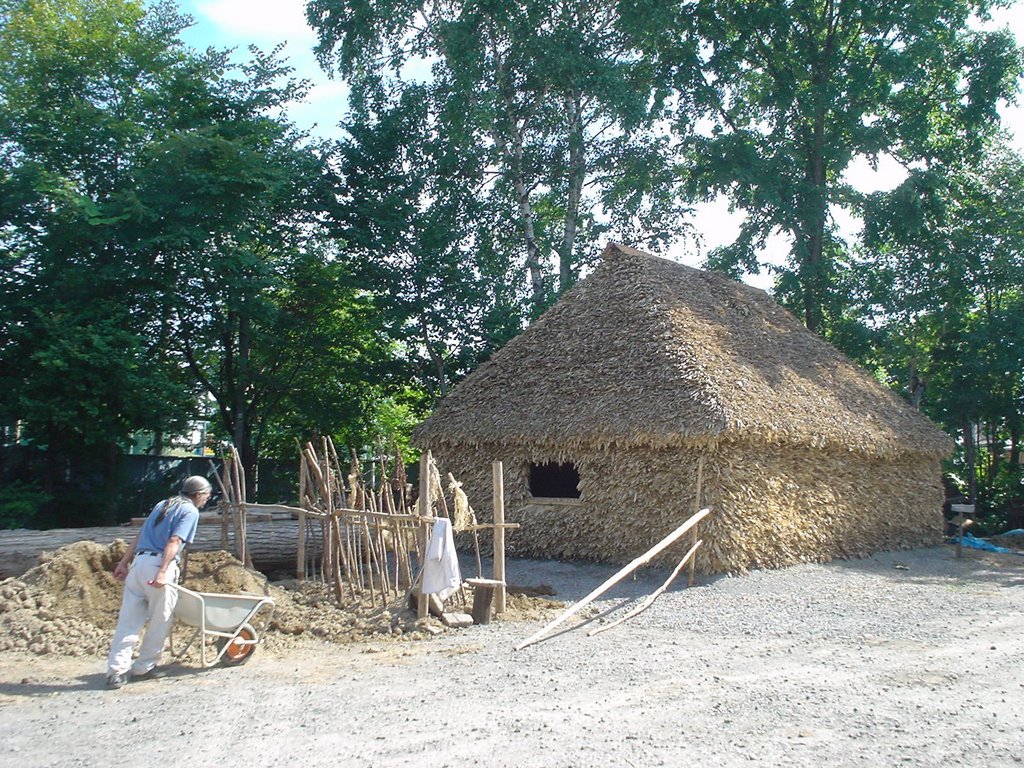 We initiated our Japan Rail Passes 3 weeks ago with a same-day roundtrip by bullet train from Tokyo (東京 'east capital') to Shizuoka (静岡 'calm hill') in a fruitless effort to view Mt. Fuji (富士山 'rich gentleman mountain'). Not once did we see any mountaintops--all being obscured by clouds and haze. I don't know how many times as a kid I strained in vain for a glimpse of Mt. Fuji as we passed Shizuoka on the train. (I have seen it on other trips, but only from afar.)
On Monday, I made a final day trip by rail pass to see one other famously beautiful place, the Matsushima (松島 'pine island') bay and islands near Sendai (仙台 'hermit platform'). (My wife was tied up with obtaining her work visa, and my daughter had left on Sunday to return to college in the U.S.) Matsushima was spectacular--as lovely as Miyajima (宮島 'shrine island') in my estimation--even though I didn't get a chance to see all the best views.
In between, we made a roundtrip from Tokyo to Sapporo (札幌, an Ainu name whose kanji meanings are arbitrary), with a day trip from Sapporo to Asahikawa (旭川 'rising-sun river'). We had to pay extra for the sleeping berths going up.
We also made day trips from Ashikaga (足利 'foot profit'--the second kanji is never read kaga except in this placename, so perhaps kaga formerly meant something less favorable, like 'swelling' or 'carbuncle') to Niigata (新潟 'new lagoon', but with a rarer pronunciation for 'new'), Nikko (日光 'sun shine'), Utsunomiya (宇都宮 'sky capital shrine'), and twice to Narita airport. I think we got our money's worth. I've got a few travelogues to write up now.
21 August 2005
Earthquake Blogging
A little while ago, at 11:29 Japan time, a magnitude 5.0 (Japanese scale) earthquake shook our building slightly. NHK almost immediately cut to earthquake coverage, repeating over and over that the epicenter was around Nagaoka in Niigata Prefecture, that there is no danger of a tsunami, that there have been no reported injuries, and that the eastern Shinkansen trains had already resumed normal operation. The magnitude in Tochigi Prefecture, where we are, was 2.0.
I'm getting superstitious. We spent yesterday in Niigata. But maybe the crucial factor is that the last time we had a big earthquake was the same day we were scheduled to take the Narita Express to go to the airport. Today, we are again scheduled to take the Narita Express to the airport to send our daughter back to the U.S. for another year of university--and a third year of college Japanese. If this pattern holds, then northern Japan can expect another largish earthquake on September 28, when I'm scheduled to fly back to the U.S.
We may have to rethink our tentative plans for a daytrip to Sendai on Monday, the last day our rail passes remain valid. I'd hate to bring that lovely city another earthquake only a week after their last one.
How Little Hou Created the Walking Telegraph Code
Day after day we racked our brains, but still couldn't find an adequate transmission method [to communicate remotely between prison compounds in Korea]. Little Hou was truly a smart fellow and engrossed in the code work most of the time. When he was eating or taking a break, he would mention to us one possibility and another, but none of them would work. Then one morning he hit on a brilliant idea, namely to simplify the Morse code as much as possible, to the degree of letting one dot or one dash stand for a numeral. This would not only speed up the transmission, but also reduce confusion. Based on this conception, he and Mushu created the Walking Telegraphic Method: the sender of the message would stand behind the window of the war criminal's cell [= the isolated cell in which Commissar Pei, the leader of the Chinese POWs, was held]. If he walked to the left side, it meant a dot; if he walked to the right, it denoted a dash; if he hunkered down below the window, that indicated the beginning of a new group of numerals. One dot meant 1, one dot plus one dash--2, two dots plus one dash--3, two dots--4, three dots--5, three dashes--6, two dashes plus one dot--7, one dash plus one dot--8, two dashes--9, and one dash--0. As a rule, every four numerals represented a word [probably = Chinese character]. After the receiver jotted down the numerals, he passed it on to the code man, who could decipher them with the aid of the codebook Little Hou was making. In reverse order to our cell, the war criminal's room had a window facing Compound 6, so they could send and receive messages from within the room. This method would definitely resolve the problem of transmission. How excited we were! We wanted to shout for joy, but we didn't dare. We only lifted Little Hou on our shoulders and walked a few rounds in the cell. Then he returned to working on the code.War Trash, by Ha Jin (Vintage, 2004), pp. 224-225
When the lead in the pencil was worn down, Mushu would bite the tip sharp. As the main worker, Little Hou didn't get enough sleep, his eyes bloodshot. We worried about him, but couldn't do much to help. Without a dictionary, we couldn't remember all the essential words, but we managed to come up with over eight hundred common characters. This wasn't bad. The code shouldn't be too elaborate; otherwise it would be difficult to master. So we aimed at fewer than one thousand characters. Whenever an often-used word came to mind, we would tell Little Hou. The penciled pages looked complicated and incomprehensible to me, but Little Hou could trace what he had done to avoid repetition.
Finally a booklet--loose sheets of toilet paper bound by a shoelace--was completed, which listed all the codes and gave instructions about the Walking Telegraphic Method. We put a title on the cover: The Pei Code.
20 August 2005
Multilingual Japan
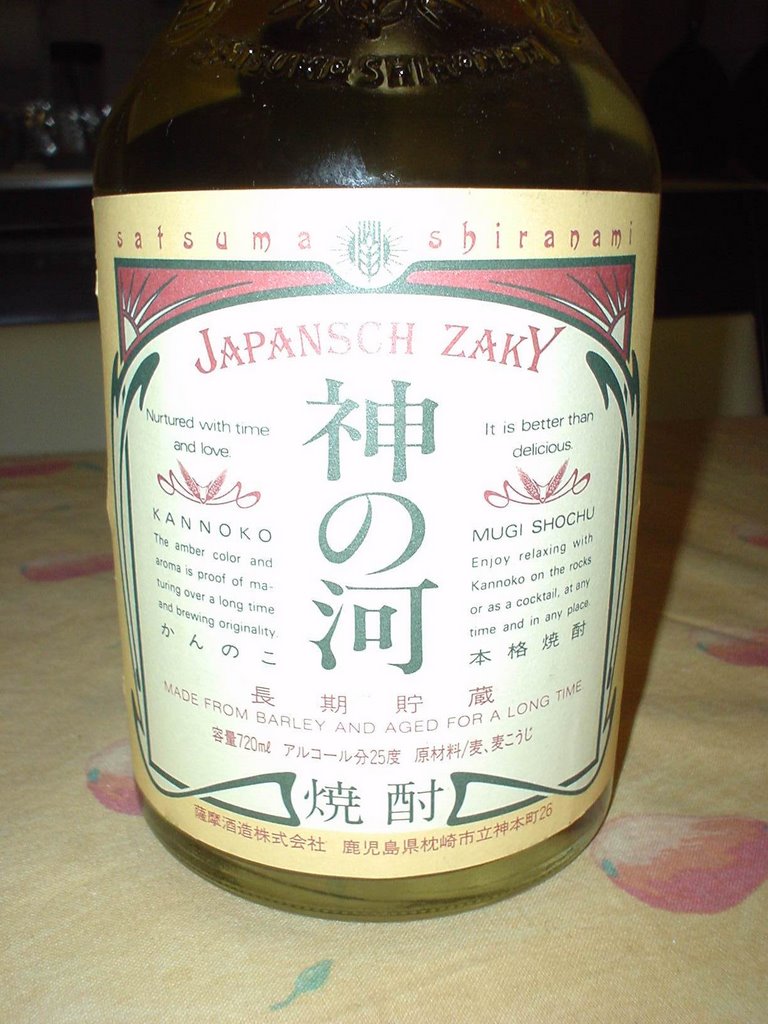 One big difference I've noted on this, my first extended trip back to Japan in 20 years, is how much more multilingual the nation is. I don't mean so much that more Japanese seem to speak foreign languages better than at any time since 1945--though I suspect that is also likely to be true.
What has struck me instead, on our attempts to get maximum usage from our rail passes, is the much greater quantity of signage in Chinese and Korean--and some Russian in Niigata--designed to help tourists speaking those languages. Many goods imported from other Asian countries also list instructions or ingredients in both Chinese and Korean.
But another thing that has struck me is that most Japanese now seem to expect foreigners to speak enough of the host country language to conduct simple transactions such as making purchases and asking directions. And I've been very impressed by the many people I've queried in my limited but sometimes deceptively fluent Japanese who've communicated very effectively in simplified and maximally redundant Japanese designed to get through to foreigners with limited proficiency.
Of course, a few bumpkins still just repeat the same thing more loudly when dealing with non-Japanese-speaking foreigners, but many people I've met have proven quite adept at effective foreigner talk in Japanese. The flip side of this--the hound that no longer barks--is the near absence of the reaction I used to get so often 20 or 30 years ago: Elaborate praise from strangers on hearing my first few words of Japanese. I've only encountered that reaction once or twice in the past 3 weeks. Nor have I encountered the speechless panic that used to overcome so many Japanese when a foreign face approached them to ask for information. Now, when speaking Japanese, the panic is more on my side, as I anticipate the inevitable hurdles of inarticulateness that are sure to trip me up the longer the conversation goes on.
Another reaction that has mercifully become much rarer is the kneejerk shouts of ハロ、ハロ (hah-ro, hah-ro) from groups of Japanese schoolboys. The only such reaction I've noticed on this trip has been from a group of uniformed middle-school boys touring a Japanese shrine in Sapporo who greeted us with ヘロ、ヘロ (heh-ro, heh-ro). The girls who followed greeted us instead with a civilized 今日は (kon-nichi-wa).
UPDATE, 23 August, 23 September: Yesterday my wife applied for her alien registration at the Ashikaga city office, where I learned that Japan will conduct a national census on 1 October 2005. The notice was posted in the following languages, in the following order: English (in larger type at the top), Korean, Chinese, Portuguese, Spanish, Thai, Tagalog, Indonesian/Malay ("Sensus nasional dilaksanakan"), Farsi/Persian (I think), Vietnamese, Hindi, Burmese, French, German, Russian, Malay/Indonesian ("Sensus Penduduk"), Arabic (if not Persian).
The same office also offered a Tochigi International Association flyer for "Consultation and Information Services" with contact information listed in the following languages: Japanese, English, Chinese, Portuguese, Spanish, Persian, Thai. The local prefectural lending library, however, had nothing substantial in any other language than English, but had many volumes of classic literature translated into Japanese from English, French, German, Russian, Korean, Chinese, German, Spanish, and Italian (roughly in that order, by quantity).
The Battle Death Blame Game
When a man died, there had to be blame. [1LT] Jimmy Cross understood this. You could blame the war. You could blame the idiots who made the war. You could blame [the dead soldier] Kiowa for going to it. You could blame the rain. You could blame the river. You could blame the field, the mud, the climate. You could blame the enemy. You could blame the mortar rounds. You could blame people who were too lazy to read a newspaper, who were bored by the daily body counts, who switched channels at the mention of politics. You could blame the munitions makers or Karl Marx or a trick of fate or an old man in Omaha who forgot to vote.SOURCE: The Things They Carried, by Tim O'Brien (Broadway Books, 1998), p. 177
In the field, though, the causes were immediate. A moment of carelessness or bad judgment or plain stupidity carried consequences that lasted forever.
19 August 2005
Hirohito: Mere Collector or Amateur Scientist?
From 1914 to 1919, when Hirohito was in middle school, Professor Hattori Hirotarô became his teacher of natural history and physics. Hattori remained his servant in scientific pursuits for more than thirty years, cultivating Hirohito's childhood fondness for insects and helping him to develop a keen, lifelong interest in marine biology and taxonomy. Under Hattori's guidance, Hirohito read Darwin's theory of evolution as interpreted by the popular writer Oka Asajirô, whose book Shinkaron kôwa (Lessons on evolution) was published in 1904. He may also have read a Japanese translation of Darwin's Origin of Species. Around 1927 he was given a small bust of Darwin, which thereafter adorned his study alongside busts of Abraham Lincoln and Napoleon Bonaparte.SOURCE: Hirohito and the Making of Modern Japan, by Herbert P. Bix (HarperCollins, 2000), pp. 60-61
In September 1925, during the fourth year of his regency, Hirohito had a small, well-equipped biological laboratory established within the Akasaka Palace. Three years later, during the second year of his reign, he built ... the Imperial Biological Research Institute, consisting of a greenhouse and two large laboratories, each with specimen rooms and libraries. Hattori became associated with this laboratory .... Years later Hattori edited Sagamiwan sango erarui zufu (Pictorial specimens of marine life in Sagami Bay), while Sanada Hiroo and Katô Shirô did the colored drawings, Baba Kikutarô wrote the accompanying explanations. Because the re-formed Imperial Household Agency held the copyright, the book was ascribed to Hirohito. Nowhere in the book, however, did the emperor's name appear, which raised the question, How much of its research had actually been done by him?
Hirohito himself was always very modest about his interest in biology. When Sagamiwan sango appeared, Hattori offered an assessment of his former pupil's scientific bent in a discussion that appeared in the Sande Mainichi on October 2, 1949. Asked whether the emperor's studies should be viewed as genuine scientific research rather than the work of an amateur, Hattori replied:Recently Professor Satô Tadao [of Nagoya University] wrote in the Nagoya newspaper that it belonged to the category of an amateur's research. Indeed, depending on how one looks at the matter, I think that is true. He never published anything under his own name and ended up furnishing raw data to various specialists. Therefore, from one point of view he is, in the final analysis, probably a mere collector. But I don't think so. He did not just hand them material he had collected. Rather, he first thoroughly investigated that material himself, and on that point he is no amateur.Hattori's assessment makes sense ... Taught by Hattori, the emperor became a naturalist and a patron of marine biology, pursuing as a hobby the collection of sea plants and animals, such as slugs, starfish, hydrozoa, and jellyfish.
Quake-Snarled Bullet Trains
 As we were about to exit our 11th-floor apartment, we suddenly felt the building sway slightly beneath our feet and heard the rhythmic rattle of an interior door against its metal latchhook. We retreated back into our doorway, nervous but confident that the newly constructed Japanese high-rise could withstand an earthquake that had not even caused us to lose our footing. Nor had it caused any visible panic in the streets of Ashikaga far below.
It was Tuesday, the 16th of August, and we were just setting out on a complex, minutely scheduled multi-train itinerary that would have us reaching Tokyo station in time to transfer to the same Narita airport express train that an old friend coming up from Osaka was booked on, so that both she and we could meet her daughter who was due to overnight in Narita on her way back from Auckland to London for university. We were all scheduled to arrive by train at 16:25, just about the time she would be clearing customs.
We would all have just enough time to eat a traditional Japanese meal together at the airport hotel before dispersing in three different directions to spend that night: our friends staying at the hotel, my wife going back to Ashikaga for school business the next day, and my daughter and I going to our friend's parents' house on the west side of Tokyo so we could spend a little more time catching up the next day.
The first leg of the familiar local train ride from Ashikaga to the nearest bullet train (Shinkansen) station at Oyama gave no hint of any major disruption. Nor did the man who booked our seat reservations for the remainder of the trip. But almost as soon as we headed for the Shinkansen platform, they started turning people away, saying the Northeast Shinkansen (through Sendai) had been shut down. We had no idea why until the station announcements began blaming the earthquake. We were forced to hop on a slow local train bound for Ueno station in Tokyo.
Fortunately, we had gotten an early start in order to have time to book seat reservations, so we still had a chance to make the 15:33 Narita Express (N'EX) from Tokyo. But the sprawling Tokyo Shinkansen station was a complete mess, with no reliable timetables, repeated announcements of delays, and stranded passengers all over the place in the peak summer travel season.
At 15:33, the Narita Express platform was still listing the train scheduled for 14:33, with no indication of the actual times for any of the delayed trains. The harried platform officials assured us that seat reservations no longer mattered, that we could climb aboard any N'EX that came by. So we did, and sure enough, no one on board bothered to check our seat assignments.
We got to the airport close to 17:00, wondering how to get in touch with our friends. We went first to the arrival area outside customs, and were shocked almost immediately to run into our friend from Osaka, who had arrived on the same train we had and was waiting for her daughter's flight to clear customs. It had been delayed, too--but not by an earthquake!
We had a very pleasant dinner, imagining that the world-famous Shinkansen system was quickly getting back on schedule. When we dispatched my wife, who knows hardly any Japanese, back to the Narita Express station, we had no idea what we had condemned her to. The N'EX had canceled most of its runs, so she had to take a series of slower trains all the way back to Ashikaga, arriving home about midnight.
An hour after my wife left, my daughter and I headed for a N'EX that was supposed to go all the way to Kokubunji on the west side of Tokyo, where our hosts for the night expected us to show up pretty late anyway. But that train was canceled, so we were instead put on a bus for Shinjuku, the major west-side transfer station. As it happened, the bus got to Shinjuku early enough to allow us to jump on a commuter express that got us into Kokubunji much faster than either we or our hosts had expected.
The northbound Shinkansen was still snarled the next evening when we headed back to Ashikaga, but all the local trains and buses provided a very effective--if slower--backup system.
18 August 2005
Bix on Hirohito and General Nogi's Suicide, 1912
At the beginning of the Taishô period [in 1912], on the day of Emperor Meiji's funeral, General Nogi and his wife closed the door to their second-floor living room and prepared to end their lives. He had removed his uniform and was clad in white undergarments; she wore black funeral attire. They bowed to portraits of Meiji and of their two sons, killed in the Russo-Japanese War. While the funeral bells tolled, they proceeded to commit ritual suicide. Mrs. Nogi acted first; he assisted, plunging a dagger into her neck, and then he disemboweled himself with a sword. The departed hero of the Russo-Japanese War left behind ten private notes and a single death poem. (The writing of waka death poems was another practice from Japanese antiquity that was revised in the nineteenth century.) In one note he apologized for his action to four family members, including his wife, and acknowledged having contemplated suicide ever since losing his regimental flag in the war of 1877; he also mentioned his aging and the loss of his sons. In another note, to a military doctor, he bequeathed his body to medical use....SOURCE: Hirohito and the Making of Modern Japan, by Herbert P. Bix (HarperCollins, 2000), pp. 42-43
Nogi's death poem, intended for public consumption, told the nation that he was following his lord into death--a practice known as junshi that even the Tokugawa shogunate had considered barbaric and outlawed "as antiquated in 1663." Conservative intellectuals ... interpreted Nogi's suicide as a signal act of samurai loyalty, pregnant with positive lessons for the nation, and for its armed forces. Nantenbô, Nogi's Zen master, was so enthralled by the majesty of his pupil's action that he sent a three-word congratulatory telegram to the funeral: "Banzai, banzai, banzai." The Asahi shinbun, however, editorially criticized those who called for the establishment of a new morality by reviving bushidô, and asserted that Nogi's harmful action could teach the nation nothing. Kiryû Yûyû, a writer for the Shinano Mainichi shinbun, went further, not only decrying Nogi's death as "thoughtless" and "meaningless" but warning presciently that "to comprehend death as loyalty" was a mistaken ethical idea that could only "end up encouraging great crimes in international relations."
When informed of "Schoolmaster" Nogi's death by the chamberlain in charge of supervising his education, Hirohito alone of his three brothers was reportedly overcome with emotion: Tears welled up in his eyes, and he could hardly speak. Doubtless he was too young really to understand the general's action, let alone the harmful effect that his anachronistic morality of bushidô might have had on the nation. But as Hirohito remarked late in life to an American reporter, Nogi had a lasting influence on him, instilling precepts of frugality and stoic virtues of endurance and dignity to which Hirohito never failed to adhere. The brave Nogi was to Hirohito a giver of orders who meant what he said and was willing to lay down his life for his master. Hirohito not only identified with Nogi, he also derived from him the conviction that strong resolve could compensate to some extent for physical deficiencies. In Hirohito's imaginings, Nogi was to be emulated almost as much as his other hero, Meiji.
25 July 2005
Travel Reading: Ha Jin's War Trash
Okay, I can't resist a little teaser from the first of my travel-reading books: Ha Jin's War Trash (Vintage, 2004). (Another is Herbert Bix's Hirohito, which may initiate a conversation or two on Japanese trains if I display the cover too openly.) Here's a sample of Ha Jin's prose.
We drilled with our new weapons and learned about the other units' experiences in fighting the American and the South Korean armies. We all knew the enemy was better equipped and highly mechanized with air support, which we didn't have. But our superiors told us not to be afraid of the American troops, who had been spoiled and softened by comforts. GIs couldn't walk and were road-bound, depending completely on automobiles; if no vehicles were available, they'd hire Korean porters to carry their bedrolls and food. Even their enlisted men didn't do KP and had their shoes shined by civilians. Worst of all, having no moral justification for the war, they lacked the determination to fight. They were all anxious to have a vacation, which they would be given monthly. Even if we were inferior in equipment, we could make full use of our tactics of night fighting and close combat. At the mere sight of us, the Americans would go to their knees and surrender--they were just pussycats. To arouse the soldiers' hatred for the enemy, a group of men, led by a political instructor, pulled around a hand truck loaded with a huge bomb casing which was said to be evidence that the U.S. was carrying on bacteriological warfare. They displayed the thing at every battalion, together with photographs of infected creatures, such as giant flies, rats, mosquitoes, clams, cockroaches, earthworms. The germ bomb, which was said to have landed near the train station, was almost five feet long and two feet across, with four sections inside. This kind of bomb, we were told, would not explode; it would just open up when it hit the ground to release the germ carriers. To be honest, some of us had rubbed shoulders with Americans when we were in the Nationalist army, and we were unnerved, because we knew the enemy was not only superior in equipment but also better trained.SOURCE: War Trash, by Ha Jin (Vintage, 2004), pp. 10-11
Throughout this period we attended regular meetings at which both civilians and soldiers would condemn American imperialism. An old peasant said his only farm cattle, a team of two, had been shot dead by a U.S. plane while he was harvesting sweet potatoes in his field near the border. A woman soldier walked around among the audience, holding up large photographs of Korean women and children killed by the South Korean army. A reporter spoke about many atrocities committed by the American invaders. Sometimes the speakers seized the occasion to vent their own grievances. They often identified the United States as the source of their personal troubles. A college graduate of dark complexion even claimed to an audience of eight hundred that his health had been ruined by the American film industry, because he had watched too many pornographic movies from which he had learned how to masturbate. Now he couldn't control himself anymore, he confessed publicly. These kinds of condemnations, high and low, boosted the morale of the soldiers, who grew restless, eager to wipe out the enemy of the common people.
On the night of March 17 we crossed the Yalu ['Duck Green']. Every infantryman carried a submachine gun, two hundred rounds of ammunition, four grenades, a canteen of water, a pair of rubber sneakers and a short shovel on the back of his bedroll, and a tubed sack of parched wheat flour weighing thirteen pounds. We walked gingerly on the eastern bridge, because the western one was partly damaged. Each man kept ten feet from the one in front of him. The water below was dark, hissing and plunging. Now and then someone would cry out, his foot having fallen through a hole. A tall mule, drawing a cart, got its hind leg stuck in a rift and couldn't dislodge it no matter how madly the driver thrashed its hindquarters. The moment I passed the tilted cart, it shook, then keeled over and fell into the river together with the helpless animal. There was a great splash, followed by an elongated whirlpool in the shimmering current, and then the entire load of medical supplies vanished.
24 July 2005
August Hiatus
The Far Outliers will be traveling in the far abroad over the next month, in their first trip back to Japan since the latter 1980s. I won't likely be posting much while we're on the road, but will probably resume posting in late August or early September. In the meantime, please sample some of the diverse range of blogs linked on the right. Here are three of my recent favorites.
Australia-based Macam-macam has been doing yeoman work digging up underreported stories from Southeast Asia--something I made a few stabs at before falling into a pattern of excerpting regularly from the books I've been reading. Some recent highlights include: new movement toward peace plans in Aceh (one of the few positive outcomes of the tsunami), Australia's new willingness to split oil and gas revenues with Timor Leste, and possible Burmese military plans for defense in depth.
London-based A Step At a Time has been translating a lot of stories from Russia: about a Finland-Swedish businessman on Chechnya; about a trip to Grozny:
I soon got the jitters. The driver was talking in Chechen, and rather rudely, too, shouting something, waving his hands. Then I understood what the matter was: he was asking who hadn’t paid. It was me, of course. The whole minibus turned round and looked at me as though I were an enemy of the people – by now they had realized that I knew no Chechen.and about campaigning around Russia with Garry Kasparov:
At the end of the last day of our trip they finally let our airplane land in Rostov - so that Kasparov and Co. could hurry off back to Moscow. "Can you believe that only five days and four nights have passed since we left Moscow?" Kasparov asked. "It feels like a month and a half." Most importantly, it was hard to believe that five days ago we were an excited group from Moscow, content, smug, traveling in a chartered plane (by the way, the VIP room in Stavropol we reserved in advance was suddenly closed on the day of our arrival for "failure to conform to regulation"). Now we presented a pathetic picture: exhausted, dressed in clothes ruined by eggs and ketchup.New York City-based Pearsall's Books has been doing an enlightening series of demographic studies, two recent examples being an analysis of census statistics on the ethnic make-up of Young America and a fascinating comparison of two U.S. drug epidemics, crack cocaine and crystal meth. Here's a sample of the latter.
What started out as a local problem on the West Coast has slowly begun to make its way east, with major meth epidemics springing up all throughout the Midwest and the Southeast, particularly in Appalachia, but not yet in the Northeast, at least outside of the gay community, where meth use is now a truly national crisis....
For the most part, the typical meth addict is a member of the white working-class, usually living in rural areas or small towns (hence the occassional nickname of "trailer park crack"). The spread of methamphetamine addiction has led to steep increases in crime rates in many formerly peaceful and safe communities. Meth-related crime has also, in parts of the country, been the main factor behind steep increases in the number of whites going to prison. This can be seen in, among other places, Minnesota and Arkansas, where meth-related crimes have been responsible for a surge in the white prison population, such that for the first time in decades both of these states have white majorities within their corrections systems....
What I find interesting is that, despite the explosion of meth addiction in recent years it seems to have taken far longer than crack in the 1980's to really make an impression on the national consciousness, and it seems to have made little impact on popular culture. I have a couple of ideas as to why this is so. For one thing, it has not really touched the East Coast yet, where most of the news media is based. All of the tv networks are based in New York, as are most of the big news magazines and the most famous paper in the nation, The New York Times. The major media, for the most part, only really focuses on the rest of the country as it needs to, and meth, happening as it does in fairly out-of-the-way places, is not really the sort of story that is easy to tackle from a New York mindset.
23 July 2005
Mongolian, Bulgarian Tied for Lead in Japanese Sumo
The Japan Times reports after Day 14 of the Nagoya Grand Sumo Tournament.
NAGOYA (Kyodo) Bulgarian komusubi Kotooshu dismantled crowd pleaser Takamisakari to up the stakes against joint leader yokozuna Asashoryu on Saturday, winning his 12th bout at the Nagoya Grand Sumo Tournament.UPDATE: Nuts! Asashoryu won his final bout, but Kotooshu didn't, so there was no playoff. Be sure to check out Kotooshu's ceremonial apron (kesho-mawashi). During the ring-entering ceremony he's a walking ad for Meiji Bulgaria Yogurt.
With just one day remaining, the pair is heading for their second clash of the 15-day meet in a possible playoff for winner takes all on Sunday.
Kotooshu, who stands over 2 meters and is being dubbed sumo's David Beckham, absorbed a fierce attack from Takamisakari before adroitly spinning on his heels and wrenching down his opponent with his trademark overarm throw at Aichi Prefectural Gym. Takamisakari dropped to 10-4 and fell out of the running for the title.
Kotooshu stunned the yokozuna earlier in the week and will have a second chance at glory, if both wrestlers beat their opponents, Wakanosato and Tochiazuma, respectively, in their final bouts of regulation on the final day.
A victory over the yokozuna would make the Bulgarian the first European wrestler to claim the Emperor's Cup hardware, but Asashoryu is still the favorite to win his fifth straight title.
22 July 2005
Paul Farmer's Word Gymnastics
"An H of G" was short for "a hermeneutic of generosity," which [Paul Farmer] had defined once for me in an e-mail: "I have a hermeneutic of generosity for you because I know you're a good guy: Therefore I will interpret what you say and do in a favorable light. Seems like I'm the one who should hope for as much from you." I have counted scores of terms like that one in his lexicon, which was also the lexicon of PIH [Partners in Health]....SOURCE: Mountains Beyond Mountains: The Quest of Dr. Paul Farmer, a Man Who Would Cure the World, by Tracy Kidder (Random House, 2004), pp. 215-217
One time his brother Jeff, the wrestler, sent him a card in which he misspelled the word "Haitians." He spelled it "Hatians." So in PIH lingo, Haitians were "Hat-eans" or simply "Hats," and their country was "Hatland." The French were "Fran-chayze," their tongue "Fran-chayze language," and Russians were "Rooskies." A "chatterjee" was a person of East Indian descent--there were a few in PIH--who talked a lot. Farmer referred to himself as "white trash"--he had an old photo to prove it, his extended family at a picnic around a couch outdoors. The man who railed about the plight of impoverished women everywhere would in private, poking fun, employ terms like "chicks." "I don't care about any of that stuff" he told me once. "Just the one thing." Impolite terms, used intramurally, were meant as philosophical rebukes to the misplaced preoccupations of those who believed in "identity politics," in the idea that all members of an oppressed minority were equally oppressed, which all too conveniently obscured the fact that there were real differences in the "shaftedness," also sometimes called the "degrees of hose-edness," that people of the same race or gender suffered. "All suffering isn't equal" was an article of the PIH faith, generated in reaction to the many times when they had tried to raise money and instead had been offered lectures about the universality of suffering, or simply lines like "The rich have problems, too." (Farmer once taught a course at Harvard called Varieties of Human Suffering.)
"When people get around Paul, they start talking like Paul," his old friend from medical school the writer Ethan Canin said. "He's such a word gymnast." There was an obvious utility in the brevity of terms like "H of G," for a mind moving fast, and for people trying to keep up. When, for instance, "TBMI" (transnational bureaucrats managing inequality) produced clever arguments (also known as "well-formed stool") against treating MDR [Multiple Drug Resistant TB] or AIDS, one could simply say, "Love, ID," and be completely understood. Everyone in PIH knew that "DQ" stood for "Drama Queen," and a DQ proposal meant an emotional appeal. ("We could use a DQ quote here, and a generic inequality-of-outcomes over here," I once heard Farmer say to a young assistant working with him on a speech.) "Geek flowers" was the completed research that PIH-ers presented to Farmer or Kim, and "scholbutt" was short for "scholarly buttressing," which meant that every statement of fact Farmer made in a paper had to be verified as coming from some authoritative source. ("He's neurotic about having it all perfect," said a medical student who did a lot of scholbutt for Farmer. "Not because he's anal but because when you're doing these things for the poor, amidst arguments that it's not cost-effective to treat them, you have to be perfect or you'll be picked apart.")
"Lugar" was luggage. "Koutoums" meant "customs." To commit "a seven-three" was to use seven words where three would do, and a "ninety-nine one hundred" was quitting on a nearly completed job. ("Nothing pisses me off like a ninety-nine one hundred," Farmer would say.) PIH-ers often said "Thank you" to people who had done something for a third party, for anyone who belonged to the multitudinous group known variously as "the indigent sick," "the shafted," and "the poor," the last being the term of choice in PIH because, as Farmer would say, it was the term that most Haitians used to describe themselves.
21 July 2005
Dr. Paul Farmer's Marxism
"For me to admire Cuban medicine is a given," Farmer said. It was a poor country, and made that way at least in part by the United States' long embargo, yet when the Soviet Union had dissolved and Cuba had lost both its patron and most of its foreign trade, the regime had listened to the warnings of its epidemiologists and had actually increased expenditures on public health....SOURCE: Mountains Beyond Mountains: The Quest of Dr. Paul Farmer, a Man Who Would Cure the World, by Tracy Kidder (Random House, 2004), pp. 194-195
One time he got in an argument about Cuba with some friends of his, fellow Harvard professors, who said that the Scandinavian countries offered the best examples of how to provide both excellent public health and political freedom. Farmer said they were talking about managing wealth. He was talking about managing poverty. Haiti was a bad example of how to do that. Cuba was a good one.
He had studied the world's ideologies. The Marxist analysis, which liberation theology borrowed, seemed to him undeniably accurate. How could anyone say that no war among socioeconomic classes existed, or that suffering wasn't a "social creation," especially now, when humanity had developed a grand array of tools to alleviate suffering. And he was more interested in denouncing the faults of the capitalist world than in cataloging the failures of socialism. "We should all be criticizing the excesses of the powerful, if we can demonstrate so readily that these excesses hurt the poor and vulnerable." But years ago he'd concluded that Marxism wouldn't answer the questions posed by the suffering he encountered in Haiti. And he had quarrels with the Marxists he'd read: "What I don't like about Marxist literature is what I don't like about academic pursuits--and isn't that what Marxism is, now? In general, the arrogance, the petty infighting, the dishonesty, the desire for self-promotion, the orthodoxy: I can't stand the orthodoxy, and I'll bet that's one reason that science did not flourish in the former Soviet Union."
My biggest problem with Marxism--apart, of course, from "the arrogance, the petty infighting, the dishonesty, the desire for self-promotion, [and especially] the orthodoxy"--is that it takes wealth for granted (as Farmer does), and therefore assumes that poverty can only be eliminated by transferring existing wealth from rich people to poor people. The best way to destroy poverty is to enable poor people both to create new wealth and to accumulate it--and not just to rely on larger and larger transfers from those who have previously managed (legally) to create and accumulate it.
20 July 2005
The Last Prince of Chosôn
The son of the last crown prince of the Chosôn Dynasty has died. The Korea Times reports:
via The Marmot's Hole
Yi Ku [李玖, 이구, I Gu], the only surviving son of Choson Kingdom’s last crown prince Yongchin, died of a heart attack at a hotel in Tokyo on Saturday. He was 73....Wikipedia has already turned his biography into an obituary.
Yi led a single life in Japan after having divorced his American wife, Julia Mullock, in 1982. Having left no offspring, Lee’s passing signifies the end of the main lineage of the Choson’s royal descent.
Yi was born in Japan in 1931 to Prince Yongchin and Masako Nashimoto, a member of Japan’s imperial family. Yongchin was the younger brother of Choson’s last monarch Sunjong and the seventh son of King Kojong. The marriage was part of Japan’s imperial ambition to merge Korea.
Yi was the second son in the marriage, but he became the sole surviving member of the royal family’s main lineage after his elder brother Chin died at the eighth month....
Yi could not come back to Korea for a while after then as President Syngman Rhee was weary of the influence of royal family members. It was 1963 when he returned to Seoul with his wife and parents and began to reside in Naksonjae residence, a small housing quarter located within Changdokkung Palace.
Gu attended the Gakushin Peers' School (学習院 gakushuin), Tokyo, Japan. He later attended Centre College, Danville, Kentucky and studied architecture at Massachusetts Institute of Technology both in the US. He was employed as an architect with I.M. Pei & Assocs, Manhattan, New York on 1960 to 1964. Made stateless by Japan in 1947, Gu acquired U.S. citizenship in 1959, and Korean citizenship in 1964. He married Julia Mullock (b. 1928) on 25 October 1959 in New York, and and they adopted a daughter, Eugenia.The Korea Times has a follow-up story on the fate of the last Korean royal family.
After the fall of Syngman Rhee, he returned to Korea in 1963 with the help of the new president Park Chung-hee, moving into the new building in Nakseon Hall, Changdeok Palace with his mother and wife. He lectured on architecture at Seoul National University and Yonsei University and also ran a business. When that went bankrupt in 1979, he went to Japan to earn money. In 1982 his wife divorced him; his mother died in 1989. He started living with a Japanese astrologer, Mrs Arita.
In November 1996, he made what he hoped would be his permanent return to Korea but, showing signs of a nervous breakdown, he was unable to adjust to life in the motherland. Restlessly going back and forth between Japan and Korea, he eventually died of a heart attack at the age of seventy-four, at the Akasaka Prince Hotel, the former residence of his parents in Tokyo, Japan.
via The Marmot's Hole
19 July 2005
Jim Kim's Search for Identity
This one's for Jodi.
Jim was born in South Korea and grew up in Muscatine, Iowa, in the 1970s. For as long as he could remember, the place had seemed too small for his ambitions. He hardly noticed the Mississippi flowing by the lovely old downtown or the fragrances of grains on summer nights or even the famous local produce, the Muscatine melon....SOURCE: Mountains Beyond Mountains: The Quest of Dr. Paul Farmer, a Man Who Would Cure the World, by Tracy Kidder (Random House, 2004), pp. 166-169
Jim's father had schemed and charmed his way out of North Korea and become, proudly, Muscatine's periodontist, with an office upstairs on Main Street. Jim's mother had come from South Korea--a grandfather had served as a minister to the last Korean king--and she had studied at Union Theological Seminary with Reinhold Niebuhr and Paul Tillich and become a Confucian scholar, and ended up for many years a housewife in Muscatine. A small, elegant woman walking across the local golf course when her children were too young to play alone, diligently trying to make sense of American sports so she could understand her children's milieu. At every opportunity she took Jim and his siblings to Des Moines and Chicago so they'd know the world was larger than it seemed from Muscatine. She taught her three children, by example, the arts of debate around the kitchen table, while her husband, who had early morning appointments, went to bed grumbling that he didn't know what they had to talk about that was more important than a good night's sleep. She'd tell them to live ''as if for eternity" and tutor them on current events, translating for Jim the images of famine and war that upset him on the TV news. Early on, Jim imagined himself becoming a doctor to treat such suffering, and excelling in science quickened his interest.
He was quarterback on the Muscatine High football team, a starting guard in basketball, the president of his class and its valedictorian. But the Kims were the only Asian family in town, except for the one that owned the Chinese restaurant. When they went to the malls of Iowa, adults stared and children followed them around, the bolder ones approaching, crying out, "Kiai!" and making as if to deliver karate chops. For Jim, embarrassment at his parents' Koreanness was the loneliest feeling of all....
He went to the University of Iowa and felt liberated there until he was told that Ivy League schools were better. He transferred to Brown, where he discovered an organization called the Third World Center. He became its director. He broke up with his Irish Catholic girlfriend because he suddenly believed he shouldn't date white women. He made his friends among black, Hispanic, and Asian students. He learned "the pimp walk." On parents' weekend he and his friends would dress up in black and stride around the campus, a phalanx of about thirty African American and Hispanic students, and one Korean, sometimes chanting, sometimes maintaining a threatening silence, and noting with pleasure the double takes and frightened looks on the faces of some of the parents.
Before Brown, Jim hadn't known that the United States interned Japanese Americans during World War II. He read up on the subject, then lectured about it. He embraced the idea of Asian "racial solidarity." He didn't realize back then just how complex a matter this could be. He didn't find out until much later that, for example, Koreans were supposed to hate the Japanese. From time to time, doubts cropped up. It seemed as if for other Asians at Brown, racial identity meant little more than eating with chopsticks and finding an Asian mate, and the paramount political issue seemed to be the "glass ceiling," the fact that Asians weren't yet rising to the very tops of institutions. But the idea of being a member of an oppressed minority was very alluring. Jim decided to learn his native language. "I wanted to learn Korean, be down with my people, be an authorized third world person, so I could say shit." He got a fellowship to travel to Seoul and happened on an interesting story for his Ph.D. thesis in anthropology--it had to do with the Korean pharmaceutical industry. In Seoul he did his research and made a mighty effort to fit in, hanging out at bars with new Korean friends and performing karaoke--beforehand on each occasion, he'd go to the bathroom and study the words to songs like "My Way."
He had left Iowa prepared, naturally enough, to think that ethnicity was the central problem of his life. By the time he came back from Korea to Harvard, to continue medical school and write his thesis, he had grown bored and a little disgusted with what was known in academic circles as the politics of racial identity. It seemed like an exercise in selfishness. "I discovered South Korea was doing just fine, and that what Koreans wanted was for me to write grant proposals so they could come to the States and get degrees. I had looked at student movements. They were all about Korean nationalism, just sort of troublemaking." When he met [Paul] Farmer, he was ready to change directions. At one point during their talks in the old, one-room PIH [Partners in Health] office, Farmer told him, "If you come to Haiti, I'll show you you're blan, as white as any white man." Jim thought of his black, Hispanic, and Asian friends at Brown, and how angry that remark would have made them.
He told Farmer that he felt liberated from "the self-hatred and evasion of ethnicity" he'd felt in Muscatine.
"It's good to have to come to understandings of that, but you've got to put that behind you now," said Farmer. "So what are you going to do? Be the first Asian to do some stupid thing like walk on the moon?"
They hadn't talked long before Jim declared that he wanted to make Farmer's preferential option for the poor his own life's work.
18 July 2005
Collaborative Writing with Srebrenica Survivors
Last Monday, Tim Lindgren of The WhereProject described his personal experience helping refugees from Srebrenica.
This week marks the 10th anniversary of the massacres at Srebrenica when nearly 8,000 Bosnian Moslems were killed and the international community stood by without intervening. The last couple of days, I've been thinking a lot about the Bosnian co-workers and clients I got to know as a refugee resettlement job developer in Chicago....via Rhine River
The anniversary evoke strong emotions for me, not simply because of the horrific nature of this event, but of all the other stories I heard from clients as I helped them find jobs. Many of these stories came out in the process of writing resumes for clients attempting to find their first job in the US. As a 23-year-old in one of my first jobs out of college, I learned a quite a bit about the nature of work as tried to construct resumes, resumes not only to represent 20 years experience as a machinist but also to account for the three year gaps in work history created by time in a concentration camp. This was perhaps my most profound experience of collaborative writing, listening to a client's story through a caseworker's translation and then trying to tell that story within the generic constraints of the resume.
* Jusuf was one of my first clients, a gentle and appreciative man in his late fifties, who was looking for his first job in the US. He had experience as a welder in Bosnia, so I took him to apply for work at Homaco, Inc. specialized in telephone jack towers. In the process of gathering information for a resume, he told me that he had been in the Trnopoli concentration camp for three months with his sons. He dropped 25 kilos and was eating grass by the end. Friends he had known for 50-years became his captors....
These stories continue to haunt me, not only because terrible to have heard, but because I feel like I walked away from them. In stead of remaining in Chicago, in proximity to these people and their stories, I felt compelled to move half way across the country to become a professional student of literature, to immerse myself in the canonical texts of Western civilization, to consume countless critical articles, and learn to create my own critical texts. In contrast to the subject matter of literary studies, the refugee stories were highly situated, located in specific communities and place, and I was lucky enough to find myself in the midst of it for a time. But when I had the chance to stay in Chicago, to stay local, in proximity to all I had gained, I wasn't able to make a connection between my graduate studies and the value of staying nearby.
I realized yesterday how deeply I still regret this decision, and how closely my interest in place is tied to this formative moment. When I moved to Boston, the transition was so difficult because I began to feel the loss of that deep sense of place I had gained in Chicago, in part through the people and places I encountered as job developer: the factory where airline meals were assembled; the laundry rooms and back entrances to every major hotel in downtown Chicago; the factory where women sewed fine silks; a floral shop on the west side; the factory where fire extinguishers glowed read in the sweltering air; the tannery that smelled so bad we were relieved to find out they weren't hiring; the plastics factory in Skokie where I learned the difference between extrusion and injection molding.
17 July 2005
Bulgarian Topples Mongolian Grand Champion!
The Japan Times headline says it all:
Bulgarian Kotooshu upsets AsashoryuUPDATE: Now the Georgian Kokkai has toppled Asashoryu, leaving the Mongolian Asashoryu, Bulgarian Kotooshu, and Japanese Wakanosato tied for the lead at 2 losses each, with Kokkai, Tochiazuma, Kaio, and Takamisakari just 1 loss back.
Bulgarian Kotooshu upset grand champion Asashoryu Sunday to end the Mongolian yokozuna's winning streak and topple him from his position as sole front runner at the Nagoya Grand Sumo Tournament.
Komusubi Kotooshu rallied from a powerful blow to the face at the start, which had sent him reeling backward. Recovering his balance, the two wrestlers locked intensely in the center of the ring before Kotooshu threw Asashoryu over his right shoulder and sent him head first into the dirt to roaring cheers from the crowd.
It was the first defeat for Asashoryu, who has won 13 cups, after 24 straight victories.
The Mongolian wrestler is now tied at the top of the tournament's standings with Wakanosato with seven wins and one loss. Kotooshu is 6-2.
"I'm happy," Kotooshu told reporters after the upset, saying he had just thought to do his best before facing off against his powerful opponent.
Minh Matsushita, RIP
Tamara Jones of the Washington Post profiles the lone American killed in the London bombings of 7 July.
LONDON -- Minh Matsushita was a man forever in motion, an adventure always in progress. His passport was a pocket-size accordion of pages bearing faded stamps and mysterious visas.via LaurenceJarvikOnline
Even as his boyhood friends from the Bronx settled down, got married, pursued careers and started families, the 37-year-old Matsushita just kept reinventing himself. He might be a beach bum in San Diego one year and a tech geek in Manhattan the next. You could find him snorkeling in Australia, or hiking across minefields in Cambodia.
Dude, what are you doing?, friends would remember asking time and again, when he would alight between trips on someone's back porch to drink through the night and tell his tales. Minh always smiled, shrugged and gave the cavalier answer his buddies came to think of as his personal motto:
"No worries, man."
For the past 18 months, Matsushita had been living out the dream of the perpetual wanderer, exploring remote corners of the world as a tour guide for an Australia-based agency called Intrepid Travel. Leading tourists on treks through the jungles and paddies of Southeast Asia, he also found for the first time in his life something more than adventure....
The details that would define Matsushita in death were flat and one-dimensional, predictable, prosaic, so very much not like Matsushita himself.
No one would know that he loved thick steaks and cheap beer and heavy metal music from the '80s and rafting on wild rivers. No one would know that he diverted tourists from the prescribed itineraries to introduce them to the kids he befriended in Cambodian orphanages. Or that he himself had fled war-torn Vietnam as a little boy with his widowed mother and the Japanese American businessman she would marry, Minh's adoptive father.
His family has set up a fund now to benefit the orphans, with Intrepid Travel promising to match any donations.
16 July 2005
Is Live 8 an Insult to Africa?
Jean-Claude Shanda Tonme, a consultant on international law and a columnist for Le Messager, a Cameroonian daily, has published his reaction to the Live 8 concert in the New York Times.
LIVE 8, that extraordinary media event that some people of good intentions in the West just orchestrated, would have left us Africans indifferent if we hadn't realized that it was an insult both to us and to common sense....Well, big-name musicians know a whole lot more about money than they do about democracy. And what do the UN, EU, or most national bureaucracies know about ending corruption? Ending dictatorships by military force is the easy part. Nation-building is nowhere close to being an Olympic sport yet. Not even an exhibition sport.
Don't insult Africa, this continent so rich yet so badly led. Instead, insult its leaders, who have ruined everything. Our anger is all the greater because despite all the presidents for life, despite all the evidence of genocide, we didn't hear anyone at Live 8 raise a cry for democracy in Africa.
Don't the organizers of the concerts realize that Africa lives under the oppression of rulers like Yoweri Museveni (who just eliminated term limits in Uganda so he can be president indefinitely) and Omar Bongo (who has become immensely rich in his three decades of running Gabon)? Don't they know what is happening in Cameroon, Chad, Togo and the Central African Republic? Don't they understand that fighting poverty is fruitless if dictatorships remain in place?...
In Africa, our leaders have led us into misery, and we need to rid ourselves of these cancers. We would have preferred for the musicians in Philadelphia and London to have marched and sung for political revolution. Instead, they mourned a corpse while forgetting to denounce the murderer....
But the truth is that it was not for us, for Africa, that the musicians at Live 8 were singing; it was to amuse the crowds and to clear their own consciences, and whether they realized it or not, to reinforce dictatorships. They still believe us to be like children that they must save, as if we don't realize ourselves what the source of our problems is.
Child Labor Trends in Vietnam
Dynamist blogger Virginia Postrel has a column in the New York Times on evolving research about child labor.
WHEN Americans think about child labor in poor countries, they rarely picture girls fetching water or boys tending livestock. Yet most of the 211 million children, ages 5 to 14, who work worldwide are not in factories. They are working in agriculture - from 92 percent in Vietnam to 63 percent in Guatemala - and most are not paid directly.I suspect most child labor policy is designed to protect child laborers in one region from competing against adult laborers in another. Concentrating instead on economic growth in the poorer region would in the longer run be more likely to create new wealth, new markets, and therefore new jobs in other regions as well.
"Contrary to popular perception in high-income countries, most working children are employed by their parents rather than in manufacturing establishments or other forms of wage employment," two Dartmouth economists, Eric V. Edmonds and Nina Pavcnik, wrote in "Child Labor in the Global Economy," published in the Winter 2005 Journal of Economic Perspectives....
Some of the best data, and the most noteworthy results, come from Vietnam, which tracked about 3,000 households from 1993 to 1998. This was a period of rapid economic growth, in which gross domestic product rose about 9 percent a year....
The effects were greatest for families escaping poverty. For those who crossed the official poverty line, earning enough to pay for adequate food and basic necessities, higher incomes accounted for 80 percent of the drop in child labor. In 1993, 58 percent of the population fell below the poverty line, compared with 33 percent five years later....
The results from Vietnam suggest that families do not want their children to work. Parents pull their children out of work when they can afford to, even when the wages children could earn are rising. Poverty, not culture, appears to be the fundamental problem.
Rather than simply banning child labor, then, policy makers should concentrate on alleviating poverty. That includes not only encouraging economic growth but also improving access to schools and to credit markets. Borrowing could allow families to buy equipment to substitute for child labor, to weather short-term declines in income and to pay school fees....
"Most child labor policy even today is directed at trying to get kids into unemployment - to limit working opportunities for kids," he said in the interview. But, "if households are already in a situation where they don't want their children to be working, but they're forced to because of their circumstance, taking additional steps to prevent the kids from working is punishing the poorest for being poor."
15 July 2005
Sea Trade under the Pax Mongolica
The failed invasions of Japan and Java taught the Mongols much about shipbuilding, and when their military efforts failed, they turned that knowledge to peaceful pursuits of commerce. Khubilai Khan made the strategic decision to transport food within his empire primarily by ship because he realized how much cheaper and more efficient water transportation, which was dependent on wind and current, was than the much slower land transport, which was dependent on the labor of humans and animals that required constant feeding. In the first years, the Mongols moved some 3,000 tons by ship, but by 1329 it had grown to 210,000 tons. Marco Polo, who sailed from China to Persia on his return home, described the Mongol ships as large four-masted junks with up to three hundred crewmen and as many as sixty cabins for merchants carrying various wares. According to Ibn Battuta, some of the ships even carried plants growing in wooden tubs in order to supply fresh food for the sailors. Khubilai Khan promoted the building of ever larger seagoing junks to carry heavy loads of cargo and ports to handle them. They improved the use of the compass in navigation and learned to produce more accurate nautical charts. The route from the port of Zaytun in southern China to Hormuz in the Persian Gulf became the main sea link between the Far East and the Middle East, and was used by both Marco Polo and Ibn Battuta, among others.SOURCE: Genghis Khan and the Remaking of the Modern World, by Jack Weatherford (Three Rivers Press, 2004), pp. 223-224
En route, the ships also called at the ports of Vietnam, Java, Ceylon, and India, and in each place the Mongol representatives encountered more goods, such as sugar, ivory, cinnamon, and cotton, that were not easily produced in their own lands. From the Persian Gulf, the ships continued outside of the areas under Mongol influence to include regular trade for a still greater variety of goods from Arabia, Egypt, and Somalia. Rulers and merchants in these other areas outside the Mongol system of influence did not operate within the system of shares in the Mongol goods; instead, the Mongol authorities created long-term trading relations with them. Under Mongol protection, their vassals proved as worthy competitors in commerce as the Mongols had been in conquest and they began to dominate trade on the Indian Ocean.
To expand the trade into new areas beyond Mongol political control, they encouraged some of their vassals, particularly the South Chinese, to emigrate and set up trading stations in foreign ports. Throughout the rule of the Mongol dynasty, thousands of Chinese left home and sailed off to settle along the coastal communities of Vietnam, Cambodia, the Malay Peninsula, Borneo, Java, and Sumatra. They worked mostly in shipping and trade and as merchants up and down the rivers leading to the ports, but they gradually expanded into other professions as well.
To reach the markets of Europe more directly, without the lengthy detour through the southern Muslim countries, the Mongols encouraged foreigners to create trading posts on the edges of the empire along the Black Sea. Although the Mongols had initially raided the trading posts, as early as 1226, during the reign of Genghis Khan, they allowed the Genoese to maintain a trading station at the port of Kaffa in the Crimea, and later added another at Tana. To protect these stations on land and sea, the Mongols hunted down pirates and robbers. In the Pratica della mercatura (Practice of Marketing), a commercial handbook published in 1340, the Florentine merchant Francesco Balducci Pegolotti stressed that the routes to Mongol Cathay were "perfectly safe, whether by day or by night."
Mandarin, Merchant, ..., Prostitute, Scholar, Beggar
The Mongol elite's intimate involvement with trade represented a marked break with tradition. From China to Europe, traditional aristocrats generally disdained commercial enterprise as undignified, dirty, and, often, immoral; it ranked with the manual trades beneath the interests of either the powerful or the pious. Furthermore, the economic ideal in feudal Europe of this time was not merely that each country should be self-sufficient, but that each manor estate should strive to be as self-supporting as practical. Any goods that left the estate should not be going to trade for other goods for the peasants on the land but to buy jewelry, religious relics, and other luxury goods for the aristocratic family or church. The feudal rulers sought to have their peasants supply all their own needs--to produce their food, grow their timber, make their tools, and weave their cloth--and to trade for as little as possible. In a feudal system, reliance on imported goods represented a failure at home.SOURCE: Genghis Khan and the Remaking of the Modern World, by Jack Weatherford (Three Rivers Press, 2004), p. 225
The traditional Chinese kingdoms operated under centuries of constraints on commerce. The building of walls on their borders had been a way of limiting such trade and literally keeping the wealth of the nation intact and inside the walls. For such administrators, giving up trade goods was the same as paying tribute to their neighbors, and they sought to avoid it as much as they could. The Mongols directly attacked the Chinese cultural prejudice that ranked merchants as merely a step above robbers by officially elevating their status ahead of all religions and professions, second only to government officials. In a further degradation of Confucian scholars, the Mongols reduced them from the highest level of traditional Chinese society to the ninth level, just below prostitutes but above beggars.
14 July 2005
Pearsall's Books on a Roll
The blog Pearsall's Books has been on a roll lately, with demographic studies, editorial analyses, and its trademark book reviews. Here, for instance, is a perceptive column Pearsall analyzes by Jason Burke in Sunday's Guardian Observer about the lifecycle of terrorist movements.
Historically, this first attack usually prompts the state security machine, after a short delay or period of indecision, to swing into action. Repressive legislation is introduced, intelligence agencies boosted and key militant leaders are killed or imprisoned. This results in more indiscriminate, brutal violence as the terrorist movement, leaderless and rudderless, mutates and fragments. With resources scarce and security high, soft targets are favoured.
What follows is crucial. Egypt and Algeria suffered Islamic militancies in the early 1990s that followed the above pattern. After nearly a decade of increasing horror, they peaked in grotesque violence. In Algeria, more than 100,000 died. But rather than boost the militants, this had the opposite effect. Public support for extremists collapsed; the 'martyrs' became 'murderers'. Reviled by former supporters, the militants became easy prey for security agencies. Now, only a criminalised rump of violent men remains in both countries. Movements that once threatened the existence of the state are effectively finished. And the critical factor throughout was the support of the bombers' own constituency.
The insurgency labelled 'al-Qaeda' fits this paradigm in many respects. The spectacular attack (9/11), then the response (the Patriot and anti-terrorist Acts, Guantánamo Bay). The degrading of the leadership (the invasion of Afghanistan, thousands of arrests ), now a brutal, indiscriminate phase as individuals buy into a hate-filled ideology (Madrid, the Beslan school massacre, London) and conduct freelance operations.
It may be argued that, as Algeria and Egypt (and Northern Ireland and the Basques) were on a national scale and the 'al-Qaeda insurgency' spans the globe, we are in untrodden territory. But I believe the basic conclusions drawn from smaller-scale examples remain valid. No one can claim, given the diversity of this attack's victims, that they were striking simply at the West. The casualties, in our wonderfully varied city, are as globalised as the ideology that caused them. This is a global militant movement working to an agenda that can inspire or repel anywhere on the planet.
13 July 2005
Naadam: Mongolia's Three Manly Games
Mongolia's 3-day Naadam period of traditional summer games ended today, but fans of Mongolian wrestling can console themselves for another ten days by watching Mongolian yokozuna Dolgorsuren Dagvadorj (aka Asashoryu) thrash Japanese, Russian, Bulgarian, Georgian, and fellow Mongolian opponents in the Nagoya Grand Sumo Tournament that started Sunday.
via Ulaan Ken Baatar and The Marmot's Hole
Intrepid book reviewer Danny Yee is now in Mongolia. Pathologically polymathic though he be, I didn't realize he was into archery, wrestling, and horse-racing! Be sure to look for his travelogue. It's sure to be a treat.
via Ulaan Ken Baatar and The Marmot's Hole
Intrepid book reviewer Danny Yee is now in Mongolia. Pathologically polymathic though he be, I didn't realize he was into archery, wrestling, and horse-racing! Be sure to look for his travelogue. It's sure to be a treat.
A Steppe Inside the Forbidden City
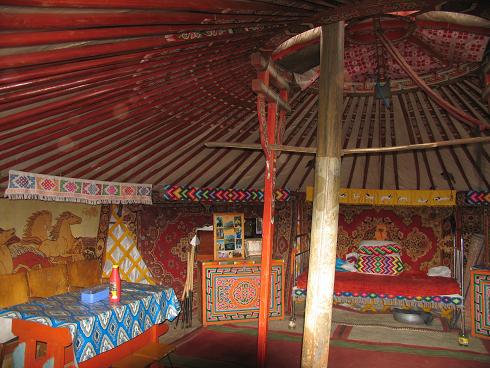
Ultimately, at the heart of [Khanbalik], Khubilai created a Mongol haven where few foreigners, including Chinese, could enter. Behind high walls and guarded by Mongol warriors, the royal family and court continued to live as Mongols. The large open areas for animals in the middle of the city had no precedent in Chinese culture. This Forbidden City constituted a miniature steppe created in the middle of the Mongol capital. During the Mongol era, the whole complex of the Forbidden City was filled with gers [yurts] where members of the court often preferred to live, eat, and sleep. Pregnant wives of the khan made sure that their children were born in a ger, and the children received their school lessons in the ger as they grew up. While Khubilai and his successors maintained public lives as Chinese emperors, behind the high walls of their Forbidden City, they continued to live as steppe Mongols.SOURCE: Genghis Khan and the Remaking of the Modern World, by Jack Weatherford (Three Rivers Press, 2004), pp. 199-200
When the Franciscan friar Odoric of Pordenone visited the Mongol territories in the 1320s, he described the Forbidden City in Khanbalik: "Within the precincts of the said palace imperial, there is a most beautiful mount, set and replenished with trees, for which cause it is called the Green Mount, having a most royal and sumptuous palace standing thereupon, in which, for the most part, the great Can is resident." In a passage that sounds very close to earlier descriptions of Karakorum, he wrote, "Upon the one side of the said mount there is a great lake, whereupon a most stately bridge is built, in which lake is great abundance of geese, ducks, and all kinds of water-fowl; and in the wood growing upon the mount there is a great store of all birds, and wild beasts." ...
Inside the confines of their Forbidden City, Khubilai and his family continued to act as Mongols in dress, speech, food, sports, and entertainment. This meant that they consumed large amounts of alcohol, loudly slurped their soup, and they cut meat with knives at the table, thereby disgusting the Chinese who confined such acts to the kitchen during preparation. With the emphasis on alcohol and rituals of drinking and drunkenness, the scenes at court must have been somewhat chaotic as the free-roaming, individualistic Mongols tried to imitate the complex and highly orchestrated rituals and ceremonies of the Chinese court. In contrast to the Chinese imperial tradition of courtiers lining up according to rank, the Mongols tended to swarm chaotically, and, perhaps most disturbing to the Chinese, the Mongol women mingled freely among the men on even the most important occasions. The ceremonies in the Mongol court became so disorganized that sometimes the khan's bodyguards had to beat back the crowds of officials and guests with batons.


12 July 2005
Khubilai's Move from Xanadu to Khanbalik
To appear as a powerful Chinese leader, Khubilai needed an impressive court located in a real city, not a peripatetic tent court nor the ad hoc structures erected at Shangdu (Xanadu), in modern Inner Mongolia. The place held special importance for him because he had first been proclaimed Great Khan at the khuriltai there, but it had no obvious advantages. Not only was that capital located in a nomadic zone, which the Chinese found quite alien and barbaric, but it had also been the traditional staging area used by his grandfather in the raiding and looting of Chinese cities. Khubilai sought to disassociate himself from the less desirable aspects of that history.SOURCE: Genghis Khan and the Remaking of the Modern World, by Jack Weatherford (Three Rivers Press, 2004), pp. 197-199
While keeping Shangdu as a summer home and a hunting preserve, he commissioned the building of another city, a real Chinese-style imperial capital, farther south at a place better situated to exploit the agricultural wealth of the lands along the Yellow River. He chose the site of the former Jurched capital of Zhongdu, which had been conquered by Genghis Khan in 1215, the year of Khubilai's birth. In 1272, Khubilai ordered the building of his new capital, and he connected it by canal to the Yellow River. The Mongols called the place Khanbalik, the City of the Khan. His Chinese subjects called it Dadu, the Great Capital, and it grew into the modern capital of Beijing ['North Capital']. Khubilai brought in Muslim architects and Central Asian craftsmen to design his city in a new style that offered more of a compromise between the tastes of the nomadic steppe dwellers and the sedentary civilization.
In contrast to the maze of winding alleys in most Chinese cities of the era, Khubilai's capital had broad, straight streets run on a north-south axis with east-west streets perpendicular to them; the guards at one gate could see straight through the city to the guards at the opposite gate. From the imperial palace, they built boulevards, more to accommodate the horses and military maneuvers of the Mongols than the wheelbarrows or handcarts of the Chinese laborers. The boulevards stretched wide enough for nine horsemen to gallop abreast through the city in case the native people rose up against their foreign rulers.
Furthering the Mongol interest in profits from international trade, Khubilai Khan designated sections of the city for Middle Eastern and Mongol populations as well as for people from all over what is today China. The city was host to merchants from as far away as Italy, India, and North Africa. Where so many men lingered, as Marco Polo pointed out in great detail, large numbers of prostitutes gathered in their own districts to serve them. Scholars and doctors came from the Middle East to practice their trades. Roman Catholic, Nestorian, and Buddhist priests joined their Taoist and Confucian counterparts already practicing in China. Muslim clerics, Indian mystics, and, in some parts of Mongol China, Jewish rabbis added to the mixture of people and ideas that thronged the empire. Far larger than Karakorum, but with many of the same internationalist principles, the city was a true world capital and fit to be capital of the world.

11 July 2005
Some Fire and Brimstone on Srebrenica
The Wall Street Journal has a harsh editorial today.
People in the West who lazily look back on the 1990s as the good old days fail to realize just how much diplomatic, economic, military, and moral credibility the West--the UN, EU, US, NATO--squandered during that halcyon decade before the end of history reversed itself so abruptly at the end of the millennium.
In the summer of 1984, I remember the great relief of returning to normalcy, to the tolerably functional societies of the West after spending a year in Ceausescu's Romania, the bleakest and most dysfunctional society I have yet encountered. (I know there are, have been, and will be worse.) We could easily endure Romania because we knew that we would eventually escape to a better place. The Romanians, however, remained trapped in their hell, whose brimstone has taken a long time to lose its potency even after the fall of Ceausescu.
Since the beginning of the 1990s, one safe area after another has been attacked from either the inside or the outside, until normalcy has come to include the possibility of yet another outbreak of savage barbarism any place, any time. As last week's attacks in London reminded us yet again, there is nowhere left to hide. We can only meet those threats head on, anywhere and everywhere, with violent warnings where necessary, as we should have done in Bosnia and Rwanda, while steadily destroying the attraction of the noxious ideologies that feed the barbarism.
Here's more from David Aaronovitch in The Times Online: 'If we don't provoke them, maybe they will leave us alone.' You reckon so?
Ten years ago today, Bosnian Serb forces under the command of General Ratko Mladic entered the Bosnian Muslim town of Srebrenica, then being defended by Dutch peacekeepers. General Mladic made three demands: that the townsmen surrender their weapons; that all males between the ages of 12 and 77 be separated out for "questioning"; and that the rest of the population be expelled to Muslim areas. Within two days, 23,000 women and children had been deported. Another 5,000 Muslim men and boys who had taken refuge on a nearby Dutch base were also delivered to the Mladic forces.But Christopher Hitchens is far more brutal.
As we now know, most of the people surrendered by the Dutch to the Serbs were slaughtered, as were more than 2,000 others, bringing the estimated tally of the Srebrenica massacre to 7,200. Yet the scale of the atrocity alone is not why we remember it. We remember because the men of Srebrenica were betrayed by their ostensible protectors, and that carries some lessons for today.
We still have to endure the disgrace (and the victims and survivors have to endure the humiliation) of knowing that Mladic and his psychopathic political boss Radovan Karadzic are still cheerfully at large. They are not hiding in some dingy cave in the unmapped hinterlands of Waziristan. They are in mainland Europe. Last Friday, when the New York Times covered both the London atrocities and the coming anniversary of Srebrenica, it ran an editorial that smugly inquired "why the wealthy nations have not done enough about the root causes of terrorism and why Al Qaeda and Osama bin Laden continue to function after almost four years of the so-called war on terrorism. Many will wonder why the United States is mired in Iraq while Al Qaeda's leader still roams free."Aljazeera.com also weighs in--and attracts a lot of reader comments.
Prettily phrased, you have to admit. Others might wonder why the wealthy nations took so long to address the "root cause" of Serbian terrorism--the root cause being Serbian fascism and irredentism--and why it is that Mladic and Karadzic are still gloatingly free after 10 years, not four. The "hunt" for the latter two gentlemen began during the Clinton administration, and on the turf of the sophisticated and multilateral Europeans, as the writer of the above words might have had the grace to admit.
People in the West who lazily look back on the 1990s as the good old days fail to realize just how much diplomatic, economic, military, and moral credibility the West--the UN, EU, US, NATO--squandered during that halcyon decade before the end of history reversed itself so abruptly at the end of the millennium.
In the summer of 1984, I remember the great relief of returning to normalcy, to the tolerably functional societies of the West after spending a year in Ceausescu's Romania, the bleakest and most dysfunctional society I have yet encountered. (I know there are, have been, and will be worse.) We could easily endure Romania because we knew that we would eventually escape to a better place. The Romanians, however, remained trapped in their hell, whose brimstone has taken a long time to lose its potency even after the fall of Ceausescu.
Since the beginning of the 1990s, one safe area after another has been attacked from either the inside or the outside, until normalcy has come to include the possibility of yet another outbreak of savage barbarism any place, any time. As last week's attacks in London reminded us yet again, there is nowhere left to hide. We can only meet those threats head on, anywhere and everywhere, with violent warnings where necessary, as we should have done in Bosnia and Rwanda, while steadily destroying the attraction of the noxious ideologies that feed the barbarism.
Here's more from David Aaronovitch in The Times Online: 'If we don't provoke them, maybe they will leave us alone.' You reckon so?
PTSD in UN Peacekeepers
Among the many retrospectives published today, on the 10th anniversary of the massacre at Srebrenica, is an article in the Washington Post focusing on the Post-Traumatic Stress Disorders suffered by the Dutch troops under UN command who were charged with preventing such atrocities.
For days, the [Dutch] battalion had waited for reinforcements and air support. None came. One soldier already had been killed by Muslim forces. By the time the Serb attack started on July 11, the soldiers' nerves were shot.Back in April, the Canada-resident Dutch blogger Peaktalk compared Karremans, the Dutch commander at Srebrenica, with Dallaire, the Canadian commander at Kigali.
"All those people ... screaming and crying. A truck, normally fit for 18 people, was packed with 200 refugees. We helped them from the truck and gave them a place in the factory hall," Poortinga recalled in the book.
"It was hell. I did my best, but after a while I collapsed. The shouting became louder and louder. The shooting came close, grenades fell, dust came from the ceiling. I found myself crying like a baby. I am not a baby at all, but then I was like a child."
Co-author Hendrina Praamsma said 40 percent of those interviewed had needed psychological treatment at some point. Some had attempted suicide. "Most of them feel abandoned, rejected, falsely accused," she said.
A 1999 report by the United Nations said Yugoslavia's then president, Slobodan Milosevic, bore primary responsibility. Milosevic is now on trial in The Hague.
Nonetheless, Holland remained traumatized.
In 2002, an exhaustive study by the Netherlands Institute for War Documentation concluded the government of Prime Minister Wim Kok had sent ill-prepared troops on an impossible mission because it wanted to boost its international prestige. The report prompted the government, still headed by Kok, to resign.
A subsequent parliamentary inquiry also cleared the troops of blame. But Srebrenica isn't over for Holland.
A district court in The Hague is hearing a civil suit by Bosnian Srebrenica survivors seeking $2.6 billion in compensation from the state for its troops' failure to protect them.
One of them is Hassan Nuhanovic, a U.N. translator whose brother and father were forced off the U.N. base by Dutch troops and haven't been seen since.
Their accusations reawakened the shame among some veterans, said Jan Burger, head of the Veterans Institute's social services. In the past two months, with the approach of the 10th anniversary, another half dozen Srebrenica veterans have sought help.
If you google Karremans you will find lots more, but I think you get it: the Dutch commander not only failed to do anything to sa[v]e Bosnian Muslim lives, he couldn't even bring himself to make a moral distinction between the warring parties. Of all people, Robert Fisk has a good summary with this sobering observation:The Dutch published their own miserable, chilling account of Srebrenica. But Karremans was packed off to become Dutch military attaché in Washington, under orders not to talk. And silent he was, to the great relief of the Dutch.We can't accuse Dallaire of failing to see the difference between right and wrong, or, for remaining quiet. His book and the documentary of his return to Rwanda are getting ample attention and rightly so. Cynics may argue that Dallaire learned from the Karremans experience and went on a media blitz to defend his record, but having studied the man and the mandate he had, the Canadian commander comes out far cleaner than some of his critics now argue. Sure, he made mistakes and there may be braver people who would have been willing to die to take a stand against the terror in front of them. We can even entertain the notion that the post-war military of left-liberal nations like Canada and Holland has failed to produce the battle-hardened moral men that we like to see when we think of war, or when we watch an epic Hollywood rendition of some historic struggle. Heroes like that are in short supply, reality is different.
08 July 2005
How the Mongols Quelled the Assassins
For Hulegu [Khan, grandson of Genghis], the ultimate prize was to conquer the Arab cultural and financial capital of Baghdad, but to get there, he had to reassert Mongol authority over several rebellious areas en route. The most difficult of these was to conquer the strongholds of the Nizari Ismailis, a heretical Muslim sect of Shiites more commonly known in the West as the Assassins. They were holed up in perhaps as many as a hundred unconquered mountain fortresses stretching from Afghanistan to Syria, the most important of which was Alamut, the Eagle's Nest, in northern Persia. Members followed without question the orders of their hereditary leader, who was known by many titles, such as Imam, the Grand Master, or Old Man of the Mountain. Because they believed that God chose the Imam, he was therefore infallible; he needed no education since everything he did, no matter how odd it might appear to mortals, was considered divinely inspired. His followers accepted seemingly irrational acts, frequent changes of the law, and even the reversal of the most sacred precepts as evidence of God's plan for humanity.SOURCE: Genghis Khan and the Remaking of the Modern World, by Jack Weatherford (Three Rivers Press, 2004), pp. 178-180
Despite the lack of a conventional army, the Ismaili sect exercised tremendous political power through a highly sophisticated system of terror and assassination, and the secrecy and success of the group bred many myths, making it, still today, difficult to factor out the truth. The cult apparently had one simple and effective political strategy: kill anyone, particularly leaders or powerful people, who opposed them in any way. The cult recruited young men who were willing to die in their attacks with the assurance that they would achieve instant entry into paradise as martyrs of Islam. The Chinese, Persian, and Arabic sources all relate the same account of how young men were lured by ample quantities of hashish and other earthly delights that awaited them in the special gardens of the cult's castles and fortresses. This was the foretaste of the paradise that awaited them if they died in the Grand Master's service. He then trained them and controlled them with a steady supply of hashish to keep them obedient and make them fearless. Supposedly, because of the importance of narcotics for the Ismailis, the people around them called them hashshashin, meaning "the hashish users." Over time, this name became modified into the word assassin. Whether the killers had actually used hashish to inspire them or not, the name spread into many languages as the word for the murderer of high officials.
Earlier, in the time of Genghis Khan's first invasion of the region, the Grand Master willingly swore obedience to the Mongols. In the following decades, the Assassins flourished in the power vacuum created by Genghis Khan's defeat of the Turkic sultan of Khwarizm and then the withdrawal of most of the Mongol forces. By the time Mongke Khan ascended the throne, the Assassins feared that the return of a large Mongol army might interfere with their newfound powers. In what may have been only a pretext for Hulegu's attacks, some chroniclers wrote that the Grand Master sent a delegation to Karakorum ostensibly to offer submission to Mongke Khan, but actually trained to kill him. The Mongols had turned them away and prevented the assassination, but because of it Mongke Khan decided to crush the sect permanently and tear down their fortresses.
Before Hulegu's army reached the Assassin strongholds, the drunken and debauched Grand Master was murdered by disgruntled members of his own entourage and replaced by his equally incapable son. Hulegu assessed the difficulty of capturing the heavily fortified castles one by one, and he devised a simple and more direct plan. Because of the sacred role of the Grand Master, Hulegu concentrated on capturing him with a combination of massive military might and the offer of clemency if he should surrender. The Mongols bombarded the Ismaili stronghold, and the Mongol warriors proved capable of scaling the steepest escarpments to surprise the defenders of the fortress. The combination of force, firepower, and the offer of mercy worked, and on November 19, 1256, on the first anniversary of his coming to power, the Imam surrendered to the Mongols.
Once Hulegu had control of the Imam, he paraded him from Ismaili castle to Ismaili castle to order his followers to surrender. To encourage the cooperation of the Imam and keep him happy until the end of the campaign, Hulegu indulged his [the Imam's] obsessive interest in watching camels fight and mate, and he supplied him with girls. In the spring of 1257, once the Assassins' castles had been taken, the Imam recognized his loss of usefulness to the Mongols, and he requested permission to travel to Karakorum to meet with the Great Khan Mongke himself, perhaps to work out some plan for his own survival. Hulegu sent him on the long journey to Mongolia, but once the Imam arrived there, Mongke refused to see him. Instead, the Mongol escort took the Imam and his party out to the mountains near Karakorum and stomped them to death.
Subscribe to:
Posts (Atom)