By missing an important fusion reaction, the Los Alamos scientists had grossly underestimated the size of the explosion. They thought it would yield the equivalent of 5 million tons of TNT, but, in fact, 'Bravo' yielded 15 megatons -- making it more than a thousand times bigger than the bomb dropped on Hiroshima.Bikini and Rongelap (100 miles to its east) are still uninhabitable.
29 February 2004
Anniversary of "Bravo" H-Bomb Test on Bikini
March 1st is also the 50th anniversary of the H-bomb "Bravo blast" on Bikini in the Marshall Islands, where the U.S. conducted 67 nuclear tests between 1946 and 1958. The Bravo test was a horrendous mistake.


Photographs from the Japanese Colonial Period in Korea
To commemorate the 85th anniversary of Korea's March First Independence Movement in 1919, the Digital Chosunilbo (English Edition) has published two articles on photographic archives from the colonial period.
The Japanese Colonial Period Through Photographs I
The Japanese Colonial Period Through Photographs II
A tip of the moja to The Marmot
UPDATE: The Korea blogs Budaechigae and KamelianXRays both offer retrospectives on the events of 1 March 1919. And the Marmot notes that South Korean President Noh took the opportunity to do a little extemporaneous bashing of Japanese Prime Minister Koizumi--to the consternation of the South Korean Foreign Ministry.
The Japanese Colonial Period Through Photographs I
The Japanese Colonial Period Through Photographs II
A tip of the moja to The Marmot

UPDATE: The Korea blogs Budaechigae and KamelianXRays both offer retrospectives on the events of 1 March 1919. And the Marmot notes that South Korean President Noh took the opportunity to do a little extemporaneous bashing of Japanese Prime Minister Koizumi--to the consternation of the South Korean Foreign Ministry.
Japan and the War, 1915
Japan and the War - From the time Japan entered the World-war last summer, down to to-day, she appears to have acted scrupulously and considerately in all her dealings with friend and foe alike.SOURCE: "General Survey," by John Lincoln Dearing, in The Christian Movement in the Japanese Empire, including Korea and Formosa, a Year Book for 1915 (Conference of Federated Missions, Japan, 1915), pp. 7-11.
Sympathy with Germany - The true attitude of Japan to the war has been little known and perhaps less understood, and we must wait for the close of the war before all that can be said to her credit shall be made public. There were many considerations which would naturally have strongly influenced Japan to maintain either a neutral position in the war, or to become an ally of Germany. Japan's large trade with Germany, the fact that many of her doctors and other professional men have been educated in Germany and hence are strongly German in their sympathies, and the very important fact that Japan's military organization is copied after Germany and many of the military leaders have been trained in Germany--all combined to produce a very strong sympathy with that nation.
Japan's Share in War - It was no easy task which Count Okuma faced in leading the nation unitedly to support its ally, England, and to engage early in the attack upon Kiaochau and the successful conquest of that port. It is not difficult to imagine how different would have been the condition of the great port cities of the Far East, Hongkong, Shanghai, Tientsin, and others, had Japan pursued a different policy and failed to render useless for German military purposes the port of Kiaochau, with its splendid base for the German navy. Her effective patrol of the Pacific guaranteed safety and security to ports and shipping of all nations, which the British navy was entirely unable to provide. The career of the Emden furnishes a suggestion of what might have occurred very generally throughout the Eastern waters, had Japan been less efficient in protecting the world's shipping.
Kiaochou and Belgium - Her treatment of Kiaochou stands out in strong contrast with Germany's treatment of Belgium, and her treatment of the German prisoners interned in Japan is greatly to her credit, when we bear in mind the indignities reported as borne by Japanese at the same time in Germany, and its natural effect upon the public mind.
Troops to Europe - The Government did not approve of the project favoured in some parts of Europe, and desired by some in Japan, of sending troops to the European war. It was ready however and willing to send Red Cross nurses and to give such other practical assistance as it could.
Support of Russia - Perhaps in no way could Japan have offered a more practical support to her ally, or have given stronger evidence of her actual sympathy, than in her voluntary assurance to her recent enemy, Russia, that she was free to withdraw all her troops from Eastern Siberia, if needed for the war, without any fear of advantage being taken of it by Japan.
Japan in South Seas - The energy which Japan showed in wresting from the Germans their Island possessions in the South Pacific is further evidence of the valuable support which she is giving to her allies. Japan well knows that in doing all this she is making of Germany an implacable enemy, and is sacrificing a relationship of great possibility, both commercially and politically.
Had the designs of Japan upon China been as selfish and inconsiderate as many are inclined to suppose, it is difficult to understand why she did not, at the outset of the war, throw her lot with Germany, whose chances of success, at least at that time, gave promise of being far greater than they appeared later on, and whose support would have been most valuable if Japan had designs regarding Chinese territory and wished to appropriate a part of that country to herself.
Relations with America - As a result of the restless activity of Jingoists on both sides of the Pacific, it is not too much to say that at times during the past year conditions have been exceedingly sensitive and gave rise to no little anxiety as to what might follow. The attitude of the two governments toward each other has at no time been such as to occasion deep concern, but the continuous and unabating sensational reports and cablegrams which have been sent back and forth have occasioned much unrest, and there has been at times fear what thoughtless persons might be led to do under the circumstances. One must carefully consider what might follow if some reckless and hotheaded youth should lead in an assault upon the American Embassy in Tokyo, plunging his country into serious international difficulties....
Relations with China - The developments of the past year have revealed an attitude of China towards Japan, and of Japan towards China, which is the ground of great discussion and difference of opinion. It is plain to see that there is apparently a fear of Japan on the part of China, and a misunderstanding of Japan on the part of foreigners dwelling in China, which must cause Japan in any case great uneasiness.
Distrust of Japan - It is difficult to understand why China should prefer to have her territory under German influence rather than under Japanese influence, but so it would seem. Why Englishmen in China should distrust a country which has already done them such good service, as Japan has done to the foreigners in China since the war began, it is hard to explain; but if the foreign press is to be believed, and if reports which come to Japan are to be given any credit, there is certainly at present a most antagonistic feeling toward Japan on the part of very many.
28 February 2004
Morobe Field Diary, August 1976: Back in the Village
I couldn't get much done yesterday because of the steady flow of lousy informants to my 'office'. But I was given plenty of betel nut and chewed till my teeth are sore. And in the evening I did a good bit of talking in Binga Numbami that goes to show that 'dry spells' are often nothing but assimilation and absorption periods. I was feeling particularly dry after my weekend in Lae (actually midweek).
The Sande today started out with Yabem liturgy, including two German > Yabem hymns; Tok Pisin scripture and sermon; followed by a translation in Binga N. spoken mostly facing the women. The men were scattered all about in a widely strewn circle, the women bunched all up next to and under a house. Gilami, the speaker, feels the message is important enough to be translated on most occasions and he is a good talker though a little inclined to righteousness (ah, a kindred soul).
The Sande today started out with Yabem liturgy, including two German > Yabem hymns; Tok Pisin scripture and sermon; followed by a translation in Binga N. spoken mostly facing the women. The men were scattered all about in a widely strewn circle, the women bunched all up next to and under a house. Gilami, the speaker, feels the message is important enough to be translated on most occasions and he is a good talker though a little inclined to righteousness (ah, a kindred soul).
Morobe Field Diary, July 1976: A Grueling Boat Trip
Travelling aboard the [M.V.] Sago is always an adventure. The last trip back from Lae on July 28 took me 24 hours almost. After 3 trips down to check on the ship I found it was to leave the next morning. So in order to not be left behind as I was before I put some cargo aboard and got up at six (without an alarm) the morning of departure to insure they wouldn't get impatient & take off. J. was prevailed upon to drive me down by 7 am. I got there and rain was falling steadily and no one was about. I waded out to where the Sago was tied up and found the Captain just getting up. Orait, by 9:30 I had decided to eat breakfast at a small haus kaikai ['house eat' = 'restaurant']. When I came back we were ready to go.
The boat put in at Buansing and we passed its neighboring enemy Laukanu (Bazela). The Sago had just been chartered to carry a Kaiwa corpse back to his village Buansing and we had to send talk to the village. Buansing is Yuwala-(Kaiwa-)speaking and its neighbor Bazela (Laukanu) is Kela-speaking. The kiap (local gov't official) insists upon a single kaunsil [village head] for both villages and since Bazela is more prominent & the Kelas' claim to the area is officially recognized over that of the Kaiwas' [who used to live inland, but most likely moved there from the coast much earlier], the former get the kaunsil. Bazela also has tin roofs while Buansing has none. I think a lumber company operates nearby and employs people from both villages so both have some board houses. I believe those were the two villages embroiled in a big fracas a while back, brought on by a combination of simmering animosities and alcohol.
As we pulled out of Buansing bay we could see a storm brewing out in the (Huon) Gulf. We were halfway out when the engine sputtered & died--out of gas. The fuel line has been leaking buckets or they forgot to fill up in town; I'm not sure which. It took a while to bandage the fuel line and refill. By the time we got underway again the rain & wind was upon us. We should have put in at Buansing until it passed but instead had a real rodeo ride till we reached the lee of Lababia Island off the next (Kela) village [Salus] down the coast, the one from which the original Kela apparently spread in both directions [up and down the coast].
Since I had a poncho and the 'cabin' was crowded I sat up on deck with my back to the wind which was coming from slitely off the port bow. Another guy was sitting next to me and in spite of my poncho I wasn't much drier than he was. I held on for dear life until my hands were aching. Since the wind & waves were coming from the sea and we were running parallel to the coast we got broadsided or nearly so a number of times and lost several pieces of cargo overboard. The little Sago rolled, pitched & yawed to beat all. I was just as happy not to be trapped inside in case it capsized.
When we finally made it to the island we didn't have a boat to go ashore in so we untied the liferaft and several people finally put together a bamboo raft after failing to find a canoe on the [uninhabited] island. Those few that made the slow trip to shore 2 at a time played Swiss Family Robinson while the rest of us stayed aboard debating whether to put in for the nite and risk the boat drifting onto the coral that was all about or to head out and risk another squall. We must have stayed about from dusk to midnite, no one aboard having room to sleep except some of the kids.
Finally we left and went to Kuwi and put off the parish pastor & his family. He had sat on top of the liferaft clutching his kid, a nearly useless umbrella and the raft all during the squall, shivering all the while.
We got back to Siboma a few hours before dawn. The Paiawa passengers were delivered to Paiawa that morning.
The boat put in at Buansing and we passed its neighboring enemy Laukanu (Bazela). The Sago had just been chartered to carry a Kaiwa corpse back to his village Buansing and we had to send talk to the village. Buansing is Yuwala-(Kaiwa-)speaking and its neighbor Bazela (Laukanu) is Kela-speaking. The kiap (local gov't official) insists upon a single kaunsil [village head] for both villages and since Bazela is more prominent & the Kelas' claim to the area is officially recognized over that of the Kaiwas' [who used to live inland, but most likely moved there from the coast much earlier], the former get the kaunsil. Bazela also has tin roofs while Buansing has none. I think a lumber company operates nearby and employs people from both villages so both have some board houses. I believe those were the two villages embroiled in a big fracas a while back, brought on by a combination of simmering animosities and alcohol.
As we pulled out of Buansing bay we could see a storm brewing out in the (Huon) Gulf. We were halfway out when the engine sputtered & died--out of gas. The fuel line has been leaking buckets or they forgot to fill up in town; I'm not sure which. It took a while to bandage the fuel line and refill. By the time we got underway again the rain & wind was upon us. We should have put in at Buansing until it passed but instead had a real rodeo ride till we reached the lee of Lababia Island off the next (Kela) village [Salus] down the coast, the one from which the original Kela apparently spread in both directions [up and down the coast].
Since I had a poncho and the 'cabin' was crowded I sat up on deck with my back to the wind which was coming from slitely off the port bow. Another guy was sitting next to me and in spite of my poncho I wasn't much drier than he was. I held on for dear life until my hands were aching. Since the wind & waves were coming from the sea and we were running parallel to the coast we got broadsided or nearly so a number of times and lost several pieces of cargo overboard. The little Sago rolled, pitched & yawed to beat all. I was just as happy not to be trapped inside in case it capsized.
When we finally made it to the island we didn't have a boat to go ashore in so we untied the liferaft and several people finally put together a bamboo raft after failing to find a canoe on the [uninhabited] island. Those few that made the slow trip to shore 2 at a time played Swiss Family Robinson while the rest of us stayed aboard debating whether to put in for the nite and risk the boat drifting onto the coral that was all about or to head out and risk another squall. We must have stayed about from dusk to midnite, no one aboard having room to sleep except some of the kids.
Finally we left and went to Kuwi and put off the parish pastor & his family. He had sat on top of the liferaft clutching his kid, a nearly useless umbrella and the raft all during the squall, shivering all the while.
We got back to Siboma a few hours before dawn. The Paiawa passengers were delivered to Paiawa that morning.
27 February 2004
After 500 Years: Muslim-Christian Fratricide in Central Maluku
Two earlier posts about Muslim-Christian violence in Maluku, Indonesia, have summarized a three-year retrospective on 1999-2001 by reporters for the Jakarta Post and a ten-year retrospective based on my own travels in the area in 1991. This final post in a three-part series summarizes a 500-year retrospective by Dieter Bartels in an online draft of an article, "Your God Is No Longer Mine: Moslem-Christian Fratricide in the Central Moluccas (Indonesia) After a Half-Millennium of Tolerant Co-Existence and Ethnic Unity" (2000).
In the shadow of the recent carnage of the East Timor independence struggle and the equally vicious ongoing battle for Aceh, other parts of Indonesia are torn apart by pernicious strife and the huge and populous island nation is threatened with disintegration. One of the crisis hearths is the eastern island group of Maluku where there is an ongoing internecine struggle between Moslems and Christians. Some of the most heated clashes have been occurring between Ambonese Moslems and Protestant Christians in the Central Moluccas. Beginning on January 19, 1999 Moslems and Christians, seemingly without warning [but arising from a criminal incident perpetrated by outsiders], started to attack one another, burning down each others houses and killing one another in both the provincial capital of Kota Ambon (Ambon City) and villages on the islands of Ambon, Haruku, Saparua, Buru, and Seram. Similar incidents occurred also in the Northern and Southern parts of Maluku involving not only Protestants but also Roman-Catholics. Thus far, the seemingly senseless confrontation, which became known as kerusuhan (unrest), left thousands of people dead and precipitated the devastation of property worth millions of dollars, wiping out much of the economic progress made in the province since Indonesian independence.It's worth pointing out that January 1999 is when former President Suharto's embattled successor, B. J. Habibie, agreed to an East Timorese referendum on whether to accept wide-ranging autonomy within Indonesia or to go for independence. The vote, in August 1999, was overwhelmingly (nearly 4:1) in favor of independence.
The conflict can be divided into two rather distinct phases: Phase I began in January of 1999 and closed at the end of April 2000. This phase was characterized by mutual attacks of native Christians and Moslems using largely primitive home-made weapons and bombs (rakitan). Generally, there was an equilibrium of strength. Phase II, having began in May 2000, is characterized by the massive arrival of non-Ambonese, mostly Javanese, Moslem vigilante group, called Laskar Jihad ("Holy War Forces"). They brought with them sophisticated modern weaponry and allied themselves with the Moslem personnel of the military which constitutes about eighty percent of the troops. These developments totally destroyed the previous balance, tipping the scale in favor of the Moslems.Bartels then outlines some of the key factors that led up to the recent violence.
From the very beginning, provocateurs, often said to be associated with the old Suharto regime, have been blamed for the unrest. The Army also has been accused playing a key role in triggering and fomenting the fratricidal violence in order to destabilize the Indonesian state as a means of restoring its political might and economic interests. Among the accusers is the Moluccan sociologist Tamrin Amrin Tomagola who believes that continuous riots will not only upgrade once again the status of the military, and tighten its territorial grip, but also derange President Abdurrahman Wahid and the National Commission on Human Rights which has implicated five generals, including former military chief and ex-cabinet minister, Wiranto, in the post-ballot atrocities in East Timor. Tomagola goes on to state that violence in Moslem areas triggers solidarity among Moslems and heightens their negative feelings toward the President and the commission (Jakarta Post 02/04/2000). Calls in January 2000 for a Jihad (Holy War) against Moluccan Christians at mass demonstrations in Jakarta and attacks of Moslem youths on Christian churches in Lombok seem to strengthen Tomagola's arguments. The use of automatic weapons in the January 23, 2000 attack by Moslem villagers on their Christian neighbors in the villages of Haruku-Sameth on the island of Haruku further points to military involvement.
- The influx of Moslems from outside the area, especially Bugis and Makasar migrants from Sulawesi into Ambon City, and Javanese settlers ('transmigrasi') into rural areas. Initial Christian attacks were against these outsiders, not fellow Moslem Ambonese.
- The failed model of religious tolerance. "As recently as November 1998, during Moslem-Christian clashes in Jakarta, then President B. J. Habibie had singled out the Moluccas as the model of religious tolerance." Moluccan exiles in the Netherlands and elsewhere "asked what happened to the traditional Moslem-Christian brotherhood and its safeguards like pela, the traditional inter-village alliance system."
- Creeping religious polarization. "Actually, the only thing that should be surprising about these clashes is their vehemence and unbridled violence." Some of this was visible even during the 1970s.
- The legacy of different colonizers. "The successive colonizers, Portuguese, Dutch, and Japanese, all tried to manipulate Moslems and Christians, as did the latest, and current, rulers of the Moluccas, the Javanese." However, "throughout most of colonial history, it seems that, at least at the village level, Moslem and Christians have coexisted in a climate where cooperation seems to have been more common than polarity and discord. Under duress, they have frequently closed ranks and as far back as the Portuguese period and in the early Dutch era, Moslem and newly converted Christian villages allied themselves against the foreign intruders who tried to force a spice monopoly onto them. Again, during the so-called Pattimura uprising in 1817, both religious groups were united in a last, failing effort to rid themselves of the Dutch yoke."
- Christian rise to superiority in late colonial period. The Dutch favored "Christian Moluccans as soldiers and administrators, allowing them a certain amount of western schooling denied to the Moslems.... In some cases, Christian villagers had Moslem children live with them in order to give them access to schools denied to Moslem commoners by the Dutch while raising them according to Moslem customs."
- Moslem ascendency during Japanese occupation. "During the Japanese occupation, the Christians suddenly saw the roles reversed as the Japanese seemingly favored the Moslem population. Christians accused the Moslems of collaboration."
- The proclamation of an independent Republik Maluku Selatan (RMS) after Indonesia declared independence after WWII. "During the ensuing struggle with the Indonesian armed forces, Christian guerrilla forces attacked some Moslem villages which were suspected of being Indonesia sympathizers. There were also instances in which Christian soldiers prevented such attacks when their home village had an alliance with the Moslem village in question."
- The breakdown of the pela alliance system. This is elaborated further below.
Some of these inter-village alliances have their origins in the distant past, long before Europeans invaded the Spice Islands in search of cloves and nutmeg. It probably started as an alliance system in the context of head-hunting, but during the Portugese and Dutch conquests in the 16th and 17th centuries, the system was utilized to resist the foreign intruders, and to help each other in times of need. As a matter of fact, quite a few of the still existing pela pacts were founded during that period, often binding Moslem and (recently converted) Christian villages together. Many new pela arose during the last desperate struggle against Dutch colonialism, the Pattimura war at the beginning of the 19th century. After this struggle was lost and the region experienced an economic depression, pela was utilized as an instrument gaining access to foodstuffs when many poor villages of Ambon-Lease established ties with the sago-rich villages of West-Seram. In the first three decades of Indonesian rule, pela was still in full bloom, mainly as a vehicle of Moluccan identity in the pan-Indonesian state and also to further village development without governmental aid....
Most alliances are between Christian villages but a considerable number are between Christian and Moslem villages, thus spanning religious boundaries. Purely Moslem pela do not exist. In contrast to Christians who use adat [local custom] rather than their common religion to establish formal ties between villages, Moslems consider themselves all part of the Islamic community (ummat) and thus find no need to further strengthen the ties among one another. However, there are a few pela, all based on genealogical ties, involving several Christian and Moslem villages and in this case the participating Moslem villages also consider each other as pela partners....
The system as described above worked still very well in the Central Moluccas from the end of World War II until about the 1980s. Attempts of the Indonesian government of political centralization and cultural uniformity since Independence led to a general fear of loss of a distinct Ambonese ethnic identity. Both Moslems and Christians had also become quite conscious about the threat that the ongoing religious polarization posed for Moslem-Christian unity. While urban politicians were fighting for the spoils offered by the new system, people at the grassroots level reacted to the twin threat of loss of identity and social disunity through placing a renewed emphasis on pela, whose dense web spanning across the islands and religious boundaries was traditionally the major force of integration. The earlier listed economic incentives, based on reciprocal mutual aid, further helped to cement the interfaith relationship.
- Elevation of global religion (agama) above tradition (adat). Increasing Christianization and Islamization after independence.
- Indonesization of Ambonese social system: Replacement of traditional village leadership. Globalization in a manner that benefitted the urban (often outsider) elite. Large-scale relocation of (Moslem) 'transmigrasi' from Java. Overpopulation, land scarcity, feuding and fission. Urbanization, with outsiders dominating commerce.
Mending the Torn Fabric
Once the fighting stops, Moslem and Christians will indeed have to come together and redefine their relationship and strive for a new intra-ethnic symbiosis in a contemporary context. First and foremost, the intertwined problems of overpopulation, land shortages, and immigration have to be solved. As a next step, it seems likely that the Ambonese in the Central Moluccas will have to do what the Ambonese exiles in the Netherlands have been doing ever since they arrived in the Netherlands in 1951, namely engage in a continuous process of reinventing adat to reflect contemporary socio-political reality. Pela on the village level can still have its uses in restoring overall harmony. Before visiting the Central Moluccas in June and July 2000, I was very pessimistic about the survival of interreligious pela. Most people who don't have pela with a Moslem village believe that these pela are forever destroyed. However, people who do have such pacts are not as ready to pronounce their alliances dead. This was certainly the case in Haria. Villagers from Samasuru (Seram) who have pela with Islamic Iha on Saparua do not dare stay there overnight as they did before when visiting Saparua but it seems they do it more out of consideration for Christian villages adjacent to Iha but are still in communication with Iha. They had given Iha land in the 1960s which was laid to waste during the unrest by outsiders. Iha insisted that Samasuru was innocent and that their alliance is still intact. The heavy attacks and counterattacks between Moslems and Christians in North Saparua occurring between September 22 and 24 were apparently instigated by the Laskar Jihad. As a result, many villagers from Iha fled to some of nearby Christian villages, seemingly to trying themselves to escape the Laskar Jihad. Their peaceful reception in these villages is perhaps one of the indicators that not all bridges have been burned.
The following story also shows some hope, though it may not immediately apparent: After the total destruction of Christian Kariuw on Haruku in the early phase of the conflict by neighboring Moslem villages of Pelauw and Ori, their Moslem pela partner Hualoi (Seram) sent a delegation with food to the village of another partner in the same alliance, Aboru (Haruku), where many Kariuwans had found refuge. The wounds were still too fresh and the food was rejected. Hope also can be found in the example of Wayame, a non-traditional, mixed Moslem-Christian settlement across the bay opposite Ambon City, which thus far which had been untouched by the conflict until late November 2000. Even then, it was not an internal conflict but an attack from the outside by Laskar Jihad forces. However, attempts by surrounding Moslem villages to officially declare Waai, a Christian village destroyed in July 2000, as a Moslem village and the intention to rebuild the mosque at exactly the same spot where it supposedly stood in 1670 when Waai was still Islamic, will inflame passions again. The suggestion was made by the chief commander (panglima) of the Laskar Jihad, Ja'far Umar Thalib, and thus it is quite likely that this declaration was made under duress....
Perhaps, and rather ironically, the simultaneous suffering of the Ambonese Moslem community under the reign of terror of the Laskar Jihad and certain army factions, may soften the existing bitterness and hatred between the two indigenous groups and facilitate ethnic reconciliation.
The NGO Catch 22
The November 2003 issue of The Journal of Asian Studies (vol. 62, no. 4) contains an interesting review by Salim Rashid of the book, Civil Society by Design: Donors, NGOs, and the Intermestic Development Circle in Bangladesh, by Kendall W. Stiles (Praeger, 2002).
If only failed states could outsource their governments, as some wag in a comment thread on the libertarian blog Samizdata once suggested.
This book is based on fieldwork done in Bangladesh between 1998 and 1999 on the role of nongovernmental organizations (NGOs) in the process of economic development. In polite, academic language, it mounts a substantial critique of the hope that NGOs will be the vanguard of change in the near future. The hopes for the NGOs were based on the thought that these organizations would bypass the moribund and corrupt state institutions and infuse fresh vigor into the development process. Such change has not come about, nor is it likely to. The negative themes also come out clearly in an article published almost simultaneously in World Development (30[5][2002]:835-46).No kidding. One of the central questions facing the international community in this era of rapidly multiplying failed states is whether national sovereignty is (a) an inalienable right, (b) a revocable privilege, or (c) an impediment to economic growth. The EU seems to favor (c), but only for states that have already passed the entrance examinations. The IMF seems to favor (b), but only for states that have some chance of passing their remedial classes and rejoining the mainstream. The only thing that everyone appears to agree on is that national sovereignty conveniently trumps every other consideration when failed states are beyond hope, especially if they were once colonies, because the psychic pain of being colonized is worse than the physical pain of bleeding to death or starving to death. In such cases, the NGOs are little more than international hospice workers.
Kendall W. Stiles coins the word "intermestic" to describe the new incestuous relationship that develops between domestic and international organizations. The requirements imposed upon NGOs to maintain this relationship serve in the end to stifle effective action. Critics from the Left believe that such organizations can only effect cosmetic change in an exploitative system and hence serve only to dissipate radical energies in wasteful directions; those from the Right applaud volunteerism and benevolence, but they want all recipients to become self-sufficient rapidly. Well, if the NGOs really do espouse radicalism, neither the Government nor the foreign donors will tolerate them for very long; on the other hand, if the NGO projects really were sustainable--a cute euphemism for "financially viable"--then the market system should suffice to do the job.
These are systemic problems.
If only failed states could outsource their governments, as some wag in a comment thread on the libertarian blog Samizdata once suggested.
26 February 2004
Morobe Field Diary, July 1976: Village Party
Last Friday, Daniel/Sigo paddled in at dusk, beached his canoe and calmly lifted a 6 ft, 50 lb or so sailfish out of the hull. He caught it on a handline and he said it jumped and jumped and pulled the canoe a ways before giving out. It filled the whole front end of the hull. The whole village came down to admire; they cut it up after dark on the bed of the canoe by lamplite; and I had a piece the next morning for breakfast. It was a catch any Kona Coast cabin cruiser fisherman would be proud of. Makes me think Hemingway's The Old Man and the Sea was a bit overdramatized.
Some of the fish was saved for a wedding party the whole village waited for from Fri to Sun nite when the overdue [M.V.] Sago came back from town with 10-12 cases of beer. The party got started about midmorning Monday. I drank a beer or two with the crowd at my end of the village, mosied off with the kaunsil to the far end where one guy had a bar going selling gin at 20 toea a capful along with enough Coke to barely color it. He made his 6K [= Kina] overhead and 4K profit. I was treated to a double shot and quickly retreated to beer only (about 4).
Well on my way to oblivion and having turned my skin black (or so many people assured me), treated others to gin and cigarettes, and tried my best to refute notions of how civilized the drinking habits of whites were, I careened back to my own end of the village with the intention of napping a few hours of the afternoon in preparation for the evening session.
But upon my return I was offered a COLD beer (thanks to some of the boat's crew having snitched a bit of the block ice for keeping the fish catch fresh) and perhaps another. Some people got out handdrums and started a rather loose 'singsing' which I was urged to join and which, after some hesitation, I did join.
I must have performed about 1.5 hours, beating on the end of any empty plastic jug along with the other men and one or two females who danced on the periphery from time to time. The kaunsil's wife then called me for tea; her husband was already done for. I drank tea with biskits and went to my house, lay down without making the bed and was out for the rest of the evening, missing the nitetime guitar playing and dancing Western style and never really paying respects to the couple (a local woman and a Wain man--an area inland of Lae).
I awoke about the time everyone was going to sleep (probably about 2-3 am) and had a sleepless nite after taking two aspirins, two antacid tablets and making my bed. The next morning the whole village was pretty subdued and I sat at my desk the whole day finishing a paperback Adventures of Sherlock Holmes that had enthralled me for two days.
My mother sent pictures of the family which I showed around and cited kinship terms for. That is the magic trick for getting onto the mess of kinship terminology. Later in the evening I drew out the triangle and circle and line chart of all my relatives and now I feel I've pretty well got the meaning of each term down but finding out who's whose what is quite another matter, especially since the names of the in-laws are tabu. But I'm working on it.
Indications are that the Numbami used to be matrilineal but due to European influence (possibly local non-Austronesian influence as well) have begun to reckon by fathers rather than by mother's brothers. The kaunsil said the party was rubbish and that when we threw one there would be enough booze for the women to 'spark' as well.
Some of the fish was saved for a wedding party the whole village waited for from Fri to Sun nite when the overdue [M.V.] Sago came back from town with 10-12 cases of beer. The party got started about midmorning Monday. I drank a beer or two with the crowd at my end of the village, mosied off with the kaunsil to the far end where one guy had a bar going selling gin at 20 toea a capful along with enough Coke to barely color it. He made his 6K [= Kina] overhead and 4K profit. I was treated to a double shot and quickly retreated to beer only (about 4).
Well on my way to oblivion and having turned my skin black (or so many people assured me), treated others to gin and cigarettes, and tried my best to refute notions of how civilized the drinking habits of whites were, I careened back to my own end of the village with the intention of napping a few hours of the afternoon in preparation for the evening session.
But upon my return I was offered a COLD beer (thanks to some of the boat's crew having snitched a bit of the block ice for keeping the fish catch fresh) and perhaps another. Some people got out handdrums and started a rather loose 'singsing' which I was urged to join and which, after some hesitation, I did join.
I must have performed about 1.5 hours, beating on the end of any empty plastic jug along with the other men and one or two females who danced on the periphery from time to time. The kaunsil's wife then called me for tea; her husband was already done for. I drank tea with biskits and went to my house, lay down without making the bed and was out for the rest of the evening, missing the nitetime guitar playing and dancing Western style and never really paying respects to the couple (a local woman and a Wain man--an area inland of Lae).
I awoke about the time everyone was going to sleep (probably about 2-3 am) and had a sleepless nite after taking two aspirins, two antacid tablets and making my bed. The next morning the whole village was pretty subdued and I sat at my desk the whole day finishing a paperback Adventures of Sherlock Holmes that had enthralled me for two days.
My mother sent pictures of the family which I showed around and cited kinship terms for. That is the magic trick for getting onto the mess of kinship terminology. Later in the evening I drew out the triangle and circle and line chart of all my relatives and now I feel I've pretty well got the meaning of each term down but finding out who's whose what is quite another matter, especially since the names of the in-laws are tabu. But I'm working on it.
Indications are that the Numbami used to be matrilineal but due to European influence (possibly local non-Austronesian influence as well) have begun to reckon by fathers rather than by mother's brothers. The kaunsil said the party was rubbish and that when we threw one there would be enough booze for the women to 'spark' as well.
25 February 2004
Morobe Field Diary, July 1976: Village History
In the beginning the Numbami inhabited the 'inside' (leeward) of Awayagi Island (toward Morobe) and Ulingi Point (across the present cove from Awayagi toward Kuwi). All Sibomas will cite these as their asples ['seat-place' = homeland]. Whe they were living there is not clear. It is not within the living memory of any Siboma and preceded time of contact with records-keeping Europeans. I estimate 1850 or so.
At this time they were in the path of raiders from Morobe in the south and Lababia in the north. The Siboma court against Paiawa hinged on testimony from Morobe that Siboma were who they ran into when they came north. Paiawa at that time were 'man bilong bus' [inlanders] and did not live on the sea. Even now the [non-Austronesian] Paiawa are regarded as close relatives (thru intermarriage) but rather of the country-cousin variety. To the north the Kela were at Lababia though they apparently traded widely and that place was the site of a (yearly?) pig festival, called bada by Siboma & possibled related to their verb -bada 'to distibute', and called a sam by I don't know who [Jabêm-speakers]. Sam is what the yearly church meeting to be held in Kela this September is called.
To escape the raids the Numbami moved up in the hills above Karsimbo River and apparently were as mixed up with the Bapi people, all mountain people, as they are with the Paiawa now. Probably moreso; the 'two' groups were described as being really one by S., and the old kaunsil, who must have been born about the turn of the century or about a little before contact, says he is really a Bapi man. Since they had to have some time to get this mixed up with the Bapi (non-Austronesians like the Paiawa) they must have left Ulingi and Awayagi around 1850. When some Europeans came to this village, called Yawale, the Bapi refused to carry for them and apparently were massacred in retaliation. They fled farther up into the mountains (they now live on the Waria River) and the Sibomas came down to Karsimbo where they were living at the time the mission contacted them and (presumably) named their harbor Braunschweig Harbor. Karsimbo is a good defensible, deep-bayed place.
Apparently due to mission influence or maybe just the cessation of fighting they moved to their present location at the Sayama River (or creek really) in the shallow harbor situated between their old Ulingi Point and Awayagi Island. Apparently these old villages were abandoned so long ago that the old tall coconut trees have fallen down or broken. Now only young trees show where the old villages used to be. Karsimbo is still marked by tall old trees and still has a habitable shoreline whereas Ulingi (and probably Awayagi as well) have lost theirs.
The story with the Buso [up the coast toward Lae] and Kuwi (which also probly matches the court record) is apparently that at some time in the past a dysentery epidemic hit Lababia and everyone fled to their kinsmen all over the Huon Gulf (which may speak for how widely they traded since trade was mostly between kin). A Siboma man asked the Sibomas if he could settle some of his kinsmen at Kuwi (Ya to the Sibomas). Another group apparently established themselves at Buso (two coves up toward Lababia) independently at around that time. Well, later the Kela and allies--mainly, I take it, Kuwi, Buso and Lababia (all Kela wantoks [speakers of the same language])--planned a great raid on the Sibomas living at either Karsimbo or Yawale. They snuck up, surrounded the village during the nite and, at dawn, attacked the unprepared Numbami, reducing their number considerably. A while later the Siboma undertook a similar counterattack against Buso (or Kuwi?) and only desisted from slaughtering them all because they had a relative in the bunch. So, according to S., they killed one Buso for every Siboma dead in the darlier attack and called it even. Whether good sense or colonial rule put an end to that feud I don't know but it seems to have ended there.
The [Austronesian] Kaiwa were perhaps earlier pushed back by the Kelas and now considerable bitterness and fighting mars the relations between the two language groups. But S. thinks the Kaiwa, like the Paiawa, were earlier man bilong antap long bus ['people from up in the bush'] and that it was only with Kela evangelizing that they came to the coast.
A final point: the money paid by South Pac. Timber to the Sibomas was split 3 ways among the Paiawa, Bapi and Siboma--I think on a 3:3:4 (or 2:2:6?) basis.
P.S. No one knows how and why the name Siboma came to be applied to the Numbami.
SOURCES: Sawangga Aliau, kaunsil, and 'Abu Bamo' ['grandfather big'], former kaunsil, both of whom were involved in successful land claim court cases involving Siboma claims against Paiawa on the one hand and Kuwi (and Buso?) on the other.
At this time they were in the path of raiders from Morobe in the south and Lababia in the north. The Siboma court against Paiawa hinged on testimony from Morobe that Siboma were who they ran into when they came north. Paiawa at that time were 'man bilong bus' [inlanders] and did not live on the sea. Even now the [non-Austronesian] Paiawa are regarded as close relatives (thru intermarriage) but rather of the country-cousin variety. To the north the Kela were at Lababia though they apparently traded widely and that place was the site of a (yearly?) pig festival, called bada by Siboma & possibled related to their verb -bada 'to distibute', and called a sam by I don't know who [Jabêm-speakers]. Sam is what the yearly church meeting to be held in Kela this September is called.
To escape the raids the Numbami moved up in the hills above Karsimbo River and apparently were as mixed up with the Bapi people, all mountain people, as they are with the Paiawa now. Probably moreso; the 'two' groups were described as being really one by S., and the old kaunsil, who must have been born about the turn of the century or about a little before contact, says he is really a Bapi man. Since they had to have some time to get this mixed up with the Bapi (non-Austronesians like the Paiawa) they must have left Ulingi and Awayagi around 1850. When some Europeans came to this village, called Yawale, the Bapi refused to carry for them and apparently were massacred in retaliation. They fled farther up into the mountains (they now live on the Waria River) and the Sibomas came down to Karsimbo where they were living at the time the mission contacted them and (presumably) named their harbor Braunschweig Harbor. Karsimbo is a good defensible, deep-bayed place.
Apparently due to mission influence or maybe just the cessation of fighting they moved to their present location at the Sayama River (or creek really) in the shallow harbor situated between their old Ulingi Point and Awayagi Island. Apparently these old villages were abandoned so long ago that the old tall coconut trees have fallen down or broken. Now only young trees show where the old villages used to be. Karsimbo is still marked by tall old trees and still has a habitable shoreline whereas Ulingi (and probably Awayagi as well) have lost theirs.
The story with the Buso [up the coast toward Lae] and Kuwi (which also probly matches the court record) is apparently that at some time in the past a dysentery epidemic hit Lababia and everyone fled to their kinsmen all over the Huon Gulf (which may speak for how widely they traded since trade was mostly between kin). A Siboma man asked the Sibomas if he could settle some of his kinsmen at Kuwi (Ya to the Sibomas). Another group apparently established themselves at Buso (two coves up toward Lababia) independently at around that time. Well, later the Kela and allies--mainly, I take it, Kuwi, Buso and Lababia (all Kela wantoks [speakers of the same language])--planned a great raid on the Sibomas living at either Karsimbo or Yawale. They snuck up, surrounded the village during the nite and, at dawn, attacked the unprepared Numbami, reducing their number considerably. A while later the Siboma undertook a similar counterattack against Buso (or Kuwi?) and only desisted from slaughtering them all because they had a relative in the bunch. So, according to S., they killed one Buso for every Siboma dead in the darlier attack and called it even. Whether good sense or colonial rule put an end to that feud I don't know but it seems to have ended there.
The [Austronesian] Kaiwa were perhaps earlier pushed back by the Kelas and now considerable bitterness and fighting mars the relations between the two language groups. But S. thinks the Kaiwa, like the Paiawa, were earlier man bilong antap long bus ['people from up in the bush'] and that it was only with Kela evangelizing that they came to the coast.
A final point: the money paid by South Pac. Timber to the Sibomas was split 3 ways among the Paiawa, Bapi and Siboma--I think on a 3:3:4 (or 2:2:6?) basis.
P.S. No one knows how and why the name Siboma came to be applied to the Numbami.
SOURCES: Sawangga Aliau, kaunsil, and 'Abu Bamo' ['grandfather big'], former kaunsil, both of whom were involved in successful land claim court cases involving Siboma claims against Paiawa on the one hand and Kuwi (and Buso?) on the other.
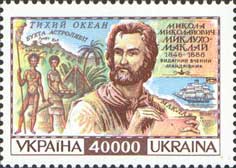
Early Russian Ethnographer in New Guinea
AnthroBase contains the following profile of an ethnographer who beat Malinowski to New Guinea by several decades.
Miklukho-Maklai, Nikolai Nikolaevich (1846-1888)
Russian anthropologist and explorer, acknowledged as the father of Russian ethnography. In 1871-72, Miklukho-Maklai did 15 months of continuous fieldwork on the Northern coast of New Guinea [in present-day Madang Province], where he pioneered methods that would only gain wide acceptance 40-50 years later, after Malinowski's fieldwork. Throughout his life, Miklukho-Maklai identified strongly with the people he studied, and he several times spoke out in their defence against colonialist powers. He laid the groundwork of the rich tradition of 19th century Russian ethnography, which continued well into Soviet times--until it was destroyed in Stalin's purges in the 1930s-50s.

24 February 2004
The Legal Status of the Japanese Wife, 1915
According to "The New Japanese Civil Code" by Professor N. Hozumi, the present Civil Code proceeds upon the equality of the sexes, and makes no distinction between men and women in their enjoyment of private life so long as a woman remains single. She may become the head of a house and exercise authority as such. She may exercise parental authority over her child if her husband is dead. She may adopt children either alone, when she is single or a widow, or in conjuction with her husband when married. She may make any contract or acquire or dispose of any property in her own name, provided she remains single.SOURCE: "The Legal Status of the Japanese Wife," by A. Caroline Macdonald, in The Christian Movement in the Japanese Empire, including Korea and Formosa, a Year Book for 1915 (Conference of Federated Missions, Japan, 1915), pp. 324-325.
When she marries, however, she enters the class technically called "incapacitated persons" treated of in Section 2 or Chapter I of the Civil Code. Under this section are four classes--minors, incompetent persons, quasi-incompetent persons and wives, or more explicitly, as it is explained under the "meaning of capacity," "such persons as minors, wives, lunatics, and spendthrifts do not possess complete capacity." A touch of nature makes the whole world kin! The next paragraph is still more illuminating.
Under the heading "Reasons for protecting incompetent persons," we find, "minors are protected because of the insufficient development of their intelligence; incapacitated persons are protected because they are, like lunatics and idiots, intellectually deformed; and quasi-incompetent persons are protected because they are either physically deformed or intellectually imperfect, like the blind, the deaf, the dumb, and spendthrifts; while wives being bound to follow their husbands, the rights of the latter are protected in order to maintain the peace of the household."
In sharp contrast are the presuffrage wives of the Southern Baptist Convention missionaries listed on p. 611 of the same work, all of whom appear either to be named Wanda, Wendy, Wilhemina, Wilma, Winifred, and the like--or else not to be worth naming:
Bouldin, Rev. G. W. & W., Tokyo
Clarke, Rev. W. H. & W., (A)
Dozier, Rev. C. K. & W., Fukuoka
Medling, Rev. P. P. & W., (A)
Mills, Mr. E. O. & W., Fukuoka
Ray, Rev. J. F. & W., Shimonoseki
Rowe, Rev. J. H. & W., Nagasaki
Walne, Rev. E. N., D.D. & W., Tokyo
Willingham, Rev. C. T. & W., Kokura
The Omi Mission in Japan, 1915
February 1915, the tenth anniversary of the arrival in Hachiman of Mr. W. M. Vories, marked the beginning of the second decade of the Omi Mission.SOURCE: "The Omi Mission," by W. M. Vories, in The Christian Movement in the Japanese Empire, including Korea and Formosa, a Year Book for 1915 (Conference of Federated Missions, Japan, 1915), pp. 136-137.
The distinctive features of this Mission consist in its being financially self-supporting; undenominational--advocating and practising co-operation in all Christian efforts; administered entirely on the field; international--having voluntary supporters in America, Europe, and Japan, and both American and Japanese workers on equal terms, the general secretary this year being Japanese; rural from choice and conviction; aimed at the establishment of a model Kingdom of God, rather than at individual conversions alone; many-sided in its approach--preaching, Sunday Schools, railway and Student Y.M.C.A., with hostels, farm, motor cruiser (Galilee Maru) on Lake Biwa, physical work in the embryo antituberculosis camp, two monthly publications, newspaper evangelism, loan library of evangelistic books, many types of women's work, and architectural office--for support and for training self-supporting mission workers; and finally, in its compromising a practical Laboratory of Mission Methods, where new lines of evangelistic and institutional effort are being tried out--and the results open to any mission in the Orient.
Beginning without resources and with only one green young worker in 1905, the Mission numbered in 1914 thirty workers, eight of whom were Americans.
The first ten years were marked by the complete alteration of the attitude of the community, from that of open and violent opposition and persecution to open and cordial favour; the building up of a staff of native workers--which is the hope of any mission enterprise; and the crystalization of aims and methods adapted to peculiar conditions, after experimentation.
The direct achievements, though sounding well in report, are, we trust, merely suggestions of real harvesting in the next decade.
23 February 2004
Syncretism vs. Hybridity vs. Creolization
The November 2003 issue of The Journal of Asian Studies (vol. 62, no. 4) contains a review by Tom Havens of the book, The Age of Creolization in the Pacific: In Search of Emerging Cultures and Shared Values in the Japan-America Borderlands, edited by Takeshi Matsuda (Hiroshima: Keisuisha, 2001). The book offers an interesting application of the notion of creolization. The following extract is from the review, which quotes from two chapters by David Blake Willis.
Long ago, the discourse on Japan's relations with the West emphasized cultural assimilation or syncretism. In the 1950s, Katô Shûichi recast the interaction as hybridity--still a powerful concept in literary and cultural criticism, although Willis believes Katô's formulation continues "to privilege a Japanese essence" (p. 6). As anthropologists and world historians use the term, "creolization" is a dynamic, interactive process based on "more even-handed horizontal relations" than in the somewhat static notion of hybridity. Creolization involves "a leveling and a borrowing that is two-way," creating "a new shared culture" that is "open-ended, eclectic, flexible, and mobile" (p. 6). Creolization facilitates transnational and transcultural (rather than international or intercultural) synergies, thus de-emphasizing states and national communities as units of analysis. Simultaneous multiple processes of creolization in various world regions today show that, "the globalization of culture is not the same as its homogenization" (p. 23)....EXEGESIS: Assimilation models imply you either remain who you are beneath the layers of outside influences (good, unless you were bad to begin with), or you lose your soul and become someone else (bad, unless you were bad to begin with). Hybridity models allow "in-betweeners" and "half-castes" but also imply the existence of purity at the cultural poles. For most people, I suspect (not me! not me!), purebreds are willy-nilly superior to mongrels, whether we're talking dogs, or cultures, or cultures gone to the dogs. Creolization models acknowledge the creation of uniquely new structures, with their own internal consistencies, arising out of a mixture of cultural (or linguistic) components, but shaped both by universal patterns and by new functions that none of the old structures adequately served.
Willis offers an empirical chapter on the transcultural experiences of creole "JAmericans" educated at CA [my alma mater!], a well-known international school in Kobe barely masked as "Columbia Academy." He argues that cultural, not necessarily genetic, hybridity often leads to true creolization, concluding hopefully that "Pacific Creoles are the cross-fertilizing currents of new directions, the lubrication for the global cultural landscape" (p. 195).
The Blogmenbashi
His Excellency, the Almighty, the All-Knowing, the Glorious, the Peerless, the Sublime President Sapurmurat Niyazov of Turkmenistan appears to have started his own blog, The Blogmenbashi. Read, O Mortals, and Imbibe the Wisdom! Study the Ruhnama and All will be Revealed!
(We still need him, We still feed him, Now he's sixty-four--as of February 19.)
Over the transom via The Ventilator
(We still need him, We still feed him, Now he's sixty-four--as of February 19.)
Over the transom via The Ventilator
Motherland Defender's Day and Chechen Deportation Anniversary
The promising new blog SiberianLight notes a poignant pair of anniversaries on 23 February 2004:
Today is the 60th anniversary of Stalin's deportation of the entire Chechen nation. Ingushetians were also deported, along with the populations of 10 other nations (approximately 1.4 million people) thought to be enemies of the state during World War II. Their exile lasted for more than ten years until Khruschev allowed them to return home after Stalin's death....Read the whole blogpost and check out a bright outlier in the far north.
Today is also Motherland Defender's Day (previously known as Army Day), dedicated to the memories of those who have fought for the Soviet and Russian armies, and their heroic efforts defending the Motherland. Spare a thought for those Chechens who continued to fight in the Soviet Army even after the deportation of their families ...
22 February 2004
Morobe Field Diary, July 1976: ELCONG Sunday
The kids at school in Kuwi were hungry and ELCONG Sunday was coming up so Friday Mr. & Mrs. S. & last daughter & I paddled over to pay a visit. ELCONG Sande commemorates the coming of the Gutnius to New Guinea, i.e., the founding of the Evangelical Lutheran Church of [Papua] New Guinea. The Gutnius was first brought to the area by Johann Flierl [who could hardly have had a more unpronounceable name in an area where few of the local languages distinguish either /f/ from /p/ or /r/ from /l/], a great huge bearded German from Neuendettelsau [in Bavaria] who established himself at Finschhafen ["Fints" at the eastern end of the Huon Peninsula] in 1886 and gradually, as his numbers increased, established mission stations at Salamaua (Kela), Lababia and Kuwi (later relocated to Siboma) among other places. Fortunately they had already begun work in Yabem or they would have had to work in Kela, whose speakers inhabit Kela, Lababia and Kuwi. [Though fairly closely related to Jabêm and Bukawa, Kela has much more severely eroded morphology and is one of the few local languages to phonemically distinguish nasal from oral vowels.]
Three men told the stories of how the Gutnius came to Kuwi, Siboma & Paiawa [whose language is non-Austronesian, thus not related to the other local languages in the Jabêm Circuit]. But they told it in reverse chronological order that briefly threatened to be set aright. The Paiawa guy, who is a relative of the kaunsil's, acted out part of the story about a guy who planted taro according to the Gutnius (not accompanied by traditional magic) and, not impressed with the lack of immediate results (à la Jack and the Beanstalk I guess), angrily threw the 'black mission[ary]'s' church bell into the sea. The Paiawa man had apparently been around to hear the story from people who witnessed the first encounter themselves. The Kuwi & Siboma storytellers were less histrionic and were repeating stories that had been told to them. The Kuwi man told how the Kuwi [people] were slow to accept the mission; they mostly ignored it so it didn't take root for some time. Also their local convert and lay missionary had a shakey grasp on Yabem which the storyteller illustrated by giving his pronunciation of Apômtau as [abomdou]. The Siboma guy got a chance to mention the mission school that used to be at Siboma. Evidently it was after mission contact that they moved from the old village in the next cove to the present site, which is a good place but not so easily defensible [from the sea].
The school kids enacted the arrival of Flierl in a decorated canoe. The guy playing Fl. dressed in white shirt & trousers, white plastic helmet and wore a long beard (actually a Standard 6 Siboma boy). All sang a singsing taught them by the 'meri tisa' ['woman teacher'] we usually stay with when we visit Kuwi. She accompanied them on a hand drum with lizard skin top tuned by rocks or something [actually beeswax] fastened strategically on the playing surface. [The kaunsil was especially supportive and soliticitous toward the meri tisa, who was also an outsider, as he had been during his own long years as a schoolteacher.]
Some young folks from Kuwi acted out the story of the Good Samaritan dressed in modern conception of Biblical garb.
The service, stories and plays (called 'piksa' by older pidgin speakers and so written in the program) were all in Tok Pisin except for the Yabem songs. The commemoration service had locally composed Yabem songs, the regular service had translations of German. [For the difference, see Morobe Field Diary, June 1976: Naive Ethnomusicology.]
A special collection was taken up for ELCONG Sande by each village beforehand. The aim was one Kina from each Kristen memba. Siboma came up with K59, Paiawa with K41, Buso with K44, and Kuwi I think had K49 with the schoolteachers contributing K7. I suspect those numbers tell more about the cash income of the various villages [i.e., how many relatives they have working elsewhere] than about the number of Kristen members or their fervor.
An afterchurch circuit meeting took up the afternoon. It was conducted in Tok Pisin and Yabem in about equal portions. I've gotten so I can hear a number of things in Yabem now. It's nearly as easy as Siboma, especially since I got a little mimeo on some grammar basics of Yabem [the last time I was in Lae].
Three men told the stories of how the Gutnius came to Kuwi, Siboma & Paiawa [whose language is non-Austronesian, thus not related to the other local languages in the Jabêm Circuit]. But they told it in reverse chronological order that briefly threatened to be set aright. The Paiawa guy, who is a relative of the kaunsil's, acted out part of the story about a guy who planted taro according to the Gutnius (not accompanied by traditional magic) and, not impressed with the lack of immediate results (à la Jack and the Beanstalk I guess), angrily threw the 'black mission[ary]'s' church bell into the sea. The Paiawa man had apparently been around to hear the story from people who witnessed the first encounter themselves. The Kuwi & Siboma storytellers were less histrionic and were repeating stories that had been told to them. The Kuwi man told how the Kuwi [people] were slow to accept the mission; they mostly ignored it so it didn't take root for some time. Also their local convert and lay missionary had a shakey grasp on Yabem which the storyteller illustrated by giving his pronunciation of Apômtau as [abomdou]. The Siboma guy got a chance to mention the mission school that used to be at Siboma. Evidently it was after mission contact that they moved from the old village in the next cove to the present site, which is a good place but not so easily defensible [from the sea].
The school kids enacted the arrival of Flierl in a decorated canoe. The guy playing Fl. dressed in white shirt & trousers, white plastic helmet and wore a long beard (actually a Standard 6 Siboma boy). All sang a singsing taught them by the 'meri tisa' ['woman teacher'] we usually stay with when we visit Kuwi. She accompanied them on a hand drum with lizard skin top tuned by rocks or something [actually beeswax] fastened strategically on the playing surface. [The kaunsil was especially supportive and soliticitous toward the meri tisa, who was also an outsider, as he had been during his own long years as a schoolteacher.]
Some young folks from Kuwi acted out the story of the Good Samaritan dressed in modern conception of Biblical garb.
The service, stories and plays (called 'piksa' by older pidgin speakers and so written in the program) were all in Tok Pisin except for the Yabem songs. The commemoration service had locally composed Yabem songs, the regular service had translations of German. [For the difference, see Morobe Field Diary, June 1976: Naive Ethnomusicology.]
A special collection was taken up for ELCONG Sande by each village beforehand. The aim was one Kina from each Kristen memba. Siboma came up with K59, Paiawa with K41, Buso with K44, and Kuwi I think had K49 with the schoolteachers contributing K7. I suspect those numbers tell more about the cash income of the various villages [i.e., how many relatives they have working elsewhere] than about the number of Kristen members or their fervor.
An afterchurch circuit meeting took up the afternoon. It was conducted in Tok Pisin and Yabem in about equal portions. I've gotten so I can hear a number of things in Yabem now. It's nearly as easy as Siboma, especially since I got a little mimeo on some grammar basics of Yabem [the last time I was in Lae].
21 February 2004
Southeast Asia Picture Archive
Anyone interested in Southeast Asia who wants to do some online sightseeing will enjoy browsing through the huge picture archive of the Center for Southeast Asian Studies at the University of Hawai‘i. Indonesia, the Philippines, and Vietnam are particularly well represented, but there are also pictures from Burma, Cambodia, Laos, Malaysia, Singapore, and Thailand.
Tonga court jester 'to pay $1m'
The BBC reports that "Tonga's former court jester has agreed to pay $1m to settle a legal dispute with the Pacific state, lawyers for the ex-jester have told AFP news agency."
Head Heeb has been tracking other recent developments in the sad decline of this anachronistic kingdom; and Peter Wagner's interview with Tongan Prince Ulukalala Lavaka Ata in the Pacific Islands Report offers another perspective on current political tensions among Tongans.
Court jesters are a very rare breed these days...."It's good to be the king," quoth the jester Mel Brooks, but it's no joke for those who have to endure the whimsical rule of doddering despots and their court favorites.
The island nation has for almost two years accused the king's former jester - American national Jesse Bogdonoff - of mismanaging a $26m trust fund. Tonga alleged Mr Bogdonoff invested unwisely and took inflated commissions. But they have now come to an out of court settlement under which neither side has to admit any liability....
The row centred around Tonga's claim that Mr Bogdonoff, who says he is the world's only court jester, cheated King Taufa'ahau Tupou IV and his government out of the money the country made from selling citizenship to Hong Kong Chinese people ahead of the 1997 handover of the former British colony to Chinese rule....
The scandal is said to have caused great anguish for Tonga's 85-year-old King, who reigns over 100,000 people across 170 coral islands in the South Pacific.
Head Heeb has been tracking other recent developments in the sad decline of this anachronistic kingdom; and Peter Wagner's interview with Tongan Prince Ulukalala Lavaka Ata in the Pacific Islands Report offers another perspective on current political tensions among Tongans.
20 February 2004
Morobe Field Diary, July 1976: Going Fishing
Yesterday was rainy so I decided to accompany the fishermen. My biking poncho kept me warm and dry for the most part and the clouds kept the sun off. But the wind and rain made it a lousy day for fishing. In the afternoon it cleared up some and, while I stayed aboard the [M.V.] Sago, some people came up with respectable catches. One fellow had a big fish (probably 5 lbs) bitten off at the gills by a shark as he was pulling it up. Another fellow caught a small shark and I saw another small one in the water (small = 2-3'). I had no desire to swim in those waters.
We fished around the islands offshore where the water is deep and most of the catch was (I think) red snapper (or red emperor] or various snappers [or sea perch, Lutjanus spp.] with sea bass [or rock cod, Epinephelus spp.] (called 'big mouth' in Tok Pisin) making up most of the remainder. The fishermen are paid 10 toea [= 0.10 K(ina)] a pound; the Sago sells them in town for 30 toea a pound and the retailer sells the fish (fresh or frozen depending on how long after the boat gets in you buy it) for 75 toea/lb. Makes American dairy marketing look pretty decent. The boat's crew cleans and weighs the fish and must be paid and then there's the gasoline and boat upkeep. Some men worked all day yesterday for 40 toea. The maximum earned was about K1.40 and the minimum 0 toea. Evidently a good day's fishing would yield about K1.00 in cash per person. So a good steady fisherman (which few are) could earn about K4-5/wk at most.
Today I stayed here because it looked to be too sunny early this morning when all went out to the island where many left their canoes yesterday. And sure enough it's a scorcher. Good for airing out the things left in my room when I was stuck in Lae.
Since the kaunsil had a lousy day fishing I suspected he might break open the case of beer I brought him last nite and he did and he & I and his son drank about a 6 pack, each getting pleasantly tipsy and storytelling. A wilder party was going on kitty-cornered from us: singing, laughing, music inside and a lot of beer bottles lying on the beach later. We put our beer on the ice in the Sago first so it was quite good.
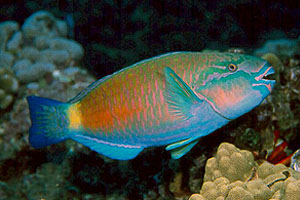
I've gotten fascinated by the little Fishes of Hawaii book that I brought with me (by Gar Goodson). Apparently a large number of fish [especially wrasse and parrotfish] go thru color & sex changes that at first had scientists fooled into giving them 360 species names (in parrotfishes for instance) when there were no more than 80 or so going through their changes.

We fished around the islands offshore where the water is deep and most of the catch was (I think) red snapper (or red emperor] or various snappers [or sea perch, Lutjanus spp.] with sea bass [or rock cod, Epinephelus spp.] (called 'big mouth' in Tok Pisin) making up most of the remainder. The fishermen are paid 10 toea [= 0.10 K(ina)] a pound; the Sago sells them in town for 30 toea a pound and the retailer sells the fish (fresh or frozen depending on how long after the boat gets in you buy it) for 75 toea/lb. Makes American dairy marketing look pretty decent. The boat's crew cleans and weighs the fish and must be paid and then there's the gasoline and boat upkeep. Some men worked all day yesterday for 40 toea. The maximum earned was about K1.40 and the minimum 0 toea. Evidently a good day's fishing would yield about K1.00 in cash per person. So a good steady fisherman (which few are) could earn about K4-5/wk at most.


Today I stayed here because it looked to be too sunny early this morning when all went out to the island where many left their canoes yesterday. And sure enough it's a scorcher. Good for airing out the things left in my room when I was stuck in Lae.
Since the kaunsil had a lousy day fishing I suspected he might break open the case of beer I brought him last nite and he did and he & I and his son drank about a 6 pack, each getting pleasantly tipsy and storytelling. A wilder party was going on kitty-cornered from us: singing, laughing, music inside and a lot of beer bottles lying on the beach later. We put our beer on the ice in the Sago first so it was quite good.

I've gotten fascinated by the little Fishes of Hawaii book that I brought with me (by Gar Goodson). Apparently a large number of fish [especially wrasse and parrotfish] go thru color & sex changes that at first had scientists fooled into giving them 360 species names (in parrotfishes for instance) when there were no more than 80 or so going through their changes.
Former Soviets Left Behind in Afghanistan
The Argus links to a poignant story on IWPR about Soviet soldiers who remained behind in Afghanistan.
On February 15, 1989, General Boris Gromov was officially the last Soviet soldier to stand on Afghan soil before he crossed the Termez bridge into the USSR, drawing a close to the long and brutal campaign that Russian politicians were later to call "a tragic mistake".
But Gennady, and more like him, were still there. As Russians, Ukrainians and the rest began shutting off from the Afghan war as a nightmare best forgotten, those who were left behind faded from memory, too.
Many would find it hard to go back – some were deserters, while others converted to Islam after being captured and held by the mujahedin. In the interim, the Soviet Union they had known collapsed into 15 different countries.
A few achieved some fame – notably the two Russian citizens known as Mohammadi and Islamuddin who served as bodyguards to the famous commander Ahmad Shah Massoud. As late as 1996, they were rumoured to be at the front line, fighting with Massoud's Northern Alliance against the Taleban.
Since then the two men are said to have left Afghanistan, going back home to Russia. But others remain.
During a recent trip to Kunduz, a taxi driver tipped me off about someone called Ahmad, a former Soviet soldier now living as an Afghan.
This was far more than a rumour – I was given the address of the building where he rents a small room with his family.
Only half an hour later, I was sitting in a local store talking to a man in the typical flat "pakol" hat, with all the mannerisms and dialects of a native Afghan – but still looking like a Russian.
He looked so intimidating that I didn't dare speak to him in Russian, switching over only after an initial conversation in Dari.
When I asked him what name his parents had given him, his face remained immobile as he whispered an Islamic invocation.
But after a long conversation in the dark, mud-walled room, Ahmad relaxed, and gradually revealed some of the characteristics of the young man he had once been – Private Alexander Levenets. The incongruousness of the situation was accentuated by the music he put on – Alexander Rosenbaum's Soviet-era ballads of army life.
The 19-year-old Alexander, from the Ukrainian village of Melovadka, joined the Soviet army in April 1983. He thought his troubles were over, that he had a ticket out of a hard life of providing for his blind widowed mother and an elder brother with diabetes.
At first army life was good, as his unit was transferred around the USSR and eventually deployed at an airbase in Kunduz.
But things took a turn for the worse as – like many Soviet conscripts – he was subjected to beatings and other forms of humiliation by other, more senior soldiers in his unit. Eventually he could bear it no longer, and deserted.
One cold October night in 1984, Alexander fled into the night. His life was saved by a kindly old Afghan, who took pity on him and allowed him to hide at his house.
The man introduced the deserter to some mujahedin, who fortunately for him belonged to one of the more moderate factions. They listened sympathetically to his story, and treated him with a respect he had not had from his countrymen.
"I stayed in the group," he said. "And after a month, I accepted Islam."
So Alexander became Ahmad, serving under guerrilla commander Omir Ghulam – but not expected to take up arms against the army he had once served in. The Afghans' acceptance of him grew into respect as he became a more observant Muslim than most of them.
19 February 2004
Times & Seasons: A Mormon Blog
I grew up among both missionaries and heathens, and still retain what I hope is a healthy respect for both camps, so long as the methods of the missionaries are not coercive and (not or) the reaction of the heathens is not violent. I'm interested in different religious (and irreligious) perspectives, so long as they are reasonable and (not or) tolerant of alternative views. (I don't regard "antireligious" as a synonym for either "tolerant" or "enlightened.") In that spirit, I'd like to recommend for those with religious interests a fairly new Mormon group blog Times and Seasons. I have no interest in adhering to Mormonism or (substitute your religion here) ________, but I find that Mormon perspectives (mea culpa: I first wrote "a Mormon perspective") sometimes challenge my facile assumptions about such issues as legislating morality, or about how much religion shapes political views, or about who qualifies to be counted as a minority or as part of a diaspora, and so forth. Here's a sample of some of the issues discussed on Times and Seasons, "quite possibly the most post-liberal, yet acclaimed, onymous Mormon group blog in history." The comment sections are generally lively and civil.
Don't Drink, Don't Smoke
Don't Drink, Don't Smoke
Perhaps nothing outwardly sets Mormons apart from the rest of society more than our adherence to the Word of Wisdom. And for insiders, as someone once said on this site, the Word of Wisdom just *feels* important. I'm far more likely to offend the Sabbath day, forget a fast, skip hometeaching, use inappropriate language, break the speed limit, or commit dozens of other sins of omission and commission than I am to join my friends sipping tea at a Chinese restaurant....Contentment
--The WoW replaced polygamy as something that sets us apart and makes us a peculiar people. Feeling like an outsider is, in some ways, integral to Mormon culture, and WoW adherence fosters this feeling.
As I drove home from work today, I heard an announcement for an upcoming program on Wisconsin Public Radio dealing with the topic of contentment. Implicit in the announcement was an assumption that contentment is a worthy life goal. This caught me off guard. Honestly, it has never occurred to me to pursue contentment. I'm not sure I even know what it means.Legislative Judgments of Morality
Randy Barnett has an interesting post up at the Volokh Conspiracy, giving a persuasive argument about why legislative judgments of morality are not a particularly good basis for legal punishments or restrictions. Barnett makes the very interesting initial assertion that: "A legislative judgment of 'immorality' means nothing more than that a majority of the legislature disapproves of this conduct."(Blog) Marital Demographics
It suddenly occured to me last night that our group's marital homogeneity is rather striking. Consider: We have eight bloggers; we live in different locations; we come from different professions; we have different political beliefs; we find a lot to differ on.Polygamists in the Pen
We are all married and all have children.... This makes us unusual in the world. At work, school, or social groups, there is often a sizable single contingent. Many people are happy to avoid marriage altogether, and even married colleagues are unlikely to begin having children very soon.
This is a photograph of George Q. Cannon, then First Counselor in the First Presidency to John Taylor, and other polygamists taken while Cannon was incarcerated for unlawful cohabitation (polygamy) during the 1880s....Resenting Our Baptism of Your Dead
Comment: "Group photos of men incarcerated for polygamy were extremely common, and were displayed as a symbol of loyalty to the Gospel. Interestingly, although there were women incarcerated as part of the anti-polygamy raids, I have never seen any photos of them. The few who were imprisoned were jailed for either contempt of court (refusal to testify against fellow Saints) or fornication. The charge of fornication, in the 19th century, was most often used to punish prostitutes. The few inditements against polygamist women were self-conscious attempts by federal officials to brand Mormon women as whores. This (along with the relative rarity of such cases) may account for the lack of photographs."
Comment: "I had exactly this discussion .... Everyone seemed satisfied that their people (everyone there was Jewish or married to a Jew, or me) would be able to reject the baptisms for themselves. Plus, one woman noted, it was a great way to boost your membership numbers. I said yeah, but it doesn't help your attendance percentages."
Tribute to Iranian and Iraqi Bloggers
I'd like to pay tribute here to the multitude of Iranian bloggers (aka Weblogestan) many of whom will be blogging their phony elections instead of voting on February 20, thanks in no small measure to pioneer and blogfather Hossein Derakhshan (aka Hoder), born in Tehran, but resident in Toronto since December 2000.
And I'd like to pay equal tribute to the smaller but growing numbers of Iraqi bloggers, pioneered by Salam Pax before the invasion and many blogfathered by Zeyad afterwards, who have been recording the successes and failures of both the occupation and the international media.
Here's a sense of how revolutionary the message of the new medium has become in Iran, from Persianblogger's recent essay about Weblogestan:
And I'd like to pay equal tribute to the smaller but growing numbers of Iraqi bloggers, pioneered by Salam Pax before the invasion and many blogfathered by Zeyad afterwards, who have been recording the successes and failures of both the occupation and the international media.
Here's a sense of how revolutionary the message of the new medium has become in Iran, from Persianblogger's recent essay about Weblogestan:
The final example I will discuss is Hossein Derakhshan, the person who sparked off the vulgarity debate in the first place with his piece about the inherent contradictions between Islam and human rights. The work of Derakhshan, or Hoder, is a prime example of defiance against the cultural hegemony of the Iranian intellectual class. He can even be seen as trying to establish a new kind of cultural hegemony in the blogosphere; one that values self-expression, individualism, and even hedonism against any kind of traditional authority [15] . As far as language is concerned, Hoder says his blog is the "scratchpad of my mind" (2003b) and his language "is consciously messy" (2003a). He prefers to spend his time writing a new entry instead of going back over what he has already written to correct possible grammatical or spelling mistakes (ibid). Additionally, he has no qualms about coining new terms (like donbaalak for trackback, and linkdooni for linkdump – both blog-related terms) without feeling any need to consult a linguistic authority, and is especially good at putting carnivalesque twists on familiar expressions, like "aytiollaahi" [16] , which combines "IT" (information technology) and "hezbollaahi" and refers mockingly to religious conservative technocrats, and "fakhr-ol internet hazrateh muvebel taaip (saad)" [17] , which both expresses extreme devotion for MovableType (a prominent blogging tool) and pokes fun at the Prophet Muhammad (or his devotees at least) by making use of a popular phrase that is used to praise him. Interestingly enough, Hoder does not share the same attitude towards the English language as he does towards Persian. Being an undergraduate student at the University of Toronto, he has bemoaned several times the difficulties of writing essays in English, and he once linked to an online resource with guidelines on writing well in English, which he described as "very useful". Hoder's approach to cultural hegemony, then, is highly differentiated between Persian and English speech communities: whereas he directly assaults authority in the former, he feels a need to assimilate in the latter.UPDATE: Click here for English translations of live election reports from Persian blogs.
Mars Rover Blog
Here's a tribute to the farthest outlier of all, the Mars Rover Blog. Sample transmissions:
- I beat my own driving record: "80 feet in a single day!"
- Look Ma, no NASA controllers: "I think I proved that I can take care of myself over here."
18 February 2004
The Sole Surviving Umayyad Heir Enters al-Andalus, 755
Once upon a time in the mid-eighth century, an intrepid young man named Abd al-Rahman abandoned his home in Damascus, the Near Eastern heartland of Islam, and set out across the North African desert in search of a place of refuge. Damascus had become a slaughterhouse for his family, the ruling Umayyads, who had first led the Muslims out of the desert of Arabia into the high cultures of the Fertile Crescent. With the exception of Abd al-Rahman, the Umayyads were eradicated by the rival Abbasids, who seized control of the great empire called the "House of Islam." ... The prince's mother was a Berber tribeswoman from the environs of today's Morocco, which Arabs had reached some years before. From this place, which the Muslims called the Maghrib, the "Far West," the descendants of the Prophet and his first followers had brought women such as Abd al-Rahman's mother back east as brides or concubines for the highest-ranking families, to expand and enrich the bloodlines....SOURCE: The Ornament of the World: How Muslims, Jews, and Christians Created a Culture of Tolerance in Medieval Spain (Back Bay Books, 2002), by María Rosa Menocal, pp. 5-11
Beginning in 711, the Muslims--here the Berbers under the leadership of the Syrian Arabs--had pushed across the small sliver of sea that separates Africa from Europe, the Strait of Gibraltar, to the place the Romans had called Hispania or Iberia....
Abd al-Rahman followed their trail and crossed the narrow strait at the western edge of the world. In Iberia, a place they were calling al-Andalus in Arabic, the language of the new Muslim colonizers, he found a thriving and expansive Islamic settlement. Its center was on the banks of a river that wound down to the Atlantic coast, the Big Wadi (today, in lightly touched up Arabic, the Guadalquivir, or Wadi al-Kabir). The new capital was an old city that the former rulers, the Visigoths, had called Khordoba, after the Roman Corduba, who had ruled the city before the Germanic conquest. It was now pronounced Qurtuba, in the new Arabic accents heard nearly everywhere. The governor of that amorphous and fairly detached frontier "province" was understandably taken aback by the unexpected apparition of this assumed-dead Umayyad prince. Out in these hinterlands, after all, so far from the center of the empire, the shift from Umayyad to Abbasid sovereignty had, until that moment, made little difference in local politics....
The vexed emir of al-Andalus saw at least some of the handwriting on the wall and offered the young man permanent refuge in the capital city as well as his daughter's hand in marriage. But the grandson of the caliph, the successor to the Prophet and the supreme temporal and spiritual leader of the Islamic world, could not be so easily bought off. Abd al-Rahman assembled forces loyal to him, Syrians and Berbers combined, and one day in May 756, a battle just outside the city walls of Cordoba decisively changed the face of European history and culture. Abd al-Rahman easily defeated his would-be father-in-law and became the new governor of this westernmost province of the Islamic world....
But this young man was, for nearly everyone in these outer provinces, the legitimate caliph, and he was not about to spend the rest of his life in embittered exile.... Although it would be two more centuries before one of his descendants actually openly declared that Cordoba was the seat of the caliphate, al-Andalus was transformed and now anything but a mere provincial seat....
This book tells the story of how this remarkable turn of events, which actually had its origins in the heart of the seventh century in what we call the Near East, powerfully affected the course of European history and civilization. Many aspects of the story are largely unknown, and the extent of their continuing effects on the world around us is scarcely understood, for numerous and complex reasons. The conventional histories of the Arabic-speaking peoples follow the fork in the road taken by the Abbasids. At precisely the point at which the Umayyad prince sets up his all-but-declared caliphate in Europe, the story we are likely to be told continues with the achievements of the Abbasids, who did indeed make Baghdad the capital of an empire of material and cultural wealth and achievement....
The very heart of culture as a series of contraries lay in al-Andalus .... It was there that the profoundly Arabized Jews rediscovered and reinvented Hebrew; there that Christians embraced nearly every aspect of Arabic style--from the intellectual style of philosophy to the architectural styles of mosques--not only while living in Islamic dominions but especially after wresting political control from them; there that men of unshakable faith, like Abelard and Maimonides [Musa ibn Maymun] and Averroes [Ibn Rushd], saw no contradiction in pursuing the truth, whether philosophical or scientific or religious, across confessional lines.
Morobe Field Diary, June 1976: Fieldworker's Frustration
Before setting out for Karsimbo I felt the first severe case of fieldworker's frustration. I was tired of being unignored, or scaring kids, of being hailed for doing the least bit of work. And though my reports and dictionaries were proceeding well I realized my speaking/hearing ability was a disappointment to both me and the rest of the village. Partly it was the necessary swing back from total communication and little work to lots of work and little communication. I didn't take my work to Karsimbo and spent more time communicating and doing things I could describe to people in the village that they didn't already know about beforehand. I talked about my solo walk up the mountain to see if I could see Kui. I ended up seeing Salamaua Peninsula and the mountain ranges behind Lae (or at least their clouds) but not Kui because the angle wasn't right. And I didn't get lost (as I had been warned I might). I followed the huge caterpillar swaths [logging roads] and only turned back when the road I was following was overgrown too much and I heard a not unsizeable creature 'break bresh'. I came down the mountain feeling quite invigorated and rehearsing my description of my excursion, finding, a little to my surprise, that I could say about all I wanted to say.
Back at camp my hosts had gone en masse to bring back a pig a guy with us had killed and so I went over to another group who had just finished fighting saksak [pounding sago] and told [them] I had climbed the mountain, not seen Kui but seen Salamaua, heard plenty of hornbills and not got lost, all in Binga N. and in return was offered betelnut, talked about a bit and informed that now I had heard Binga N. finish. It was just the sort of success I needed to bolster my spirits and encourage my teachers.
I came back to Siboma telling stories of the two pigs that guy killed--one with a spear made from a speargun--and of beating kundu [sago], which is not waitman's work.
The last day there they forced me not to help with a third sago palm they were helping someone else do but on the way back I got the big paddle [not the kid's paddle they gave me on the way there] and paddled like a maniac to dispel my lethargy. I sat in the front where I would affect the steering less and just did most of the power stroking while my mama ('father') and awa ('mother') took turns keeping the canoe on course and paddling. Part of the fun of this kind of fieldwork is getting to readolesce all over again as well as play with kids on their level--all for science of course. So my brief dumps down in which I found myself last weekend are dispelled and I've set aside my dictionary work for a while to start talking more. This weekend I'm in good spirits--partly because I'm heading into Lae for a day or two. And when I get back with my new supplies I will be able to go visiting with more grace (i.e. goods) and confidence. And people are beginning to talk to me in B.N. off the bat now after I began to start every communication in B.N. leaving Tok Pisin for the reserves.
I torture the kaunsil with thoughts of the cold beer waiting for me at the other end of my boat ride. I plan to bring back a case, along with a thousand other items.
Back at camp my hosts had gone en masse to bring back a pig a guy with us had killed and so I went over to another group who had just finished fighting saksak [pounding sago] and told [them] I had climbed the mountain, not seen Kui but seen Salamaua, heard plenty of hornbills and not got lost, all in Binga N. and in return was offered betelnut, talked about a bit and informed that now I had heard Binga N. finish. It was just the sort of success I needed to bolster my spirits and encourage my teachers.

I came back to Siboma telling stories of the two pigs that guy killed--one with a spear made from a speargun--and of beating kundu [sago], which is not waitman's work.
The last day there they forced me not to help with a third sago palm they were helping someone else do but on the way back I got the big paddle [not the kid's paddle they gave me on the way there] and paddled like a maniac to dispel my lethargy. I sat in the front where I would affect the steering less and just did most of the power stroking while my mama ('father') and awa ('mother') took turns keeping the canoe on course and paddling. Part of the fun of this kind of fieldwork is getting to readolesce all over again as well as play with kids on their level--all for science of course. So my brief dumps down in which I found myself last weekend are dispelled and I've set aside my dictionary work for a while to start talking more. This weekend I'm in good spirits--partly because I'm heading into Lae for a day or two. And when I get back with my new supplies I will be able to go visiting with more grace (i.e. goods) and confidence. And people are beginning to talk to me in B.N. off the bat now after I began to start every communication in B.N. leaving Tok Pisin for the reserves.
I torture the kaunsil with thoughts of the cold beer waiting for me at the other end of my boat ride. I plan to bring back a case, along with a thousand other items.
Morobe Field Diary, June 1976: Sago Work
I'm just back from a trip to the former Numbami village of Karsimbo for the purpose of getting a breath of fresh air (kisim nupela win) and getting sago starch (paitim saksak). I had a chance to observe the process of producing edible sago from start to finish so I'll attempt a description.
First a suitable tree [Metoxylon sagu] is selected. One near a stream is best so the pulp won't have to be carried far to wash. A man chops down the tree, which is a thorny son of bitch and the kaunsil borrowed my zori [rubber slippers] to do the job. Then the outer bark is removed with an axe or, less effectively, with a bushknife (busnaip). The men usually do such work but women may participate. It's a matter of practicality, not custom. The inner bark is then stripped in slats with the aid of a siala, a large digging stick used also for making holes to plant taro in the garden--a smaller version is stuck in the ground and used to husk coconuts.
The strips of inner bark are then used to catch the pulp. This leaves the pinkish white inner fibery trunk of the tree ready and waiting submissively for you to hammer the crap out of it with a wanginda, a tool with an adze-like handle and a head of anything from a flat, sharp-edged stone to any old shell casing or length of pipe. The handles vary from child- to man-sized thicknesses. Pounding is not limited to one sex or the other and is the most tiring of the chores associated with kundu/saksak/sago palm. Being unskilled immigrant labor my job is mostly pounding which I do rather effectively after my first attempt in which I broke the head (a huge nut of iron) off one wanginda and blistered my hands badly. It requires some skill to combine chopping a piece off the log and smashing the stuff previously chipped off to a fine enough consistency to yield plenty of powder, kundu ano or 'true sago' [or 'sago essence'], when washed. This time I was permitted to do a third of one medium-sized tree and half of a small one (12-14" diam. 10-12' long).
Meanwhile a man constructs a washing machine [or chute] of a section of the outermost covering [of a sago branch] something like a [huge] stick of celery. In the wide mouth of it, he arranges the coconut webbing to filter the fiber out of the powder as he pours water thru it and turns it and squeezes it. The orange colored water runs down the celerylike [stalk] to a hole thru which it drains into a mat of the leathery husk [sheath] of some tree--people in Yap used something similar to sit on when meeting out in the open and theirs was from the areca palm. The coconut tree webbing and the mat, called yáwanji > yáunji, are the only parts of the washing machine to be reused. The hole is plugged with green fiber that both blocks the water from escaping down the rest of the open tube and conducts it down into the mat. [See more images of sago pounding and washing (scroll down).]
The washed pulp (ulasa) is built up around the edges of the mat for support as it gets fuller. When a lot of sago is a-beating several washers are set up. Only men wash and only women (& children) carry the pulp from tree to washer. When all is washed (-lomosa) the powder, kundu ano, will have settled to the bottom in a heavy pasty mass and the water is then drained off (-lapa tina tomu) ['beat water apart'] and the paste scraped off and shaped into large rectanguloid lumps. Green sago fronds are then laid on the ground and the lumps burnt on top of them with dry fronds (damu meaning both 'torch' and 'dry frond' the two being one). The burnt skin of the lumps (baloga) is sweet and considered a treat. The mat is carefully scraped of all the powder, odd bits being dumped in a pan for the dogs. After that the lumps are carried back with the coconut webbing (gogowa--sorry, this is the tube, nuta is the webbing, the laplap (lavalava) bilong kokonas). Bihain [= later] the kaunsil agrees to put the whole thing on tape for me in Binga Numbami; he practiced a bit just now and I could follow most of it fairly well, having seen it all and catching the right cues here and there.
First a suitable tree [Metoxylon sagu] is selected. One near a stream is best so the pulp won't have to be carried far to wash. A man chops down the tree, which is a thorny son of bitch and the kaunsil borrowed my zori [rubber slippers] to do the job. Then the outer bark is removed with an axe or, less effectively, with a bushknife (busnaip). The men usually do such work but women may participate. It's a matter of practicality, not custom. The inner bark is then stripped in slats with the aid of a siala, a large digging stick used also for making holes to plant taro in the garden--a smaller version is stuck in the ground and used to husk coconuts.
The strips of inner bark are then used to catch the pulp. This leaves the pinkish white inner fibery trunk of the tree ready and waiting submissively for you to hammer the crap out of it with a wanginda, a tool with an adze-like handle and a head of anything from a flat, sharp-edged stone to any old shell casing or length of pipe. The handles vary from child- to man-sized thicknesses. Pounding is not limited to one sex or the other and is the most tiring of the chores associated with kundu/saksak/sago palm. Being unskilled immigrant labor my job is mostly pounding which I do rather effectively after my first attempt in which I broke the head (a huge nut of iron) off one wanginda and blistered my hands badly. It requires some skill to combine chopping a piece off the log and smashing the stuff previously chipped off to a fine enough consistency to yield plenty of powder, kundu ano or 'true sago' [or 'sago essence'], when washed. This time I was permitted to do a third of one medium-sized tree and half of a small one (12-14" diam. 10-12' long).
Meanwhile a man constructs a washing machine [or chute] of a section of the outermost covering [of a sago branch] something like a [huge] stick of celery. In the wide mouth of it, he arranges the coconut webbing to filter the fiber out of the powder as he pours water thru it and turns it and squeezes it. The orange colored water runs down the celerylike [stalk] to a hole thru which it drains into a mat of the leathery husk [sheath] of some tree--people in Yap used something similar to sit on when meeting out in the open and theirs was from the areca palm. The coconut tree webbing and the mat, called yáwanji > yáunji, are the only parts of the washing machine to be reused. The hole is plugged with green fiber that both blocks the water from escaping down the rest of the open tube and conducts it down into the mat. [See more images of sago pounding and washing (scroll down).]

The washed pulp (ulasa) is built up around the edges of the mat for support as it gets fuller. When a lot of sago is a-beating several washers are set up. Only men wash and only women (& children) carry the pulp from tree to washer. When all is washed (-lomosa) the powder, kundu ano, will have settled to the bottom in a heavy pasty mass and the water is then drained off (-lapa tina tomu) ['beat water apart'] and the paste scraped off and shaped into large rectanguloid lumps. Green sago fronds are then laid on the ground and the lumps burnt on top of them with dry fronds (damu meaning both 'torch' and 'dry frond' the two being one). The burnt skin of the lumps (baloga) is sweet and considered a treat. The mat is carefully scraped of all the powder, odd bits being dumped in a pan for the dogs. After that the lumps are carried back with the coconut webbing (gogowa--sorry, this is the tube, nuta is the webbing, the laplap (lavalava) bilong kokonas). Bihain [= later] the kaunsil agrees to put the whole thing on tape for me in Binga Numbami; he practiced a bit just now and I could follow most of it fairly well, having seen it all and catching the right cues here and there.
16 February 2004
Aging Asia
"The impending tempo of population aging in China is very nearly as rapid as anything history has yet seen," says Nicholas Eberstadt in "Power and Population in Asia" in the Hoover Institution's Policy Review, No. 123. "Although China’s population will hardly be as elderly as Japan's by 2025, its impending aging process promises to generate problems of a sort that Japan does not have to face. The first relates to its national pension system: Japan's may be financially vulnerable, but China's is nonexistent."
via Arts & Letters Daily
At this juncture ... sub-replacement fertility is thought to characterize every country and locale in East Asia save tiny Mongolia. In Southeast Asia, Singapore and Thailand are already sub-replacement societies, and Indonesia appears to be rapidly closing in on the replacement fertility level. As for South and Central Asia, Sri Lanka and Kazakhstan are outposts of sub-replacement fertility within the region.Russia's decline is much farther along.
Modern Russia has given the lie to the ameliorative presumption that literate, industrialized societies cannot suffer long-term health declines during times of peace. According to Moscow's official calculations, the country's life expectancy was lower in 2001 than it had been in 1961-62, four decades earlier. For Russia's men, life expectancy had dropped by almost five years over that interim--but female life expectancy was also slightly down over that period. This anomalous circumstance could not be entirely attributed to the deformities of communist rule, for both male and female life expectancy were lower in 2001 than in 1991, the last year of Soviet power....Another looming problem for East Asia is the sex ratio, expressed in terms of the number of males for every 100 females.
In absolute arithmetic terms, this Russian mortality crisis qualifies as a catastrophe of historic proportions. Over the extended period between 1965 and 2001, age-standardized mortality for Russia’s men rose by over 40 percent. Perhaps even more surprising, it also increased for Russia’s women by over 15 percent.
China's tilt toward biologically impossible sex ratios at birth seems to have coincided with the inauguration of its coercive antenatal "one child policy," which was unveiled in 1979. Is Beijing's population control program responsible for these amazing distortions? A tentative answer would be yes--but not entirely. In other Chinese or Confucian-heritage populations where oppressive population control strictures were not in force--Hong Kong, Taiwan, Singapore, South Korea--unnatural sex ratios at birth also emerged in the 1980s and 1990s. In these other spots, the confluence of son preference, low fertility, and sex-selective abortion likewise have distorted the sex ratio at birth--although nowhere so much as in China today. In most of those other locales, moreover, recent data suggest that sex ratios at birth are lower than they were in the early 1990s (Taiwan, South Korea) or even the 1980s (Singapore), while China's rise shows no signs of reversing.... Only two provinces in the entire country--the non-Han regions of Tibet and Xinjiang--reported sex ratios within the biologically normal human range. At the other end, three provinces (Hubei, Guangdong, and Anhui) tabulated child sex ratios of almost 130--while three others (Hainan, Hunan, and Jiangxi) returned with ratios of over 130.So where can we look to balance these trends?
Interestingly enough, the Asian Pacific power with the most strategically favorable profile may be one that we have not yet discussed: the United States.Of course, such population projections always assume that humans will just keep doing what they always do, regardless of changing conditions. Fortunately, most humans have minds capable of adapting their behaviors to new circumstances.
By the UNPD's [United Nations Population Division's] medium variant projections, the United States is envisioned to grow from 285 million in 2000 to 358 million in 2025. In absolute terms, this would be by far the greatest increase projected for any industrialized society; in relative terms, this projected 26 percent increment would almost exactly match the proportional growth of the Asia/Eurasia region as a whole. Under these trajectories, the United States would remain the world's third most populous country in 2025, and by the early 2020s, the U.S. population growth rate--a projected 0.7 percent per year--would in this scenario actually be higher than that of Indonesia, Thailand, or virtually any country in East Asia, China included.
In these projections, U.S. population growth accrues from two by no means implausible assumptions: (1) continued receptivity to newcomers and immigrants and (2) continuing “exceptionalism” in U.S. fertility patterns. (The United States today reports about 2.0 births per woman, as against about 1.5 in Western Europe, roughly 1.4 in Eastern Europe, and about 1.3 in Japan.) Given its sources, such population growth would tend, quite literally, to have a rejuvenating effect on the U.S. population profile--that is to say, it would slow down the process of population aging. Between 2000 and 2025, in these UNPD projections, median age in the United States would rise by just two years (from 35.6 to 37.6). By 2025, the U.S. population would be more youthful, and aging more slowly, than that of China or any of today’s "tigers." (Furthermore, to state the obvious, neither a resurgence of HIV/AIDS nor an eruption of imbalanced sex ratios at birth look to be part of the U.S. prospect over the decades immediately ahead.)
via Arts & Letters Daily
Morobe Field Diary, June 1976: Naive Ethnomusicology
It's Sunday and Friday nite I was expecting to get into town (or leave for town, which means getting in Saturday morning). A bunch of people from the Kui, Siboma and Paiawa church circuit [or parish?] have to go build a house for a big church meeting in September of the Lae or Morobe Parish [or circuit?] so they will use the [M.V.] Sago to carry all and drop them on the way to town, do their business (and me do mine) and pick them up on the way back. So I'm writing letters like mad to mail when I get into town.
The church service reminded me to write something about the music. All songs are in Yabêm and the words are in a hymnal without the notes, only marks indicating repetition [where to repeat]. Some of the songs are translations from German standards and are immediately recognizable from their steady beat, be it fast or slow (usually quite plodding), as it proceeds, Westernly from bar to bar. The others are local compositions with the author's name and place at the bottom and these are recognizable by a rhythm that goes from crescendo to crescendo. They usually build up slowly on the men's voices which carry the low tones [pitch] and gradually pick up the women who usually trail a bit behind the men and carry the crescendo to its peak in high tones [pitch] and at a much greater amplitude since all voices are contributing. The men then beat the women to the beginning of the next cycle, the song often carried by just one person at first then by more and more till the next crescendo peak. So one is a bar and staff rhythm, the other a crescendo to crescendo rhythm. Thus endeth my first attempt at ethnomusicology.
UPDATE: Recommended reading for specialists: Mission and Music: Jabêm Traditional Music and the Development of Lutheran Hymnody, by Heinrich Zahn [1880-1944]. Translated by Philip W. Holzknecht. Edited by Don Niles. Boroko: Institute of Papua New Guinea Studies, 1996.
"This entire work is a fitting tribute to one of the little-recognized--but hardly "unsung"--heroes in the development of Jabêm music and literature." --Oceanic Linguistics 36 (December 1996) (Read full review)
"[Zahn's] feeling for context almost makes him a contemporary of the sociologically oriented ethnomusicologists of today such as for example Thomas Turino." --Oceania Newsletter 21 (September 1998) (Read full review)
The church service reminded me to write something about the music. All songs are in Yabêm and the words are in a hymnal without the notes, only marks indicating repetition [where to repeat]. Some of the songs are translations from German standards and are immediately recognizable from their steady beat, be it fast or slow (usually quite plodding), as it proceeds, Westernly from bar to bar. The others are local compositions with the author's name and place at the bottom and these are recognizable by a rhythm that goes from crescendo to crescendo. They usually build up slowly on the men's voices which carry the low tones [pitch] and gradually pick up the women who usually trail a bit behind the men and carry the crescendo to its peak in high tones [pitch] and at a much greater amplitude since all voices are contributing. The men then beat the women to the beginning of the next cycle, the song often carried by just one person at first then by more and more till the next crescendo peak. So one is a bar and staff rhythm, the other a crescendo to crescendo rhythm. Thus endeth my first attempt at ethnomusicology.
UPDATE: Recommended reading for specialists: Mission and Music: Jabêm Traditional Music and the Development of Lutheran Hymnody, by Heinrich Zahn [1880-1944]. Translated by Philip W. Holzknecht. Edited by Don Niles. Boroko: Institute of Papua New Guinea Studies, 1996.
"This entire work is a fitting tribute to one of the little-recognized--but hardly "unsung"--heroes in the development of Jabêm music and literature." --Oceanic Linguistics 36 (December 1996) (Read full review)
"[Zahn's] feeling for context almost makes him a contemporary of the sociologically oriented ethnomusicologists of today such as for example Thomas Turino." --Oceania Newsletter 21 (September 1998) (Read full review)
Morobe Field Diary, May 1976: An Injured Child
The other day some women came back from their garden with a [c. 3-year-old] kid who had sliced off the top joint of his ring finger. It took some discussion before they asked me for medicine and bandage. I had only some of those sterile gauze pads and bandaids along with disinfectants but nothing to stop the bleeding and felt pretty useless but it turned out they decided to put kambang, the [slaked] lime chewed with betel nut, on as a disinfectant and I have an ample supply of that. I measured some out on my knife blade and put it on the cotton and one guy tied up the bandage. When they took the original bandage off blood shot out of the finger. They said later that the kambang would act as a poultice and when it went to work that nite the kid would not feel in the best of spirits. A doctor came or they took the kid to the doctor in the next village and he gave a penicillin shot and rebandaged the wound and yesterday the guy who did most of the original doctoring came to get my disinfectant powder and some bandaids so the wound seems to be healing all right. Since then I have been of slitely more use in dispensing aspirins, one cold tablet, and bandaids. Next time in town I plan to get more aspirins and some stomach marasin for me. My host's wife gets migraines.
Subscribe to:
Posts (Atom)