20 June 2005

Two Dilemmas: Kosovo in 1999, Vietnam in 1965

When bombing initially failed to change the enemy's policy, the pressures on the president to commit ground troops increased. The president, a politician more interested in the mechanics of domestic reform than in foreign policy, pondered his options. To back off at this point would result in devastating humiliation for the United States, with consequences around the world that could not be foreseen but which might well be severe. To escalate the war by introducing ground troops would be to risk a bloody debacle and a political backlash. Every choice presented the possibility of disaster.

THIS IS A description of the situation that confronted President Bill Clinton in the spring of 1999, after the United States and its NATO allies began bombing Serbia with the goal of forcing Yugoslav dictator Slobodan Milosevic to agree to autonomy for the Albanian ethnic majority in the Yugoslav province of Kosovo. It is also a description of the dilemma of President Lyndon Johnson in the spring and summer of 1965, when the failure of U.S. bombing raids against North Vietnam to dissuade Ho Chi Minh's communist dictatorship from its low-level war against South Vietnam had become apparent. In each case, what was at stake for the United States was its credibility as the dominant global military power and the survival of a regional alliance--NATO in the case of the Balkan war, the Southeast Asia Treaty Organization (SEATO) in the case of the conflict in Indochina. (In fact, SEATO did dissolve, when the United States abandoned Indochina to communist conquest between 1973 and 1975.)

Both Slobodan Milosevic and Ho Chi Minh were communist dictators who manipulated the nationalism of their subjects--Milosevic in the service of his dream of a Greater Serbia dominating the former Yugoslav federation, Ho in the service of the dream of a united Vietnam dominating all of Indochina. Both Milosevic and Ho promoted their goals by supporting guerrilla terror campaigns in other countries. Milosevic armed, supplied, and directed Serb paramilitary units engaged in mass murder and ethnic cleansing in Bosnia, Kosovo, and other parts of the former Yugoslavia; Ho armed, supplied, and directed Viet Cong guerrillas in South Vietnam, Laos, and Cambodia who waged war against South Vietnamese military and police forces and murdered tens of thousands of South Vietnamese officials and civilians. In both cases, the low-intensity wars launched by the communist-nationalist dictators produced tidal waves of refugees. Hundreds of thousands of non-Serbs were forced from their homes in different parts of the former Yugoslavia by Serbian ethnic cleansing. Nearly a million residents of North Vietnam fled Ho Chi Minh's rule in the 1950s, and following the communist conquest of South Vietnam in the 1970s more than two million others risked their lives in fleeing the country. Of the two communist-nationalist leaders, Milosevic was the less tyrannical; his Serbian regime was far less repressive than the government of Ho Chi Minh. The latter was a strict Stalinist dictatorship that tolerated no political or intellectual dissent and executed more than ten thousand North Vietnamese villagers in cold blood in a few months because they were landlords or prosperous peasants and thus "class enemies," according to Marxist-Leninist dogma.

Despite these similarities, the U.S. wars in the Balkan and Indochinese peninsulas differed in one fundamental respect. The Yugoslav War was not a proxy war among great powers. Although Russia protested the NATO war against the Serbs and supplied some limited assistance to the Milosevic regime, postcommunist Russia, truncated, impoverished, and weak in the aftermath of the Soviet collapse, did not commit itself to defeating American policy in the Balkans. The situation was radically different in the 1960s. The Vietnam War was a proxy war between the United States, the Soviet Union--then growing rapidly in military power, confidence, and prestige--and communist China. Despite their rivalry for leadership of the communist bloc of nations, the Soviets and the Chinese collaborated to support North Vietnam's effort to destroy South Vietnam, to promote communist revolutions in Indochina and, if possible, Thailand, and to humiliate the United States. In the 1990s, Serbia was a third-rate military power lacking great-power patrons. In the 1960s, North Vietnam was protected from an American invasion, and equipped with state-of-the-art weapons and air defenses, by the Soviet Union and China, the latter of which sent hundreds of thousands of troops to support Ho Chi Minh's war effort between 1965 and 1968. By the late 1970s, the Vietnamese communists, after annexing South Vietnam, occupying Cambodia, and breaking with and defeating China in a border war, possessed the third largest army in the world and ruled the most important satellite region of the Soviet empire outside Eastern Europe. At the time of the Vietnam War, the United States was engaged in a desperate worldwide struggle with two of the three most powerful and murderous totalitarian states in history; in 1999, the United States faced no significant challenge to its global primacy by another great power or coalition.

The American wars in defense of Kosovo and South Vietnam, then, differed chiefly in this respect: More--far more--was at stake in Vietnam.
SOURCE: Vietnam, the Necessary War: A Reinterpretation of America's Most Disastrous Military Conflict, by Michael Lind (Simon & Schuster, 1999), pp. x-xii

"[This] is a necessary book." --Dan Rather, CBS News

I'm going to excerpt more from this book. It challenges almost every aspect of my received wisdom about the War in Vietnam during the 1960s and 1970s, during which time I spent 996 days in the U.S. Army--all safely Stateside. A degree of survivor guilt impels me to explore another viewpoint about why so many Americans of my generation--and far, far more Vietnamese of all ages--ended up either killed or disabled by that godforsaken conflict.

Reporting on the Kosovo War

Why did the [Kosovo] war end when it did? If you believe Nato or any of the alliance governments it ended because the bombing campaign had succeeded. The high-tech weapons performed largely as advertised and Milosevic and the Serb people no longer had the stomach to see their country being destroyed around them. If you believe some of the correspondents, the war ended because during peace talks on June 3 the Russians urged Milosevic to do a deal, threatening to cut gas supplies to Serbia.

It took the BBC's documentary division to reveal why Russia, which had steadfastly supported their fellow Slavs throughout the war, brought this pressure to bear on Serbia. The second BBC programme on Kosovo called "An Audit of War" broadcast on October 18 said, "Shortly after Serbia accepted the peace deal the International Monetary Fund provided Russia with nearly three billion pounds to payoff the interest on its foreign debts."

This leaves us with the most intriguing question of all--what was the war really all about? The Spectator doubted if it was actually about the ethnic cleansing of the Kosovars. "In the three years leading up to 25 March 1999, between two and three thousand people had died in Yugoslavia's latest ethnic conflict," wrote Mark Steyn, the magazine's American correspondent. "Not a pretty sight. But let's say it was the upper number, 3,000. That still gives it a lower murder rate per capita than New Orleans or New York ... Washington, Oakland, Houston, Las Vegas, Dallas.

"Sitting in Belgrade browsing through the homicide statistics Slobo must have thought that the Americans of all people would appreciate how some societies can tolerate a level of slaughter others might find excessive." But, said Steyn, Milosevic failed to understand a crucial distinction--if you kill people in drive-by shootings, liquor store hold-ups and child custody disputes, that was the sign of healthy mature democracy. But if you killed people because of an ongoing blood feud rooted in centuries of history, that was barbaric.

Perhaps President Clinton gave the game away when early into the bombing campaign he tried to ease America's doubts. "Had we not acted," he said, "the Serb offensive would have been carried out with impunity." The bombing, therefore, was to punish the Serbs. Punishment is an established part of U.S. foreign policy [and not that of every country outside of late 20th-century Europe?]. Gary Sick, who was then in charge of Gulf policy at the National Security Council, said after Iran took American hostages in Teheran in 1979, "There was a strong view ... that Iran should be punished from all sides."

But what was Serbia being punished for? "For the humiliation we suffered at their hands in Bosnia," according to Robert Fisk. "For daring to resist the project of establishing the West's hegemony" said the celebrated Russian dissident Alexander Zinoviev in Le Monde.
SOURCE: The First Casualty: The War Correspondent as Hero and Myth-maker from the Crimea to Kosovo, by Phillip Knightley, with an introduction by John Pilger (Johns Hopkins U. Press, 2000; first published in 1975), pp. 517-518

Interesting that, when it comes to the Kosovo War, the Telegraph/Spectator's Mark Steyn appears to have kept company with the Guardian/Observer's John Pilger and the Independent's Robert Fisk.

19 June 2005

Romania's Role in Freeing Hostages in Iraq

Jim Hoagland's column in last Thursday's Washington Post exposed an unusual angle on the hostage-taking business in Iraq.
Three haggard Romanian journalists appeared on al-Jazeera television April 22, in handcuffs and with guns pointed at their heads, to beg for their lives. They would be killed if Romania did not immediately withdraw its 860 troops from Iraq, their captors announced to the world....

There is a happy ending to this particular story: The Romanian government, which rejected any troop withdrawals, managed to win the journalists' freedom a month after their suffering was exploited on al-Jazeera. With the help of Iraq's besieged authorities, Bucharest has also unraveled many details of the kidnapping plot.

That investigation in turn contributed to the freeing Sunday of French journalist Florence Aubenas and her Iraqi translator, Hussein Hanoun Saadi. They and the Romanians were held on a "hostage farm" north of Baghdad by one of the local networks that traffic in foreign and Iraqi hostages. French Prime Minister Dominique de Villepin publicly thanked Romania on Tuesday for its help.

Criminality became ingrained in Iraqi society during the long and brutal rule of Saddam Hussein, and it did not disappear with the U.S. invasion. Many of those who finance or commit the bombings and other atrocities that flash nightly on American television screens, where the violence is interpreted uniformly as a political phenomenon, fight to be able to return to crime-as-usual in Iraq.

The Romanian case also casts new light on the strong connections that united the Iraqi dictator -- and other Arab leaders -- with the intelligence services and political establishments of the Soviet bloc for three decades. As they made cause against the United States together, they also made money together.

The U.N. oil-for-food scandal is in many ways only a small strand in the vast web of international corruption and violence spun around the Middle East's oil riches....

The [Romanian] election last December of a democratic government headed by President Traian Basescu [who ran as an anticorruption candidate] has finally opened the files of the Romanian Intelligence Service ...
O să fie foarte interesant, cred eu.

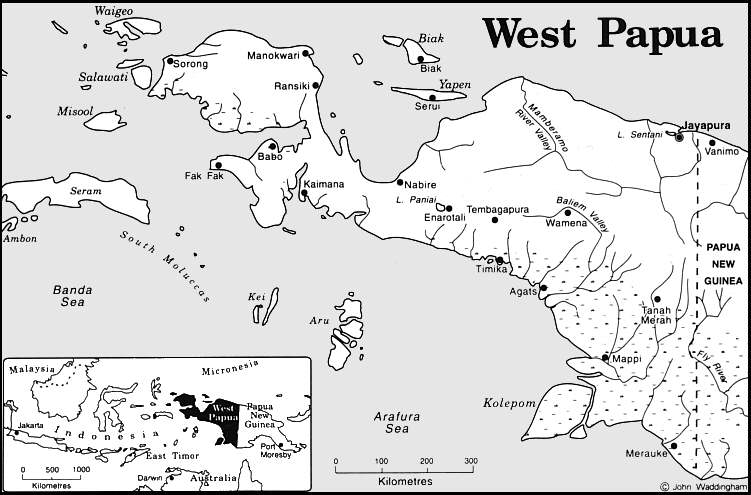
Growth of Papuan Nationalism, 1961-2004

Honolulu-based East-West Center has issued a policy study that is of particular interest to me, for its focus both on Papua and on the construction of national identity.
Pan-Papuan identity is much more widespread and the commitment to a Papuan nation much stronger in 2004 than it was in 1963, when Indonesia thought it was liberating the Papuans from the yoke of Dutch colonialism. Rather than feeling liberated from colonial rule, Papuans have felt subjugated, marginalized from the processes of economic development, and threatened by the mass influx of Indonesian settlers. They have also developed a sense of common Papuan ethnicity in opposition to Indonesian dominance of the local economy and administration, an identity that, ironically, has spread in part as a result of the increasing reach of Indonesian administration. These pan-Papuan views have become the cultural and ethnic currency of a common Papuan struggle against Indonesian rule. Yet the sharp ethnic distinctions Papuans make between themselves and Indonesians reflect the various and complex relationships Papuans have had with the latter.

Despite the sharp distinctions they draw between themselves and Indonesians, the Papuans are themselves diverse. Papuan society is a mosaic of over three hundred small, local, and often isolated ethno-linguistic groups, whose contacts with each other and with non-Papuans has varied significantly. The evolution of Papuan nationalism has therefore gone hand in hand with the creation of a pan-Papuan identity. The first generation to begin thinking of themselves as Papuans were the graduates of the mission schools and colleges established by the Dutch to train officials, police, and teachers after the Pacific War. The study examines two regions to illustrate something of Papua's ethnic and religious diversity as well as the different ways in which regions have interacted with the world outside Papua. These two regions, Fakfak [on the lower beak of the Bird's Head] and Serui [on Yapen Island], had displayed some of the strongest pro-Indonesian sentiment prior to 1961. Today, the choice between Papuan and Indonesian identity is a hotly contested issue in Fakfak, while Serui has become anti-Indonesian. The analysis in these case studies sheds additional light on the ways Papuans have negotiated their ways through choices of identity and political orientation.
SOURCE: Constructing Papuan Nationalism: History, Ethnicity, and Adaptation, by Richard Chauvel.

Beijing's (and Washington's) Policies toward the Uyghurs

Honolulu-based East-West Center has just issued a policy study that sounds two notes worth repeating.
Both Beijing and Washington are about to lose crucial political opportunities in this far-flung territory. Beijing’s new hard-line stance, which restricts even language and culture, has galled the many moderate Xinjiang citizens who once grudgingly accepted Chinese political restrictions as a price of regional economic development. The PRC government still has an opportunity to win back these people with a more pluralistic cultural policy that emphasizes support for Uyghur and other policy-relevant minority languages and that eases other cultural restrictions, particularly on religion. Without such a policy shift, as Beijing well knows, Xinjiang could become China’s Kashmir. Yet if current PRC policy stays on course, any change is likely to be even more restrictive, since the government considers its cultural accommodation of the 1980s and 1990s to be a cause of unrest, rather than a solution to it.

The United States, for its part, must make clear to Beijing that current U.S. political imperatives will not distract U.S. policy from supporting human rights, including cultural rights. The Uyghurs have been among the most pro-American citizens in China. They also happen to be Muslims. If the United States wants international partners in fighting terrorism, it should cultivate a cooperative partnership with China, including the Uyghurs. If the Xinjiang region is to be involved in an initiative against international terrorism, then the United States can urge China and its allies to cultivate the Uyghurs—with their knowledge of the language and cultures of Central Asia—as partners rather than as opponents. As Washington has begun to realize, its anti-Uyghur policies, even those targeted only at violent fringe groups, have already generated negative sentiment in Xinjiang towards the United States. Policies perceived as anti-Uyghur or anti-Muslim could well radicalize previously apolitical Uyghurs, pushing them into militant or radical Islamic groups.
SOURCE: The Xinjiang Conflict: Uyghur Identity, Language Policy, and Political Discourse, by Arienne M. Dwyer (2005).

18 June 2005

Algeria: Split by the Gulf War

Initially, the Gulf crisis, set off by Iraq's invasion of Kuwait on August 2, 1990, drew increasingly marked lines of separation within the Algerian political class. Although all the parties condemned the Western reaction--the massing of troops and weapons in Saudi Arabia--whose aim, according to some, was only to "preserve their interests," or even "seize control of hundreds of billions of Arab dollars and threaten the Islamic and Arab nation in its security," the position toward Saddam Hussein's regime was far from unanimous.

The ISF [Islamic Salvation Front] Islamists proved to be increasingly embarrassed. How ought one to "protect" Saudi Arabia's appeal for Western troops? Response: "Let us brandish the torch of Islam. Let us brandish the jihad. Down with the servants of colonialism! No to Iraqi intervention in Kuwait, no to the intervention of unbelievers in Saudi Arabia, no to the governments that have compromised with the West. Yes to the peace dialogue. My dear brothers, we reject all intervention in our affairs." The ISF preacher who gave this speech in Constantine ended it with the search for the inevitable scapegoat, "the Jews, who occupy all the holy places of Islam" (Sigau 1991).

The rejection of "the American war," which increased after the air offensive by the coalition against Iraq on January 17, 1991, did not signify adherence to the doctrine of Iraq's sole party, the Baas [= Baath]. From one end of the Maghreb to the other, the violence of the conflict provoked the return in force of the tradition of revolutionary populism, of a movement of unanimity without any possible differences in points of view. And yet, in the many pro-Iraqi demonstrations that occurred in Rabat, in Algiers, and in Tunis, a rift appeared.

On the one hand, there were those who demanded peace, an immediate cease-fire. They spoke of safeguarding the unity of the "Arab nation." They adopted the tone of the Third World movement of the 1960s, supported in the past by the Moroccan Mehdi Ben Barka and the West Indian writer Frantz Fanon: they denounced the oppression of the peoples of the "Arab nation" by a regime resolved to establish its hegemony over it. The rejection of US intervention against Iraq was accompanied by a denunciation of the petroleum monarchies in the Gulf. They were accused of placing their capital in Western financial institutions when, in the overwhelming majority of Arab countries, social progress remained very slow. But that effort at social clarification collided with the power of consensus based on identity, the sense of belonging to the same "Arab camp." And the "Palestinian cause" further united people. Some, however, particularly the heads of the human rights leagues, attempted to explain the necessary distinction between Saddam Hussein's totalitarian regime and the suffering of the Iraqi people.

On the other hand, in Morocco and Algeria the Islamist movement championed the jihad. The Western view of the Arab world, simplified to the point of caricature, encouraged this movement. Feeding the worship of a fixed past, the Islamist movement assimilated democracy (seen simply as a product of European history) to irreligion, that is, to one of the weapons in the vast conspiracy fomented by the enemies of the Prophet.

The West, out of habit or laziness, has relegated all the Arab countries to a global otherness--a homogeneous whole, sometimes invaded by abrupt fits of fever--without understanding that these peoples, in mobilizing against the war, aspired not to a return to military nationalism, but only to a greater degree of justice.

Public opinion brandished the democratic argument with the slogan "two weights, two measures." The Algerians emphasized the glaring inequality in the application of UN resolutions. But the majority of them did not embrace Saddam Hussein's regime. In Rabat and Tunis as well, there was a demand for more rights and not for the withdrawal of the international community.

The tragedy lay in the refusal by the "North" to take these considerations into account. It has then been easy for the Islamists to demonize the idea of democracy, understood as a product of the West and not as a universal principle.
SOURCE: Algeria, 1830-2000: A Short History, by Benjamin Stora (Cornell U. Press, 2001), pp. 208-209

Algeria: From Pan-Arabism to Islamism

The collapse of the FLN and the ISF's rise to power lay in the continuing failures of pan-Arabism and the development of political Islamism.

The Arab defeats by Israel (in 1967 and 1973) led to the crisis in Arab nationalism. The volatile mixture of Islamism and oil led to new conflicts, while the state apparatus originating in Arabism defended itself with concessions and repressions. Given the Iran-Iraq war (1980-1988) and its parade of atrocities, the persistence of underdevelopment, the lack of resolution of the Palestinian question, and the Israeli invasion of Lebanon in 1982, people in the 1980s were troubled by a queasy sinking sensation and the certainty that the collapse of values would ineluctably be punished. Gradually, for some, the hope of a return to original Islam was carved out. The new power acquired by the Gulf states (especially Saudi Arabia) after the oil crisis appeared to many faithful as a sign of divine providence. Compared to the patent failures of the secular states, which had fashioned their industrial development model on that of Eastern Europe, the international weight acquired by Riyadh gave fundamentalism a new credibility.

In the early 1980s, the landscape of the Maghreb was transformed. With the urban riots in Morocco in 1981 and 1984 and in Tunisia in 1984, and the Algerian outbreak in October 1988, social frustrations were laid bare. The organs for controlling and organizing societies were no longer adequate to stifle their expression. The rise of the individual and the slow acquisition of personal freedoms were translated into the creation of associations (the human rights leagues, for example) and public demonstrations to demand new rights.

That approach required the end of the single-party system, which had failed in its curious mixture of universalism and specificity (Islam and national socialism). The Algeria of 1990, with the multi-party system and elections planned for 1991, opened the way to the nation/society's appropriation of the freedoms until then confiscated by the party/state. That desire for democracy, which opposed the "forced modernity" proposed by the military, fractured the vision of Arab nationalism, especially since every state baldly obeyed its own logic, its own interests. In practice, every instance of nationalism developed at the expense of pan-Arabic propaganda. The borders, even the most artificial ones coming out of colonization, produced the same state allegiances in the territories they circumscribed, the same networks of sympathies and behaviors that gradually became fixed and institutionalized. Positions were taken, choices made, which the bureaucratic cadres in the states were reluctant to abandon.

Political Islamism emerged as a major factor, and took its place in the void left by Arab nationalism (Peuples méditerranéens, 1990). The populations were barely gathering up the detritus of modernity. They felt that yawning gap--between the rulers and the ruled, between the very rich and the very poor, and between the "North" and the "South"--as an injustice. The rise of Islamism, experienced as the hope for a return to ethics, in combination with the bankruptcy of the single-party system, brought about a need for individual responsibility, which would go hand in hand with the search for a new kinship.

At the same time, the crisis of "Arab Socialism" made a need for personal freedom, or individualized responsibility, appear. Human rights leagues, but also new unionist organizations, women's movements, cultural associations, and a series of journals began the work of criticism: how could the state become disengaged from the economy? How could individuals assert themselves as political subjects and as citizens? How could the culture, and in particular the representations of Islam, transform itself? That reflection on democracy was still very fragile when the Gulf crisis erupted, with Iraq's invasion of Kuwait on August 2, 1990.
SOURCE: Algeria, 1830-2000: A Short History, by Benjamin Stora (Cornell U. Press, 2001), pp. 201-202

17 June 2005

Charles Robert Jenkins and the Japanese Media

I have to confess I'm fascinated by the story of the U.S. Army deserter Charles Robert Jenkins and his kidnapped Japanese wife Hitomi Soga, both of them far outliers by any standard. They're in North Carolina now, and most accounts of their visit are rehashes of the same wire service stories from AP, Kyodo, Reuters, etc. But one story by Jim Nesbitt, a staff writer for a major North Carolina regional paper, the Raleigh News & Observer, stands out. Unable to get much more than the time of day from an extremely tight-lipped Jenkins, Nesbitt decides to report on the Japanese media coverage. (Yes, I know, reporters covering other reporters is all too common these days, but I think this one works pretty well because Nesbitt is discovering different cultural perceptions, not just reinforcing his own conventional wisdom.) Here's a sampling.
WELDON -- On the tree-lined avenue in front of the two-story brick home of Army deserter Charles Robert Jenkins' sister, scores of Japanese camera crews and reporters practice an electronic form of brinkmanship.

Sharp-elbowed and competitive, they aim to capture every moment of Jenkins' first visit to North Carolina since he spent four decades as a defector in North Korea.

But unlike their American counterparts, their focus is on Jenkins' wife, Hitomi Soga, 46, who was abducted by North Korean agents in 1978 while shopping with her mother in their hometown on Japan's isolated Sado Island and spirited away by speedboat to the Communist dictatorship.

Since her solo return to Japan in 2002, Soga has become a leading symbol of the abductee saga, her story wrapped in Japan's enduring interest in the fate of as many as 60 Japanese citizens who were also abducted by North Korea from 1977 to 1983.

Her quest to be reunited with Jenkins, 65, who stayed in North Korea with their two daughters because he feared punishment for desertion, became the focus of negotiations led by Prime Minister Junichiro Koizumi, who made a personal appeal to North Korean officials for their release.

In the eyes of the Japanese, this is a love story and a tale of motherly devotion -- with Soga at center stage....

Her story is made more poignant by the uncertainty surrounding her mother, Miyoshi Soga, who also disappeared the same day. The North Korean government has never admitted abducting Soga's mother.

The Japanese see a psychic connection between Soga's missing mother and her husband's desire to see his own mom -- a wish Soga has said she wanted fulfilled so she and her daughters could meet [her husband's mother Pattie] Casper.

"It's a double image," [New York-based TV Asahi senior producer] Nakamura said. "The union of Jenkins and his mother reflects her [Soga's] fantasy dream of being reunited with her mother."

For the Japanese, Jenkins has been a sideshow, a supporting actor whose remarkable story has been seen through the lens of his wife's saga. They've known from the start that he was a 25-year-old Army sergeant who deserted the squad he was leading during a patrol of the demilitarized zone separating the two Koreas in January 1965.

Until they hit North Carolina, though, and started talking to U.S. veterans and visiting his hometown in nearby Rich Square, about 25 miles southeast of here, they didn't realize the anger some have for him.

"The people didn't really know Mr. Jenkins was a deserter and how serious that was," said Toshiyuki Matsuyama, a Washington-based reporter for the Fuji News Network. "Now, we're focusing on the negative aspects of his visit."...

In the three days Jenkins has been in Weldon, the sight of Japanese reporters interviewing locals at the Weldon Super Market or the Trustworthy Hardware Store on Main Street in Rich Square has become common.

But coverage that has been almost round-the-clock has given Japanese reporters, producers and camera crews little time to explore the local delights.

Tomohiko Murayama, who covers Sado Island for the Niigata Television Network, spent a year as a high school exchange student in Kentucky 20 years ago and wasn't unhinged by being stuck in Weldon.

"This is the typical small town in the United States, isn't it?" Murayama said.
Yes! If only the reporters from the New York Times, the Washington Post, the Guardian, and the wire services understood small-town America (and Japan) as well as Murayama seems to. Hats off to Nesbitt, too, for an original and informative take on the media circus.

Muninn's Linguistically Fractured Conversations

While Muninn is in South Korea trying to add Korean to his already proficient Japanese and Chinese, he has been posting some charming and insightful accounts of his experiences with the new language and culture. Here's a little taste:
I have had some of the most interesting conversations talking to random old people and as someone who is interested in the history of East Asia, I especially enjoy those who I have met while on this side of the Pacific pond....

Today I had another one of these experiences, this time, sitting just across from the entrance of Korea’s National Library.

It actually started yesterday when I went to meet a friend who works at the National Library for dinner. While I was waiting I was approached by an elderly man wanting to try out his English on me. It didn’t work very well, as his listening skills were minimal. My Korean sucks too. He managed to tell me he was born in 1932 and after a few more frustrated attempts at making some sentences, I asked him if he spoke Japanese. Of course, he did, he was taught Japanese in elementary school and was only 13 when the colonial period ended.

Once we shifted into Japanese, our conversation moved much more smoothly. However, we both had six o’clock meetings to go to so we agreed to meet again at the library tonight at six to continue our conversation....

It was a wonderful chat, and I’m sure he had many more stories to tell but it was getting cooler and dark, so we exchanged contact info and parted ways. It was then, towards the end of our conversation that I noticed something about his Japanese. He spoke surprisingly well, albeit with a lot of common mistakes that I often hear less skilled Korean speakers of Japanese make, and had a vocabulary roughly equal to his half dozen years in the Japanese education system of the colonial period. He would throw in more difficult Korean nouns, which we either looked up or were similar enough to Japanese that I could often guess them from context. However, what took me longer to notice was something I found fascinatingly similar to how Sayaka and I communicate (a mish mash of English, Japanese, and Chinese): He had basically been using Korean particles and grammatical words (e.g. (으)니까) at least half of the time. One reason, I realized, why this took me so long to notice is that it simply fits so well. It rarely, if ever, altered the order or structure of his sentences.

Also, since I have been here over a week now, these words don’t seem out of place so I didn’t even recognize them as not being Japanese until the end of our conversation. Also, he was essentially doing the reverse of what I have been doing here when I speak to Japanese classmates or Japanese speaking Korean friends. I feel so much more comfortable talking to them in Korean because I can randomly throw in Japanese words or grammar into the various gaping holes of my Korean and not skip a beat in sentence construction. Of course, I know, I am supposed to be filling those holes with real Korean, but you know… I got stuff to say, debates to win, long-winded stories to tell!

紐約洋基勝明尼蘇達雙城 4 : 3

Sinography-solver Amritas leads you down the garden path toward the real meaning of this actual headline from a Chinese newspaper, and in the process counters a few myths about Chinese characters. Hint: 明尼蘇達 doesn't really mean UNTIL BRIGHT NUNS LIVE AGAIN, although it does have something to do with St. Paul, Mingnisuda.

If that's not enough for you, pay a visit to Language Hat's post about a site that lists the most common Chinese characters in order of frequency.

Siberian Light on Mongolian Elections

Siberian Light shines a spot on the Mongolian elections:

Nabetz at New Mongols has a look at some international rankings, showing that not all of Russia's non-European neighbours have problems with democratising, or resisting pressure from Russia and China to maintain pliable authoritarian regimes:

With numbers like this, it's easy to understand why Mongolia has been able to have nine national parliamentary and presidential national elections in about 15 years--all of them free, fair, and, perhaps most tellingly, friendly (compare elsewhere in the region). That political power has changed been passed back and forth between several parties is an indication that the Republic is advancing more strongly, more peacefully, and more openly than ever....

Hopefully, the example of Mongolia will also bring an end to the sometimes fashionable belief that countries without a Christian tradition and/or occupation by American troops can't democratise.

16 June 2005

When the Stars and Stripes Scooped L'Humanité in Algeria

On May 8, 1945, the day the [World War II] armistice was signed, Muslim Algerians paraded in most of the cities of Algeria, with banners bearing the slogan "Down with fascism and colonialism." In Sétif, the police fired on Algerian demonstrators, who countered by attacking police officers and Europeans. It was the beginning of a spontaneous uprising, supported by the PPA [Algerian People's Party] militants of Constantinois. In the rural areas, peasants revolted in La Fayette, Chevreuil, Kherrata, and Oued Marsa. Among the Europeans, 103 were listed as killed and 110 wounded. On May 10, the authorities organized a true "war of reprisals"--to borrow the Algerian historian Mahfoud Kaddache's expression--which turned into a massacre. Shootings and summary executions among the civilian population continued for several days under the direction of General Duval. Villages were bombed by the air force, and the navy fired on the coast. The French general Tubert spoke of 15,000 killed among the Muslim population. Algerian nationalists put forward the figure of 45,000 dead.
SOURCE: Algeria, 1830-2000: A Short History, by Benjamin Stora (Cornell U. Press, 2001), pp. 21-22
The French Communist newspaper L'Humanité, obsessed with purging Vichyites in North Africa, and yet to develop its anti-colonialist stance, readily accepted the possibility that the [Sétif] affair was the work of Hitlerian elements: "Energetic action was taken in North Africa against Fifth Column criminals." American and British correspondents also accepted the official account. "Rumours of food riots are confirmed in Paris by the Cabinet," said the New York Times. "At Sétif what was described by the Governor General as 'Hitlerian elements' attacked the population while it was celebrating VE day. Troops were used." Reynolds News even provided details: "Several people were killed when armed bands of Arabs, led by a violently anti-French party known as Manifesto marched down from the mountains on the Town of Setif and fired on the crowd." Only the Christian Science Monitor's correspondent Egon Karkeline questioned the official version. "Despite the veil of censorship with which the French government has surrounded the recent riots in Algiers," he wrote, "it is manifest that these disturbances had a serious character."

Then, more than a month after the French attack, the United States Army newspaper Stars and Stripes blew the whole story wide open. The Rome edition of the paper, quoting sources in Casablanca, gave a reasonably accurate account of what had occurred, hedging only with "the true picture of events and their cause was obscure." The Stars and Stripes version was picked up and reprinted in the New York Times, the Manchester Guardian, the London Daily Telegraph, and many other newspapers. This sent Ch.-Andre Julien of the Socialist official daily, Le Populaire, after the story, and on June 28 he wrote the first account in France to give anything like the true picture of what had happened: "Senegalese and Legionnaires were allowed to massacre at will around Sétif. Their path could be followed by trails of fire. In the Jijelti region, where there had been no disorders, other Senegalese murdered and burned at leisure. Planes scattered bombs on Arab tent camps. The military gave the number of victims as between six and eight thousand." This report brought revised figures from the Ministry of the Interior. The "more than 100" casualties now became 1,200, and it was officially admitted that 50,000 Arabs had taken part in the events of May 8.

All this time there had been an eye-witness account of the first trouble in Sétif. Pierre Dubard of Le Figaro had watched the demonstration and had seen the police violence, but he was unable to get his story past the censor until July 7, two months after the event. When it finally appeared, it confirmed not only Le Populaire's story, but also most of what had appeared in Stars and Stripes. French official sources were completely discredited, the danger of accepting government statements at face value was amply illustrated, and the manner in which each newspaper's political line had influenced its version of the Sétif attack had been clearly shown.
SOURCE: The First Casualty: The War Correspondent as Hero and Myth-maker from the Crimea to Kosovo, by Phillip Knightley, with an introduction by John Pilger (Johns Hopkins U. Press, 2000; first published in 1975), pp. 393-394

Algeria: Recycling Terms from the Last War

Beginning in Algeria in July 1993 there were forests burning once again in the Aurès, Algiers was still living under a curfew, terrorist attacks attributed to Islamists were striking police officers and intellectuals, and hundreds of "suspects" remained in detention, sometimes without trial. The Algerian press had begun to mention the "sweep operations," and the French press added reports from "the underground." "Terrorism" and "torture" made their reappearance in the vocabulary of all the triumphant communiques, announcing, on the one hand, the "eradication" of the "last armed groups," and, on the other, "the imminent victory of the Muslim people." A strange sensation has developed that this is a remake of the war of independence [1954-62]: an impression of déjà vu or "déja entendu."

Forty years later, the vocabulary is unifying, consolidating the two eras, making them look alike. Has the country, then, entered a second--and identical--Algerian war?

Nothing is less certain. In the first place, in history, formal analogies have but little pertinence if they confine themselves to highlighting the similarity between certain forms, in this case the resurgence of terrible forms of violence. And, in the second place, the Algeria of the 1990s has only a very distant relation to that of 1962.

The country today is highly urbanized; the rural areas no longer play the same role; more than 60 percent of the population is under thirty; and the rate of schooling is very high. The differences could be multiplied, with, at the center, the end of the colonial system, the massive departure of pieds noirs [French colonists], and the political operation of an independent state. It may therefore seem absurd to assert that the same scenario is being repeated. Yet the protagonists in the confrontation--the followers of the ISF [Islamic Salvation Front], the "democrats," the army--have intentionally adopted the terms inherited from the past of the Algerian War. And that is what is truly of interest--Islamists speaking of "the valorous mujahideen," wanting to hunt down "the new pieds noirs" who have appropriated the revolution; "democrats" calling the ISF militants "harkis" [Muslim colonial auxiliaries] who want to crush the Algerian nation. Some circles within the regime have launched campaigns against the "secular assimilationists," as during the time of the colonial system, when a lost identity had to be reestablished. And all the camps mention a shadowy "party of France" (Hizb França) supposedly destabilizing Algeria.

This mimicry is striking. The memory of the war of independence operates as a factor in the assignment of the roles to be played. The contemporary actors dress in theoretical garments borrowed from the past. But, if they do not realize the novelty of the present, and if they subjectively replay the old situation, it is because they remain under the automatist influence of a memory fabricated forty years ago.
SOURCE: Algeria, 1830-2000: A Short History, by Benjamin Stora (Cornell U. Press, 2001), pp. 232-233

For a more hopeful follow-up, see this OxDem Report from April 2004.

15 June 2005

Vaclav Havel Sends Birthday Wishes to Aung San Suu Kyi

Former political prisoner and Czech president Vaclav Havel uses the Washington Post to send a birthday message to Burma's Aung San Suu Kyi, who turns 60 next Sunday.
I hope that the European Union will draw a lesson from [its failure to improve human rights in Cuba] -- for example, when it again negotiates lifting the arms embargo on China. It makes sense to keep up the pressure on the military junta in Burma, which considers all the justifiable calls to free Aung San Suu Kyi and other political prisoners, as well as calls to begin democratic reforms, to be unjustifiable interference in the country's internal affairs.

Even a decade and a half after the fall of communism there, the citizens of Central and Eastern Europe still vividly remember that their communist rulers made the same arguments. Abuses of human rights and freedoms have never been and will never be solely internal affairs of any country. As someone who years ago experienced firsthand the arbitrary rule of a dictatorial regime but then lived to see better times -- to a large extent because of the international solidarity extended to us -- I appeal to all those who have the opportunity to act against such arbitrary acts to express their solidarity with people who to this day live in a state of "unfreedom."

This is also why -- together with my friends His Holiness the Dalai Lama, Prince El Hassan bin Talal of Jordan, former presidents Richard von Weizsaecker of Germany and Frederik W. de Klerk of South Africa, and others -- I founded the Shared Concern Initiative. The first public manifestation of this initiative was an open letter in support of Aung San Suu Kyi. This is why I welcomed it when the Association of Southeast Asian Nations moved beyond its "non-interference" policy and began publicly debating whether Burma should assume the chairmanship of that organization. This is why I support U.S. sanctions against the Burmese regime and why I find it easy to identify with resolutions by U.S. legislators. This is also why I appeal to the European Union to learn from its Cuban fiasco and step up the pressure on the Burmese regime both within the framework of the United Nations and in other international forums -- and to do it in clear and comprehensible terms.

The current situation in Burma is bad. Since 1990 the ruling State Council for Peace and Development has repeatedly promised that it would take steps leading to gradual democratization of the regime. Not a single one of these promises has been even partially fulfilled.

But I am still an optimist. After all, I come from a country where, as late as mid-1989, while all around us totalitarian icebergs were cracking and thawing, the stupid, repressive regime remained strong. I, together with other people of a similar mind-set, was in prison. Yet, by the end of that same year I was elected the president of a free Czechoslovakia.

Seemingly unshakable totalitarian monoliths are in fact sometimes as cohesive as proverbial houses of cards, and fall just as quickly. Continuing democratization of the whole region, together with growing dissent inside the country, must eventually have a positive effect. As Aung San Suu Kyi celebrates her 60th birthday, I wish for her that those changes will happen as soon as possible, and that my silly idea -- to hand her a rose -- becomes a simple and easy thing to do.

Halloran on Reshuffling U.S. Forces in the Pacific

Last Sunday's (12 June 2005) Honolulu Advertiser carried an article by Richard Halloran on possible realignments of U.S. forces in the Pacific.
As pieced together from American and Japanese officials, who cautioned that no firm decisions have been made, the realignment shapes up like this:

Army: The Army headquarters at Fort Shafter would become a war-fighting command to devise and execute operations rather than to train and provide troops to other commands as it does now. The U.S. four-star general's post in Korea would be transferred to Hawai'i.

I Corps at Fort Lewis, Wash., would move to Camp Zama, Japan, to forge ties with Japan's ground force. Japan would organize a similar unit, perhaps called the Central Readiness Command, to prepare and conduct operations with the U.S. Army.

Japanese officials are considering elevating the Self-Defense Agency to a ministry and renaming Japan's Ground Self-Defense Force as the Japanese Army and the same for the navy and air force. Shedding those postwar names would reflect Japan's emergence from its pacifist cocoon.

In South Korea, the U.S. plans to disband the Eighth Army that has been there since the Korean War of 1950-53, to relinquish command of South Korean troops to the South Koreans, and to minimize or eliminate the United Nations Command set up during the Korean War.

A smaller tactical command would oversee U.S. forces that remain in South Korea, which would be down to 25,000 from 37,000 in 2008. That may be cut further since Seoul has denied the U.S. the "strategic flexibility" to dispatch U.S. forces from South Korea to contingencies elsewhere.

Marine Corps: The Marines, who have a war-fighting center in Hawai'i, would move the headquarters of the III Marine Expeditionary Force, or III MEF, to Guam from Okinawa to reduce the friction caused by the U.S. "footprint" on that Japanese island. How many Marines would move was not clear, but combat battalions would continue to rotate to Okinawa from the United States.
via The Marmot's Hole

Time Reporter a North Vietnamese Spy

The New Yorker recently published a long profile of Pham Xuan An, a Time magazine reporter during the Vietnam War, who led a double life as a spy for the North Vietnamese. The author is Thomas A. Bass, an English professor at SUNY-Albany. It's a story that should have rated mention in Phillip Knightley's account of war reporting from Vietnam in The First Casualty, so perhaps Knightley was unaware of it.
“Here is Pham Xuan An now,” Time’s last reporter in Vietnam cabled the magazine’s New York headquarters on April 29, 1975. “All American correspondents evacuated because of emergency. The office of Time is now manned by Pham Xuan An.” An filed three more reports from Saigon as the North Vietnamese Army closed in on the city. Then the line went dead. During the following year, with An serving as Time’s sole correspondent in postwar Vietnam, the magazine ran articles on “The Last Grim Goodbye,” “Winners: The Men Who Made the Victory,” and “Saigon: A Calm Week Under Communism.” An was one of thirty-nine foreign correspondents working for Time when the Saigon bureau was closed and his name disappeared from the masthead, on May 10, 1976.

Recognized as a brilliant political analyst, beginning with his work in the nineteen-sixties for Reuters and then for the New York Herald Tribune and The Christian Science Monitor, and, finally, as a Time correspondent for eleven years, Pham Xuan An seemed to do his best work swapping stories with colleagues in Givral’s cafe, on the old Rue Catinat. Here he presided every afternoon as the best news source in Saigon. He was called “Dean of the Vietnamese Press Corps” and “Voice of Radio Catinat”--the rumor mill. With self-deprecating humor, he preferred other titles for himself, such as “docteur de sexologie,” “professeur coup d’etat,” “Commander of Military Dog Training” (a reference to the German shepherd that always accompanied him), “Ph.D. in revolutions,” or, simply, General Givral.

We now know that this is only half the work An did as a reporter, and not the better half. An sent the North Vietnamese a steady stream of secret military documents and messages written in invisible ink, but it was his typed dispatches, now locked in Vietnam’s intelligence archives and known to us only through secondhand reports, which will undoubtedly rank as his chef d’oeuvre. Using a Hermes typewriter bought specially for him by the North Vietnamese intelligence service, An wrote his dispatches, some as long as a hundred pages, at night. Photographed and transported as undeveloped rolls of film, An’s reports were run by courier out to the Cu Chi tunnel network that served as the Communists’ underground headquarters. Every few weeks, beginning in 1952, An himself would leave his Saigon office, drive twenty miles northwest to the Ho Bo woods, and descend into the tunnels to plan Communist strategy. From Cu Chi, An’s dispatches were hustled under armed guard to Mt. Ba Den, on the Cambodian border, driven to Phnom Penh, flown to Guangzhou (Canton), in southern China, and then rushed to the Politburo in North Vietnam. The writing was so lively and detailed that General Giap and Ho Chi Minh are reported to have rubbed their hands with glee on getting these dispatches from Tran Van Trung-An’s code name. “We are now in the United States’ war room!” they exclaimed, according to members of the Vietnamese Politburo.

As Saigon fell to the Communists, An, like his fellow-correspondents, was hoping to be evacuated to the United States. Vietnam’s military intelligence agency planned to continue his work in America. The Politburo knew there would be a war-after-the-war, a bitter period of political maneuvering in which the United States launched covert military operations and a trade embargo against Vietnam. Who better to report on America’s intentions than Pham Xuan An? In the last days of the war, An’s wife and their four children were airlifted out of Vietnam and resettled in Washington, D.C. An was anxiously awaiting instructions to follow them, when word came from the North Vietnamese Politburo that he would not be allowed to leave the country.

An was named a Hero of the People’s Armed Forces, awarded four military-exploit medals, and elevated to the rank of brigadier general. He was also sent to a reeducation camp and forbidden to meet Western visitors. His family were brought back to Vietnam, returning a year after they left. The problem with Pham Xuan An, from the perspective of the Vietnamese Communist Party, was that he loved America and Americans, democratic values, and objectivity in journalism. He considered America an accidental enemy who would return to being a friend once his people had gained their independence. An was the Quiet Vietnamese, the representative figure who was at once a lifelong revolutionary and an ardent admirer of the United States. He says he never lied to anyone, that he gave the same political analyses to Time that he gave to Ho Chi Minh. He was a divided man of utter integrity, someone who lived a lie and always told the truth.

“An’s story strikes me as something right out of Graham Greene,” says David Halberstam, who was friends with An when he was a Times reporter in Vietnam. “It broaches all the fundamental questions: What is loyalty? What is patriotism? What is the truth? Who are you when you’re telling these truths?” He adds, “There was an ambivalence to An that’s almost impossible for us to imagine. In looking back, I see he was a man split right down the middle.”

In his 1965 book on Vietnam, “The Making of a Quagmire,” Halberstam described An as the linchpin of “a small but first-rate intelligence network” of journalists and writers. An, he wrote, “had the best military contacts in the country.” Now that Halberstam knows An’s story, does he bear him any grudges? “No,” he says, echoing the opinion of almost all of An’s former colleagues. “It’s a story full of intrigue, smoke and mirrors, but I still think fondly of An. I never felt betrayed by An. He had to deal with being Vietnamese at a tragic time in their history, when there was nothing but betrayal in the air.”

via A Glimpse of the World via Simon World

14 June 2005

One-for-All-Reporter from Rhodesia

The coverage of Rhodesia [during its revolt against white minority rule] was deeply flawed from the beginning. The problem, stated briefly, was this: how could any war correspondent give a balanced account of a war where one side was Anglo-Saxon, entrenched in the cities, with access to the resources and the techniques of public relations, and where the other side consisted of people of a different race and culture, operating in the remote countryside, and who had neither the means nor--and this may be more important--the inclination to compete in terms of propaganda?

The answer is that no war correspondent could. The better ones soon became tired of regurgitating official hand-outs from the Smith regime in Salisbury and went home. But no newspaper wanted to admit that it had given up trying to present a balanced view of the war, so stories from Rhodesia continued to appear, particularly in British newspapers. Who was sending them? Few readers of the London Daily Telegraph realised that the paper's correspondent in Salisbury, Brian Henry, was the same person as the Daily Mail's Peter Norman, who was in turn the same person as the Guardian's Henry Miller. And that in real life all these correspondents were a Rhodesian journalist called Ian Mills, who, as it happened, was also the BBC's correspondent!

The dangers in this practice of the "multiple correspondent" immediately became apparent. One is that Mills, a competent journalist, could have become too busy to do much else than take whatever official information he could get and send it off to his many outlets together with what comment he could obtain on the telephone. He would hardly have had time to investigate the truth or otherwise of what he was being told, especially if such an investigation could involve long absence from his base. Next, with similar stories appearing in a variety of newspapers under a variety of names, the reader could feel that each confirmed the accuracy of the other. He would then tend to place more weight on the story's facts than if he knew that all the stories were actually written by the one correspondent.
SOURCE: The First Casualty: The War Correspondent as Hero and Myth-maker from the Crimea to Kosovo, by Phillip Knightley, with an introduction by John Pilger (Johns Hopkins U. Press, 2000; first published in 1975), p. 471

Sultanical Reforms in Brunei?

Macam-macam reports on the latest cabinet reshuffle by the Sultan of Brunei (whose Silver Jubilee mug I proudly possess).

Two of the most striking changes included the appointment of the first non-Muslim ever to the Cabinet:

Lim Jock Seng, an ethnic Chinese, was made foreign minister 2, a post higher than deputy foreign minister, but one step below Foreign Minister Prince Mohamed Bolkiah, the sultan's brother.

and the removal of long-time Education Minister Abdul Aziz, reviled as one of the most pro-Muslim and anti-everyone else members of the Sultan's government.

This highlights one problem of nepotism-ridden bureaucracies: You need twice as positions, one to do the real work, the other to enjoy the title and ensure political reliability--or your customer base, in the case of a Chinese community bank I used to work for. Unrelated immigrants from China, Korea, the Philippines, and other states of the U.S. did a lot of the back office technical work, each carrying at least half the weight of a nonproductive relative of the owners who interfaced with the old-time customers. The CEO and principal shareholder, who was reputed to favor unrelated employees, but couldn't bring himself to fire the deadwood, eventually sold the bank in frustration.

The Brunei reshuffle reminds me of a linguistic treatise I read a decade or so ago about the proliferation of "speech levels" in the bureaucratic Malay of the Sultan's palace. Brunei's Palace Malay has a far richer treasury of words used to exalt one's superior and debase oneself than any other Malay dialect. (It almost equals Javanese.) And that vocabulary has expanded just as fast as the Sultan's well-paid bureacracy has expanded during the Sultanate's oil boom. It's as if the U.S. government were to issue guidelines for how a GS-8 is to address a GS-12, and vice versa, and so on up the bureaucratic ranks.

13 June 2005

An Interfering Journalist in the Korean War

Executions for political reasons began when Seoul was recaptured by the allies [as if they never occurred when Seoul was first captured by the North!], and when the South became threatened again they increased at an alarming rate.

John Colless, an Australian working for AAP-Reuter, reported that the police shot fifty-six political prisoners alongside the Sariwon railway station and then watched American troops give first aid to those who had not died outright....

One correspondent took direct personal action to stop the executions. He was Alan Dower, of the Melbourne Herald. Dower, a former commando officer, was driving into Seoul with [the BBC's Rene] Cutforth and a cameraman, Cyril Page, when they passed a column of women, many carrying babies, and wearing straw masks over their heads, being escorted by South Korean policemen. Dower stopped the jeep and asked what was happening. "These Communists," a policeman said. "They go be shot, executed." Dower said, "What? Babies Communist? Who say they Communist?" The policeman looked puzzled. "People say. People in street point and say that person Communist." The three correspondents followed the column to a gaol on a hill at the outskirts of Seoul and watched the heavy gates clang behind it. Then Dower, who was armed, thudded on a peep-hole with the butt of his carbine. When a policeman's face appeared, Dower pointed the gun at him and threatened to shoot him if he did not open the gates. Inside, the correspondents saw the column of women and children kneeling alongside a deep, freshly dug pit. On the other side were two machine guns. "Hell," Dower said, "this is a bloody fine set-up to lose good Australian lives over. I'm going to do something about this." The correspondents stormed into the office of the gaol's governor and found him sitting behind his desk. Dower aimed his carbine and said, "If those machine guns fire I'll shoot you between the eyes." After the governor promised that the guns would not fire and that there would be no executions, Dower threatened that if he failed to keep his word Dower would seek him out and kill him.

In Seoul, Dower went to United Nations officials and told them what had happened. "They pleaded with me not to make an international incident out of it. I told them that I had sent my paper an outline of the story, but if there were any more executions, then I'd send a story that would rock the world. They promised to see that there would be no more women and children death marches and as far as I could find out there weren't." But what had already been published, by Dower and by a few other correspondents, mostly non-American, caused a wave of disillusionment with the South Korean regime and with the war in general. The British Sunday newspaper Reynolds News summed up this feeling: "Terrible things are being done in Korea in your name. They are being done by Syngman Rhee's police sheltering behind US and British United Nations troops."
SOURCE: The First Casualty: The War Correspondent as Hero and Myth-maker from the Crimea to Kosovo, by Phillip Knightley, with an introduction by John Pilger (Johns Hopkins U. Press, 2000; first published in 1975), pp. 374-376

Collaborating Journalists in the Korean War

Phillip Knightley's partisan bias gets more and more heavy-handed as he describes wars during his lifetime. He condemns journalistic collaboration with one side, but condones or even praises it on the other. He recognizes agitprop from one side, but not from the other. He feels compelled to foreground atrocities by one side, but to downplay or deny them on the other. He makes clear his assumption that no war is ever justified against a communist or revolutionary opponent, and that a war correspondent's primary duty is to convey the utter horror and futility of war to any public that enjoys the benefits of a relatively free press--which very often includes only one side in a conflict.
Given [the antagonistic attitude of the UN briefing officers], it is understandable that many United Nations correspondents began to turn to the two Western correspondents with the North Korean-Chinese delegation, Wilfred Burchett, now [in 1975] with Ce Soir, a Paris left-wing newspaper, and Alan Winnington of the London Daily Worker.... The UN correspondents soon discovered that Burchett and Winnington had the complete trust of the North Korean-Chinese delegation [to the truce talks] and had free access to all the documents, maps, and reports relating to the negotiations. The two became a regular source of information for the UN correspondents, and a cause of much annoyance to the UN briefing officers....

Many American newsmen disliked fraternising with Burchett and Winnington. There is no doubt both correspondents supported the communist side and made no secret of this fact. Burchett was later accused of going further, playing down North Korean atrocities [which Knightley also fails to mention], painting a false picture of conditions in North Korean POW camps [which Knightley duly repeats] and, worse, of assisting in the interrogation of UN POWs in these camps. Burchett vehemently denied this to me and various court actions in Australia later failed to resolve conclusively this accusation [only the last one, presumably]. But in Korea, the truth was that Burchett and Winnington were a better source of news than the UN information officers, and if the allied reporters did not see them they risked being beaten on stories....

As for the correspondents, one cannot escape the conclusion that, although they showed admirable professional courage on the battlefield, they failed to show equal moral courage in questioning what the war was all about.... Instead, too many correspondents became engrossed in describing the war in terms of military gains and losses, rather than standing back, as one or two British correspondents did, and trying to assess whether the intervention was justified, whether its aims were feasible, whether any long-term gains were worth the short-term cost....

So correspondents must accept some of the blame for the fact that 2 million civilians were killed in Korea, more than 100,000 children were left orphaned, and the whole peninsula, says Rene Cutforth "looked as if a gigantic wind had swept it clean of everything." All for what? It remains difficult to name a single positive thing the war achieved.
SOURCE: The First Casualty: The War Correspondent as Hero and Myth-maker from the Crimea to Kosovo, by Phillip Knightley, with an introduction by John Pilger (Johns Hopkins U. Press, 2000; first published in 1975), pp. 386-390

12 June 2005

Richard Rodriguez on the Protestantization of Latin America

Richard Rodriguez has some interesting observations in an old interview for Reason magazine about the attraction of Protestantism for Latin Americans.
Reason: What do you think about the attraction of Latin Americans. both here and in Latin America, to evangelical Protestantism?

Rodriguez: Catholicism is a religion that stresses to you constantly that you can't make it on your own, that you need the intercession of the Virgin Mary, and the saints, St. Jude, and your grandmother--candles and rosaries and indulgences and the pope. There are all these intermediaries, because you facing God would be hopeless.

Suddenly, into the village comes this assurance that you don't need padrecito. You can read the bible yourself--you don't need someone to tell you what it says. You don't need the Virgin Mary, you don't need the saints, you don't need anybody. God is speaking to you. And just because your father beat your mother, just because your grandfather was poor, doesn't mean it has to happen to you. You can change your whole life around. This is all based on the Easter promise and not, as the Catholic church has always based it, on some Good Friday suffering.

Reason: Protestants always have empty crosses.

Rodriguez: It is an enormously powerful motif, the notion that Christ just got off the cross and walked away somewhere--went off to L.A.--and you could do it too. I think Protestantism is most successful in those cases where people are beginning to taste and sense discontinuity. And they begin to make sense out of it as providential. Protestantism also establishes, in a time of social change, the memory of the village. Within the storefront church, you can hold hands and remember what it was like in another time.

It will be one of the great changes of Latin America, the Protestantization of Latin America, and I think in some way that it will change the United States. The relationship of the evangelicals in places like Texas where there are rednecks and Mexicans together is really very interesting. The new Mexican who is now appearing in places like police departments--this is a new face of Latin America, and it is not necessarily one that we want.

Reason: How so?

Rodriguez: I think there has always been a charm to Latin America as being sort of morally lazy. We've always used it as a place where we could go to after dark and do whatever we wanted that we couldn't do here. We never really expected that Latin America was going to become a moral Clorox for our society, and maybe there's a ferocity there that we don't expect.

Reason: Aside from the desire to have this Latin America of easy virtue, are there bad consequences to that?

Rodriguez: How shall I put this? Mexican cops have never been cops I like to deal with. And there can be this ferocity--you see it in New York now with a lot of Puerto Rican and Hispanic households, the ferocity against the gay movement, the Rainbow Curriculum, for example. I see myself as a homosexual man--much freer in America than in Latin America.
via Marc Cooper

While some Latin American evangelicals are migrating in, other homegrown evangelicals are seeking a way out. ChristianExodus.org is moving thousands of Christians to South Carolina to reestablish constitutionally limited government founded upon Christian principles. This includes the return to South Carolina of all "powers not delegated to the United States by the Constitution, nor prohibited by it to the States."

11 June 2005

Richard Rodriguez on the Keanu Reeves Generation

A Step at a Time links to a transcript of Scott London interviewing Richard Rodriguez for the old NPR series Insight & Outlook. It hasn't lost any relevancy. Here's a sample.
London: Why do we always talk about race in this country strictly in terms of black and white?

Rodriguez: America has never had a very wide vocabulary for miscegenation. We say we like diversity, but we don't like the idea that our Hispanic neighbor is going to marry our daughter. America has nothing like the Spanish vocabulary for miscegenation. Mulatto, mestizo, Creole - these Spanish and French terms suggest, by their use, that miscegenation is a fact of life. America has only black and white. In eighteenth-century America, if you had any drop of African blood in you, you were black.

After the O.J. Simpson trial there was talk about how the country was splitting in two - one part black, one part white. It was ludicrous: typical gringo arrogance. It's as though whites and blacks can imagine America only in terms of each other. It's mostly white arrogance, in that it places whites always at the center of the racial equation. But lots of emerging racial tensions in California have nothing to do with whites: Filipinos and Samoans are fighting it out in San Francisco high schools. Merced is becoming majority Mexican and Cambodian. They may be fighting in gangs right now, but I bet they are also learning each other's language. Cultures, when they meet, influence one another, whether people like it or not. But Americans don't have any way of describing this secret that has been going on for over two hundred years. The intermarriage of the Indian and the African in America, for example, has been constant and thorough. Colin Powell tells us in his autobiography that he is Scotch, Irish, African, Indian, and British, but all we hear is that he is African.

London: The latest census figures show that two-thirds of children who are the products of a union between a black and a white call themselves black.

Rodriguez: The census bureau is thinking about creating a new category because so many kids don't know how to describe themselves using the existing categories. I call these kids the "Keanu Reeves Generation," after the actor who has a Hawaiian father and a Welsh mother. Most American Hispanics don't belong to one race, either. I keep telling kids that, when filling out forms, they should put "yes" to everything - yes, I am Chinese; yes, I am African; yes, I am white; yes, I am a Pacific Islander; yes, yes, yes - just to befuddle the bureaucrats who think we live separately from one another.

London: There is a lot of talk today about the "hyphenating" of America. We no longer speak of ourselves as just Americans - now we're Italian-Americans, African-Americans, Mexican-Americans, even Anglo-Americans.

Rodriguez: The fact that we're all hyphenating our names suggests that we are afraid of being assimilated. I was talking on the BBC recently, and this woman introduced me as being "in favor of assimilation." I said, "I'm not in favor of assimilation." I am no more in favor of assimilation than I am in favor of the Pacific Ocean. Assimilation is not something to oppose or favor - it just happens.
What prompted this was a report by Marc Cooper about Rodriguez being pressured into canceling his commencement address at Cal State East Bay.

10 June 2005

Could Rotuma Become Another Transnistria?

I've meant for several days to post an excerpt from a fascinating study by the omniscient Head Heeb about potential secessionist gangsters on Rotuma.
On May 19, 2000, a group of indigenous Fijian nationalists, led by George Speight and supported by a number of influential chiefs, seized control of Parliament and held it for more than 50 days. On May 29, with Parliament still under siege, the military declared the government deposed and took over in opposition to both Speight and the elected legislature. During the next few months, Viti Levu and Vanua Levu were in a state of chaos, with attacks on Indo-Fijian tenant farmers and mutinies within the military. All this prompted renewed discussion of independence on Rotuma.

That's where the organized crime angle comes in. Present on Rotuma at the time, ostensibly as a "tourist," was Tzemach ben David Netzer Korem, the titular vice president of a micronation known as the Dominion of Melchizedek. The Dominion claims various Pacific and Antarctic territories and asserts a pseudobiblical basis for its sovereignty, but is in fact a complicated financial scam. Korem (whose real name is Ben Pedley, and who proudly notes that his high school class "voted him 'Most Original'") has used the apparatus of Melchizedek to conceal various securities and tax frauds, and has also made money from sales of licenses and travel documents.

However shady Korem may be, however, he has shown a considerable amount of skill in promoting Melchizedek's interests. Among other things, Melchizedek has actually managed to secure diplomatic recognition from the Central African Republic and Burkina Faso (aided, I suspect, by a certain amount of money under the table), giving it a patina of respectability and increasing the value of its travel documents. With the chaos surrounding the Fijian coup, however, Korem saw the chance to take Melchizedek to the next level. If Rotuma became a de facto sovereign state under a friendly government, it would become not so much a shell company as a shell nation in which Korem could establish banks, corporations and other financial entities beyond the reach of the law. A unilateral declaration of independence on Rotuma likely wouldn't be recognized, much as Somaliland's separation from the dysfunctional Somali state hasn't gained international recognition, but in some ways that would be even better for Korem - a Rotuma existing apart from international institutions would be a legal black hole like Transnistria is for the Russian mob.
There's more for those interested.

Soccer Stadium Politics

Two interesting political developments happened in the seating areas of football/soccer stadiums in Bangkok and Tehran.

In Bangkok, the stadium was eerily silent and empty as during the World Cup match between North Korea and Japan. (Japan won 2-0.) Live spectators were banned this time, and the venue was moved to neutral territory, after North Korean fans ran amok when their team lost a World Cup game to Iran in Kim Il-sung stadium in Pyongyang in April.

In Tehran, despite postgame riots when Iran beat Japan (2-1) in March, the stadium was full and the fans were raucous for other reasons.
One of the victories scored at Azadi Stadium Wednesday evening was Iran's soccer triumph over the island nation of Bahrain, an easy 1-0 win that guaranteed Iran a slot in next year's World Cup and set off dancing in the streets of the capital.

Another sort of victory came about 90 minutes before the game, when female soccer fans pushed their way past guards posted outside the stadium.

Defying a rule that has banned women from soccer matches for more than a quarter-century, the young activists demanded seats in the sports complex that Iran's religious rulers named Azadi, or "freedom."

"We were just insisting on our rights," said Laila Maleki, one of the young women. "We're part of no campaign."

Of the 100 or so women in the Special Grandstand on Wednesday night, most were invited by Iran's minister for sports, Mohsen Mehralizadeh, who is also one of the country's vice presidents. An advocate of equal participation for women and a presidential candidate, Mehralizadeh has in recent months arranged for women to attend national soccer games.
By the standards of football hooliganism, North Korean fans are the normal ones. They tend to riot against foreigners when their own team loses. Whereas Iranian fans are bipolar: Their joy at winning tends to turn into anger at their own government.

09 June 2005

Books and Chain Letters

Pearsall's Books has whacked me from afar with the book stick that seems to be flailing the blogosphere. So here are my answers.

1. How many books I've owned

No idea. A few thousand, I'm sure, in my five decades as a constant reader. Most of them I've read (or skimmed, or not) then passed on to family, friends, or the local Friends of the Library, where I have also bought many second-hand books.

2. The last book(s) I bought

Three second-hand books from Amazon partners: The First Casualty: The War Correspondent as Hero and Myth-Maker from the Crimea to Kosovo; Emergency Sex and Other Desperate Measures: A True Story from Hell on Earth; and Vietnam: The Necessary War: A Reinterpretation of America's Most Disastrous Military Conflict

3. The last book I read

Gulag: A History (no surprise to my regular readers)

4. Five books that have meant a lot to me

Graham Greene's The Power and the Glory, reinforced by Endo Shusaku's Silence, when I was in high school and questioning my (non-Catholic) religious heritage, but not yet my political faith. Oddly enough, the themes listed in the SparkNotes study guide outline some of what captured my imagination: the dangers of excessive idealism; the disparity between representation and reality; the interrelated nature of so-called opposites; the paradox of Christian humility (and that of other do-gooders). I might add another, the need for ritual, even without belief, to keep communities of ostensible believers from fracturing apart.

Alexandr Solzhenitsyn's The First Circle, Cancer Ward, August 1914. Solzhenitsyn, more than Tolstoy or Dostoevsky or Gogol or Turgenev or Chekhov, was my Russian writer. I must have read Ivan Denisovitch in high school, but the rest I very likely read during 1969-72 while I was in the Army (a fitting venue). Solzhenitsyn took some wind out of my political sails, and a dark year in Romania during 1983-84 further becalmed my youthful leftism, leaving considerable uncertainty in its wake. Bucharest was no Damascus. I discovered no new faith; I just became less convinced about my earlier verities, leaving me with "pessimism of the intellect, optimism of the will" (Romain Rolland via Timothy Garton Ash).

Eric Hobsbawm and Terence Ranger's The Invention of Tradition, which was not so much an eye-opener as a confirmation that others were onto the question of how much of our history is contructed. In my final undergraduate year, long before I read this book, I wrote a paper for an anthropology class on American Indians in which I compared creative elements of the Meiji "Restoration" in Japan with Native American "revival" movements like the Ghost Dance and Peyote Cult. (My prof really liked it.) I'm fascinated by how things change, and used to subscribe to Natural History just to read Stephen Jay Gould's columns about the history of evolutionary thought. Ernst Mayr's One Long Argument: Charles Darwin and the Genesis of Modern Evolutionary Thought also helped stimulate my thinking about change, and so have various works by William H. McNeill. His succinct but stimulating Polyethnicity and National Unity in World History is worth tracking down, but see a depressing follow-up here.

John DeFrancis' The Chinese Language: Fact and Fantasy, plus his more broad-ranging successor, Visible Speech: The Diverse Oneness of Writing Systems. DeFrancis (plus a year in China) did a lot to counter my Japanese-influenced sense of Chinese characters as having very nearly arbitrary relations to spoken sounds. It's amazing how few of the linguistics books I read in grad school have had a lasting impact. Of course, a lot of it was reading seminal article after seminal article, each brimming with the seeds of its own obsolescence.

David Fromkin's A Peace to End All Peace: The Fall of the Ottoman Empire and the Creation of the Modern Middle East is a favorite in my most favorite subject area: history. But I've probably read more works by Barbara Tuchman than by any other historian, among which my favorite is Stilwell and the American Experience in China, 1911-1945. I have a weakness for narrative history that highlights chance combinations of contingencies and personalities. Although I think intentional human agency counts for a lot, I believe unintended outcomes count for more.

5. Next victims

Okay, having exceeded my book count, I now flail in the general direction of only three new victims: Andrés Gentry, Fabian of Macam-macam, and Sean the White Peril.

06 June 2005

Ultimului Strajer al Capitalei, 1916

Halfway Down the Danube shares a telling snapshot of the monument To the Last Defender of Bucharest against the Germans in 1916.

Can Rwandan Genociders Return?

Black Star Journal translates the gist of a Senegalese report (in French) about Rwandan refugees in the Democratic Republic of the Congo.
According to the Senegalese daily, many of them remain in hiding in the bush and drown themselves in alcohol. They are torn between the desire to return and turn in their weapons and the fear of having to answer for a macabre past.

The paper estimates that there are some 10,000 former combattants and 30,000 of their relatives exiled in the Democratic Republic of the Congo.

Interestingly, the paper notes that since a wide majority of these Hutu ex-pats were too young to have participated in the 1994 genocide, some analysts think that conditions would be favorable for a return to Rwanda.

An Economist's Take on Jared Diamond's Collapse

Alaska-based econoblogger Ben Muse cites fellow economist Partha Dasgupta's review of Jared Diamond's Collapse in the London Review of Books. Seems Diamond fails to understand the relationship between pricing and scarcity in modern economies. Of course, if the government controls pricing, then it effectively slaughters that bellwether.
Forests loom large in Diamond’s case studies. As deforestation was the proximate cause of the Easter Islanders’ demise, he offers an extended, contrasting account of the way a deforested Japan succeeded, in the early 18th century, in averting total disaster by regenerating its forests. Now consider another island: England. Deforestation here began under the Romans, and by Elizabethan times the price of timber had begun to rise ominously. In the mid-18th century what people saw across the landscape in England wasn’t trees, but stone rows separating agricultural fields. The noted economic historian Brinley Thomas argued that it was because timber had become so scarce that a lengthy search began among inventors and tinkerers for an effective coal-based energy source. By Thomas’s reckoning, the defining moment of the Industrial Revolution should be located in 1784, when Henry Cort’s process for manufacturing iron was first successfully deployed. His analysis would suggest that England became the centre of the Industrial Revolution not because it had abundant energy but because it was running out of energy. France, in contrast, didn’t need to find a substitute energy source: it was covered in forests and therefore lost out. I’m not able to judge the plausibility of Thomas’s thesis – there would appear to be almost as many views about the origins, timing and location of the Industrial Revolution (granting there was one) as there are economic historians – but the point remains that scarcities lead individuals and societies to search for ways out, which often means discovering alternatives. Diamond is dismissive of the possibility of our finding such alternatives in the future because, as he would have it, we are about to come up against natural bottlenecks...
via Regions of Mind

Here's a link to an interview with Diamond about that same book.

05 June 2005

J-School as Seminary, Reporters as Missionaries

NYU journalism professor Jay Rosen, who blogs on PressThink, offers an interesting essay, Deep Throat, J-School and Newsroom Religion, about journalism school as a seminary of sorts that churns out idealistic do-gooders who pretty much all share the same faith without realizing they belong to a minority faith that often differs radically from the faiths of their readers. (Also see Rosen's earlier essay entitled Journalism Is Itself a Religion.)
I'm going to show you a passage where I think the religion of the newsroom appears in everyday life. It comes from a piece called The Useless Credential, which ran at testycopyeditors.org. The author, Darryl McGrath, graduated from the Columbia's Graduate School of Journalism in 1986, the year I joined the faculty at NYU. She writes:
I would tell the dean that this business does not know what to do with career reporters, the people in their 40s who realized years ago they were never going to make it to the New York Times or win a Pulitzer, but nevertheless loved chasing stories and exposing public corruption and giving a voice to the downtrodden. (Yes, I’m still that idealistic.) We are the journalists who never wanted to move into the higher-paying jobs, like editing and management or newsroom Internet technology, because we absolutely loved being reporters. But as we got older, we realized that very few newspapers wanted to pay a salary that would allow us to continue doing what we do best: report. The journalism school did little to prepare me for this reality.
Which is a good point. Notice how McGrath said she still believed in the religion, despite salaries so pitiful they suggest employers do not. She said she "loved chasing stories and exposing public corruption and giving a voice to the downtrodden." That's the lord's prayer in the mainline church of journalism right there. And I think it's dead on too when she adds: "I’m still that idealistic."

Deans of Journalism, scribble a note: Investigative reporting, exposing public corruption, and carrying the mantle of the downtrodden were taught to McGrath not as political acts in themselves--which they are--and not as a continuation of the progressive movement of the 1920s, in which the cleansing light of publicity was a weapon of reform--which they are--but just as a way of being idealistic, a non-political truthteller in the job of journalist. (Which is bunk.)

This kind of instruction is guaranteed to leave future journalists baffled by the culture wars, and in fact the press has been baffled to find that it has political opponents. Well, jeez louise, so did the progressives of the 1920s! As far as the religion knows, none of this is happening. And J-schools--by passing the faith along but making little room for non-believers--are part of the problem.

In the newsroom faith that I have been describing, Watergate is not just a big, big story with a knock-out ending. It is the great redemptive tale believers learn to tell about the press and what it can do for the American people. It is a story of national salvation: truth their only weapon, journalists save the day. Whether the story can continue to claim enough believers--and connect the humble to the heroic in journalism--is to my mind a big question. Whether it should continue is an even better question.

More so now that we know about W. Mark Felt. If Deep Throat was not Hal Holbrook but the number two guy at the FBI, was he Woodward's source, or was Woodward really his agent? Now look at Epstein's conclusion: "agencies of government itself..." were mainly responsible for getting the truth out about Watergate. Suppose he's right, more or less. Admitting it would crash a big portion of the religion.
Missionaries, anthropologists, aid workers, peacekeepers, and other such outside agents also frequently end up being used in power plays by rival leaders in their target communities.

The whole essay is worth reading, along with the comments.

via Instapundit